Glass and reflections ~ thoughts on editing and photographic approach, with two examples

When I look at photos from over two decades ago, I see how my photographic knowledge has changed. Starting at the base of a mountain, one focusses on the first faltering few steps – they feel like everything and exclude all else. As one climbs further, the beautiful details of the landscape become a focus, and the feet simply move automatically, without thought. There’s always something to learn. One never reaches the ragged peak but remains intrigued by the mists shrouding it.
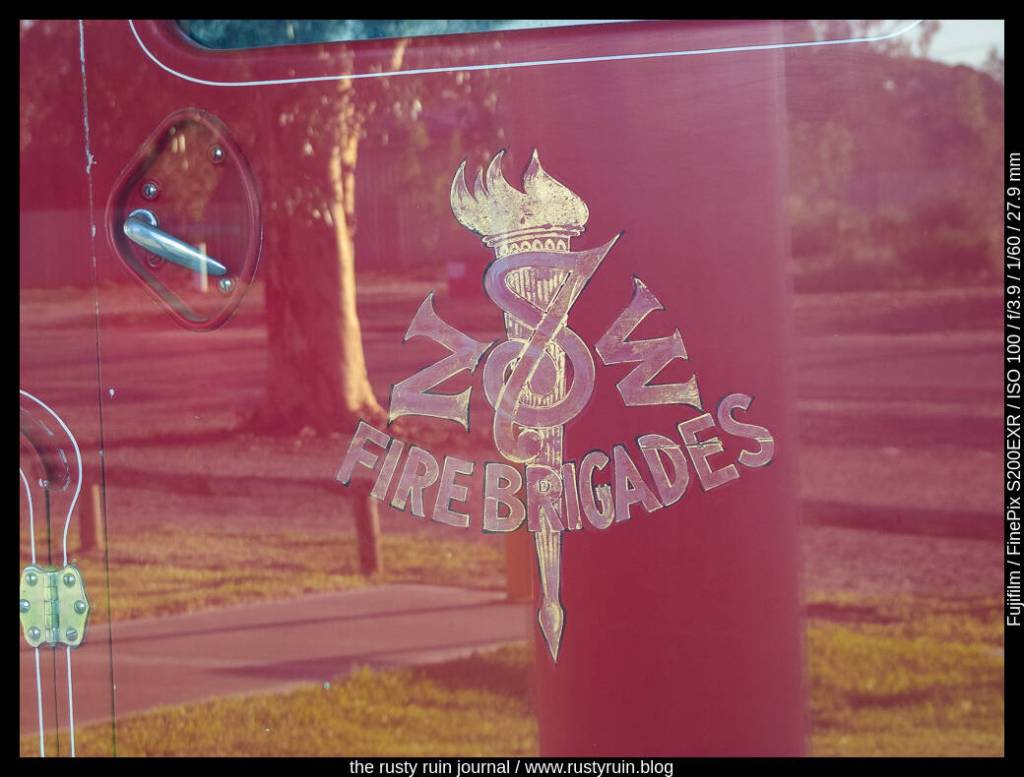
NSW Fire Brigade – Finepix S200 EXR

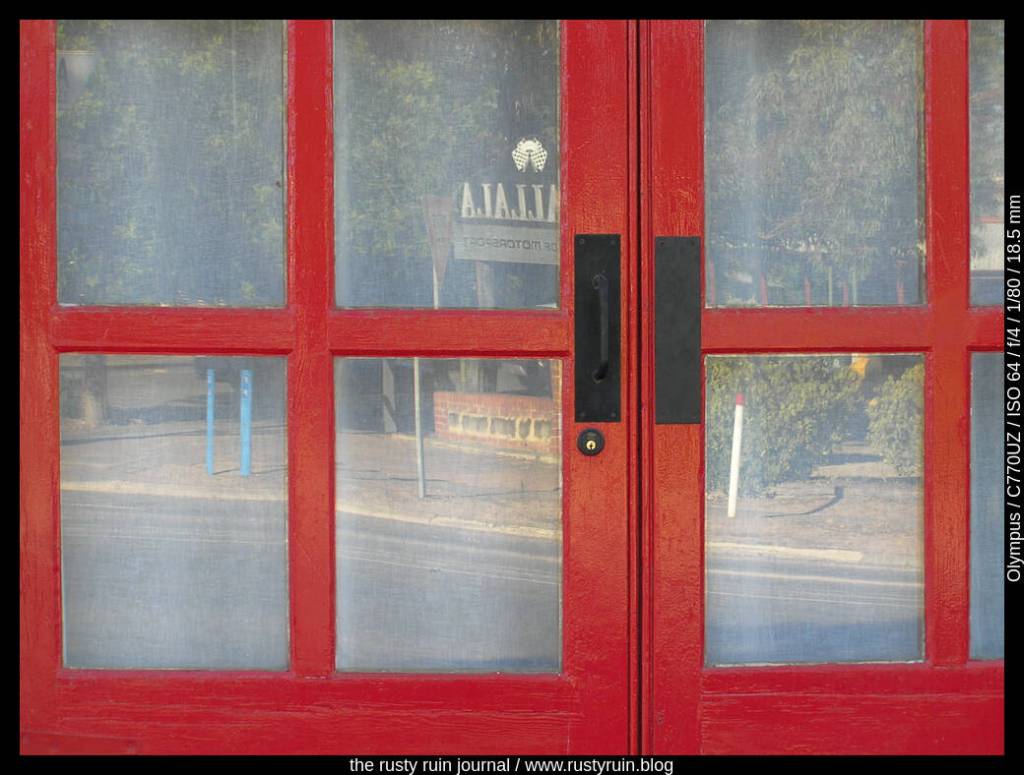
I like that the photo is reminiscent of a multiple exposure, The reflections of the glass add really interesting detail and texture to the red body of the old fire truck. When setting up for this photo, I was mindful of the placement of reflected background elements, and needed to position myself so the tree trunk didn’t cover either the door handle or the rather attractive insignia – two elements I really wanted to highlight.

Similarly, though it can’t be seen, there was an angled pole of misshapen proportions in the background I found distracting as I composed in the viewfinder. I stepped to the side to hide it behind the larger pole that runs through the NSW Fire Brigade symbol. These seemingly small decisions determine the final image and whether it remains a keeper or a delete.
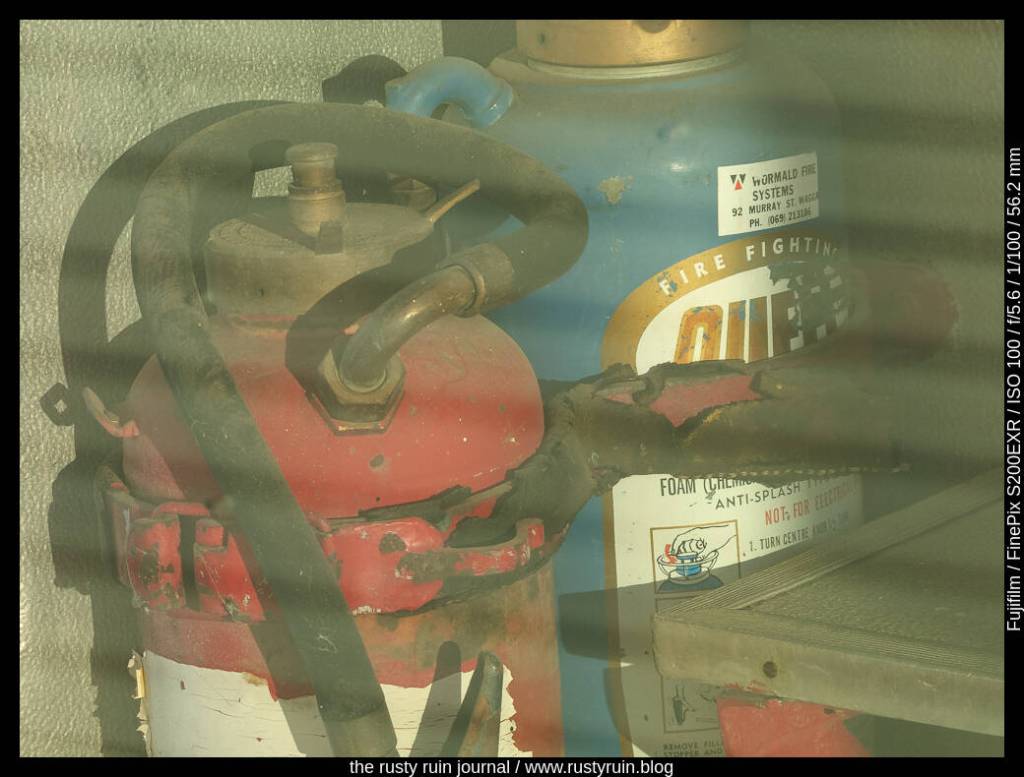
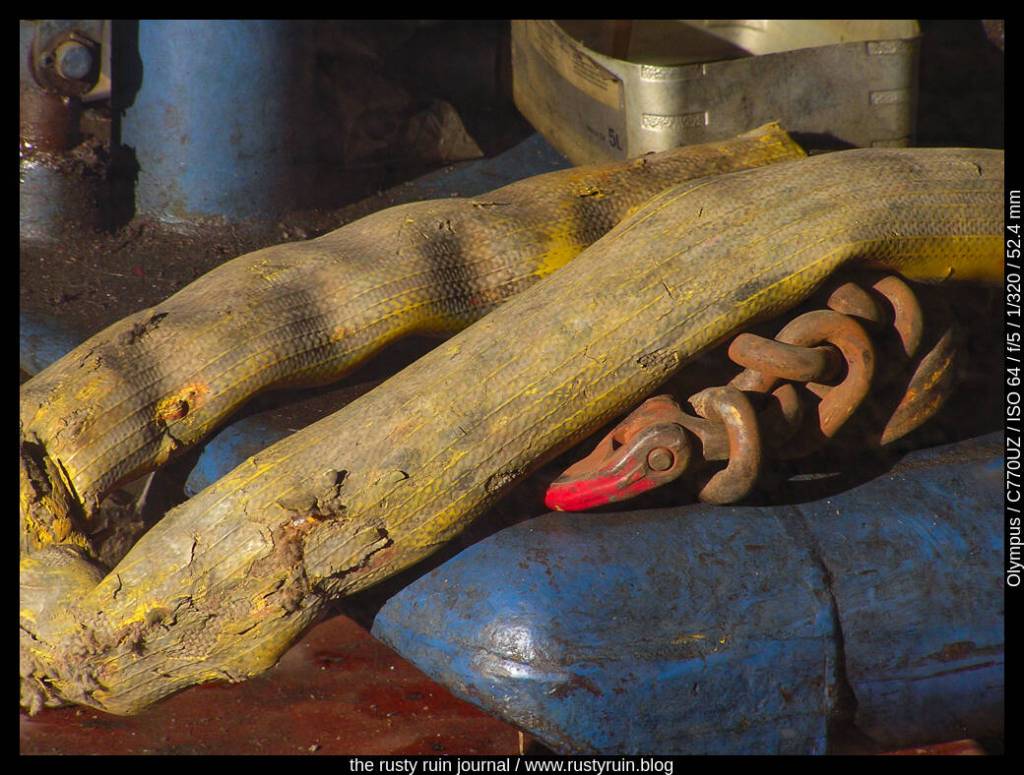
Fire fighting equipment behind glass

What I really enjoy about this photo is the quality of the light – the softness of it and the way it enhances the mistiness of the glass. It would be all too easy to add extra contrast to give it punch. It would also be easy to darken the equipment during editing to decrease the soft filter effect of the thick glass. But I think it works well without this additional contrast punch.

Even before making a photo, I strive to visualise what I want the photo to look like after editing, if possible. Multiple small decisions are made even before the shutter button is pushed – it may begin when I am drawn emotionally and imaginatively to a scene, but the process continues through technical cosiderations of aperture and so on, and then into my photo editor of choice.

A Sunset Series ~ Darlington Point, NSW

How often do we think that no photograph can ever record the majesty of a sunset? Rather than record an accurate scene, the best we can do is render an approximation that allows us to, perhaps, amplify certain attractive qualities during the editing process.

During this endeavour, liberal use of the tone curveHighlights, Lights, Darks, and Shadows – may provide the tonal characteristics that produce a pleasant enough photo that one might imagine themselves, just for a moment, watching the sun in real-time as it illuminates the sky.

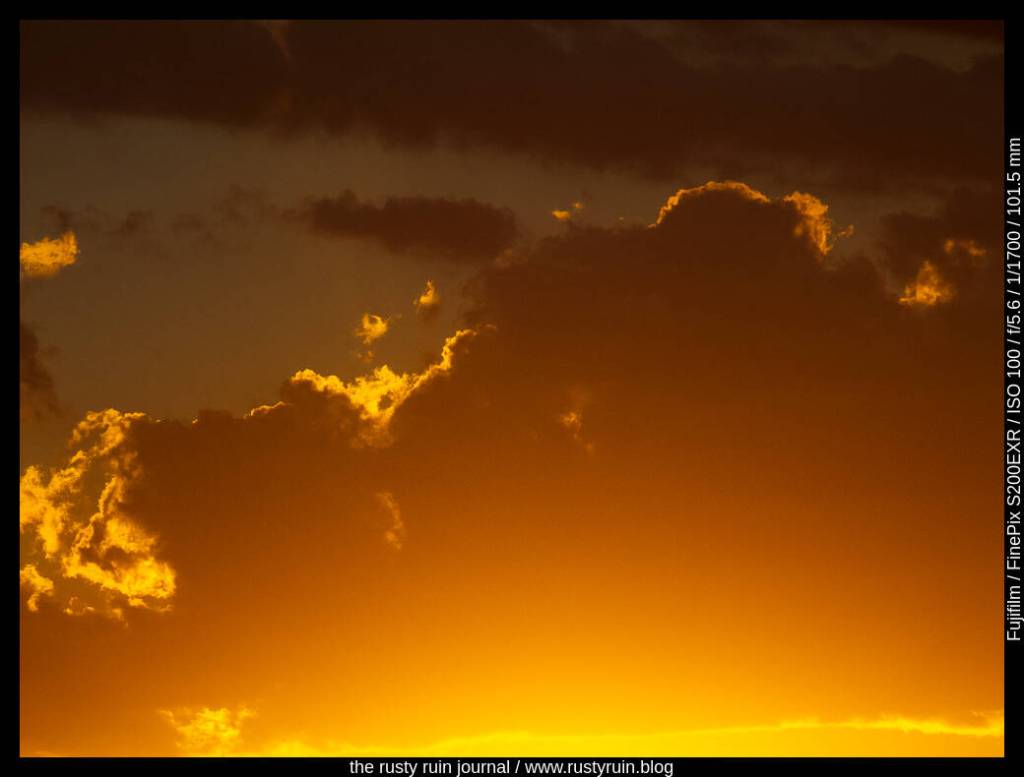
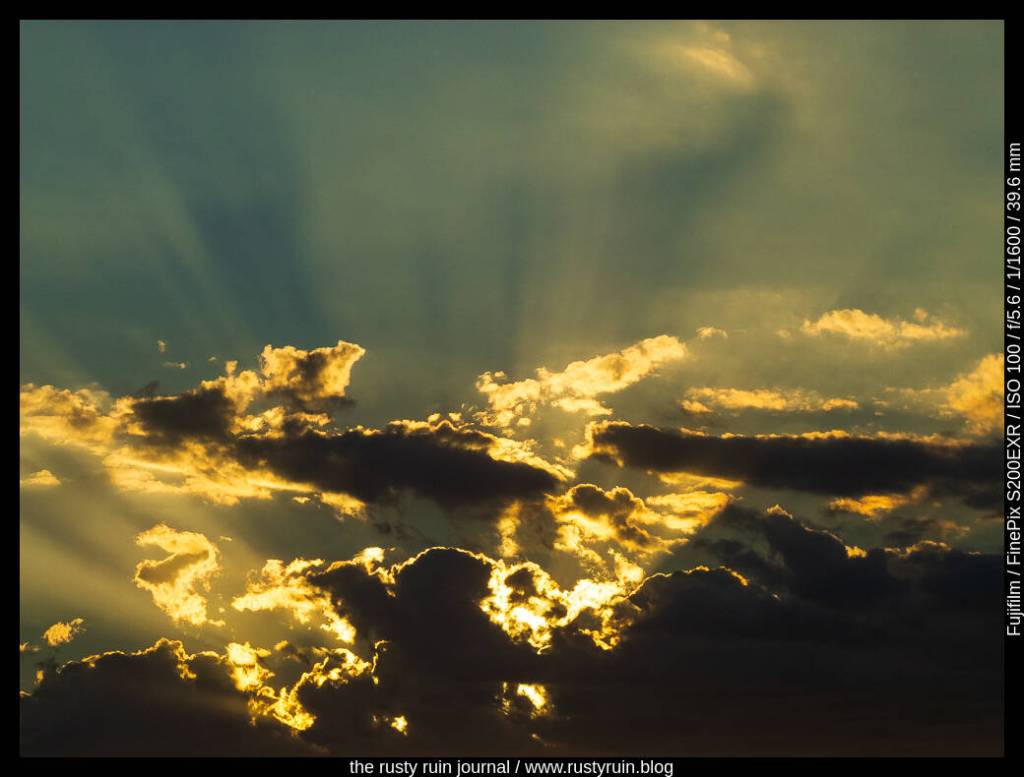
Sunset #1 – Finepix S200 EXR

As charcoal clouds largely obscured the sun, underexposing this photo at the moment of recording deepened the colours, revealed the delicate sun rays, and rendered a sky full of contrast and dynamic light. Though possible to adjust exposure settings during editing, having a final vision for the image in my mind – moody and dark – necessitated a faster shutter speed and, therefore, slight underexposure.

Visualising the final look of a photo and adjusting exposure accordingly is like scribbling in a notebook of ideas that informs the editing process many months later – oh, the clouds are moody and dark, I’ll go with that look! In this way, ideas for editing begin before pressing the shutter button.

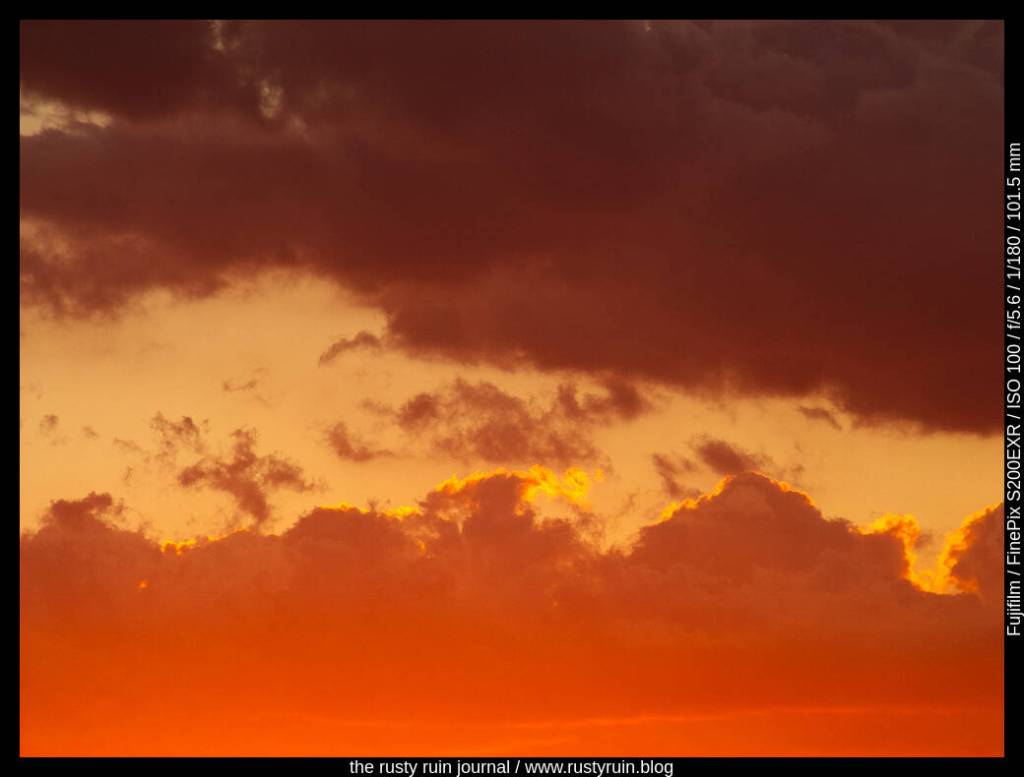
Sunset #2

Retaining the moody clouds through a careful decrease in Darks and Shadows, and increasing White Point and Light to amplify the sun’s aura produces an approximation of the golden illumination I witnessed at the time.

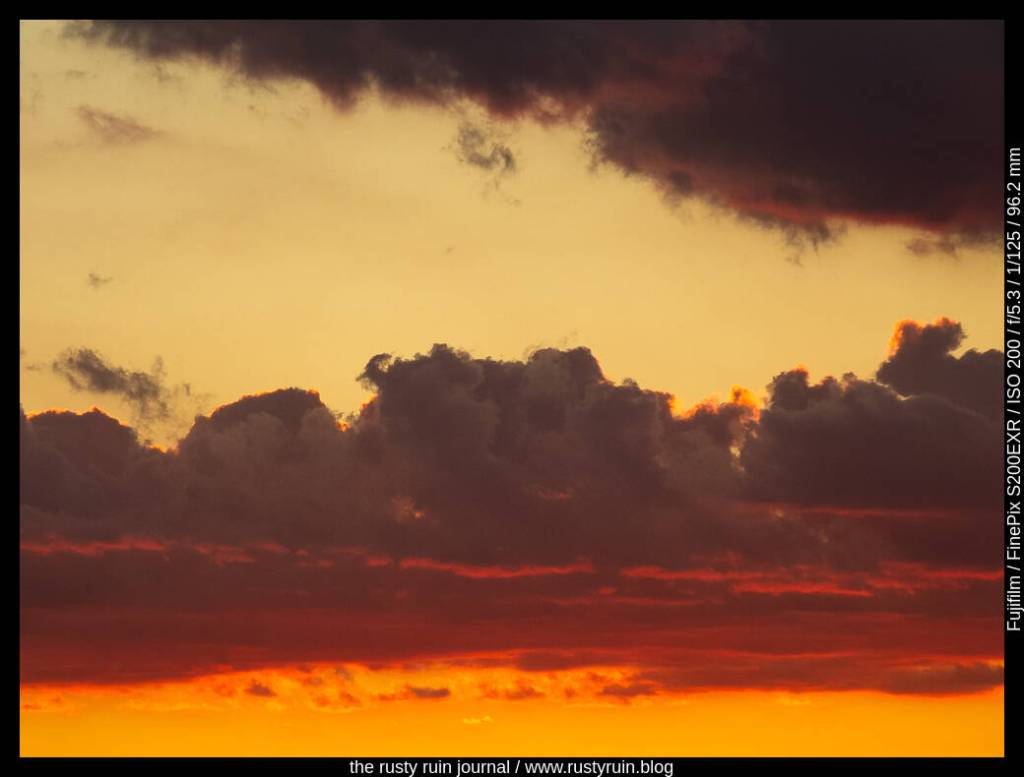
Sunset #3

Here, I wanted to focus on the orange yellow, and pinkish hues that defined this section of sky. Less contrast produces a more harmonious rendering – my feeling at the time of recording.

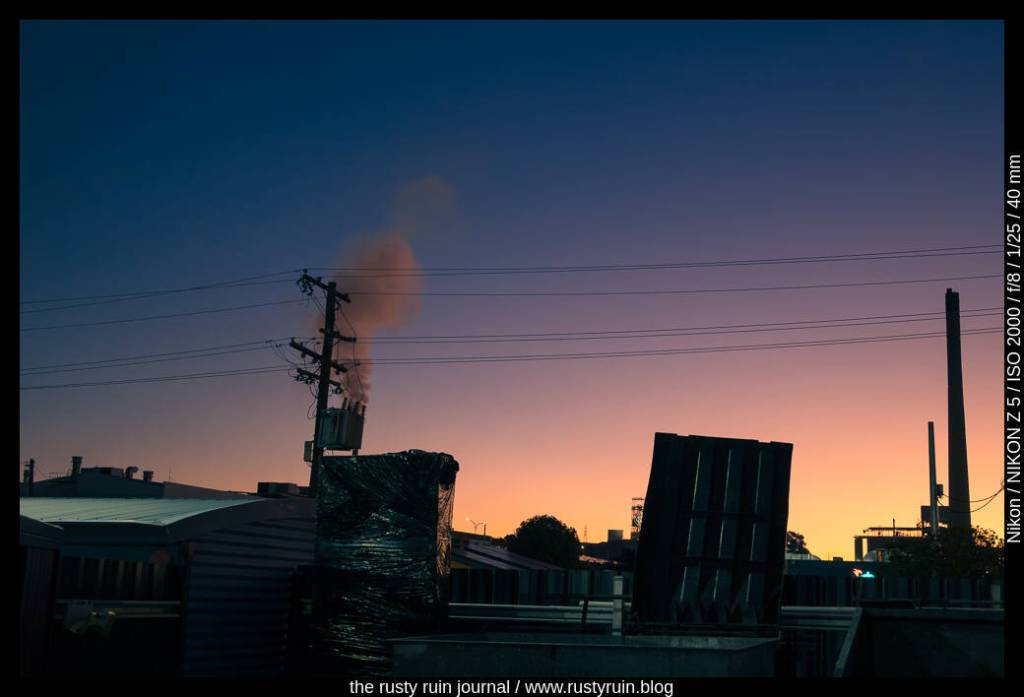
Sunset #4

As the sun moved below the horizon, the clouds absorbed night’s early shadow and languid bands of amber, magenta, and vermillion brushed the edges.

Slow warm nights in Mount Isa

Slow smoke pours from towering stacks into the still air, day and night. Minerals are pulled from the ancient desert ground and form the heart of industry in Mount Isa. I think everyone smokes, drinks, and wears a vest in this place. It must be a tough life out here.

Everything seems caked in sweat and dust. The soil is red and orange, and lazy heat hangs in the air. Abandoned mines are something of a tourist attraction here. Of course, I’m attracted to those ruined places.
Mt Isa sunset – Nikon Z5

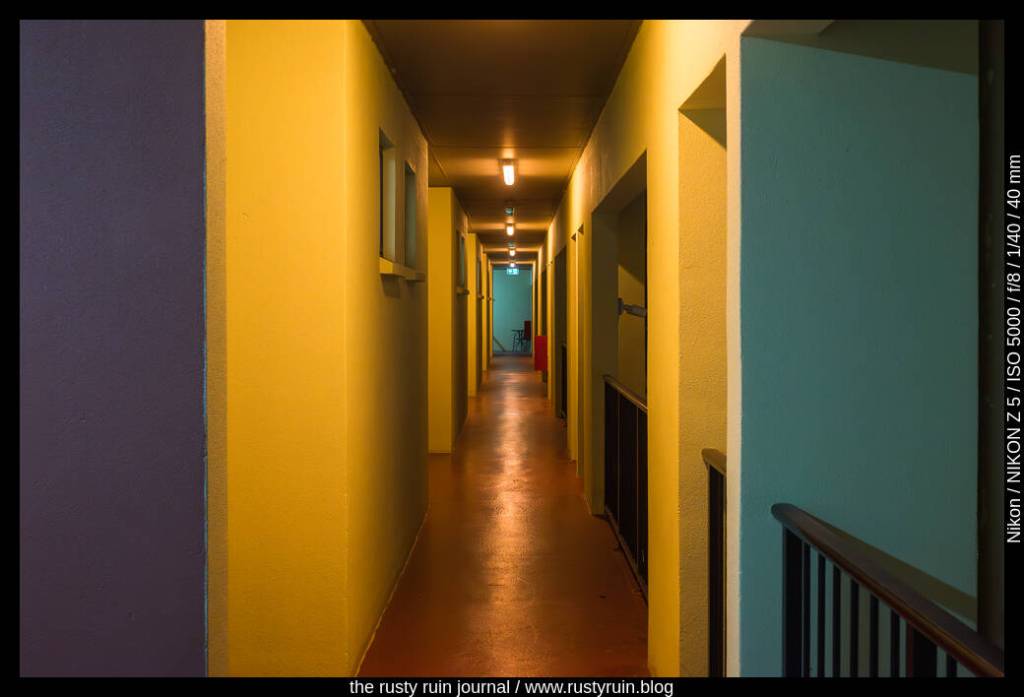
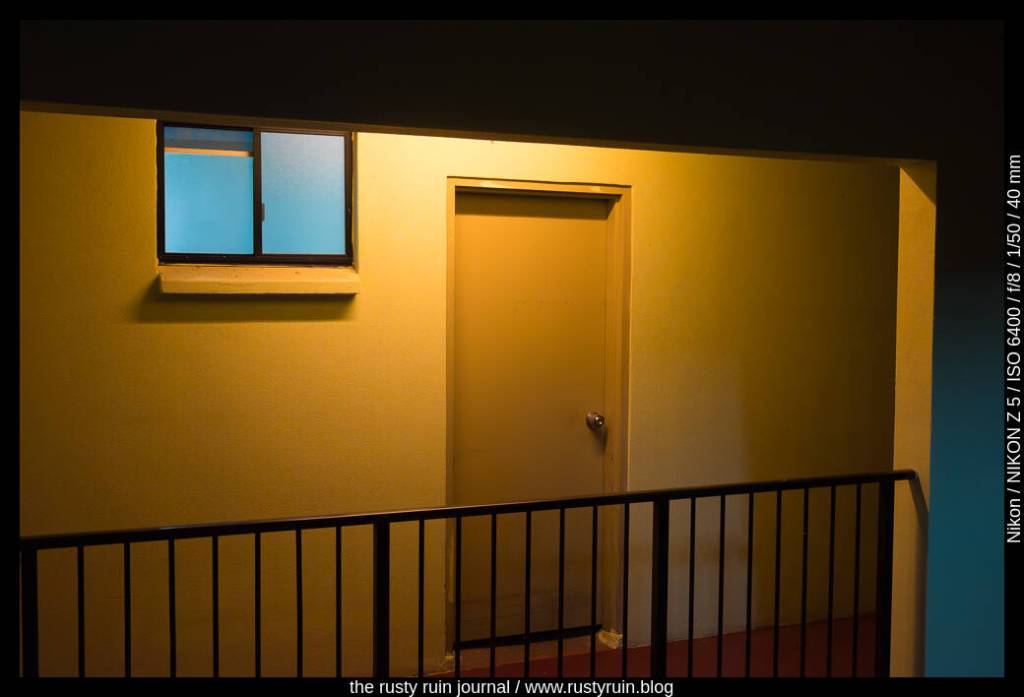
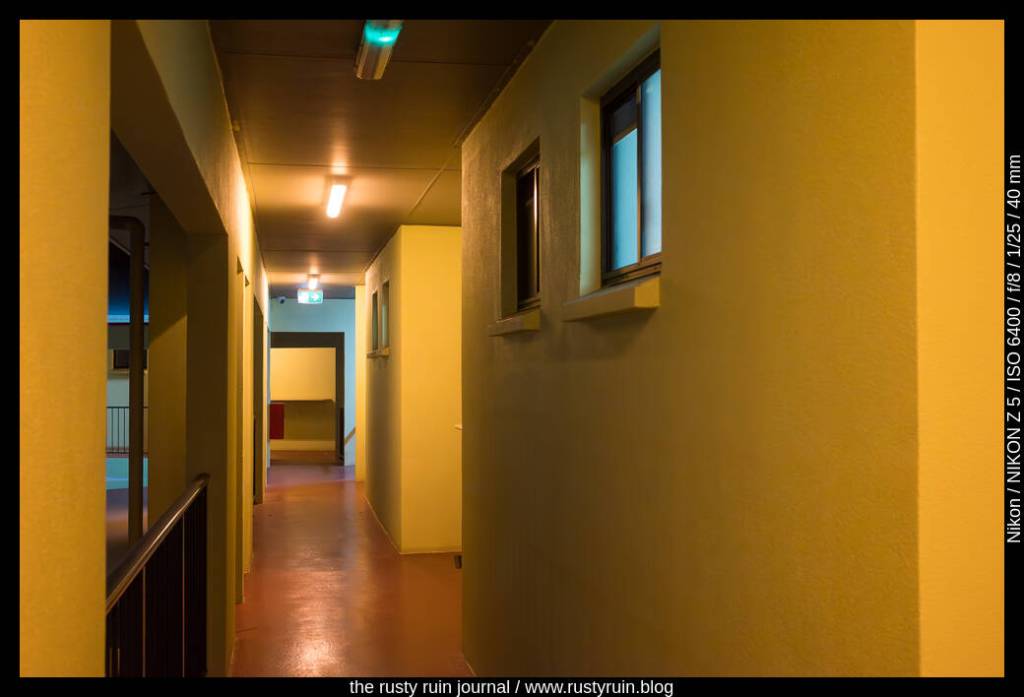
I take the opportunity to walk around the motel late at night. Likely, most people are sleeping or watching TV drowsily. What strikes me are the warm colours and the long walkways. I imagine the owners wouldn’t be too interested in using the photos for marketing purposes!

A friend of mine tells me he likes the orange and yellow lights. They make him feel comfortable. I agree – they’re nicer than the new clean white lights. They’re atmospheric. They go well with the heavy air and the smokestacks.

The chair at the end of the walkway – Nikon Z5 and Nikkor 40mm lens
Yellow door and yellow wall
Blue glow from the window

A bench and shadows ~ one in colour and one in black and white

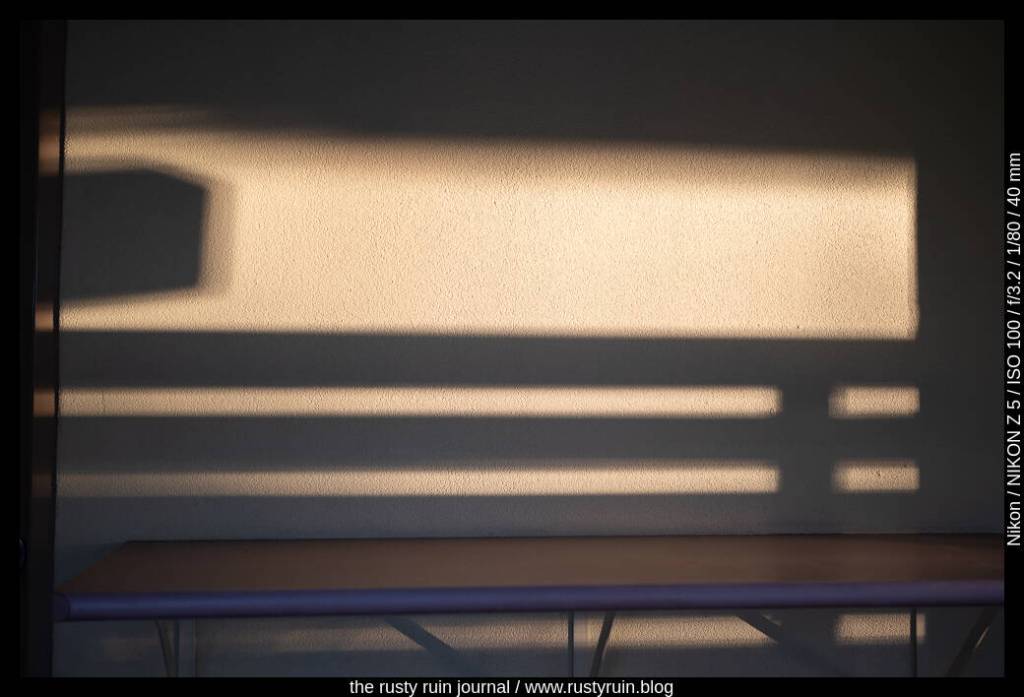
After my last post, it seems I’m in the mood for monochrome. The interplay of light and shadow – the patterns on the rough wall – the cold metal bench. This collection of quiet and ordinary things caught my eye, emotion, and imagination:

Metal bench and shadows #1 – Nikon Z5 and Nikkor Z 40mm
Metal bench and shadows #2

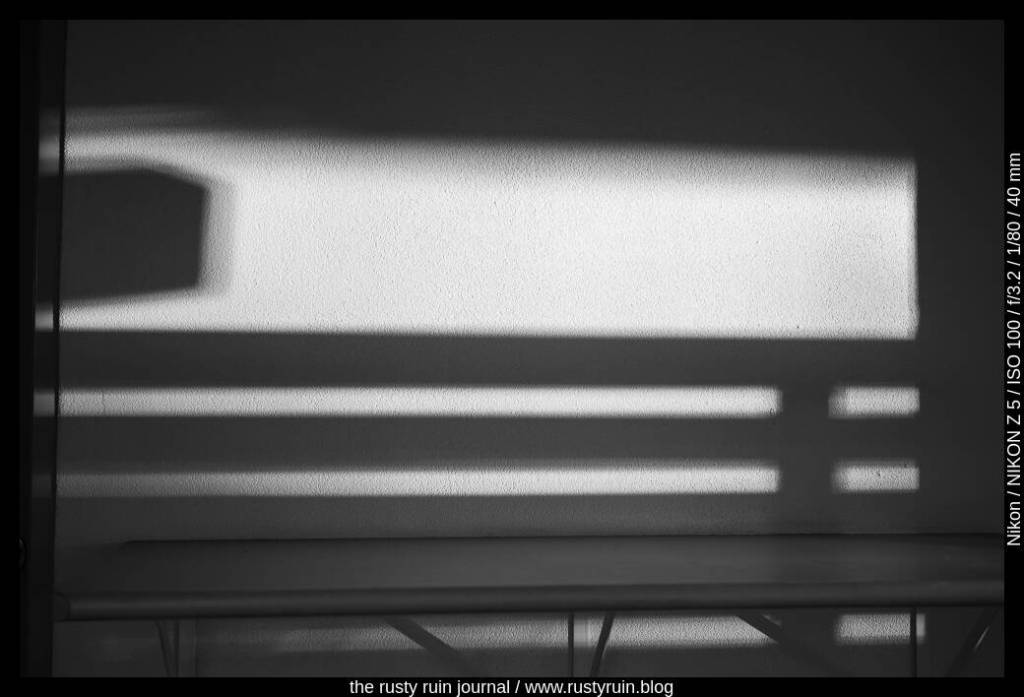
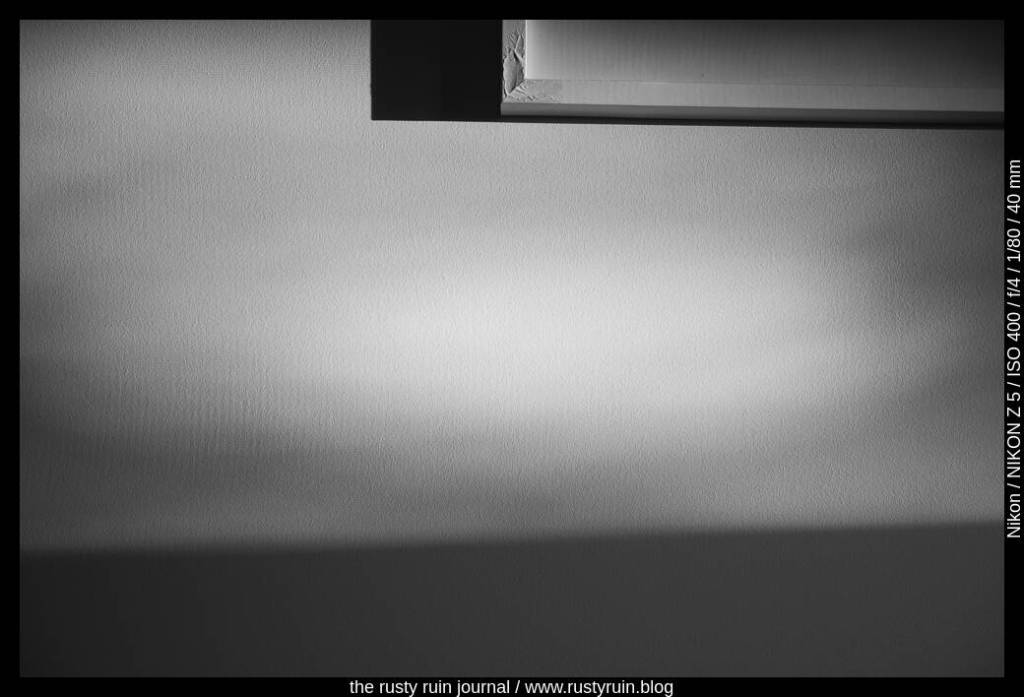
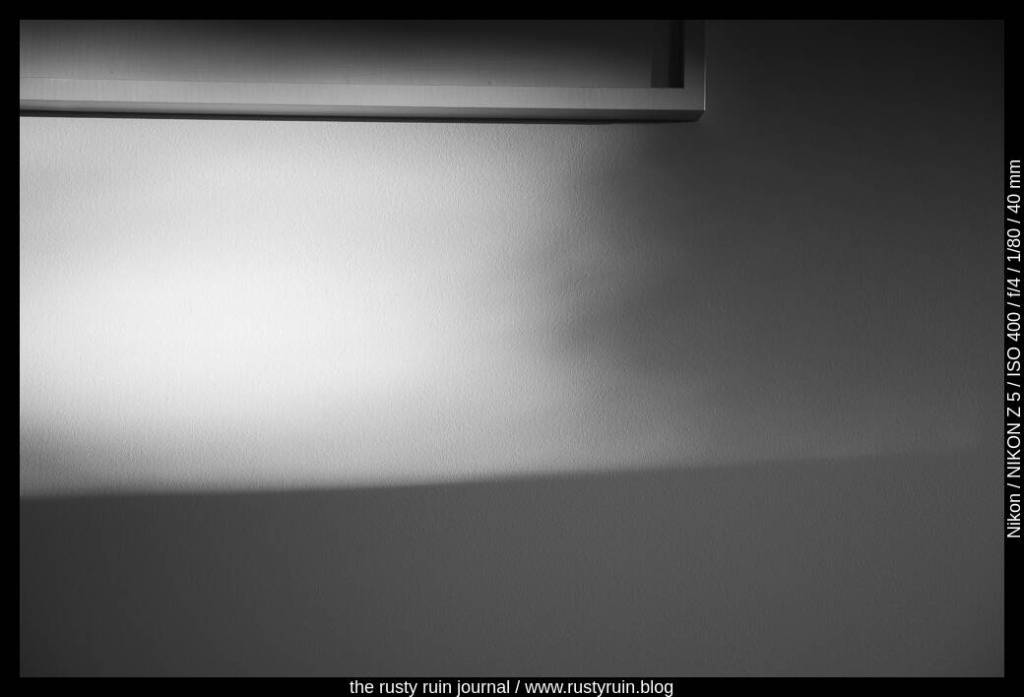
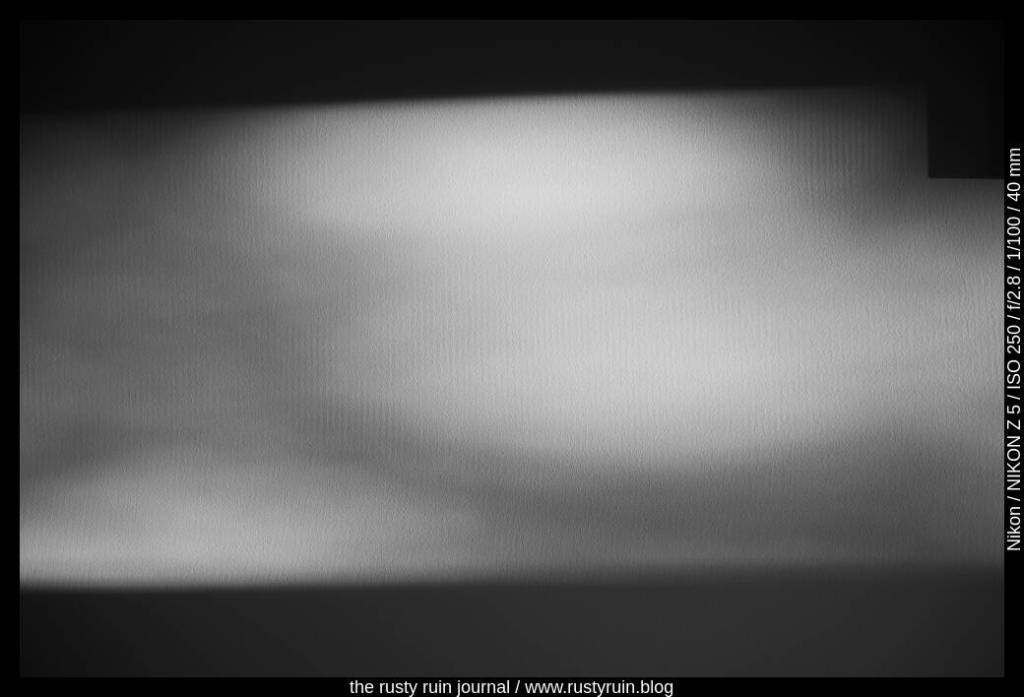
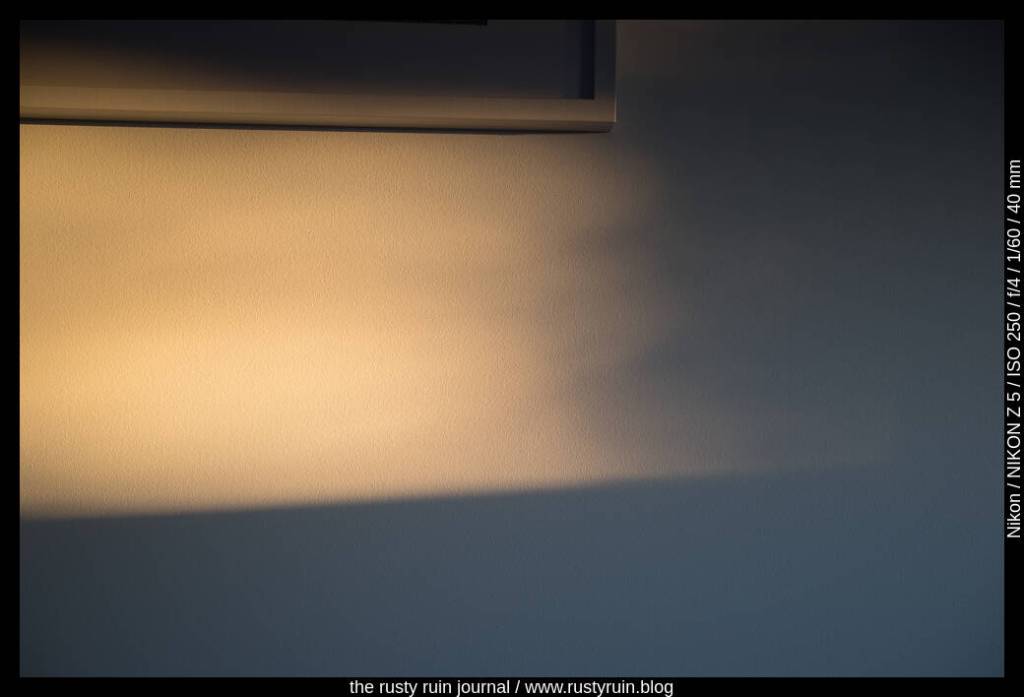
The leisurely glow of sunlight on walls ~ a short series in black and white

A set of photos in colour. Now in black and white. I almost always use colour in my photos, but there’s also something intriguing about the removal of colour. Black and white reduces the picture to the most minimal of tonal qualities – light and shadow – the eye drawn to delicate gradations. I sometimes think that black and white photography can be overly contrived, entangled as it is with classic street photography and delusions of stepping into the shoes of Henri Cartier-Bresson and others.

I admit that I probably don’t explore black and white in an editing context as much as I should. Or at least, as much as would contribute to a photograph that pleases me.

The sharp corner intruding rather rudely – Nikon Z5 and Nikkor Z 40mm
The angles yet apparent
Receding now to darker edges
From the outside: a whirl of bordered shadows

Nifty fifty and the Nikon D50 ~ a casual photo-walk

The Nikon D50 appeals to me because it sits somewhere between the small Nikon D40 and the prosumer Nikon D70/D70s. With a plastic body that’s closer in style to 1990s Nikon film SLRs like the F65, it seems a world away from Nikon’s current black, sleek, industrial-feel mirrorless cameras and Z-mount lenses. The silver-bodied D50 I have may be technologically long in the tooth, but the 6.1 megapixel sensor still packs an imaging punch when used with careful intent.

Looking at you – Nikon D50 and Nikkor 50mm AF-D 1.8 lens

The Nikkor 50mm 1.8 AF-D is one of my favourite lenses, and I can use it on the D50 because the body includes a screw-drive motor. Not only is the lens light and small, but the glass happens to be sharp and practically distortion-free. On the D50, it’s a perfect match, squeezing everything from the 6.1 megapixel CCD sensor. Even at base 200 ISO, the D50 is very quiet when it comes to digital noise.

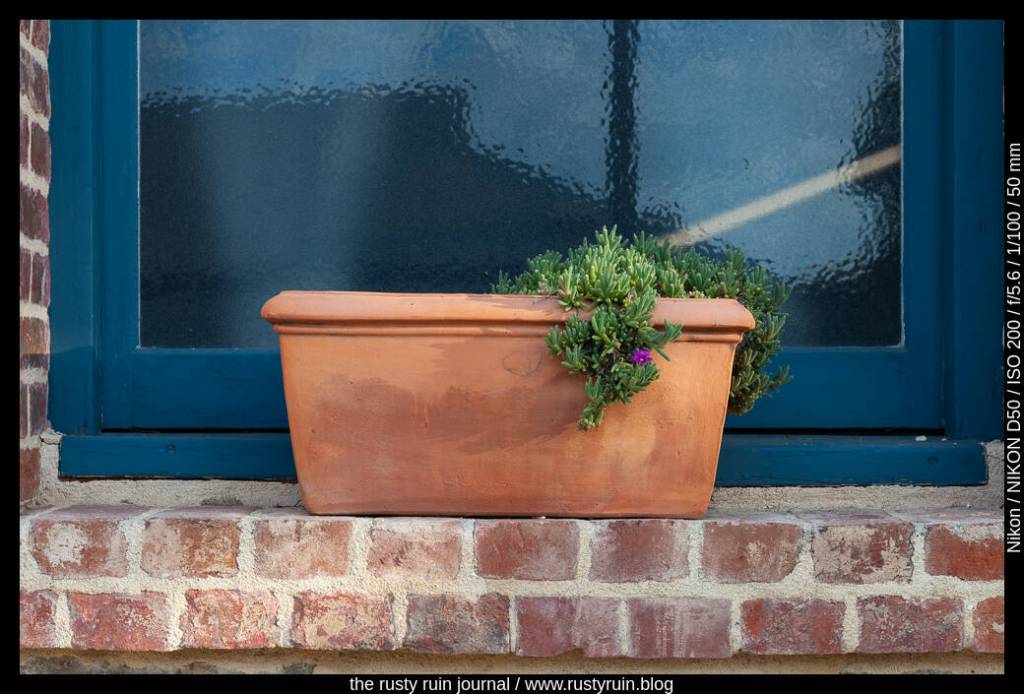
Against the blue window, green foliage spills over warm terracotta – Nikon D50

This is the sort of camera and lens combination that invites contemplative photography at sunset on an overly warm eve. Old buildings, weathered window frames, and glowing reflections put me in mind to simply wander and open my eyes to vast possibility. Something about the terracotta on blue, framed by red brick, drew my imagination – ordinary, understated, usually unnoticed, and quiet.

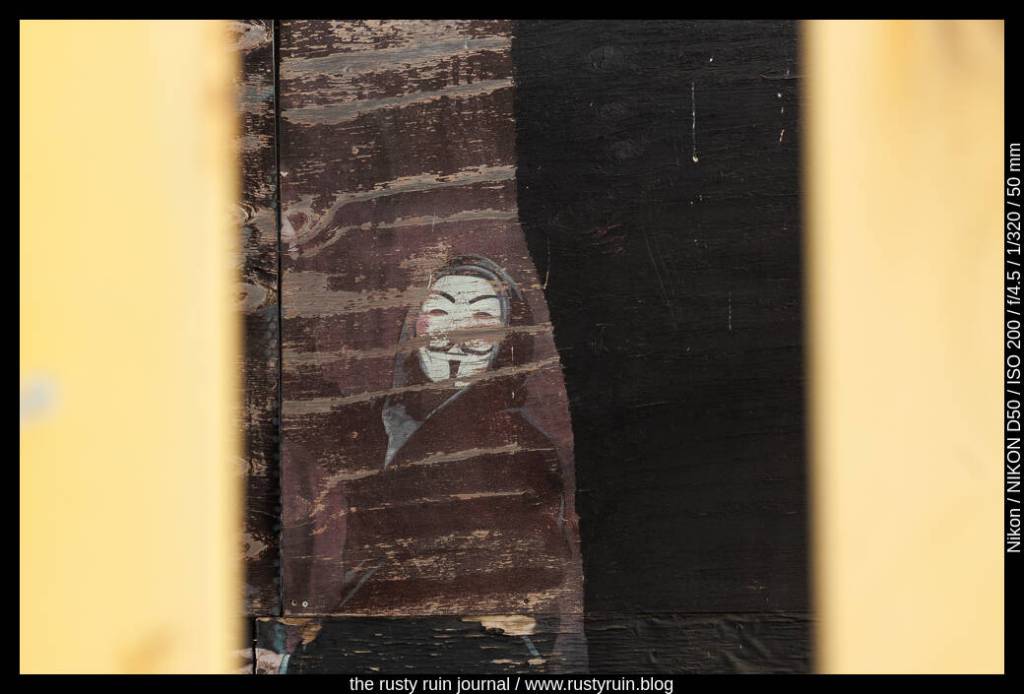
The face between the yellow bars – Nikon D50

Getting close to the yellow bars and setting the aperture to F4.5 allowed me to sufficiently blur them, communicate depth and dimensionality, and still maintain excellent sharpness in the peeling paint and the smiling figure – the subject of the photo.

The Nikon D50 fills an old DSLR usage gap for me – small and light enough to pack with another camera for the day; the ability to use AF-D lenses like the aforementioned Nikkor 50mm 1.8 due to the included screw-drive focus motor; and a top-plate LCD that communicates the most common camera settings at a glance.

The Olympus Camedia C-770 Ultra Zoom ~ 4 million pixels of unhurried contemplation

Just as I once developed a taste for the Fufifilm Finepix series of bridge cameras, it seems that I’ve developed a similar taste for old Olympus bridge cameras. I blame it on the recent resurrection of my Olympus C-725!

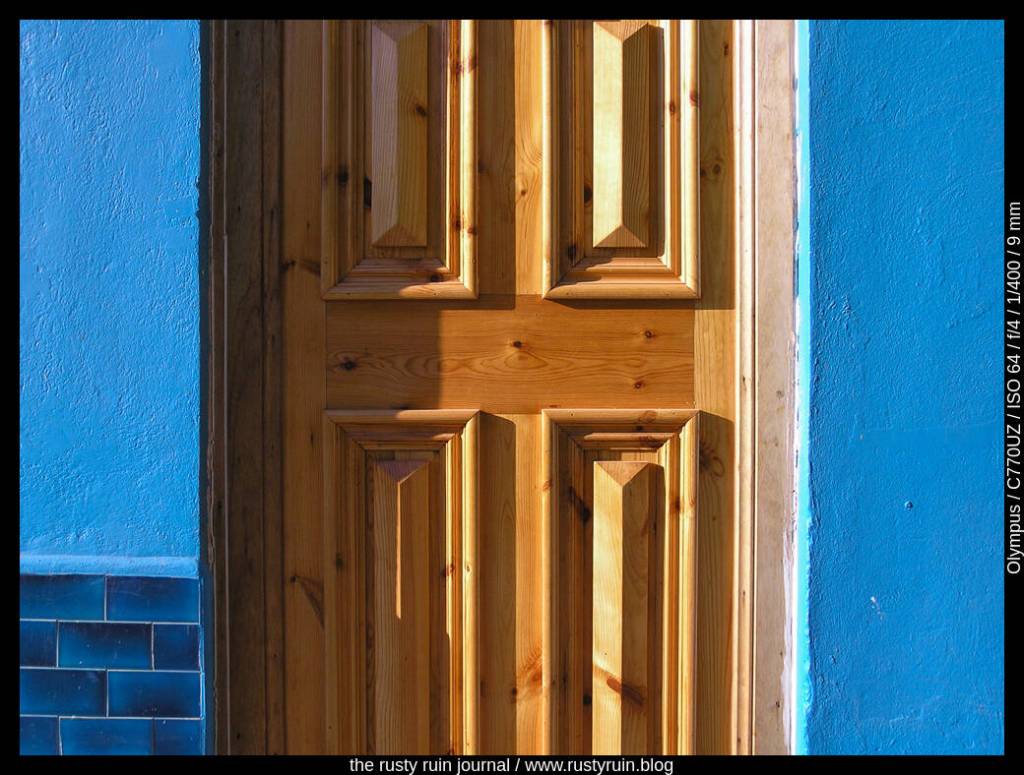
Behind the varnished door – Olympus C-770

On paper, the Olympus Camedia C-770 doesn’t seem like much: 4 megapixels, shutter lag that would annoy today’s impatient camera users, a 1.8 inch TFT screen, a longer start-up time than you’d hope for (good for those with a contemplative photography bent), and the need to use an XD card as a means of storage – let me tell you, those XD cards aren’t especially cheap.

Despite the negatives, there are surprising positives: an excellent lens with a sluggish 10x zoom; a decently fast 2.8 aperture at the wide end; a double (yes, double) flash for nuclear tests with unsuspecting portrait subjects; a respectable Electronic Viewfinder (yes, these old digital cameras carried the DNA of modern mirrorless cameras); a very readable EVF information overlay that includes a live Histogram; level settings for Sharpness, Contrast, and Saturation; the capability to record TIFF files if you can deal with the slow write times to the XD card (only 8 bit, unfortunately); and an enlarge feature that seems to engage an upsizing algorithm and makes those 4 megapixel files into 8 megapixel-sized files.

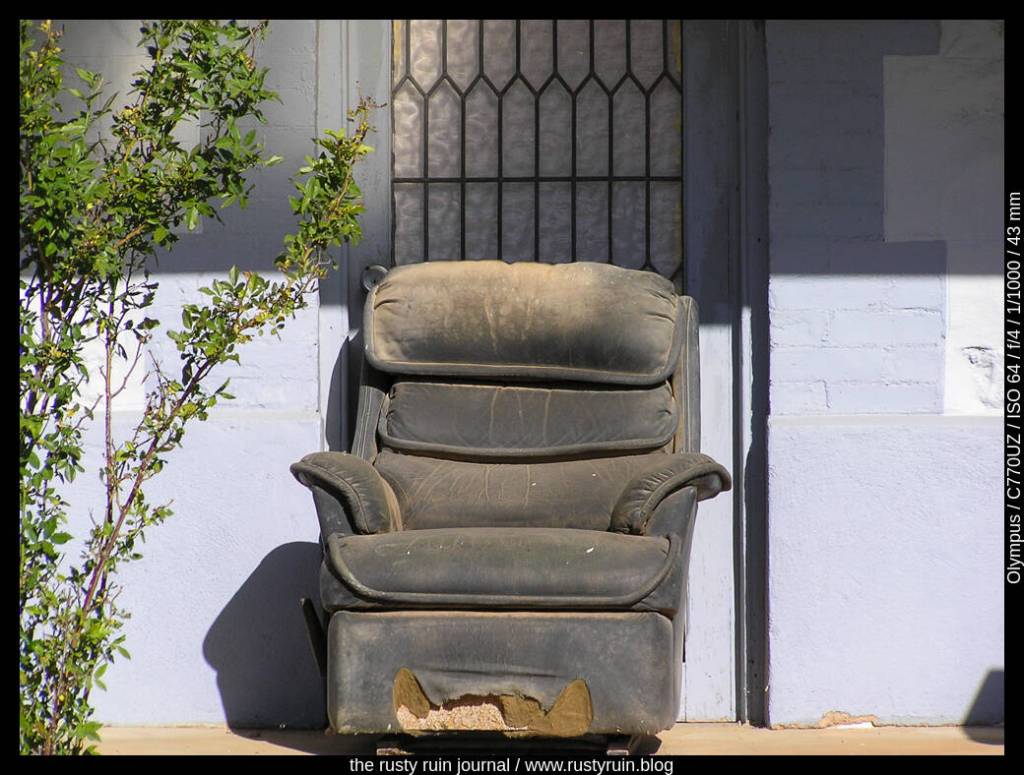
Have a seat – Olympus C-770 Ultra Zoom

I set the camera to record Super High Quality JPG files, dialled back the Sharpness and Contrast by -1, and increased the Saturation +1. Out of the camera, the images are pleasing. At 64 ISO, the digital noise pattern is so fine that it’s negligible. Of course, you wouldn’t want to push such an old camera beyond ISO 400 anyway, unless more digital noise is your goal. Nor would you want to entertain a low shutter speed when zooming enthusiastically, as there’s no vibration reduction or image stabilisation.

Red door corner – Olympus C-770

LIke the Olympus E-1, the Olympus bridge cameras are great little image makers when used within optimal limits ~ high dynamic range scenes will punish these old sensors and you’ll be forced to crush blacks or blow highlights. To compensate for these limits, I choose my scenes carefully – evaluating the dynamic range before putting the camera to my eye. Often, I’ll recompose, making decisions on how many shadows/highlights to include and how this will affect my vision for the final photo.

Worn and weathered gear behind the old shop window – Olympus Camedia C-770 UZ

Discovering quiet corners ~ the transient and the imperfect

Feeling sentimental, I recently took the newly revived Olympus C-725 to a local marina on New Year’s Eve. It was a lovely night with friends and family. I also packed the Kodak Charmera of course, having been my 30 gram pocket companion since Christmas. Since the ageing 16 megabyte XD card in the Olympus only holds a maximum of 21 photos at the High Quality setting – a storage concern sure to vex many modern digital camera users – I reached for the Charmera once I received the dreaded Olympus Card is Full message in bright orange text.

Stacked for the evening – Kodak Charmera

Encouraging a playful mindset, the Charmera encourages photos that are both ordinary and atypical. Divorced from the need to create a worthy image with a worthy camera, there are no gorgeous sunsets or beautiful portraits. There are instead worn chairs stacked against a blue wall and orange chairs stacked atop a weathered table. Beauty in the ordinary – liberated from the gear – Kodak wabi-sabi – the appreciation of the imperfect and the impermanent.

Orange chairs chained to a wooden table

The glow of angled orange plastic at sunset, set against the wood and brick, with a hint of blue wall – an ordinary scene recorded by a distinctly ordinary toy camera.

The size of the camera doesn’t matter. The quality of the digital sensor is just another tool to be used wisely. What matters is the encouragment of the eye and the imagination in the moment.

One corner of a Chevrolet

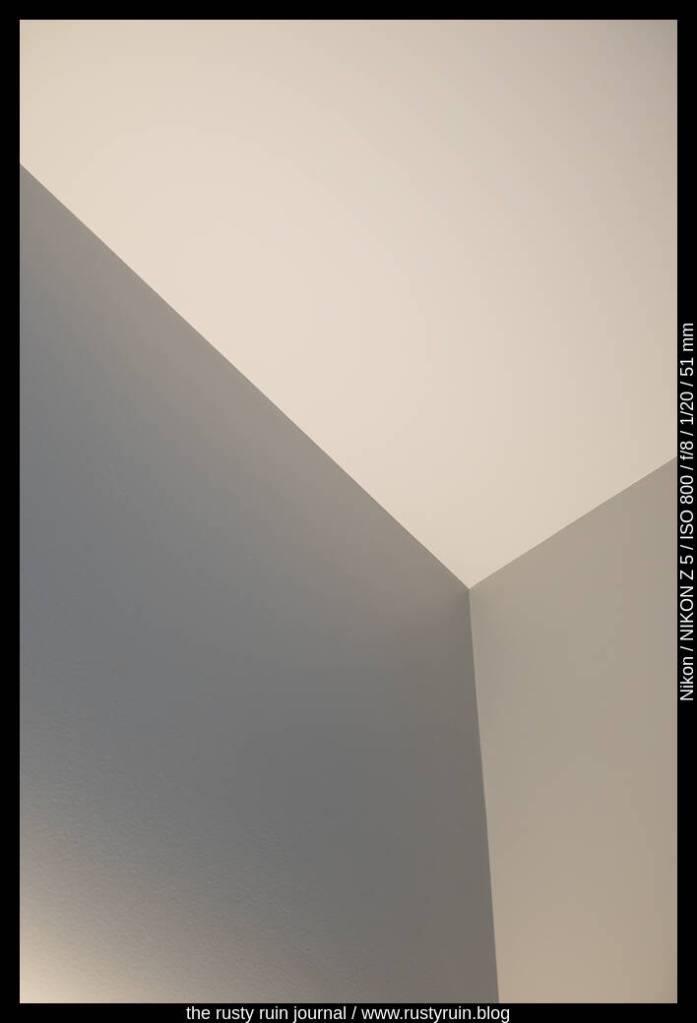
The quiet walls speak of soft light and secret corners

When the body is tired and sleep is needed – when the grey clouds amass and the wind blows – when the camera feels heavy and the ideas diminish – what to do? I stared into the corners of our sky-high holiday apartment and found inspiration in the artificial light. Thus, a mini-series of photographs presented themselves: quiet walls on quiet days.