The Helios 44 lens ~ a Cold War legend

Some years back, I made another blog that was mostly about film cameras, vintage lenses, and digital cameras. That blog is long since gone, but I’m resurrecting some of the better posts here:

Like most Soviet-era lenses, the venerable Helios 44 is built like a tank! One great thing about them is that they’re pretty easy to dismantle and clean. You can’t say the same about modern Nikkor lenses, can you? Helios lenses were manufactured in the millions by innumerable factory workers. Notwithstanding recent problems and bloodthirsty geopolitical games, I’m still quite fond of my Soviet-era lenses and cameras.

I took the Helios out for a spin on my little Olympus E-PM1 digital camera. There’s nothing quite like seeing a big old heavy Soviet lens sticking out of a sleek modern Japanese digital camera. It’s all glorious manual focus of course, but with the chunky metal ring on this example moving so smoothly, nailing focus was easy. All photos are JPGs straight out of the camera without additional processing.
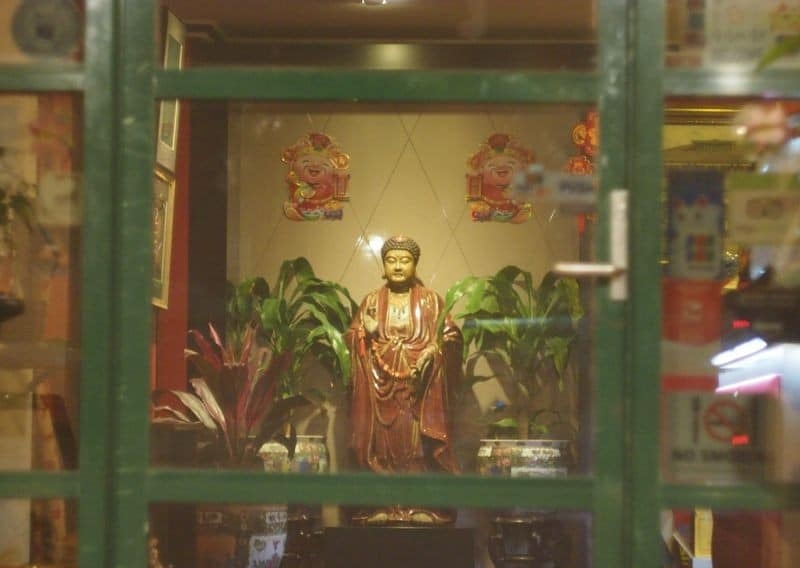
Night Buddha – Olympus EPM-1 and Helios 44-2 lens

As I was walking down the street, I noticed Buddha gracing the hallway of a Chinese restaurant in town. I like the way the door frames it and the combination of colours. It was quite a challenge because of the lack of light. I had to hold very still in order to make this one. It was either that or push ISO to a place I’m not comfortable with on this camera.

Look closely and you can see an ant nestled amongst the white petals. For a mass manufactured lens from 1978, it’s pretty sharp. The combination of old and new technology can yield some interesting results, don’t you think? At a wide aperture, the background is softened nicely, even on a smallish sensor Micro 4/3 camera.

Helios 44 lens flare

Finally, here’s an example of the famous Helios 44 lens flare. Many photogs would cringe and cling to their modern multi-layered ED glass, but I love this effect! See how it softens the image? This veiling flare is an effect that some people spend time recreating in their fave photo editor. I’m getting it with a cheap lens from 1978. Of course, flare, like sharpness, is just another tool in your photo kit-bag. Sometimes you want it and sometimes you don’t.

In use, the Helios 44 is reassuringly heavy and solid. If you’re going to source one on eBay, it’s best to buy one that has either been recently serviced or is in good working condition. Though taking it apart is more straightforward than other lenses, it’s still no easy task. Fortunately, the Helios lens was produced in such great numbers that finding one in decent working order shouldn’t be too hard. The most common problem with the Helios 44 is that the original cheap wax used to grease the innards and focussing helicals tends to seize up after several decades.

Strange name, big Cold War glass ~ the Zenitar 16mm 2.8 Fisheye lens

If you believe the more scurrilous online rumours, the quality of a camera lens from the former Soviet Union was directly proportional to the Vodka consumption of weary factory workers. This is not the colourful fancy one might suppose, as any factory line embedded in an economic and socio-political culture where wages are neither incentive nor punishment is more likely to be driven by exhausted hands and eyes.

None of this suggests that any cheap trinket or fast fashionable piece made today in vast factory cities by exploited workers and then sent abroad to be marked up for huge profits is any better. Always, there are grifters and exploiters taking advantage of the vulnerable and the gullible. But anyway…I digress slightly. The source of my Soviet-produced lens beyond the factory floor is not a story for today.

The Zenitar 16mm 2.8 Fisheye lens is an impressive piece of Cold War glass. It’s a hefty thing in the hands, has a distinct and very short hood, a lens cap that can’t be used on any other lens, and looks great when the sunlight bounces off the large curved glass that sits right out front. On my trusty Olympus EM5 Mark 2, this 16mm Zenitar has a field of view equivalent to a 32mm focal length in 35mm format. So, if I was using it on my Z5, which has a 35mm sensor, the field of view is the native 16mm. Because my Olympus has a digital sensor that’s half the size of the one in my Z5, I double the 16mm to a field of view of 32mm instead.

Trudging through swampland at mid-afternoon – Olympus EM5 Mark 2 and Zenitar 16mm Fisheye

My copy of the lens is sharp enough at apertures F 5.6-8, and even at those settings the corners display a lack of sharpness that’s more fizzy than actually mushy – as though details are being pulled away from the centre and slightly distorted. The effect reminds me of using a plastic lens but I don’t find it unpleasant.

Capitalism harms us all – Olympus EM5 Mark 2 and Zenitar 16mm Fisheye

As with other wide angles, and certainly with all Fisheye lenses, there’s distortion. You can see how the normally straight cortners of the skip bins in the above photo look bowed. I don’t have an issue with it, as this is just a feature of the lens, but it’s not the sort of lens you want if you desire pleasant portraits, straight horizons, and distortion-free buildings (using the Nikkor 16mm 2.8 lens profile in Lightroom will straighten out most of the distortion if you really want that).

Lenses like this are great for getting in very close to a subject to take advantage of the optical distortions they produce. On the Olympus, however, the Fisheye effect is certainly much less because of the smaller sensor size, making it a really valuable wide-angle lens if you don’t mind manual focus, fizzy corners, and the chance that the quality of your copy may have suffered due to the effects of authoritarianism and the revolutionary whims of Vladimir Lenin.