Just down the highway from Darlington Point is Altina Wildlife Park. I admit that zoos and wildlife sanctuaries, private or public, present something of a dilemma for me. I am wholly in favour of conservation efforts when it comes to endangered animal species – though many such travesties are due to human activities. I understand there might be scientific and educational aspects too. Yet, I also can’t shake the feeling that there’s a commodification of animals happening.
Not only do zoos cage exotic animal species that are endangered in the wild, they also often display other species that face no threat of extinction at all. Is there a reason a common Cockatoo or Dingo might be caged other than to simply complete a menagerie for an audience? It might be argued that increased ticket sales support further efforts in conservation, of course. True, perhaps. I’m no expert in these things, other than to relate some vague feelings and thoughts that gnaw at the edges of mind.
Still, a tour of the large back pastures of the park did draw my attention to numerous amimals I’d not seen before – most notably the African Painted Dog and the long-legged Maned Wolf (a curious canid omnivore with a sensitive stomach and a delicate diet that walks in the same manner as a Giraffe – both right legs, then both left legs, and so on).
Despite the promise of the above words, I have no pictures of these exotic creatures, partly because I don’t like steel cage wire in my photos and also because I’d not packed the fastest camera in the world to acquire focus and record unpredictable animal movements. Yes, I could have switched the camera to a high-speed recording mode, but the heat of the day clearly melted my problem solving skills.
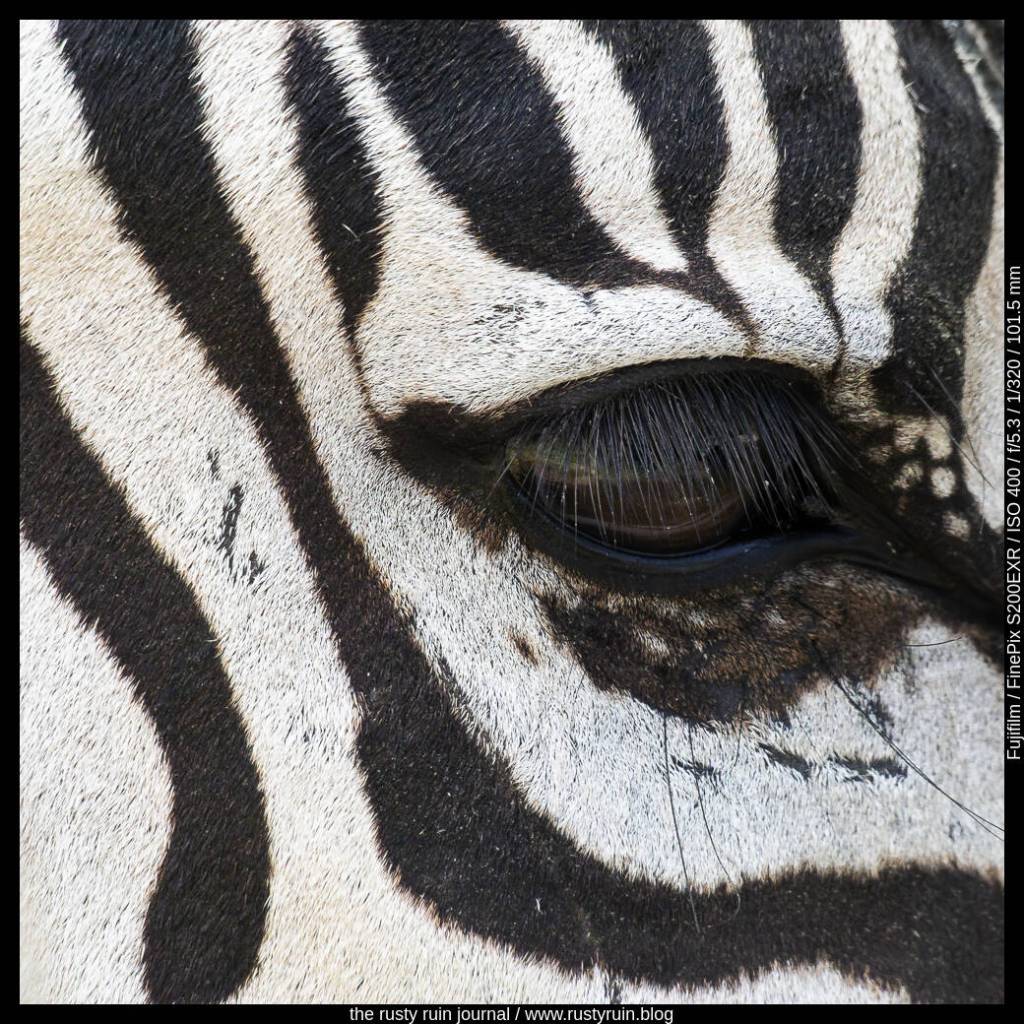
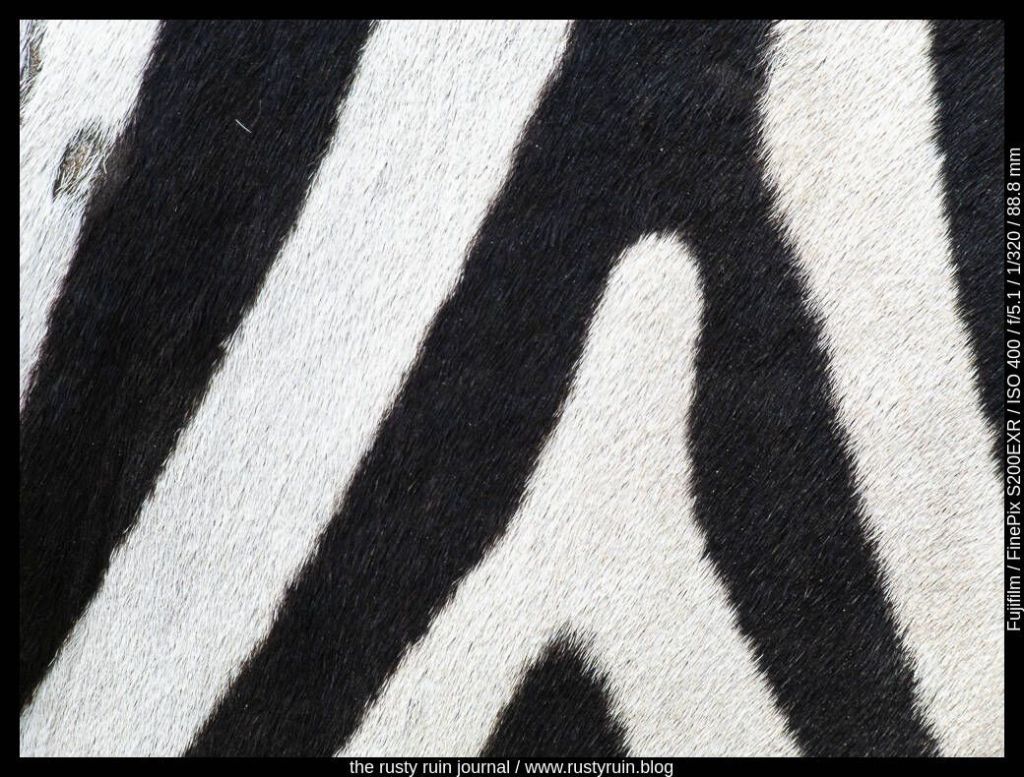
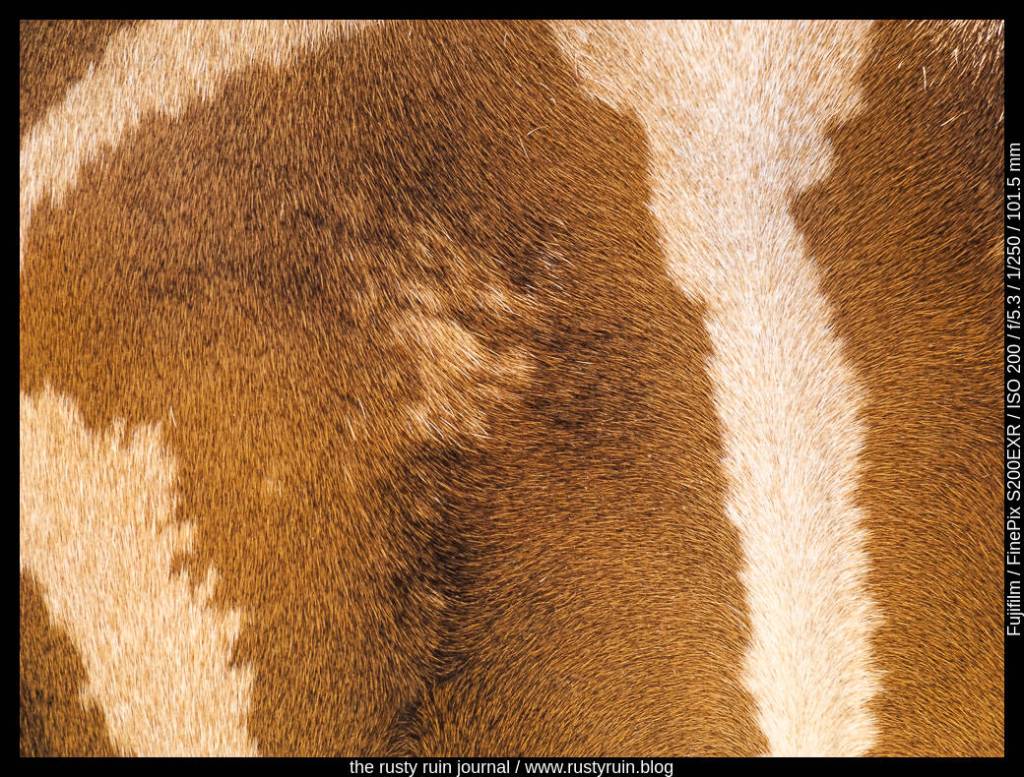
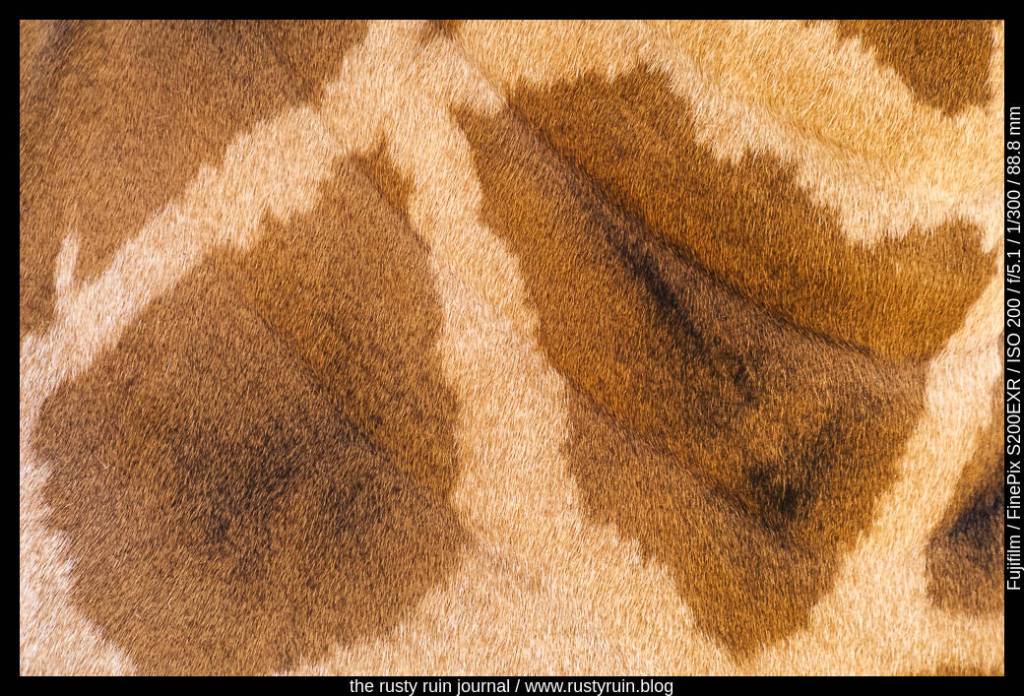
Instead, I give you a handsome Meerkat, and some closeups of a Zebra and a Giraffe – not overly exciting, I know:
Meerkat alertZebra’s EyeZebra fur
Apparently, Zebras are considered one of the most dangerous animals by zookeepers. People tend to get fooled into a false sense of security, thinking they’re just friendly horses with stripes. They are, by all accounts, very skittish and don’t mind kicking anything that freaks them out to death, zookeepers included.
Giraffe fur #1Giraffe fur #2
Giraffes, on the other hand, are quite gentle. We were taken to see both the Zebras and Giraffes and could hand feed them apple and carrot slices – the flighty Zebras only through the wire, of course. This was all part of a purchased package that permitted us exclusive up-close access to some of the animals. It was actually great to see them this way.
If you’d told me 15 years ago that my 1 megapixel Kodak would become a vintage digicam fetish item for Gen Z, I might have been amused. At the time, I was looking for tech-upgrades I could afford. It was all about more megapixels, as that seemed to be the measure of a digital camera in the 2000s – a time when companies thought they had a chance to revive their fortunes after the film era.
I might not be Gen Z, but it’s nice to use these old cameras again. Exploring macro modes, slow start-up times accompanied by bell chimes, and outdated storage media (XD card, anyone?) reminds me of how exciting the digital camera market was back then. Even a company like Casio – largely known for calculators and watches –was dipping their toes into a market that was fresh and ripe for innovation.
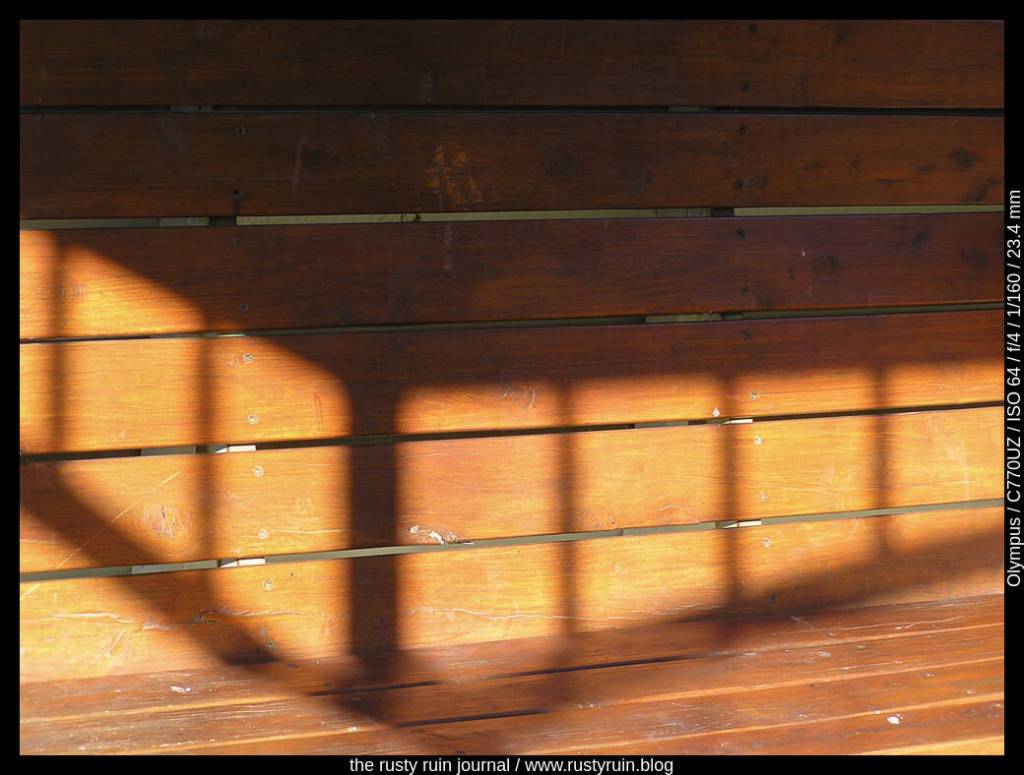
Soft shadows on wood #1 – Olympus C-770
For those of us who lived through it, this particular past doesn’t hold the mythical gold that Gen Z thinks it does, but it’s also perfectly natural to yearn for brighter yesterdays, especially when today is so obsessed with both the perfection of the image and the kind of moral purity testing that accompanies a technology layer that weaves relentlessly through our lives, recording our thoughts and feelings so that we’re not allowed to ever forget or forgive.
Despite the nostalgia, there are other benefits to reviving old digital cameras:
Save the environment by not chucking out a perfectly usable old camera. Companies tapping viciously into the dopamine hits that reliably ensure we hit the technology upgrade treadmill and spend spend spend don’t help our planet.
Use limits to learn – it might only have a maximum ISO of 400, no image stabilisation, and a sensor that goes blind as soon as a sliver of a highlight hits the photosites, but those old camera limits will teach you patience. They’ll teach you to consider dynamic range. They’ll teach you to slow down and compose each frame properly because the camera doesn’t have the same easy conveniences our modern cameras do.
An old digital camera will also teach you that photography is about more than expensive camera gear. I’ve said it before – people have been making wonderful photos for more than a century. Great photos are not restricted to the 21st century and camera gear that makes your bank account weep. If you’re not making good photos with a cheap camera, you’re not going to make good photos with a $6000 camera.
The end of year holidays have provided rare opportunities to explore city, country, and local suburbs. It’s nice to throw the Kodak Charmera into a pocket and walk around an unfamiliar neighbourhood, keeping an open mind and allowing the small things to catch my attention and focus. The unobtrustive nature of the little Kodak also means that I can largely remain unnoticed on suburban streets.
Brown beams and blue sky – Kodak Chamera
The fantastic Community Hub and Library in this suburb stands as a testament to the vision and efforts of locals and politicians to ensure that the area, known to have many endemic social, economic, and health problems, provides community, resources, recreation, and safe places to gather. Walking through tall glass doors, the immediate quiet and calm stands in stark contrast to daily incidents of drug-affected raging at the air and the sad turmoil of embattled relationships that seem to define the street corners.
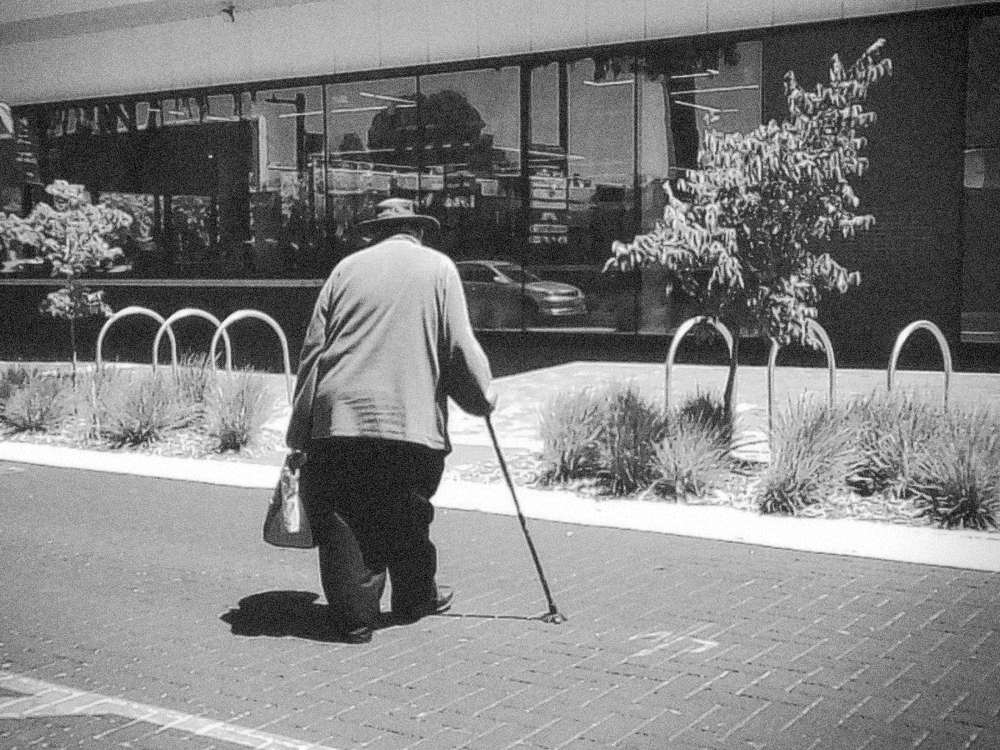
Crossing and counter-balance
Standing before the prize-winning photographic prints adorning the gallery space in the library, I think of the steep expense of the listed camera gear used by the photographers versus the social conditions and poverty outside.
A small photo of a nine year old girl, brandishing a Nikon Z9 and a giant lens, thicker than her arm, stares back at me from an artist card placed under the runner-up picture she entered into the competition – a photo of a dead shark on a tropical beach. Her hands curl around a camera body that cost thousands and a lens that cost even more. And here I am with my $50 Kodak Charmera, looking out of the library window at the old cemetery that was here before the shopping centre, pondering the absurdity of it all.
If you believe the more scurrilous online rumours, the quality of a camera lens from the former Soviet Union was directly proportional to the Vodka consumption of weary factory workers. This is not the colourful fancy one might suppose, as any factory line embedded in an economic and socio-political culture where wages are neither incentive nor punishment is more likely to be driven by exhausted hands and eyes.
None of this suggests that any cheap trinket or fast fashionable piece made today in vast factory cities by exploited workers and then sent abroad to be marked up for huge profits is any better. Always, there are grifters and exploiters taking advantage of the vulnerable and the gullible. But anyway…I digress slightly. The source of my Soviet-produced lensbeyond the factory floor is not a story for today.
The Zenitar 16mm 2.8 Fisheye lens is an impressive piece of Cold War glass. It’s a hefty thing in the hands, has a distinct and very short hood, a lens cap that can’t be used on any other lens, and looks great when the sunlight bounces off the large curved glass that sits right out front. On my trusty Olympus EM5 Mark 2, this 16mm Zenitar has a field of view equivalent to a 32mm focal length in 35mm format. So, if I was using it on my Z5, which has a 35mm sensor, the field of view is the native 16mm. Because my Olympus has a digital sensor that’s half the size of the one in my Z5, I double the 16mm to a field of view of 32mm instead.
Trudging through swampland at mid-afternoon – Olympus EM5 Mark 2 and Zenitar 16mm Fisheye
My copy of the lens is sharp enough at apertures F 5.6-8, and even at those settings the corners display a lack of sharpness that’s more fizzy than actually mushy – as though details are being pulled away from the centre and slightly distorted. The effect reminds me of using a plastic lens but I don’t find it unpleasant.
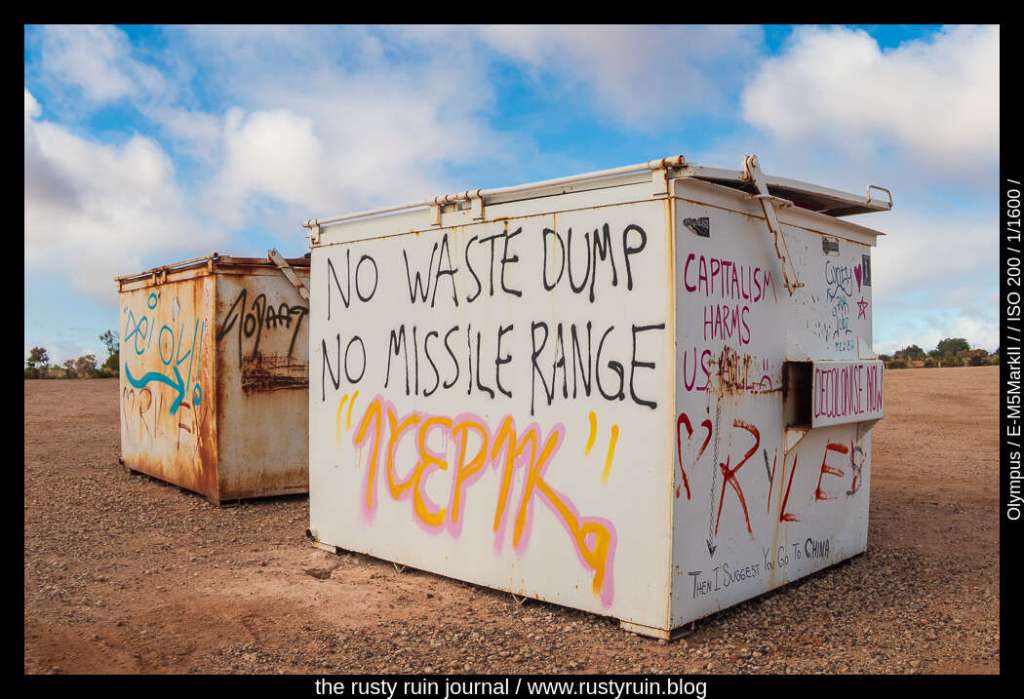
Capitalism harms us all – Olympus EM5 Mark 2 and Zenitar 16mm Fisheye
As with other wide angles, and certainly with all Fisheye lenses, there’s distortion. You can see how the normally straight cortners of the skip bins in the above photo look bowed. I don’t have an issue with it, as this is just a feature of the lens, but it’s not the sort of lens you want if you desire pleasant portraits, straight horizons, and distortion-free buildings (using the Nikkor 16mm 2.8 lens profile in Lightroom will straighten out most of the distortion if you really want that).
Lenses like this are great for getting in very close to a subject to take advantage of the optical distortions they produce. On the Olympus, however, the Fisheye effect is certainly much less because of the smaller sensor size, making it a really valuable wide-angle lens if you don’t mind manual focus, fizzy corners, and the chance that the quality of your copy may have suffered due to the effects of authoritarianism and the revolutionary whims of Vladimir Lenin.
How do you store your digital photo files? In this modern world, it’s a regular concern – how to safely and securely store all of the digital detritus that builds up around us. It used to be so easy when we just had to remember a few passwords. There was no such thing as 2 factor authentication years ago. Security breaches and cyber-hacks have put paid to having an easy life when it comes to digital security. And you know something? I’m a bit burned out on all of it…it feels a bit too much some days.
Stacked for the night – Nikon D70s
Just trying to organise photo files feels like a burden. I’ve had hard drives go bust over the years. The ever-swelling trove of files gets bigger and the voice gets louder: “Find an easy way to store all this crap or delete more!” – as if I’m stuck playing a simulation game and the goal is just to move shit around every minute of every day and night. Like Sisyphus pushing the boulder up the hill.
As I said previously, I use Microsoft One Drive these days. At the very least, I can use the cloud to quickly backup DNG files and TIFFs for future download. I know lots of people feel like they shouldn’t have to pay, but in the age of information overload, I think it’s a good idea to find a reasonable solution that offers enough storage for a good price. It’s the business model that Google tends to run with: offer generous freemium cloud storage, but not too much, so that people come to rely on it for their photo and file backups. Then offer paid tiers for more storage room.
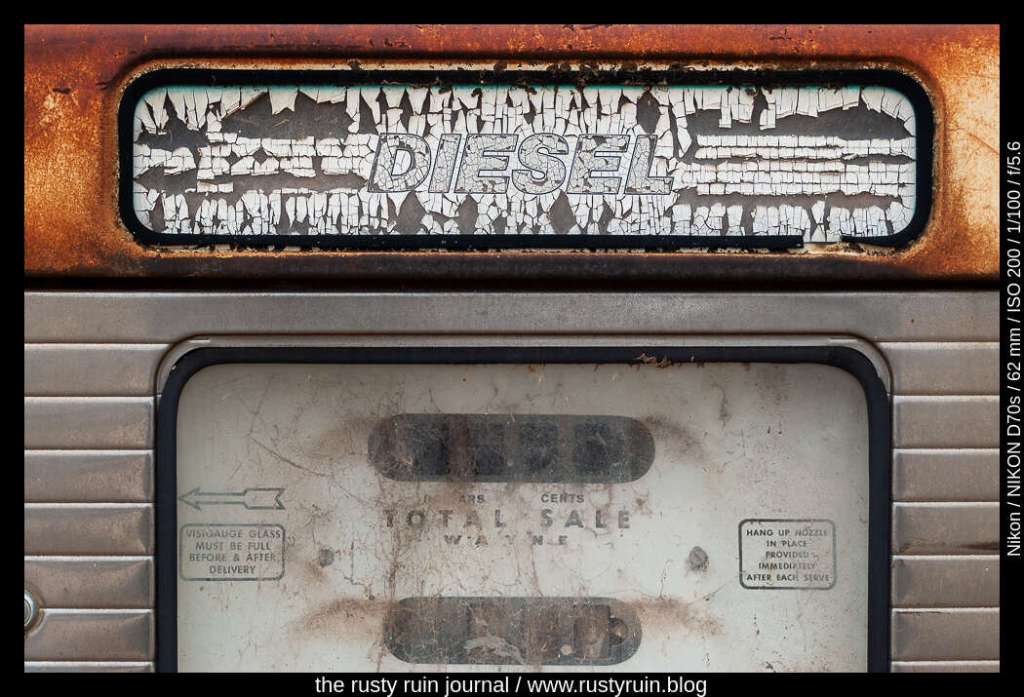
Diesel back in the day – Nikon D70s
I suppose we’re always looking to organise something – photos, files, music, our lives. And truthfully, sometimes all of those files feel like too much of a weight – like a digital albatross. I can’t even tell you how many sites I’ve been locked out of because an old paid email address went bust and now the site is sending the password I’ve forgotten to an email address that doesn’t exist. Or software license codes that got lost in the shuffle of hard drives and file moves. The 21st century has the feel of a password-protected version of copy of a copy of a copy, featuring tiny beige plastic parts that need to be glued together against a time-limit. So, I guess this is my rant about simplicity and complexity, as if there was ever a simple time. And since I work with vulnerable people, many of whom live really tough lives, I must say that I feel a little queasy even making a small complaint about any of it. Life moves and changes and we’re just the floating leaves flung by the ripples and waves as it goes.
In my previous post, I sang the praises of the Nikon D200 – first released in 2005. Back then, I could barely afford a decent digital point ‘n’ shoot, let alone a premium DSLR like the D200 ! Even RAW photos from this Nikon feature similar contrast, punch, and compressed dynamic range to those from the Olympus E1 – yet another widely respected antiquarian among cameraphiles and CCD sensor enthusiasts. I’ll not expand fervently on that in this entry, as I’ve done previously! Just some more photos from the hefty and reassuringly solid Nikon D200:
A rusty old shed somewhere – Nikon D200 and Tamron 17-50mm F2.8 lensThe green shed – Nikon D200
Notice the old tin shed theme so far? I won’t deny that lonely sheds make for some nice pictures, especially when they’re decaying into the sun-beaten soil.
The yellow shed – Nikon D200
Seriously, I was going to post something other than a shed, I really was, but I couldn’t help myself! Back to another angle of the yellow shed you saw in my last post. Looking at these photos, I can’t help but wonder again about the image quality perfected in some of these old cameras. Makes you also wonder about the role of marketing and what we believe.
My interest in rust is, as you might imagine, slightly more than that of the average person down the road. I don’t have data to back this up, but I’m not convinced that the idea of making photos of rusty things is of primary importance to many people as an activity. What I’m quite certain of is that people are definitely interested in the answers to big questions: Why am I here? Are we alone in the universe? Is death the end? What does the future hold?
In the middle of nowhere that used to be somewhere – Nikon Z5
Rust and ruin are symbols of decay and time passing. Some people are terrified by this idea, perhaps hoping that science will one day discover the answer to immortality. Others believe they have the answers to the big questions already. For them, perhaps, ruin holds fewer terrors. I wrote about this in a previous post if you want to have a read. I even included one of my favourite poems.
In shadow and broken steel – Nikon Z5 with Nikkor 40mm F2
Sidestepping terror to make life easy
I started this post like most others. Truthfully, I didn’t really have much direction, other than the desire to explore rust and ruins as universal symbols that remind us of our mortality in the vastness of the river of time’s relentless passing. But lately, I find myself thinking more and more about the impact that I and others have on the world. For example, my use of shaving cartridges, with all the plastic they include, isn’t just annoyingly expensive, but also destructive. All of that plastic ends up in landfill, contributing nothing to the environment but toxicity.
It’s perfectly understandable that people prefer to have easy lives where everything is mapped out and makes sense. An easy to understand narrative provides us with answers to many, if not all, of the big questions we have. It’s easier to come to terms with the idea of toxic human waste, selfish governments, and genocides when it’s part of a cosmic plan ~ the evil will get their punishment and the good will find peace. Unfortunately, human history is nothing if not a struggle between the powerful and the powerless.
Rusting in the shadow of trees – Olympus E1
I think this makes it too easy to sidestep the feeling of terror gnawing at the mind in times of quiet. What does the future hold when we know all too well that the capacity for destruction lies in the same bed as the capacity for art within every human being? I strongly suspect that we may turn quickly and desperately to solutions as a species once it’s too late. The powerful will have squeezed every last drop of value from us and we’ll have been too busy buying fast-fashion clothing from giant toxic factories where people are grossly underpaid and overworked for the benefit of the few. Where do those unsustainable fast-fashion items end up, do you think? What good do they serve, other than to appease vanity?
Living with less
One kind of response I’ve often heard from people when speaking of this topic goes something like this: “But what about the economy and jobs? If we follow environmental policies, we’ll lose jobs. And how do we keep the lights on? Maybe we should think about nuclear power?“
My blunt rebuttal these days is usually along these lines: “The environment isn’t interested in your comfort. We may all need to accept the idea that we must live very differently with a lot less.”
The idea that we must not stall our economy and standard of living as we explore ways of doing less destruction to the planet is not only absurd, it is also dangerous. All this does is serve the lives of people who have vested interests in making money and living comfortably. They don’t want their lives altered and would rather continue driving big vehicles that spray minute particles of rubber into crucial waterways. Yet, nature is change. Nothing remains the same. Living a life with less money, less oil, less waste, less electricity, less gas, less cars, and less fast-fashion is not only wise, it’s likely the only path to take.
The empty house near the empty hotel – Olympus OMD EM5 Mark 2
In my last post, I discussed the idea of the Indieweband the state of the World Wide Web. If you have any interest, I urge you to read Olia Lialina’s fantastic essay on the transition from the idea of My to Me on the web. It’s lengthy but contains a wealth of information about how the web has changed and how the web user has changed. It coalesces many of the thoughts I’ve been having for some years now.
Lialina references a late 90s quote from Tim Berners-Lee – the man often called the inventor of the World Wide Web – where he talks about personal home pages:
“With all respect, the personal home page is not a private expression; it’s a public billboard that people work on to say what they’re interested in. That’s not as interesting to me as people using it in their private lives. It’s exhibitionism, if you like. Or self-expression. It’s openness, and it’s great in a way, it’s people letting the community into their homes. But it’s not really their home. They may call it a home page, but it’s more like the gnome in somebody’s front yard than the home itself.”
Lialina calls out the arrogance in this statement – the idea that regular people using the web, and enthusiastically learning HTML so they can create a personal home page, are amateurs creating nothing more than quaint gnomes in the garden. A clear divide is inserted between the web professional and the web amateur – between the skilled technologist and the average person on the street.
Dress me up any way you want – Olympus OMD EM5 Mark 2
The personal home page as rebellion
There have always been people looking to make lifelong careers and profits out of the web. The idea that the web would be a gigantic repository of information available to everyone equally is very much a 90s ideal. Alongside developments in technology, and in service to these professionals and technocrats, the web has changed from something a person logs into occasionally to check email and exercise an alter-ego, to an always-on connection where the idea that you’d even have a home page, rather than a simple Instagram bio, seems odd to many young web users.
When Tim Berners-Lee said that the web isn’t a home for the average web user, he may not have envisioned just how defining that statement would become. Today, giant corporations lay claim to sections of the web and tell us how we should interact with it. Too bad if you want to upload your own hand-made HTML to their platforms, because they won’t allow it. You can’t be trusted to engage in good design as defined by them. And you certainly can’t be allowed to disengage with their data collection because then you’d be worthless to them as a method of making money.
Corporations and technologists making their income from the monetisation of the web aren’t interested in anyone owning any part of it. They want you to stay in their curated walled gardens so they can sell your data, sell your profile, and make you believe you’re getting something useful in return when you spend time filling their platforms with content for free. Need to stay in touch with friends and family? Yeah, lucky thing we have a social media platform for that! Of course, we always had a thing called email where we could stay in touch, too.
Whilst the retro-web revival highlighted by places like Neocities is reminiscent of 90s home pages, and is populated by well-meaning people who want to return to a supposed web golden age, there’s still a pervasive attitude of reworking the ugly design of those original 90s websites so that modern design principles aren’t insulted. The 90s aesthetic is catalogued and examined by the current crop of professisonals. Thus, it becomes another social movement defined by what technologies one had access to, and is assigned space beneath the umbrella of Web 1.0 – itself just another label designed to make conversations about the past easier to grasp.
Of course, we’ve learned so much about web accessibility and our tools have improved to the point where we can now make easy-to-read websites that don’t feature dancing baby GIFs. There’s certainly admission in some quarters that web users in the 90s used the tools they had to make the best websites possible – an admission that the personal home page aesthetic was perhaps not completely a result of people with bad design tastes. But there are also people now who’d like to revive the 90s aesthetic with modern tools like the latest CSS and other scripting that didn’t exist back then, whilst adhering to accessibility and good design principles because, of course, we must do that since it’s bestdesign practice – best practice only in terms of appeal, standardisation, and monolithic design that has, of course, nothing to do with the admirable and simple personal goal of just having a digital home. Not adhering to good design principles would make a site anti-corporate, anti-design, and anti-social, according to arrogant web technologists.
The idea that we should adhere to standards and monolithic design principles seems based on the idea of appealing to the greatest number of people, attracting the most attention, making the most money, and going viral – all of which are core concepts of capitalism that certainly didn’t define personal home page design in the 90s. During the time of the slow web, you’d get excited if a single person emailed you once a month and said how awesome they thought your personal home page was and how you had things in common – and it was a genuinely exciting moment of connection because you weren’t bombarded with likes and followers and subscribers and junk emails every single day. One connection felt real and important because it was uncommon.
Sometimes, on those long and lonely roads through outback Australia, you come across things you don’t expect to see. Burned out cars flipped on the roadside are commonplace. So too are the broken bottles, campfire ashes, and plastic rubbish that litter desolate truck stops. What you don’t expect to see is an old campground and motel that lies in ruins, featuring an alien and UFO theme. This is Wycliffe Well – once known as Australia’s UFO sighting capital.
Attention Campers – Nikon Z5
In this ruined complex of dormitories, recreation rooms, and offices, we found the remains of glory days, when the site was home to a thriving community looking for their first UFO sighting. The signs are everywhere, including alien murals and painted UFO landings, as well as enigmatic depictions of Karlu Karlu (otherwise known as Devil’s Marbles), providing the geological majesty that perhaps fired the imaginations of UFO spotters who saw lights in the sky around here decades ago.
Welcome – Nikon Z5
The story of the site is a familiar one from a business perspective. It was owned for a long time by one family and managed by an ambitious man who drew upon the UFO mystery to market the facilities effectively to tourists. There were glory days, as the bar and large on-site restaurant provided rollicking evenings of food and music to guests. Finally, they decided to sell up and less enthusiastic owners took the reins whilst promising to repair and maintain the place. It now lies in ruins after flood waters ravaged the site. And there’s little doubt that tourism dried up in the wake of the Covid pandemic.
House 1 – Nikon Z5
It’s an eerie place to explore on the way to somewhere else. Though vandals have long since taken plenty of souvenirs, the site remains a strange and melancholy tribute to outback Australia’s tourist economy and the challenges of surviving in remote locations. Sadly, it’s now at risk of further damage, as huge uncontrolled bush-fires are currently sweeping through the area.
I’m not a scientist. I’m not an engineer of any sort. I’m certainly not a designer of optical devices or digital sensors, just so you know. There has been debate in some corners of the web about old cameras with CCD sensors rendering better colour and their images looking more film-like. I think a pleasing photo is a subjective thing and people are free to decide what that looks like. I’m just curious about the nature of the debate and why people might think this way.
CCD sensors were the dominant type of digital sensors at the dawn of digital photography. Around 2010 or so, CMOS sensors started to appear in new camera models. At the time, I really didn’t think about it, as I couldn’t even afford any of the better CCD cameras anyway. And believe me, there are plenty of CCD cameras that make junk photos! Interestingly, the CCD colour is better pundits rarely discuss those junk cameras, perhaps because their output doesn’t suit the argument that CCD colour is better.
Of Nikons, Canons, Pentax, and Fujifilm
When people talk about those lovely CCD colours, they usually reference the same cameras: most of the early Nikon CCD cameras, the Fuji Super CCD cameras, early Canons and compacts of a certain model, the Olympus Evolt series, the Leica M9, and a handful of compacts with excellent output. Of course, those cameras were always considered excellent. Reviews at the time of their release praised them, so it’s no surprise that they’re still great cameras today.
I used a few CCD cameras at the time, and then moved to CMOS cameras because that’s what was being sold. I don’t remember anyone discussing the merits of CCD colour versus CMOS colour. I do know that the output of many cheap and cheerful CCD cameras at anything higher than 200 ISO is pretty awful – there’s lots of chroma and luminance noise, and the colours don’t look so great. If you read reviews of those old consumer cameras online, you’ll see there was a focus on accuracy of colour. This is because camera makers saturate certain colours to make the output more attractive for consumers.
Consider the quote above about an old CCD camera. Evidence that colour reproduction has always been on the mind of the photographer and that CCD cameras, for all their current hype, have issues with accurate colour reproduction. This is not to say that inaccurate colours are less attractive. Many cameras are sold based on how their on-board JPG conversion software renders colour, after all.
What influences the colour of a digital photo?
First of all, whether it’s a CCD sensor or a CMOS sensor, the sensor itself is actually colour-blind. The sensor only sees lightness/brightness and not colour. The Colour Filter Array on top of this slice of silicon filters wavelengths of light into Red, Green, and Blue. All of this data is transferred to AD converters and the signal amplified. The on-board software takes this data and, in the case of JPG output, it does some clever stuff to render a compressed file. To achieve the Canon look or the Olympus look, or whatever, the software also applies a tone curve, temperature and tint settings, and may saturate certain colours more heavily.
The Fuji-Chrome look in digital
Fuji is pretty well-known for offering users lots of film presets in their digital cameras. These settings emulate some of the qualities of certain films, including colour, grain, and tone curve. The photo above is from an old Fuji Finepix S7000. It’s a JPG straight out of the camera on the Chrome setting. Note that there’s a slight green bias in the white balance, as well as extra contrast. Definitely a pleasing photo.
On some makes of camera, the White Balance is known to bias warmer or cooler. Nikons tend to have a cooler look to photos, and this helps to produce better colour in some scenes where a warmer bias would create unnatural colours, such as in some types of skin tones. But these things largely matter only when JPG file output is needed.
Choice of lens also has some influence on how a photo looks. People talk about the Leica look, for example, noting that there’s some mystique about it. I don’t have the money to buy a Leica of any sort, so it’s hard for me to comment on this phenomenon. What I do know is that a poor lens can produce poor output, and a great lens can produce great output. Leica have always been known for the superiority of their optics, so it’s most likely that the signature Leica look has a lot to do with the contrast and sharpness imparted by the lens.
Hype and reality
So, why are some people talking about the inherent superiority of CCD sensors and how they render colour? Is CCD colour a question of hardware or software? Here are some common reasons and assumptions, including my thoughts on them, from people who believe that CCD sensors produce better or more film-like images:
The old CCD sensors have thicker Colour Filter Arrays that separate colour better and produce stronger images: As I said, I’m no engineer, so this is tough to question. If this is true, then all a camera maker would need to do is to put a thicker CFA on a new CMOS sensor, and it would approximate all of those great colour results from old cameras. I strongly suspect that the CFAs have very little, if anything, to do with it though, given that there are other strong influences on how a photo looks, such as white balance and camera software.
Camera manufacturers stopped using CCD because CMOS was cheaper, which led to less organic images: Companies do things to save money all the time, but would they really intentionally hobble the output of their cameras to the extent that many CCD enthusiasts believe?
Camera X with a CCD sensor makes photos that look so much better than camera Y with a CMOS sensor, so therefore the CCD sensor must be superior: Let us not forget that most CCD pundits never mention all the junk CCD cameras from that era (is anyone talking about those plasticky Nikon L series compacts that produce average photos?). They mostly talk about the CCD cameras that are still good, even today. They were praised then, and they are still making good photos now. I think that some people who were too young to remember the digital transition now cultivate the mistaken assumption that old camera technology is mostly inferior to today’s technology, and that those great cameras from yesteryear make photos look great because there’s some hidden and forgotten technology in them – the CCD sensor.
CCD cameras make images that are film-like: Let us be clear – only film looks like film. I grew up with film cameras and remember the cheap cameras (I couldn’t afford anything else), powerful in-built flashes, and cheap consumer film. I think the look that many young people talk about relates to the softer quality of many film photos due to low-grade lenses and the appearance of highlights from low-priced consumer film cameras. Those old CCD cameras have limited dynamic range, often creating blown highlights. The best CCD sensors, at low ISOs, do produce less digital noise due to the chip’s architecture, and some people say that this means it’s closer to film. But modern CMOS sensors have advanced greatly in these areas and have far more dynamic range, colour accuracy, and noise control. Just look at the crappiest CCD cameras at anything above base ISO and you’ll see some pretty ugly chroma and luminance noise. The best CCD cameras from that era can make some very nice low noise images, even up to 800 ISO, but none of this means it looks like film. Plenty of people know more about it than I do, but film grain is random and organic. Digital noise is square and uniform. Where an old and highly regarded CCD camera may be useful is at the lowest ISOs and almost no perceptible digital noise. That could make for some nice black and white conversions. The low noise might also make it a better fit for overlaying scanned images of film grain. I’ve never seen much point in overlaying film grain over digital photos that already have digital noise.
You’ll have unlimited film-like images if you buy this cheap CCD camera: There are lots of YouTube videos touting the benefits of these old digicams, even going so far as to label them Y2K cameras. This is a hook to lure people in to watching the videos so that the creators can game the algorithm and snag subscribers, with a little magical thinking and potential profiteering thrown in. Growing up, I saw thousands of photos from film cameras of all sorts. The so-called Y2K camera, the moniker itself a pointer to the generational interest in digicams, doesn’t make film-like images.
If you want to read a pretty in-depth, though only loosely scientific, article on CCD versus CMOS colours, take a look at this site. Spoiler alert: there isn’t a visible difference between them for most people, and any colour output differences seem to come down to company preferences with regard to on-board software processing. CMOS also offers so much more low-light performance that it’s little wonder CCD was replaced by it in the end.
There is something curious about the Olympus E-1 I’ve been using recently, in light of this speculation about sensors. The RAW files it produces are not as flat and dull as you’d expect. They require little editing when exposure settings are nailed. Is that the sensor? Maybe. More likely a tone curve applied, though it seems odd that this can be seen in the RAW files? You can read my thoughts about it here.
Nikon Z5, when paired with sharp lenses, can produce wonderful output
Does it matter?
People love the photos they love. And I’m not an engineer, so I don’t have all the answers. In the end, it doesn’t really matter. Humans are always looking for meaning somewhere and often latch onto narratives despite the data. And that’s OK. Creating and finding greater meaning in life is what we’ve always done.
What I do find interesting is how much prices have risen for the CCD cameras that get the most attention in these online forums and social media discussions. No doubt, some people in those corners have enough interest in profits and online followers that they’ll keep pushing the CCD vs CMOS colour narrative, even unconsciously. I think this is what bothers me the most: the fact that a lot of young people are being duped into paying a three figure sum for a point and shoot from the early 2000s just because some YouTubers told them that the CCD sensor it features produces filmic photos.
In the end, whatever the truth, it’s all part of the marketing and hype cycle. It’s a snake-oil trend that will eventually fade. A generation that grew up seeing family members use those early digital cameras are now looking back to find inspiration in a world that’s over-saturated by AI and overly processed images from smartphones. They feel nostalgic about those old cameras from their childhood and that’s perfectly OK and understandable.
Are digicams worth using now?
The short answer is: yes, of course old cameras are worth using now! Admittedly, I like some of those old cameras because I can afford some of the best ones and their history interests me. And where else would they end up? In the junkyard, thoughtlessly tossed and abandoned as old XD cards and Compact Flash cards molder and rot in their plastic slots? We don’t need the latest and greatest cameras to make interesting photos, that’s for sure.
I do have one thing to thank the Y2K digcam craze for: it has provided me with the impetus to explore some of the early digital cameras I always wanted and could never afford at the time. I can now appreciate some of the great technology in some of those cameras and see how we ended up where we are now. It has also taught me something else: image-making hasn’t advanced as much as the big companies want us to believe.



























 The Rusty Ruin Journal