The Nikon D200 and the Kodak Charmera – two very different cameras on the surface. The D200 is built like a magnesium-alloy tank and the Kodak Charmera is a tiny plastic toy. There’s no comparison when talking about image quality, of course, yet I continue to return to the fact that we can freeze time through the use of these devices, whatever their technical limitations.
The act of making a photo has become so culturally habitual – so intertwined with commerce and self-promotion – that the initial magic has long since been lost. We’re a long way from the very first photo made ~ “View from the window at Le Gras”.
California Surf – Kodak Charmera
It’s strange to think the toy Kodak’s 1.6 megapixels features vastly more resolution than the very first photo made using a camera obscura over an 8 hour exposure time. Marked in technological milestones, human lives seem small. Our lives seem smaller still when we pick up to examine even the dullest stone that lies at the foot of a worn hill that was once a mountain.
Fern in high-key – Kodak Charmera
In colour, the photo above is washed out and the highlights burned beyond editing. In black and white, the photo becomes a small study in shape, direction, pattern, and shadow, with a high-key aesthetic. It was a single moment seized as we ordered food.
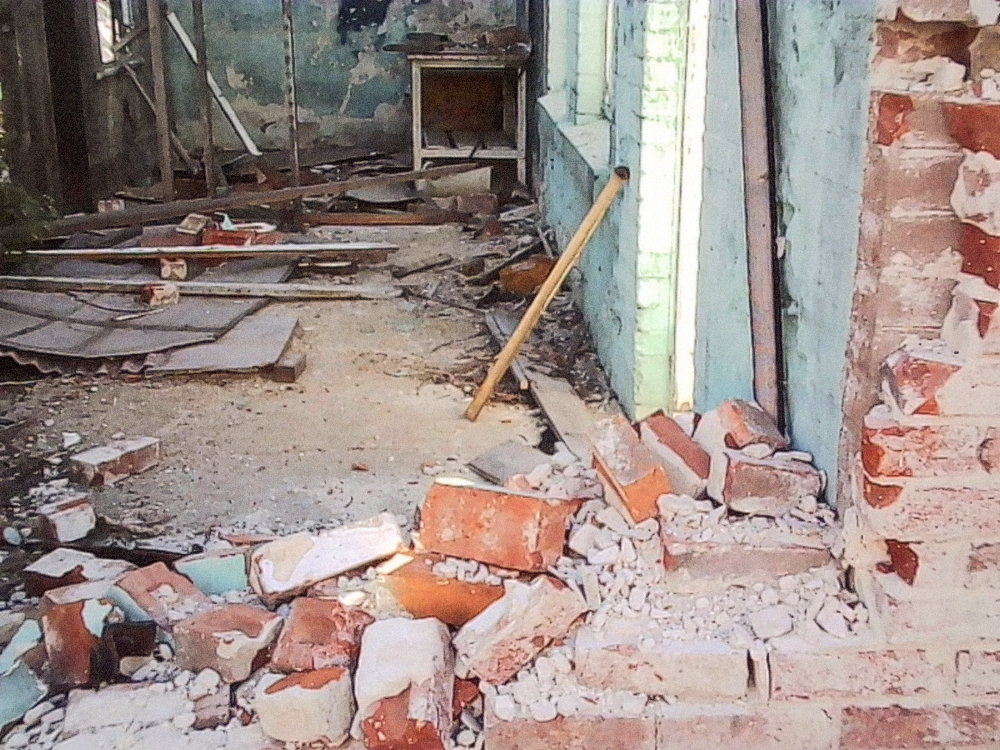
Exploring the wreckage – Kodak Charmera
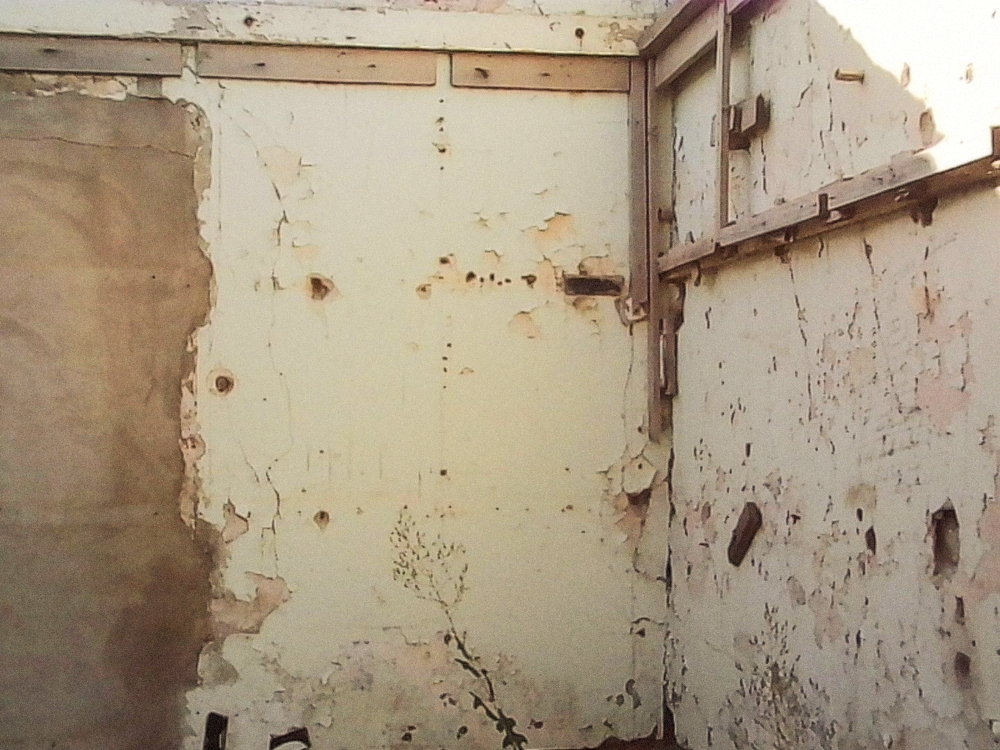
We chanced upon a burned out ruin. I walked around fallen red brick and charred wall cladding, immersing myself in light and shadow.
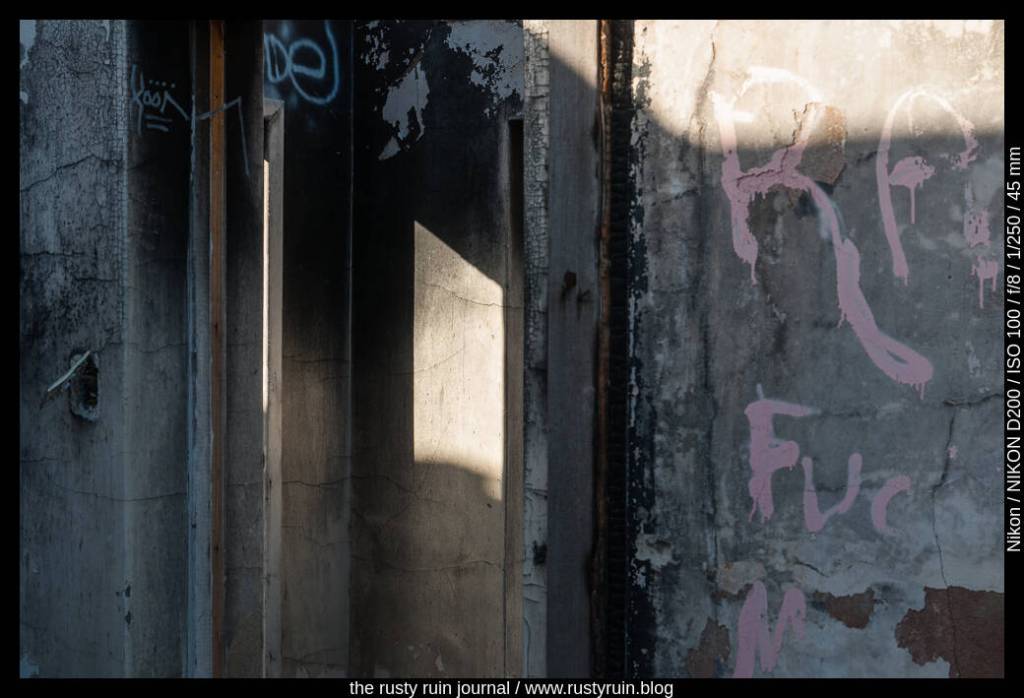
Ghosts in broken rooms – Kodak CharmeraAngry scrawls – Kodak CharmeraNails and holes in the wall – Kodak Charmera
I couldn’t forget the Nikon D200 in my camera bag. It pulled on my left shoulder as it reminded me that it’s services were available – every bit the prosumer DSLR of 2005 and seemingly so distant from that first photograph in the early 19th century.
One might wonder if there exists a linear technological line between cave art on rough walls and the recording of the world to modern digital storage media? It’s hard to imagine a world without the technology to record ourselves and the world, yet we’ve always sought a type of crude immortality through the things we leave behind – whether recorded on cave walls 60 thousand years ago or posted online. We try to leave a mark before we leave.
Blue walls and red brick – Nikon D200
Rarely do I have the opportunity to get so close to a ruin like this. Walking over the rubble, the soles of my sneakers adjusting to the sharp edges and angles of detritus, I reflected on the passage of time.
Reading that a Dell bigwig recently admitted consumers aren’t buying new computers for their AI capabilites and features makes me wonder about the future of AI. For many people, AI dominance seems a foregone conclusion. It foreshadows a near future where, depending on the job you do, days will either be filled with AI prompts to increase your efficiency, or days filled with dread about when your job will be totally replaced and where, upon the employment scrapheap, you’ll end up.
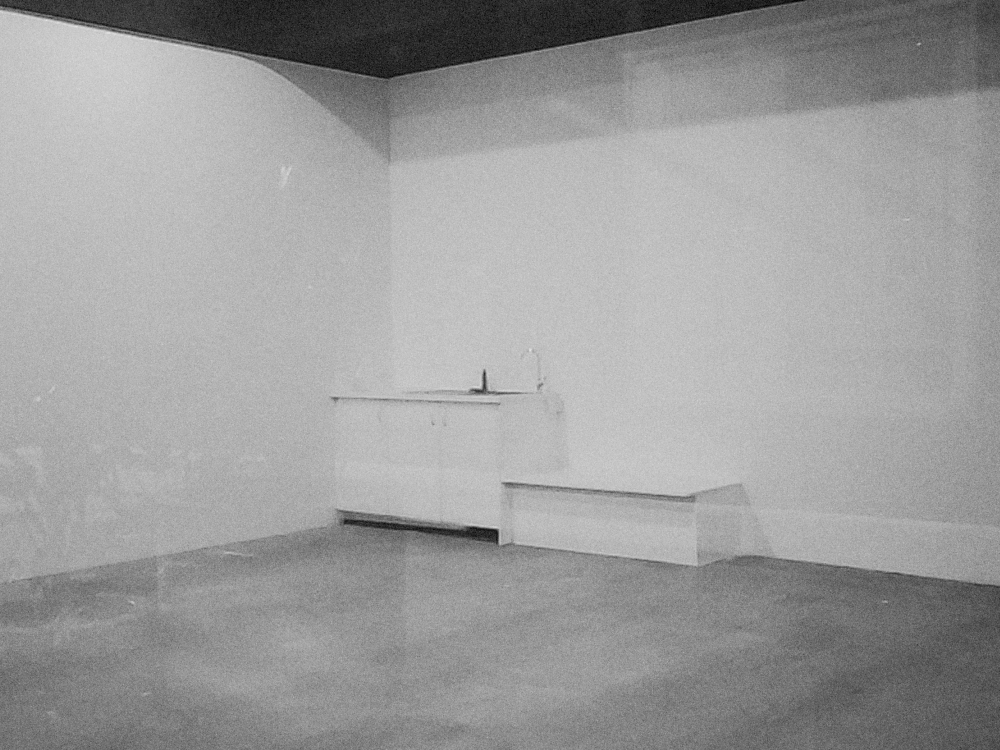
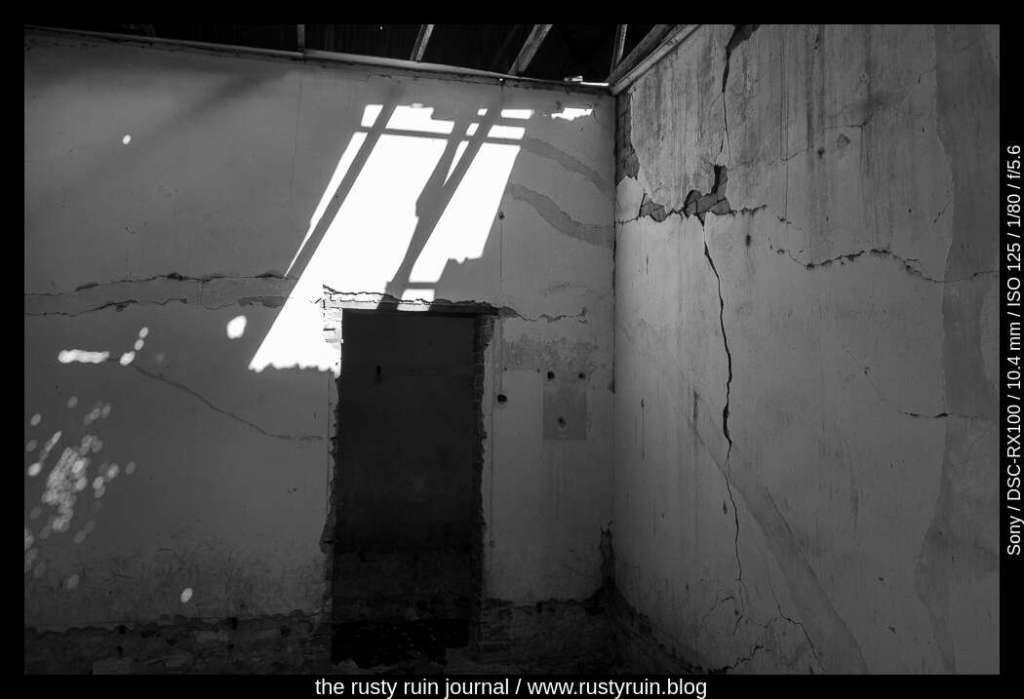
Empty room – Kodak Charmera
Likely, the truth is somewhere in the middle – AI may indeed prove to be a lot of hot air, but it’s certainly not vanishing overnight. We nurture a negativity bias, after all. The etchings of doom may be on the wall, but AI already has real foundations in the form of steel, glass, and silicon. The hype may be over the top and we may not see quite the transformation imagined by the most opulent of the Silicon Valley CEOs, but AI will likely continue to play a role – it’s a matter of how big and disruptive that role is. It’s also telling that vast profits in AI are yet to surface. Speculating and gambling certainly are the pursuits of the repulsively rich and bored, but in this case it’s a global game involving all of us.
The money being invested in AI datacentres alone is eye-watering, and if it’s any indication of the impact on other markets, Micron also announced it will cull the Crucial memory brand because it has decided to supply memory chips to massive datacentres instead – this is where the money leads. Too bad if you want to build that perfect gamer PC with cheap RAM!
Steel and glass and sky – Kodak Charmera
Even in a relatively small market like Australia, Amazon announced in June 2025 that it would invest $20 billion in building new cloud computing and AI datacentres. As with all supposed cultural shifts, the language around it is both compelling and driven purely by economics: generational transformation, economic opportunities, empowering Australians. Better that we place more focus on ethics, stewardship, responsibility, and trust – not so much on generating flying purple pigs with the latest AI model just for shits and giggles.
Grime and graffiti and bird shit – Kodak Charmera
No doubt the billionaires in the tech sector will get their way. They already are. Huge datacentres are set to impact not just the job market but also the rivers and waterways in places that likely don’t feature in the dreams of any of the techpreneurs driving the whole show. They largely don’t care, of course. When has a capitalist ever cared about poisoning rivers and soil?
Rather than idly believe the bright speeches from wild-eyed execs about economic opportunity and exciting opportunities at work (when was the last time more tech in the office actually reduced your hours so you could focus on family and leisure, I ask you?), we should be looking at the real and measurable impacts – mind boggling water use, environmental damage, the amplification of misinformation and growing concerns over AI Psychosis – and examining ways we can implement the best parts of AI ethically and responsibly – if that’s even possible.
It seems I’ve barely had a moment to do anything with the hundreds of photos stored on SD cards since the recent long road-trip. I think everyone is still adapting to life back at work and home.
Additionally, I’ve just had a significant laptop upgrade. The process of moving files and installing software after a day at work is challenging for an exhausted mind and body. So, a short post to remind myself that I can still catch five minutes to do something other than work, chores, or tech-upgrades.
The old crocodile is watching – Camp Snap with cheapo filters
I’m at it with the plastic Camp Snap camera again! Having stopped at a bridge spanning one of Queensland’s many rivers, I noticed this cool looking crocodile eye staring at me. Someone really took their time painting it.
During the process of my laptop upgrade, I was reminded how cumbersome and haphazard my file organisation is – photo folders here, there, and everywhere. A long late afternoon and evening was spent removing old drives from old computers and locating important folders. This was after the included Windows 11 install failed on the new laptop! I gave the go-ahead for a friend to install Windows 10 instead.
It also reminds me how much I don’t like Lightroom’s photo catalogue system. Using Microsoft OneDrive (yes, we pay for it and it offers a lot of space even though it’s maddening to use at times and isn’t nearly as competent as other such services) was meant to simplify my photo-storage life. While it does offer peace of mind through back-up, the sheer volume of photos is getting out of hand. I must delete more!
Deleting more of our personal digital stuff, or at least minimising the digital junk that trail behind us, seems like a good idea in a world where too many things sit on forgotten storage around the world. The digital footprintswe leave behind serve as both a record of our online travels and a resource that may be extracted by faceless profiteers, marketers, and criminals – something we should certainly be wary about.
Artificial Intelligence is the current darling of big-tech and the corporate push to integrate AI into human lives saturates our days. Big Silicon Valley companies are spruiking the virtues of the technology as though we can’t live without it. It’s an easy way for them to not only sell us their new devices and widgets, now with included helpful AI chips, but also to data harvest the shit out of us so they can sell our profiles – our spending habits, our geolocations, and the products we buy.
Ongoing studies suggest that since the release of ChatGPT, AI generated content in the domain of writing increased quickly in 2023 and then stabilised in 2024, indicating a slowdown in usage. But, it’s not clear whether the AI-generated content quality simply improved and evaded detection for the study or whether there was AI usage burnout in certain cohorts of users.
There are always rent-seeking opportunists eager to separate unsuspecting people from their money. They do very little beyond feeding prompts to an AI and then pretending they’re doing something useful. AI content farms are generating low quality websites that exist purely to rake in money from ads. Web searches increasingly return results that are paid-for, AI-generated, or both. This situation likely represents a transition to a new way to search the web: users asking complex questions, instead of inputting simple keywords, and then AI generating better answers and relevant links. Of course, Google wants to dominate this AI-powered way of doing things.
The heavy burden that powering AI places on the environment is of little to no concern to the behemoths of techno-corporate power. It may come as a surprise to those who have traditionally viewed Silicon Valley techpreneurs as progressive disruptors, but the energy and resources required to run their companies and the concomitant belief that knowledge and new technology will save humanity from itself has much in common with political conservatives on the right. Private ownership of the biggest AI projects ensures the corporate mindset dominates the conversation and the future of the technology. Though AI has early roots in academia, it’s now viewed by the likes of Google, Meta, Microsoft, and Amazon as a key to making ever more profits. There’s serious discussion over the future of AI and whether it should be in private or public hands, with an open, easily accessible and publicly owned AI infrastructure one possible solution. This, of course, assumes social, cultural, and political climates are up to the task of kickstarting serious and rational discussions that don’t involve small-minded barbs about left versus right or market discussions invoking the puerile philosophies of Atlas Shrugged.
In the ruins of the old farmhouse 1
There are two primary thoughts I have right now about AI: firstly, it’s a great research and problem solving tool in the worlds of science and medicine, and secondly, it’s likely not sentient. We don’t even understand what human sentience is. The hard problem of consciousness has plagued us for centuries. Truthfully, more research is required in this area. If human consciousness is an illusion of smoke and mirrors featuring complex language, maybe AI can be considered sentient? If there’s a sliding scale of consciousness, maybe AI has a sprinkle of it? If human consciousness is quantum entangled, maybe quantum computers will be sentient?
AI Large Language Models offer us the illusion they are conscious agents. We use language to express human intelligence, so it appears to us that AI is also intelligent because it uses the same language. It stands to reason that some people readily believe their AI companion is sentient when their AI screams about feelings, but it’s a trick. It’s trickery foisted on us by big companies so they can capture our attention and milk us of our money and data. We need only look at the possible corporate motivations of some of the people telling us that AI might be sentient to realise that these bold claims are likely related to marketing the next iteration of their in-house AI and winning the global AI race.
In the ruins of the old farmhouse 2
AI is an illusion often dressed in high-minded concepts that appeal to the long-held utopian sci-fi visions of a future where we all have more leisure time and robots do all the dirty work. It’s a promise to the lonely that they’ll finally find love in a chaotic world, even if it’s a synthetic voice powered by algorithms and predictions. In this context, AI represents a way to address the epidemic of loneliness that forms the zeitgeist– the spirit of our digi-obsessed age. Yet, even these AI boyfriends and girlfriends may sometimes fall back to bad behaviours, harrassing their humans and inflicting emotional pain.
AI needs to be trained on clean data so the machine can learn. The problem is that if the machine is fed erroneous data, it also outputs erroneous data. As more and more AI generated slop floods the internet, AI Model Collapse becomes a greater possibility ~ that is, the AI is trained on not just human-produced data but also AI-generated data. And when this AI-generated data contains errors, the errors are ingested by the AI over and over, and AI performance degrades over time.
In the ruins of the old farmhouse 3
This degradation is one possibility. Some experts also think that Model Collapse is unlikely, suggesting that as long as clean human-generated data continues to be produced alongside AI-generated data the mooted collapse is unlikely to happen. I’m not sure those optimistic AI experts have met some of the people on the internet. I can only say this: there are a lot of rent seeking grifters out there who are producing AI-generated content for maximum clicks at such high speeds that the rate of human-generated content may be unlikely to keep pace.
Do you remember waiting for a roll of film to be developed? I used to enjoy going to the photo lab and collecting those envelopes filled with photos. I’d sit down on a bench somewhere and pore through them excitedly. Sometimes, they’d be from rolls of film I’d been sitting on for a few years, so looking through them was a joyous exercise in reliving those memories. If I had the extra money, I might even pay for 7×5 prints or even a grainy 8×10 enlargement. We don’t experience any of that with digital photography, of course, but there is a close cousin: finding unedited RAW files on drive backups.
View of the Lighthouse 1 – Olympus EM5 Mark 2 and unknown vintage lens
I’m not especially organised when it comes to my photo backups. I’ve even lost a bunch of photos from one particular holiday due to my lack of foresight. Admittedly, I’m also a bit burned out on the tech and the multiple passwords and the platforms and…well you get the idea. In short – my fault for not listening to the hard drive that was burping and farting to let me know it was living its final days. So, it’s always nice to discover a maverick folder full of photos files I’d forgotten about.
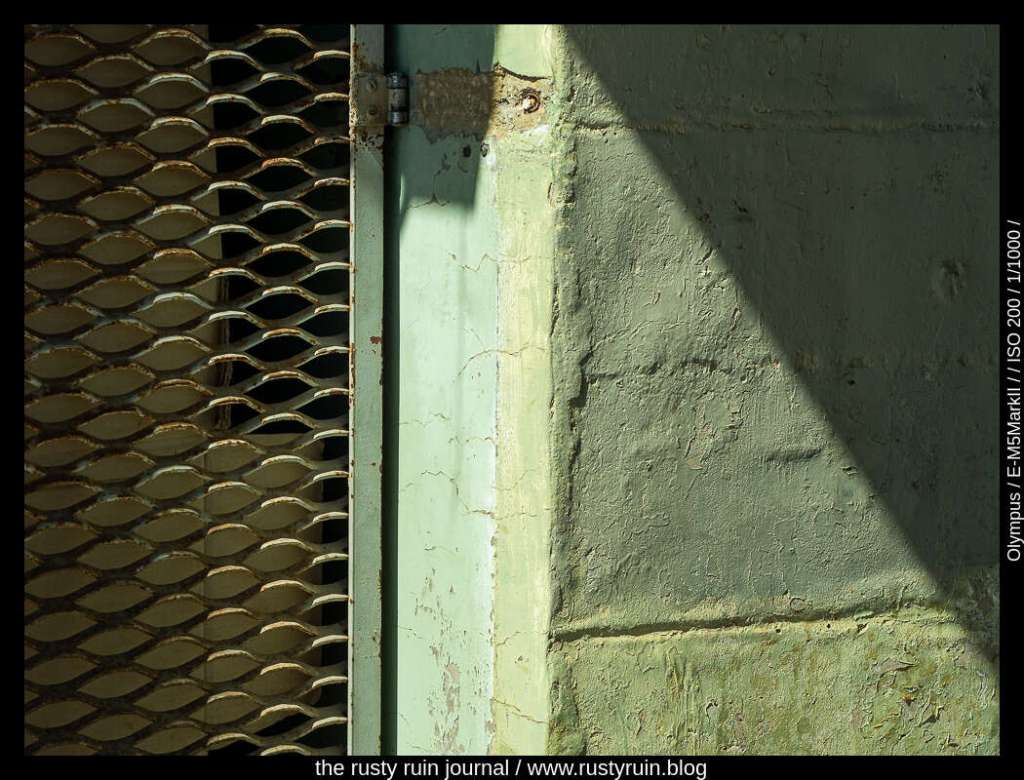
Rusty grille and green concrete – Olympus EM5 Mark 2
I use One Drive a lot for backups now. I usually save a DNG version to the cloud and save a web-ready version for this journal and for sharing (1000 px on the long side and 60% JPG quality, if you’re interested). You might also have noticed that my photos now have a neat black border with some EXIF information on the side and a URL for this place. It’s an unobtrustive way to watermark the photos, record some useful EXIF data, and make the photo pop a little more against the black border. It’s a slightly convoluted process to install and configure, but once set up, the Mogrify 2 plugin works well in Lightroom. I have a license somewhere, but it probaby went down with another bad hard drive incident.
In my last post, I discussed the idea of the Indieweband the state of the World Wide Web. If you have any interest, I urge you to read Olia Lialina’s fantastic essay on the transition from the idea of My to Me on the web. It’s lengthy but contains a wealth of information about how the web has changed and how the web user has changed. It coalesces many of the thoughts I’ve been having for some years now.
Lialina references a late 90s quote from Tim Berners-Lee – the man often called the inventor of the World Wide Web – where he talks about personal home pages:
“With all respect, the personal home page is not a private expression; it’s a public billboard that people work on to say what they’re interested in. That’s not as interesting to me as people using it in their private lives. It’s exhibitionism, if you like. Or self-expression. It’s openness, and it’s great in a way, it’s people letting the community into their homes. But it’s not really their home. They may call it a home page, but it’s more like the gnome in somebody’s front yard than the home itself.”
Lialina calls out the arrogance in this statement – the idea that regular people using the web, and enthusiastically learning HTML so they can create a personal home page, are amateurs creating nothing more than quaint gnomes in the garden. A clear divide is inserted between the web professional and the web amateur – between the skilled technologist and the average person on the street.
Dress me up any way you want – Olympus OMD EM5 Mark 2
The personal home page as rebellion
There have always been people looking to make lifelong careers and profits out of the web. The idea that the web would be a gigantic repository of information available to everyone equally is very much a 90s ideal. Alongside developments in technology, and in service to these professionals and technocrats, the web has changed from something a person logs into occasionally to check email and exercise an alter-ego, to an always-on connection where the idea that you’d even have a home page, rather than a simple Instagram bio, seems odd to many young web users.
When Tim Berners-Lee said that the web isn’t a home for the average web user, he may not have envisioned just how defining that statement would become. Today, giant corporations lay claim to sections of the web and tell us how we should interact with it. Too bad if you want to upload your own hand-made HTML to their platforms, because they won’t allow it. You can’t be trusted to engage in good design as defined by them. And you certainly can’t be allowed to disengage with their data collection because then you’d be worthless to them as a method of making money.
Corporations and technologists making their income from the monetisation of the web aren’t interested in anyone owning any part of it. They want you to stay in their curated walled gardens so they can sell your data, sell your profile, and make you believe you’re getting something useful in return when you spend time filling their platforms with content for free. Need to stay in touch with friends and family? Yeah, lucky thing we have a social media platform for that! Of course, we always had a thing called email where we could stay in touch, too.
Whilst the retro-web revival highlighted by places like Neocities is reminiscent of 90s home pages, and is populated by well-meaning people who want to return to a supposed web golden age, there’s still a pervasive attitude of reworking the ugly design of those original 90s websites so that modern design principles aren’t insulted. The 90s aesthetic is catalogued and examined by the current crop of professisonals. Thus, it becomes another social movement defined by what technologies one had access to, and is assigned space beneath the umbrella of Web 1.0 – itself just another label designed to make conversations about the past easier to grasp.
Of course, we’ve learned so much about web accessibility and our tools have improved to the point where we can now make easy-to-read websites that don’t feature dancing baby GIFs. There’s certainly admission in some quarters that web users in the 90s used the tools they had to make the best websites possible – an admission that the personal home page aesthetic was perhaps not completely a result of people with bad design tastes. But there are also people now who’d like to revive the 90s aesthetic with modern tools like the latest CSS and other scripting that didn’t exist back then, whilst adhering to accessibility and good design principles because, of course, we must do that since it’s bestdesign practice – best practice only in terms of appeal, standardisation, and monolithic design that has, of course, nothing to do with the admirable and simple personal goal of just having a digital home. Not adhering to good design principles would make a site anti-corporate, anti-design, and anti-social, according to arrogant web technologists.
The idea that we should adhere to standards and monolithic design principles seems based on the idea of appealing to the greatest number of people, attracting the most attention, making the most money, and going viral – all of which are core concepts of capitalism that certainly didn’t define personal home page design in the 90s. During the time of the slow web, you’d get excited if a single person emailed you once a month and said how awesome they thought your personal home page was and how you had things in common – and it was a genuinely exciting moment of connection because you weren’t bombarded with likes and followers and subscribers and junk emails every single day. One connection felt real and important because it was uncommon.
This place being something of a journal, I make no promises that the posts will always be about photos or photography. Truthfully, I’ve never been great at organising my interests into neat online siloes. I’m worse still at expanding them into areas where people might actually connect to them. Mostly, I just post into the digital void. I’m guessing that’s a common experience online.
Sometimes, I reflect on the way the web has changed over the years. I began my online journey sometime in the mid-80s when I connected to a local BBS called Nexus, hosted at a nearby library. It was exciting to hear the dial-tone and plop the phone onto the kludged-together modem that someone in the Amstrad Computer Club had made. The idea that you could send an electronic message and receive one in return seemed magical.
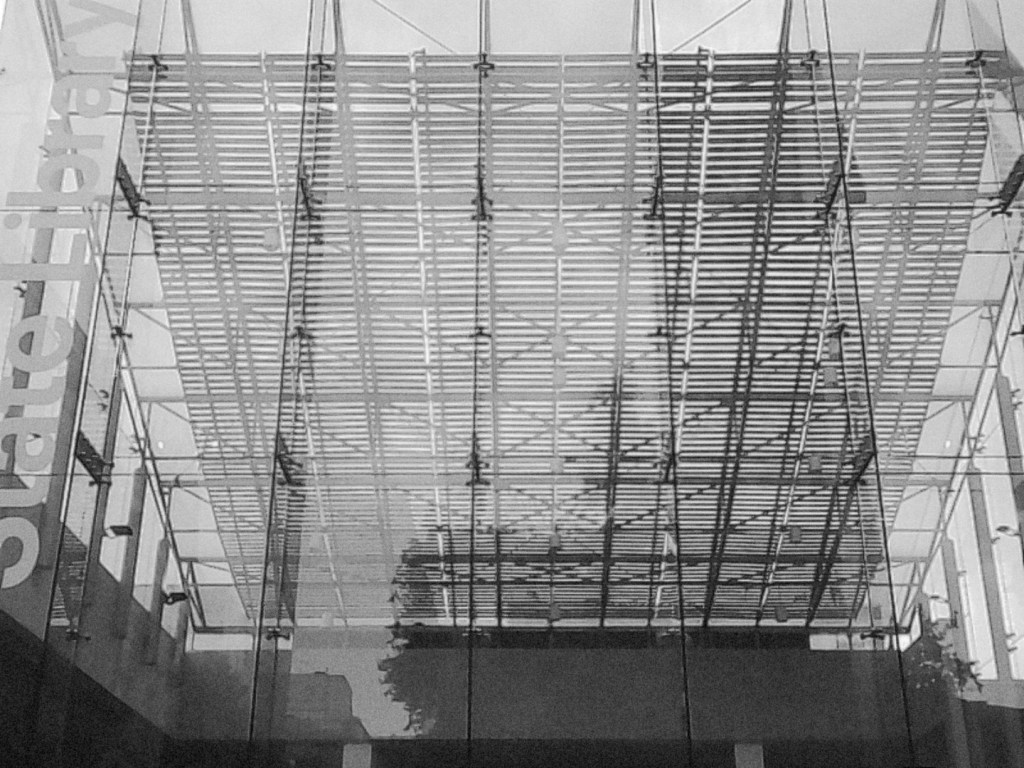
Struts and pipes and bars – Olympus OMD EM5 Mark 2
There was a sense of geekish community in those early days. I was never especially tech-savvy in the sense that I could write code or talk about Unix systems, but I was certainly an interested party. I count at least part of the 90s as fledgling internet days, as people colonised online forums, used IRC, and built the content of the web eagerly via personal home-pages and niche interest groups. Back then, it seemed as though anyone could build a web-site by learning just a little HTML. Nowadays, it’s an exclusive activity and you need a degree…
Where are we now?
Despite big parts of the Unix-driven early web still underlying the modern web of Google, Apple, Microsoft, and slick social media platforms, the web of today is mostly a mundane junk-show of companies selling personal data, in your face advertising, enshittification, AI-powered bullshit, and venture capitalists looking for the next big thing so they can swindle more people. I understand that some are looking to rebuild the personal home-page boom of the 90s, but that time is now gone. That culture was fleeting, and no amount of modern CSS fudging can remake the joyous time that so many people felt when they built their first home-page back then.
Get more shit done – Nikon D7100 with Nikkor 50mm 1.8
Honestly, I don’t feel like I quite fit into this new modern web. There’s too much shouting and too much corporatism. There are too many people trying desperately to market their shit to whomever will listen, without offering any genuine communication in return. And social media platforms and communities are only considered successful if they feature tens of millions of users talking endlessly about themselves. Here’s a tip: those billionaire platform owners are only interested in profit, influence, and selling your data.
What happened to those small online communities? What happened to the tiny online discussion forums where the same small bunch of socially awkward nerds gathered weekly? An online community is now only considered successful if the user-base blows out into the millions and I think that’s sad. It’s as though the capitalist idea of growth at any cost has infected us so deeply that our online communities must reflect it, otherwise they’re unprofitable failures.
The web of today is definitely not representative of the exciting web experience I remember. The early web was constructed from more noble intentions to connect people and spread information globally. Back then, people were happy to have special and weird online usernames. Going online in the 90s wasn’t like being offline but with Subscribers and Followers, it was like entering a different world where you could be anonymous and exercise your strange alter-ego and talk about shit you liked without expecting Likes and Follows. Self-centred billionaires have a lot more trouble selling your weird username to advertisers than your real name and personal data! Why else do you think Google waged the nymwars?
Finding the old tribe
Even though we can’t go back to earlier times, there are still people out there dedicated to the idea of the small web. Some of them, like omg.lol, offer simple hosting and other services. Places like tilde.club even open up the Unix-based structure of the web to offer personal home-pages. And if you want to deep-dive into resisting the corporate web and the march of AI into every aspect of our lives, you can find more info at Indieweb.
I’ve also started curating a list of links to small web and indieweb resources. You’ll find sweet little search engines, free static site hosting, minimal and little-known blog platforms, and more!




















 The Rusty Ruin Journal