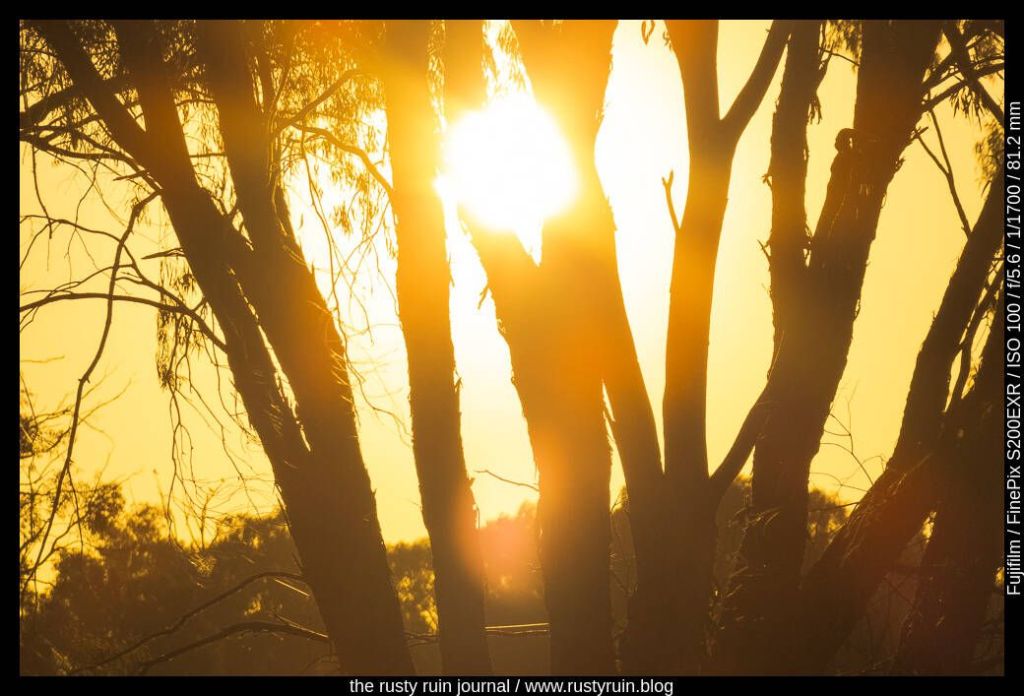
Driving around to find a good vantage point for the sunset, I spotted a group of trees arranged attractively. It was a quick photo, as we’d collectively decided to challenge the remaining minutes of sunlight by driving elsewhere for a different view.
Golden sun through trees
Thinking before pressing the shutter button and visualising the final photo: the shape and position of trees for my composition – the detail in the tree trunks and branches was not important – communicating feeling through light, colour, and shadow.
I underexposed to throw the foreground of trees into strong shadow. The detail and texture of bark didn’t matter so much as the shape and silhouette of each tree.
During editing, I decreased the Shadows and Darks further, increased White Point, and increased Saturation slightly to amplify the golden glow.
When I look at photos from over two decades ago, I see how my photographic knowledge has changed. Starting at the base of a mountain, one focusses on the first faltering few steps – they feel like everything and exclude all else. As one climbs further, the beautiful details of the landscape become a focus, and the feet simply move automatically, without thought. There’s always something to learn. One never reaches the ragged peak but remains intrigued by the mists shrouding it.
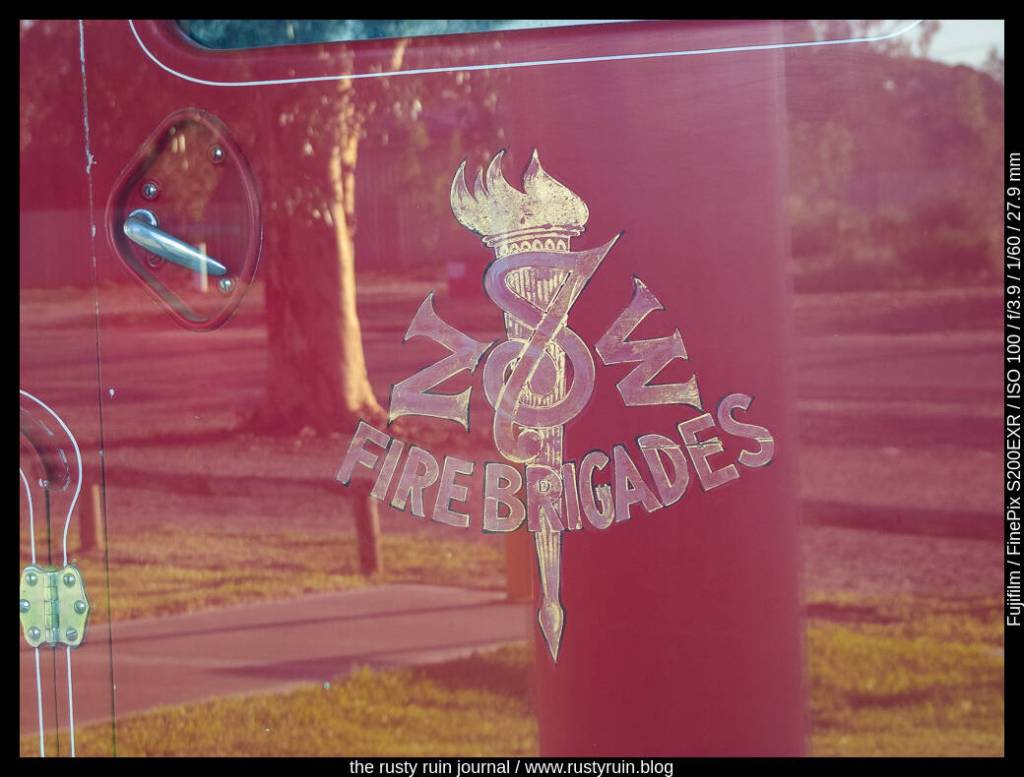
NSW Fire Brigade – Finepix S200 EXR
I like that the photo is reminiscent of a multiple exposure, The reflections of the glass add really interesting detail and texture to the red body of the old fire truck. When setting up for this photo, I was mindful of the placement of reflected background elements, and needed to position myself so the tree trunk didn’t cover either the door handle or the rather attractive insignia – two elements I really wanted to highlight.
Similarly, though it can’t be seen, there was an angled pole of misshapen proportions in the background I found distracting as I composed in the viewfinder. I stepped to the side to hide it behind the larger pole that runs through the NSW Fire Brigade symbol. These seemingly small decisions determine the final image and whether it remains a keeper or a delete.
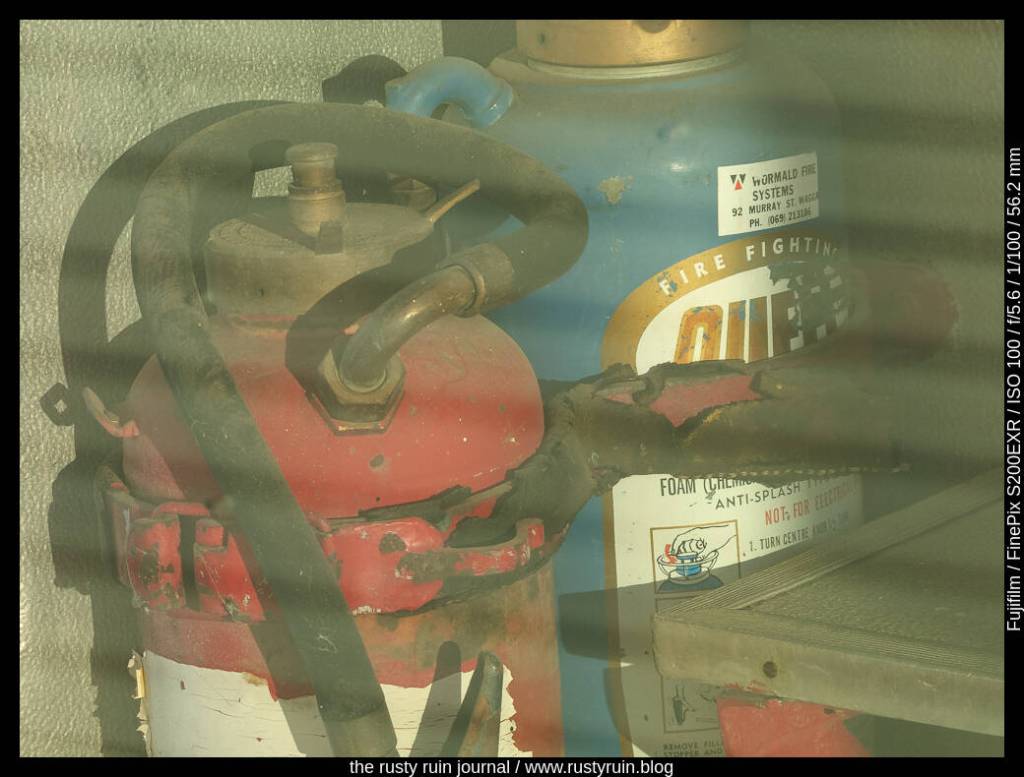
Fire fighting equipment behind glass
What I really enjoy about this photo is the quality of the light – the softness of it and the way it enhances the mistiness of the glass. It would be all too easy to add extra contrast to give it punch. It would also be easy to darken the equipment during editing to decrease the soft filter effect of the thick glass. But I think it works well without this additional contrast punch.
Even before making a photo, I strive to visualise what I want the photo to look like after editing, if possible. Multiple small decisions are made even before the shutter button is pushed – it may begin when I am drawn emotionally and imaginatively to a scene, but the process continues through technical cosiderations of aperture and so on, and then into my photo editor of choice.
Just down the highway from Darlington Point is Altina Wildlife Park. I admit that zoos and wildlife sanctuaries, private or public, present something of a dilemma for me. I am wholly in favour of conservation efforts when it comes to endangered animal species – though many such travesties are due to human activities. I understand there might be scientific and educational aspects too. Yet, I also can’t shake the feeling that there’s a commodification of animals happening.
Not only do zoos cage exotic animal species that are endangered in the wild, they also often display other species that face no threat of extinction at all. Is there a reason a common Cockatoo or Dingo might be caged other than to simply complete a menagerie for an audience? It might be argued that increased ticket sales support further efforts in conservation, of course. True, perhaps. I’m no expert in these things, other than to relate some vague feelings and thoughts that gnaw at the edges of mind.
Still, a tour of the large back pastures of the park did draw my attention to numerous amimals I’d not seen before – most notably the African Painted Dog and the long-legged Maned Wolf (a curious canid omnivore with a sensitive stomach and a delicate diet that walks in the same manner as a Giraffe – both right legs, then both left legs, and so on).
Despite the promise of the above words, I have no pictures of these exotic creatures, partly because I don’t like steel cage wire in my photos and also because I’d not packed the fastest camera in the world to acquire focus and record unpredictable animal movements. Yes, I could have switched the camera to a high-speed recording mode, but the heat of the day clearly melted my problem solving skills.
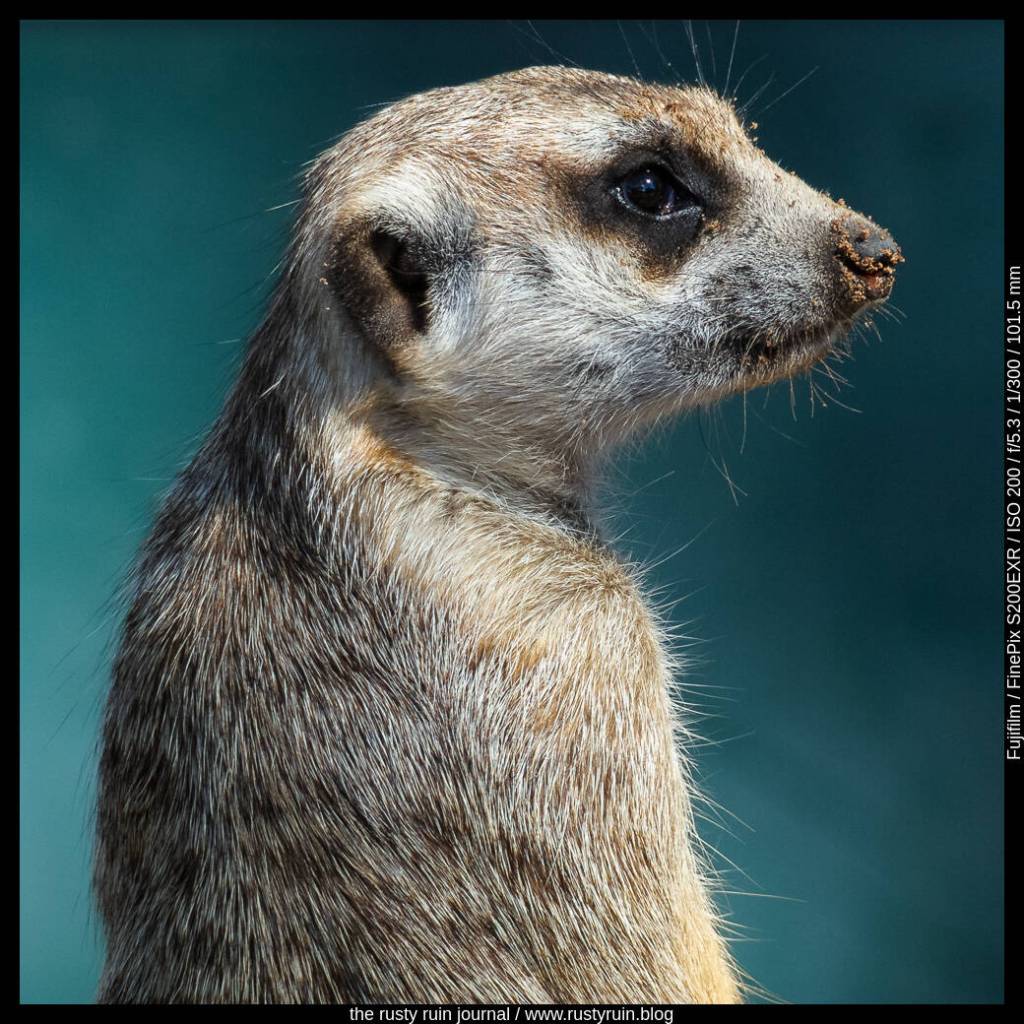
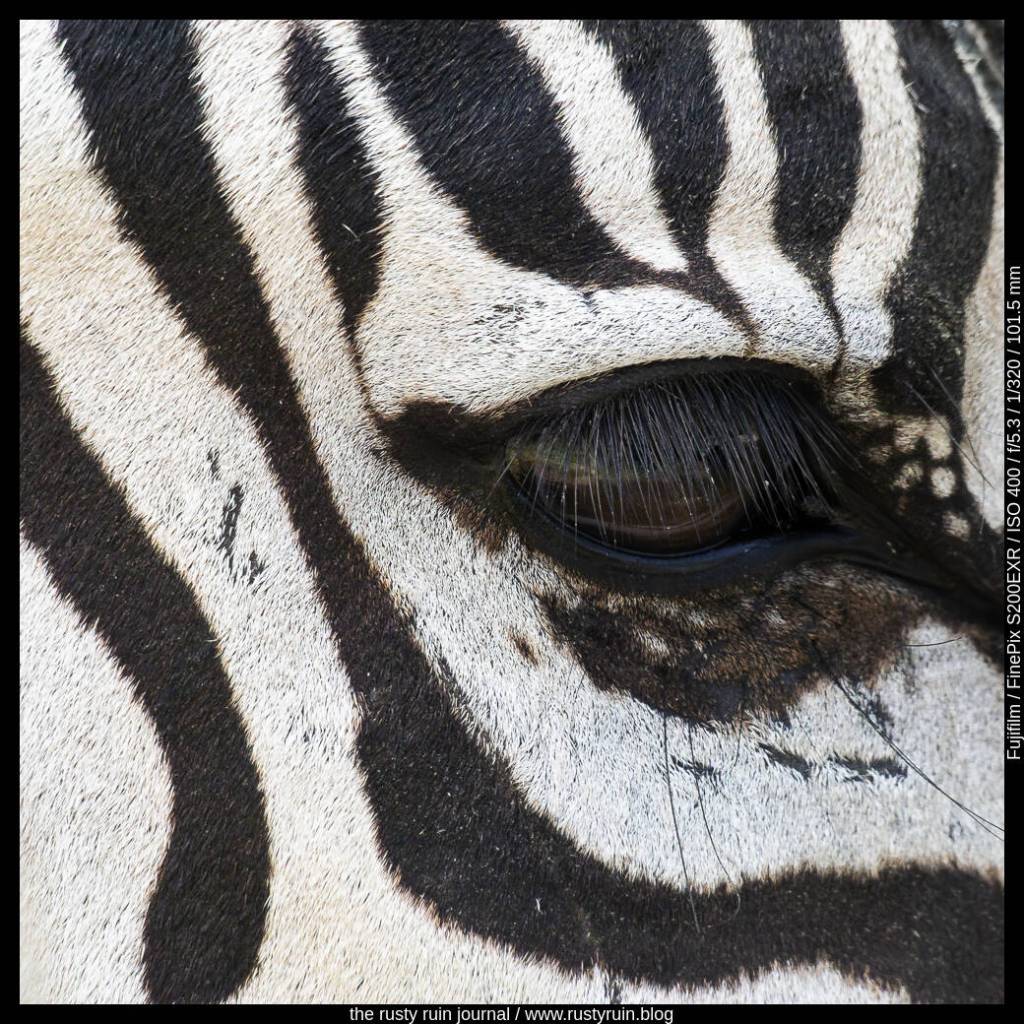
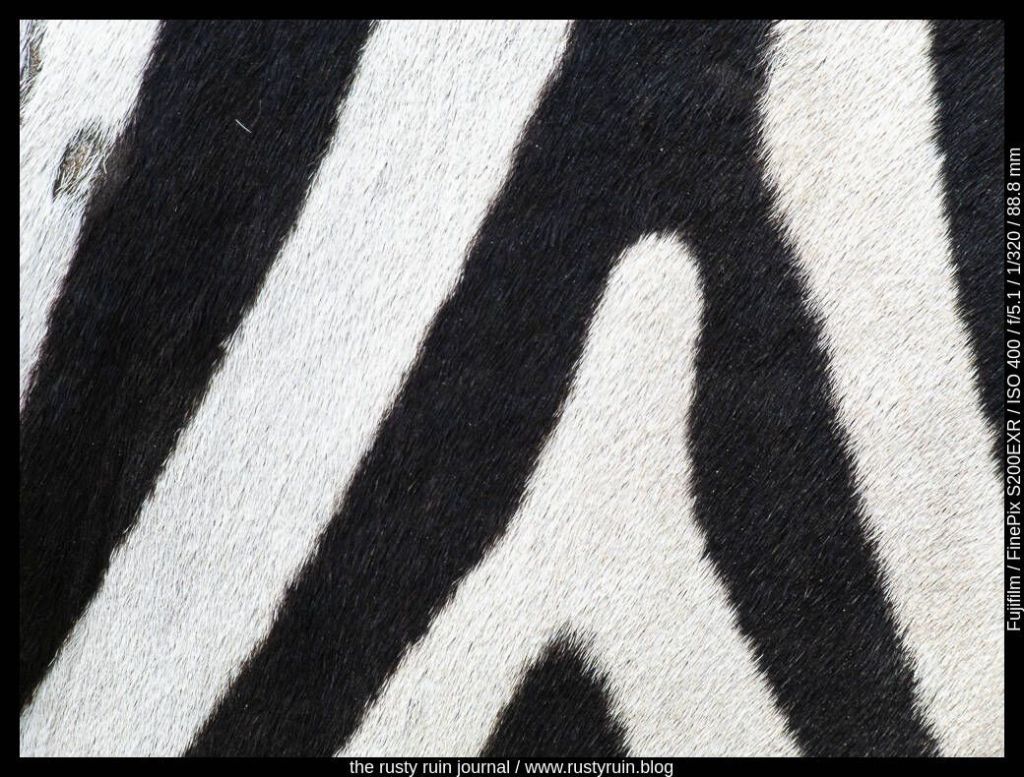
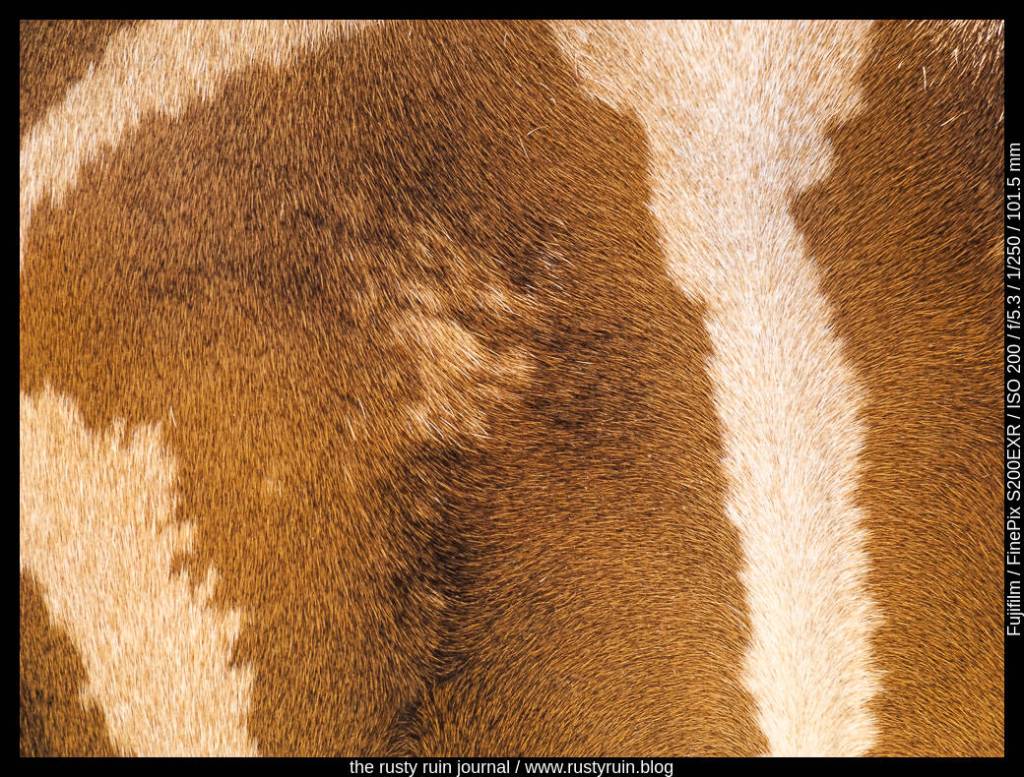
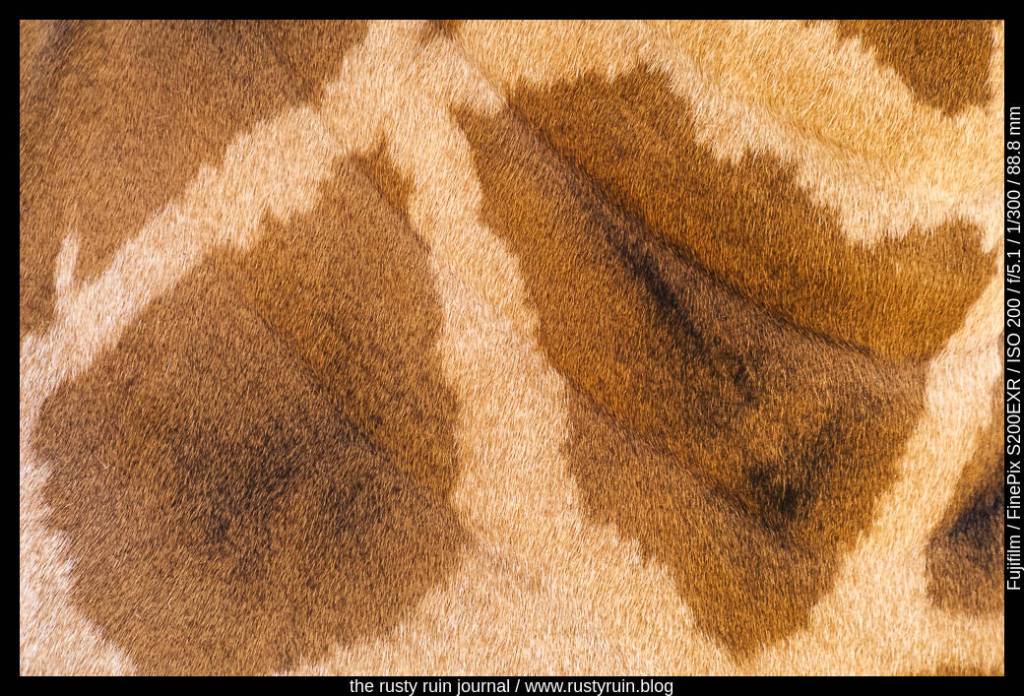
Instead, I give you a handsome Meerkat, and some closeups of a Zebra and a Giraffe – not overly exciting, I know:
Meerkat alertZebra’s EyeZebra fur
Apparently, Zebras are considered one of the most dangerous animals by zookeepers. People tend to get fooled into a false sense of security, thinking they’re just friendly horses with stripes. They are, by all accounts, very skittish and don’t mind kicking anything that freaks them out to death, zookeepers included.
Giraffe fur #1Giraffe fur #2
Giraffes, on the other hand, are quite gentle. We were taken to see both the Zebras and Giraffes and could hand feed them apple and carrot slices – the flighty Zebras only through the wire, of course. This was all part of a purchased package that permitted us exclusive up-close access to some of the animals. It was actually great to see them this way.
How often do we think that no photograph can ever record the majesty of a sunset? Rather than record an accurate scene, the best we can do is render an approximation that allows us to, perhaps, amplify certain attractive qualities during the editing process.
During this endeavour, liberal use of the tone curve – Highlights, Lights, Darks, and Shadows – may provide the tonal characteristics that produce a pleasant enough photo that one might imagine themselves, just for a moment, watching the sun in real-time as it illuminates the sky.
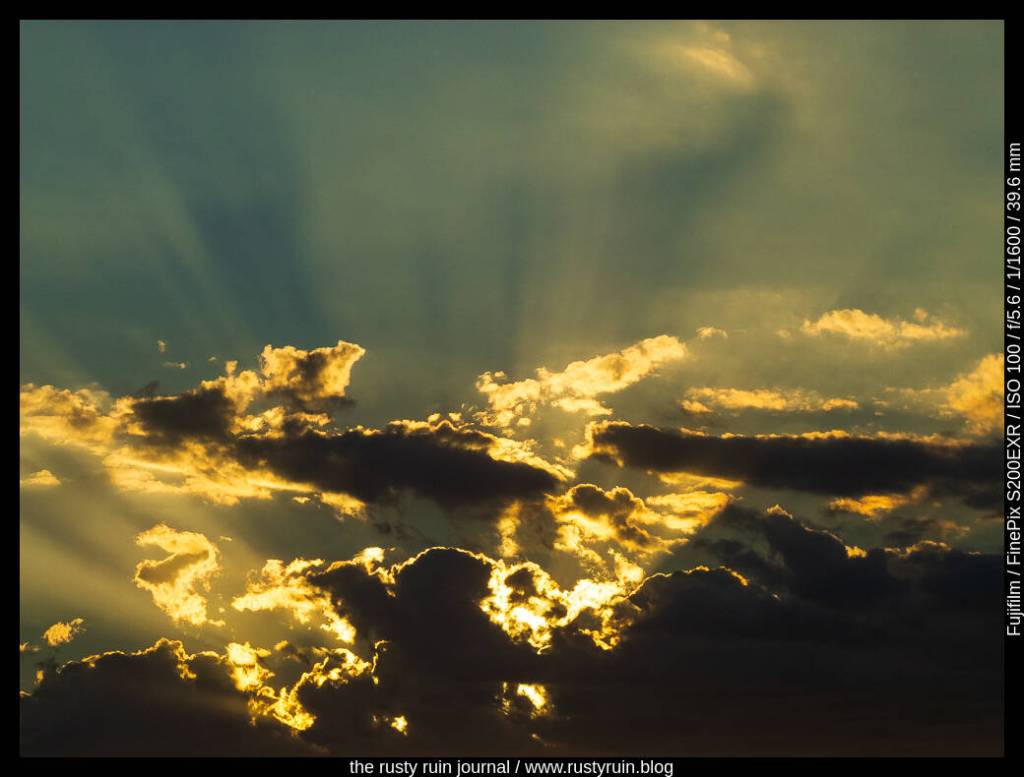
Sunset #1 – Finepix S200 EXR
As charcoal clouds largely obscured the sun, underexposing this photo at the moment of recording deepened the colours, revealed the delicate sun rays, and rendered a sky full of contrast and dynamic light. Though possible to adjust exposure settings during editing, having a final vision for the image in my mind – moody and dark – necessitated a faster shutter speed and, therefore, slight underexposure.
Visualising the final look of a photo and adjusting exposure accordingly is like scribbling in a notebook of ideas that informs the editing process many months later – oh, the clouds are moody and dark, I’ll go with that look! In this way, ideas for editing begin before pressing the shutter button.
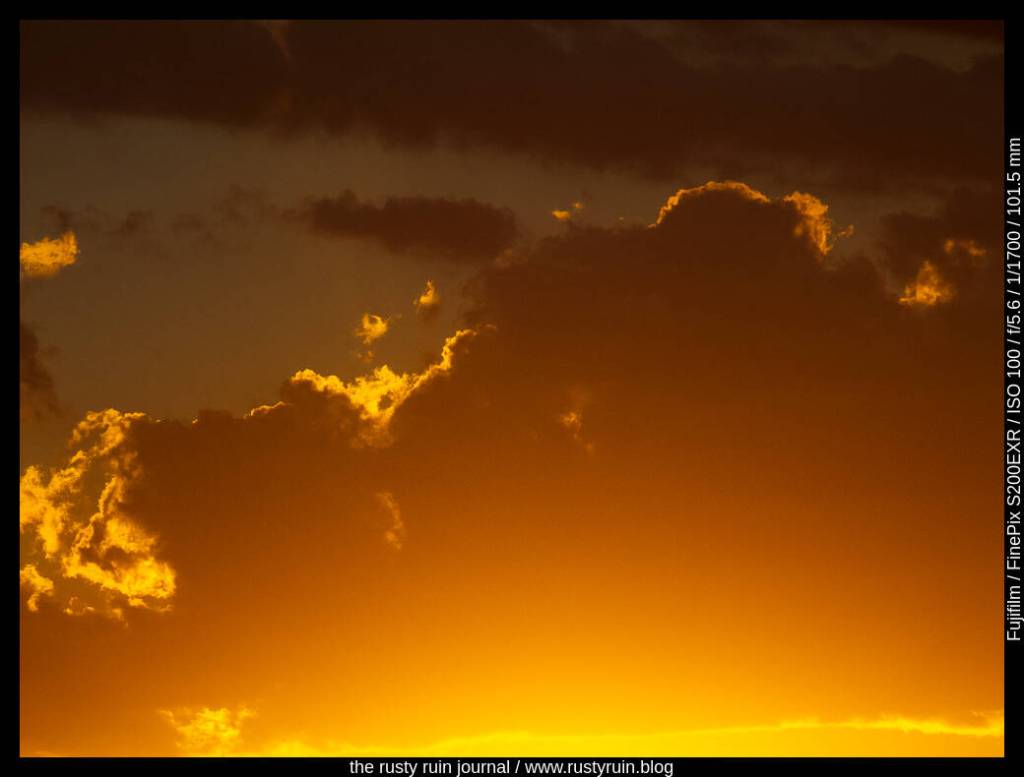
Sunset #2
Retaining the moody clouds through a careful decrease in Darks and Shadows, and increasing White Point and Light to amplify the sun’s aura produces an approximation of the golden illumination I witnessed at the time.
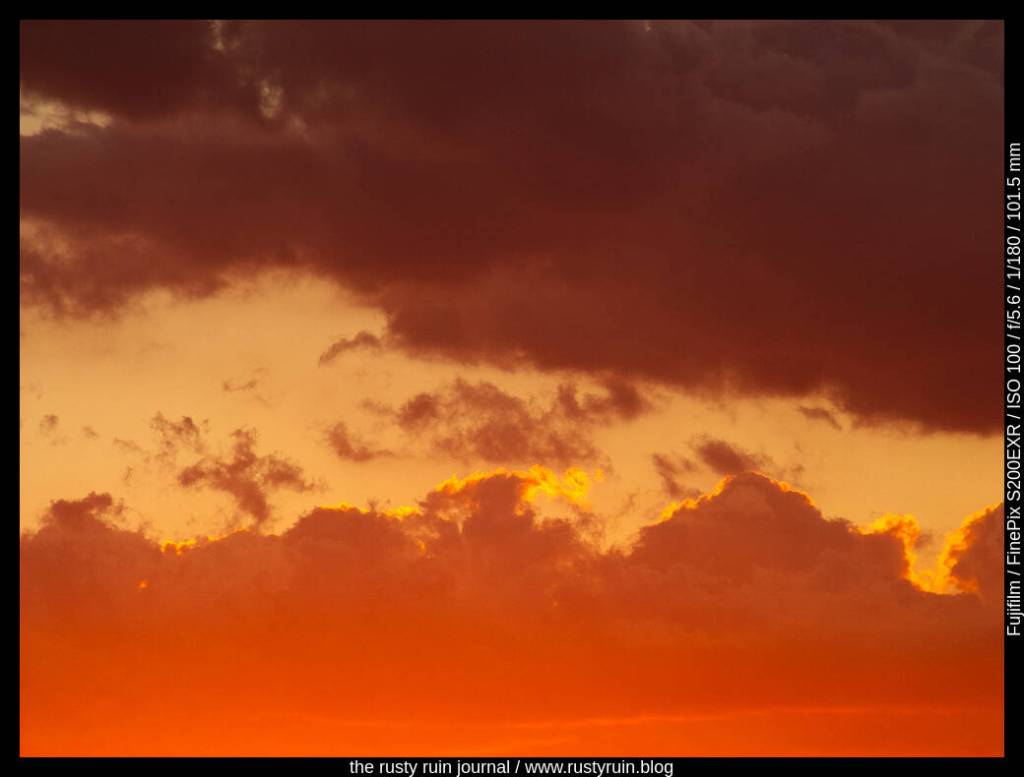
Sunset #3
Here, I wanted to focus on the orange yellow, and pinkish hues that defined this section of sky. Less contrast produces a more harmonious rendering – my feeling at the time of recording.
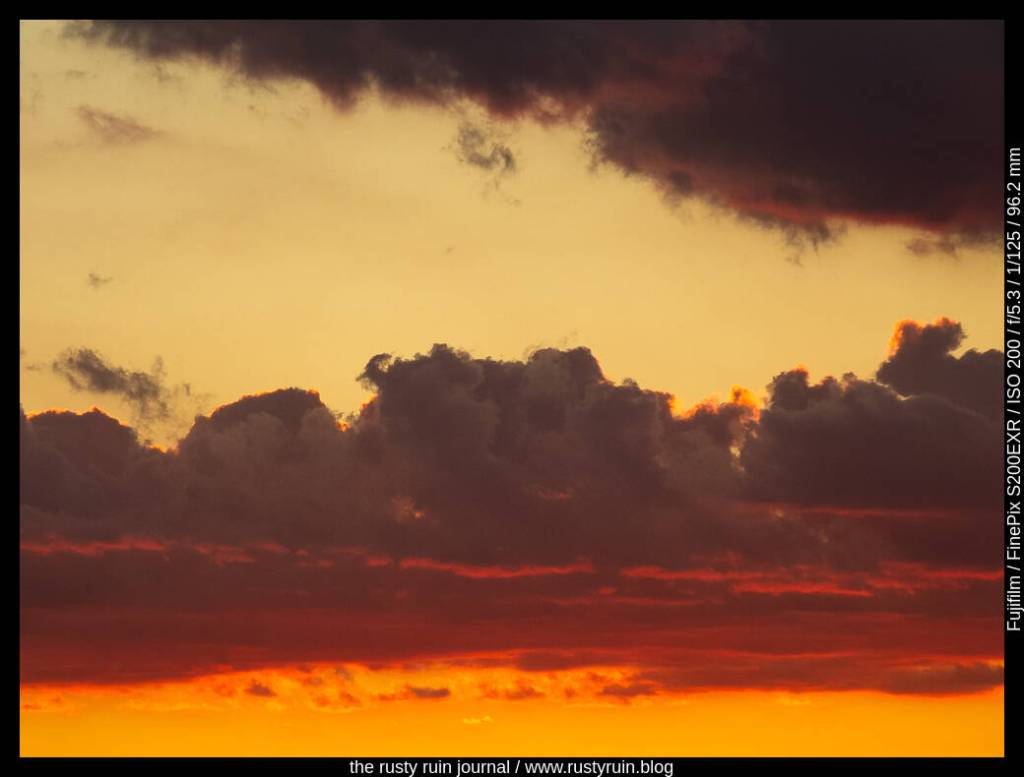
Sunset #4
As the sun moved below the horizon, the clouds absorbed night’s early shadow and languid bands of amber, magenta, and vermillion brushed the edges.
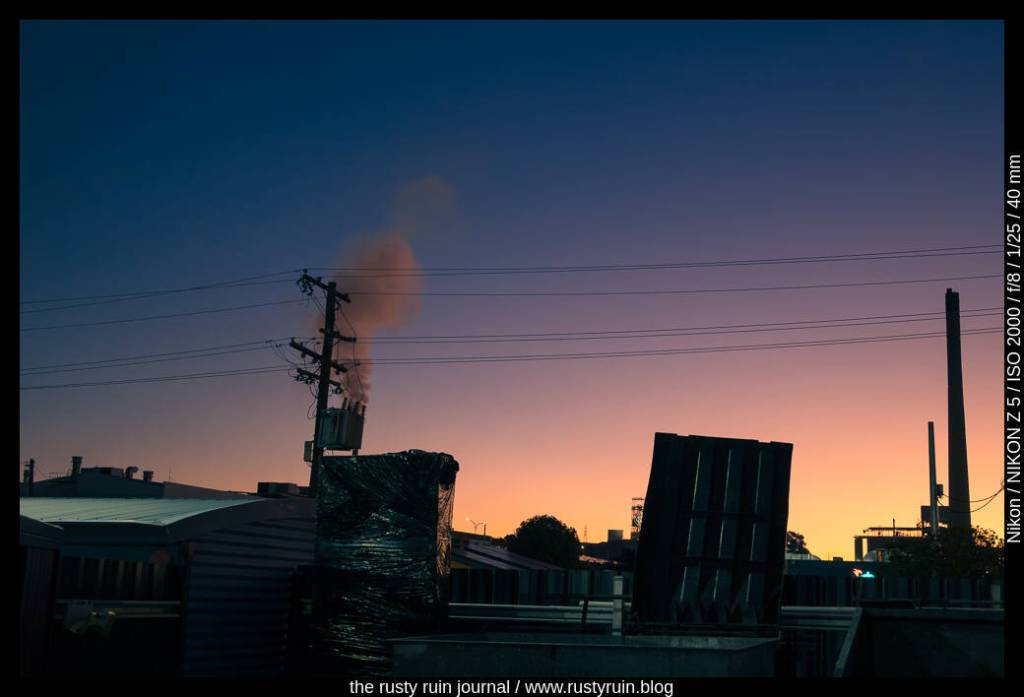
Slow smoke pours from towering stacks into the still air, day and night. Minerals are pulled from the ancient desert ground and form the heart of industry in Mount Isa. I think everyone smokes, drinks, and wears a vest in this place. It must be a tough life out here.
Everything seems caked in sweat and dust. The soil is red and orange, and lazy heat hangs in the air. Abandoned mines are something of a tourist attraction here. Of course, I’m attracted to those ruined places.
Mt Isa sunset – Nikon Z5
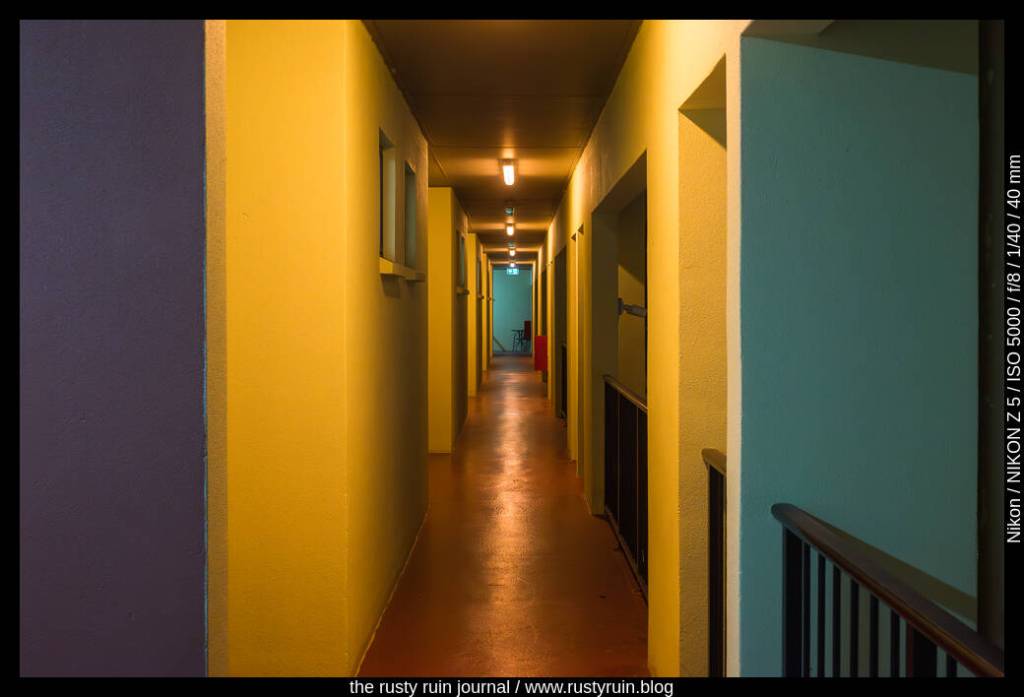
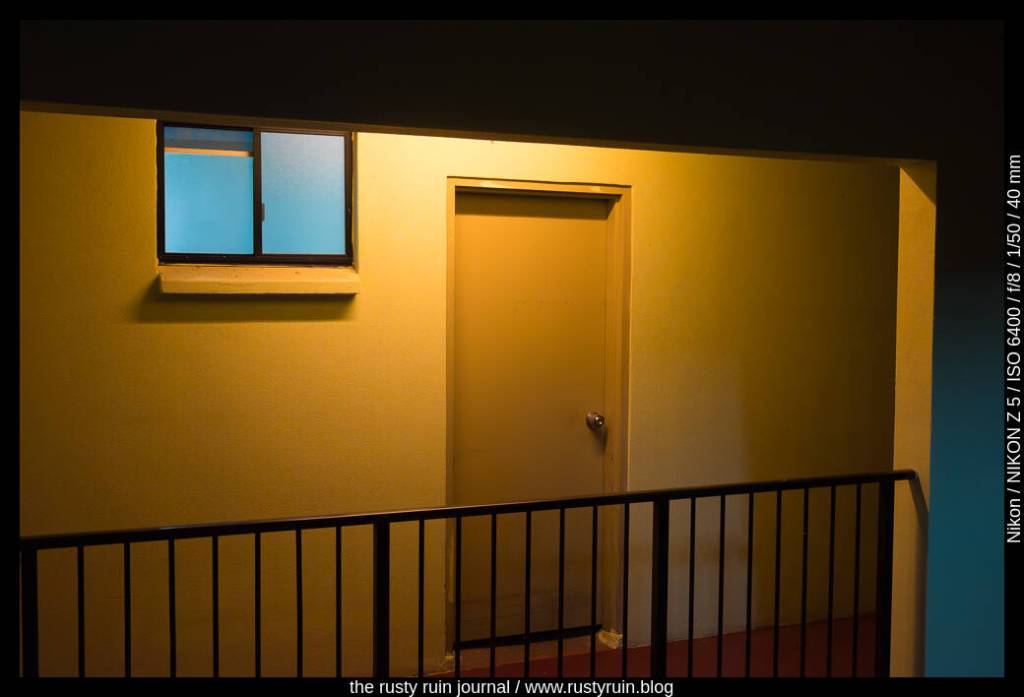
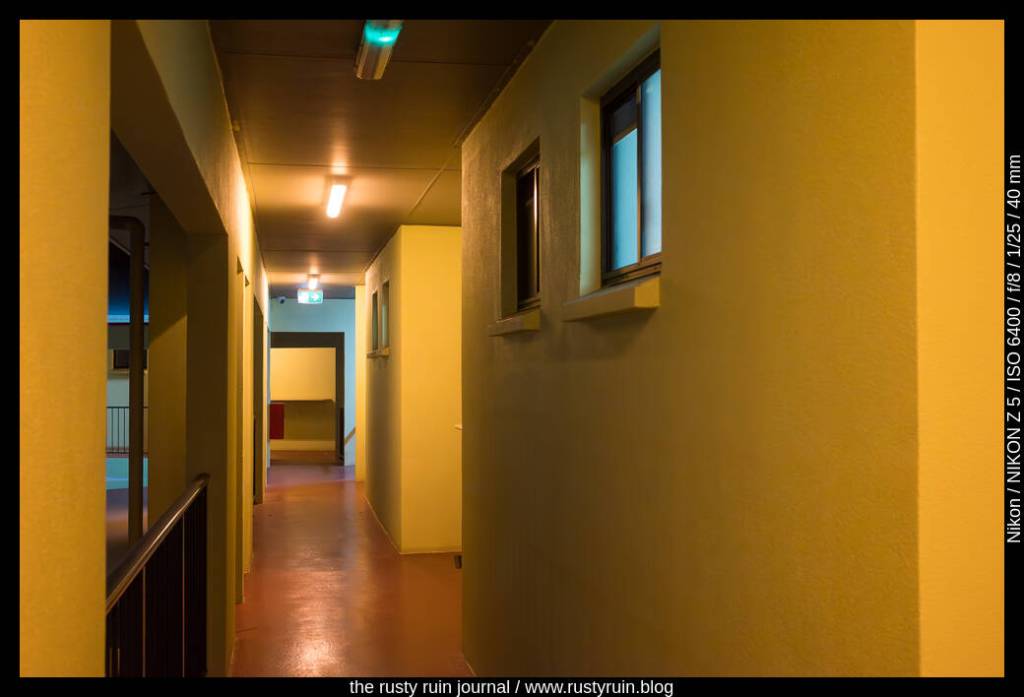
I take the opportunity to walk around the motel late at night. Likely, most people are sleeping or watching TV drowsily. What strikes me are the warm colours and the long walkways. I imagine the owners wouldn’t be too interested in using the photos for marketing purposes!
A friend of mine tells me he likes the orange and yellow lights. They make him feel comfortable. I agree – they’re nicer than the new clean white lights. They’re atmospheric. They go well with the heavy air and the smokestacks.
The chair at the end of the walkway – Nikon Z5 and Nikkor 40mm lensYellow door and yellow wallBlue glow from the window
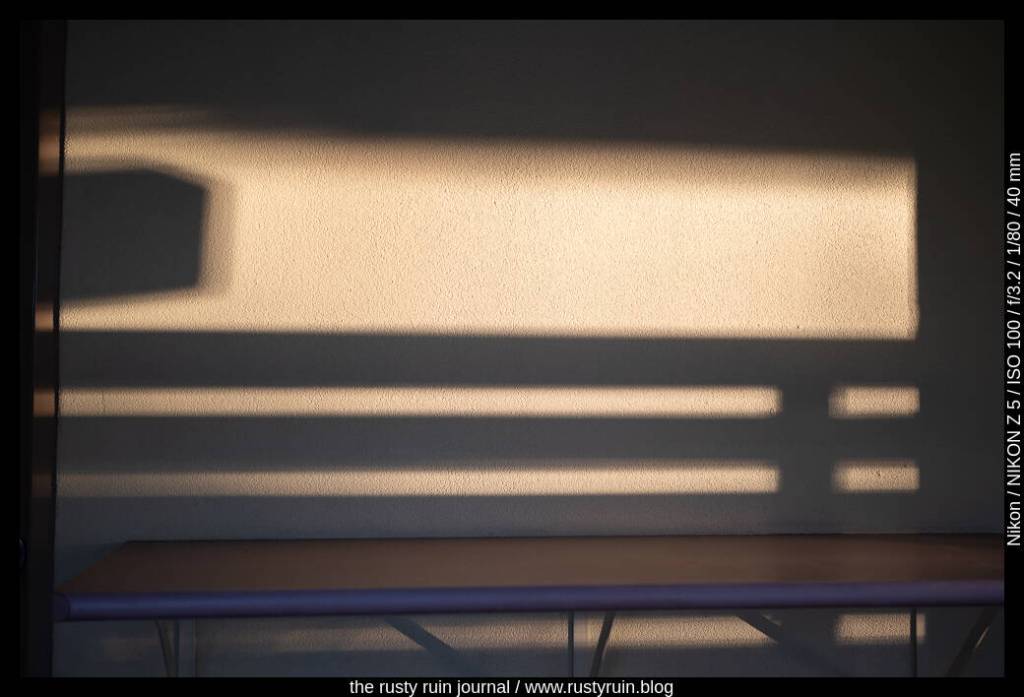
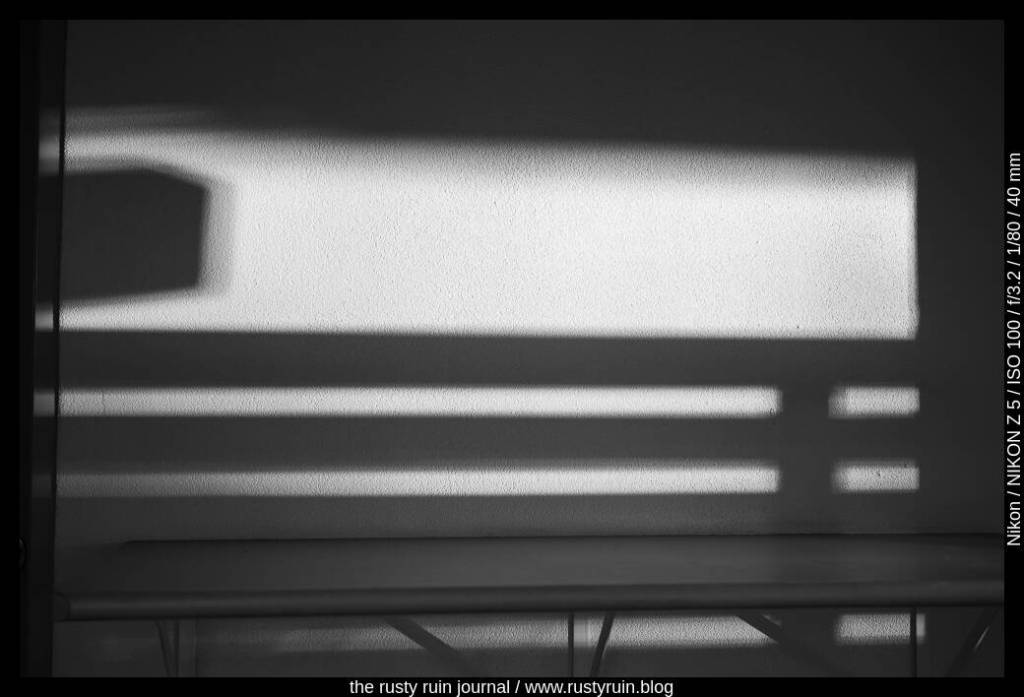
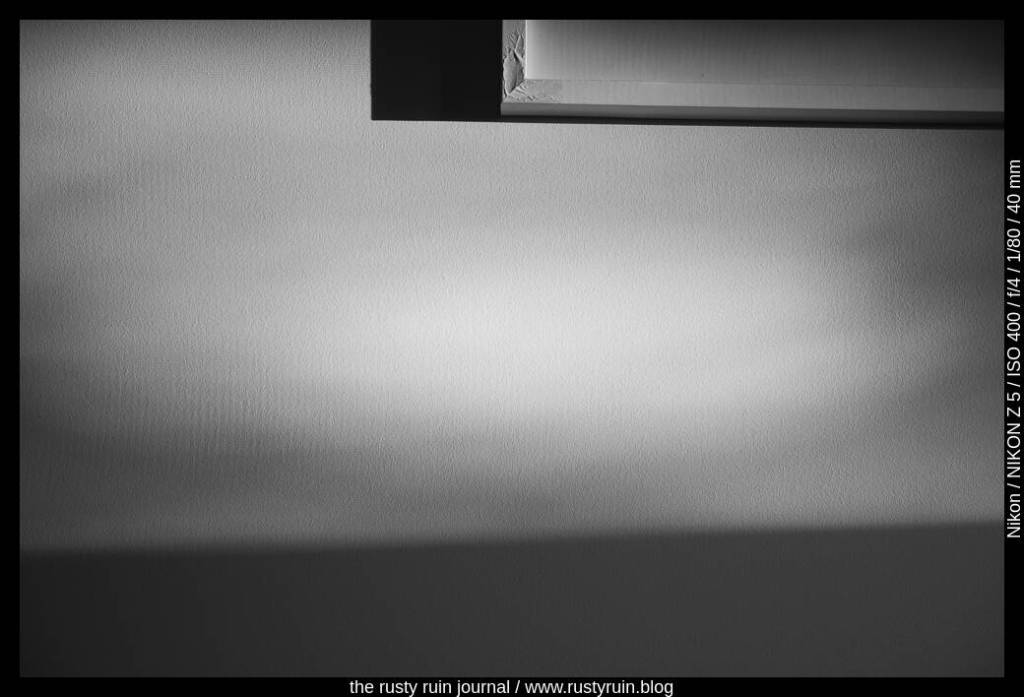
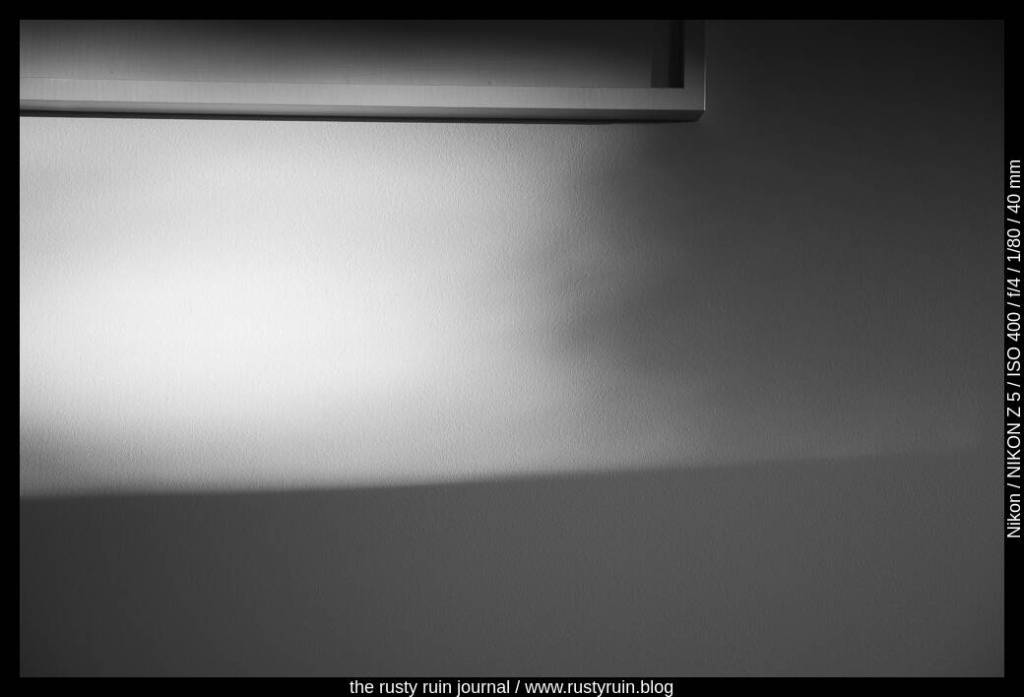
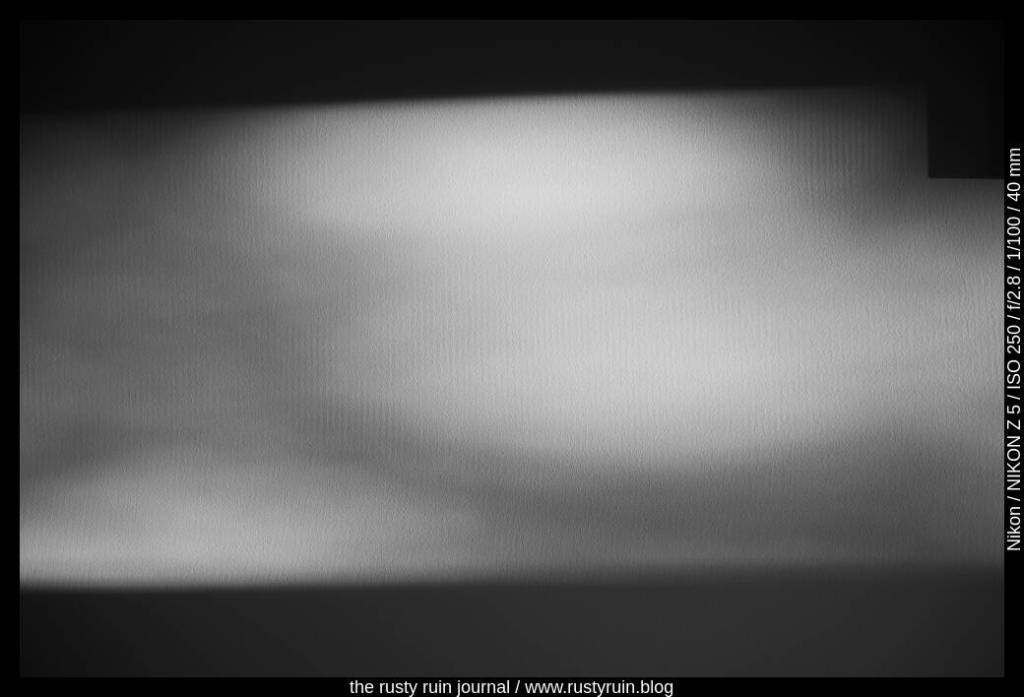
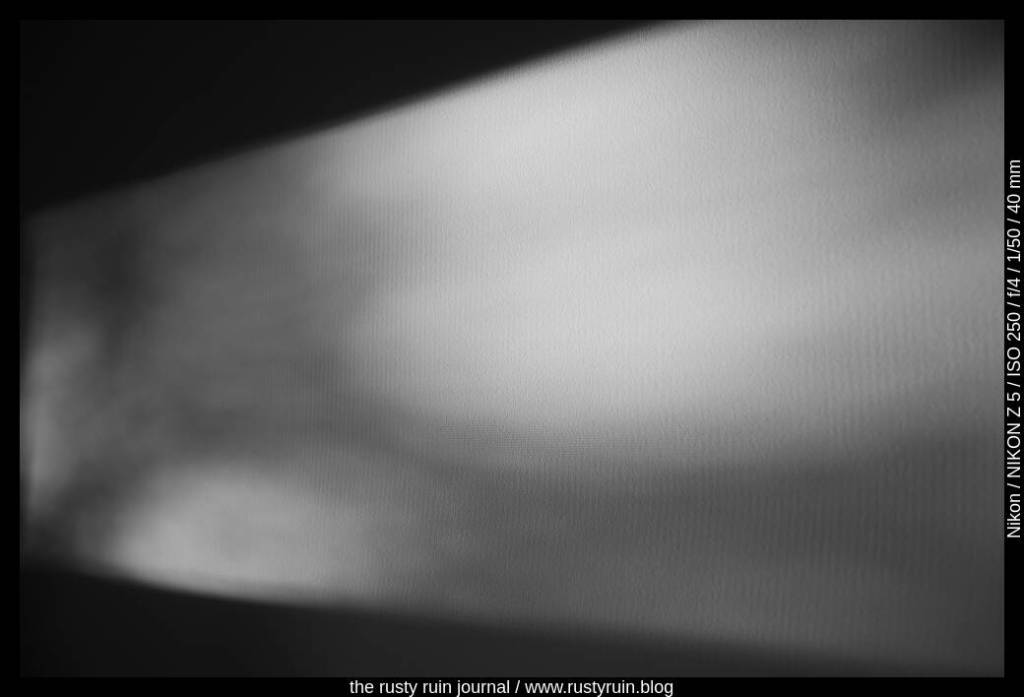
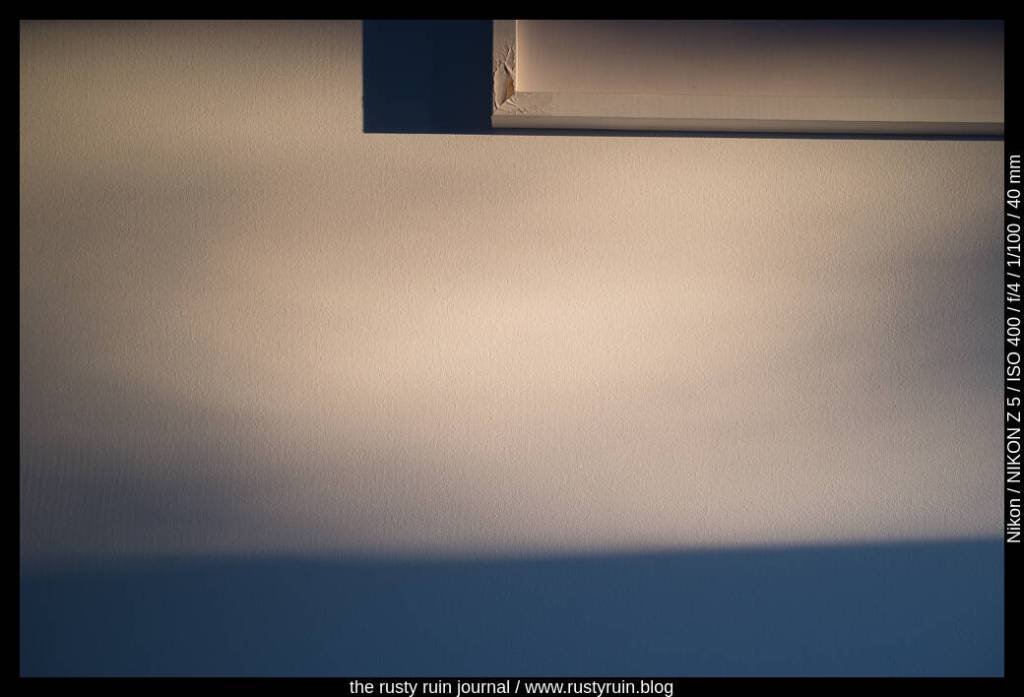
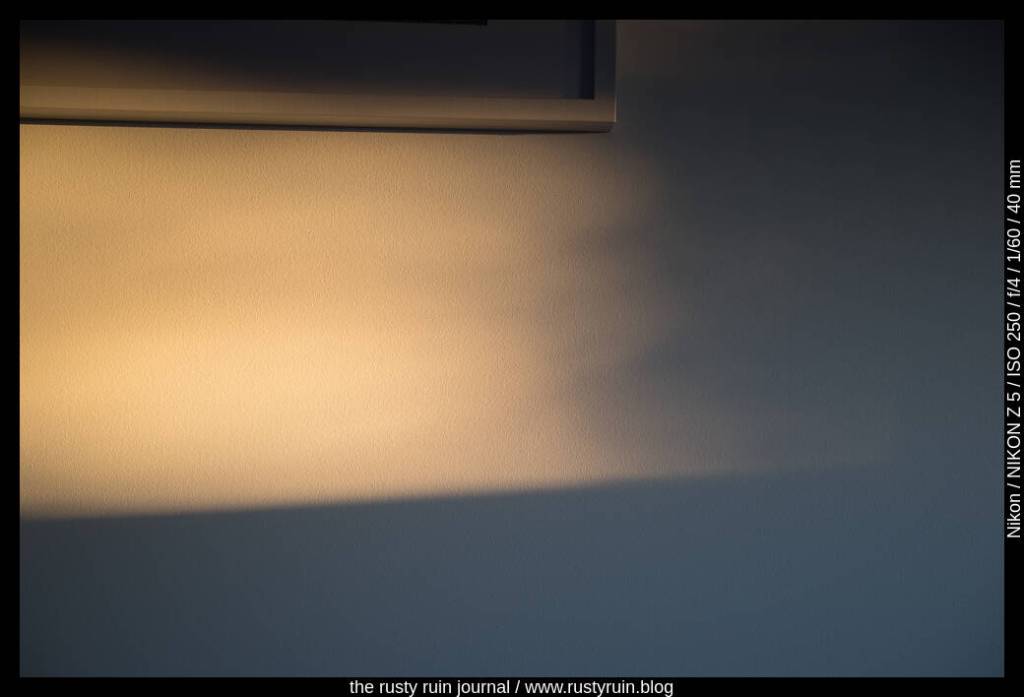
After my last post, it seems I’m in the mood for monochrome. The interplay of light and shadow – the patterns on the rough wall – the cold metal bench. This collection of quiet and ordinary things caught my eye, emotion, and imagination:
Metal bench and shadows #1 – Nikon Z5 and Nikkor Z 40mmMetal bench and shadows #2
A set of photos in colour. Now in black and white. I almost always use colour in my photos, but there’s also something intriguing about the removal of colour. Black and white reduces the picture to the most minimal of tonal qualities – light and shadow – the eye drawn to delicate gradations. I sometimes think that black and white photography can be overly contrived, entangled as it is with classic street photography and delusions of stepping into the shoes of Henri Cartier-Bresson and others.
I admit that I probably don’t explore black and white in an editing context as much as I should. Or at least, as much as would contribute to a photograph that pleases me.
The sharp corner intruding rather rudely – Nikon Z5 and Nikkor Z 40mm The angles yet apparentReceding now to darker edgesFrom the outside: a whirl of bordered shadows
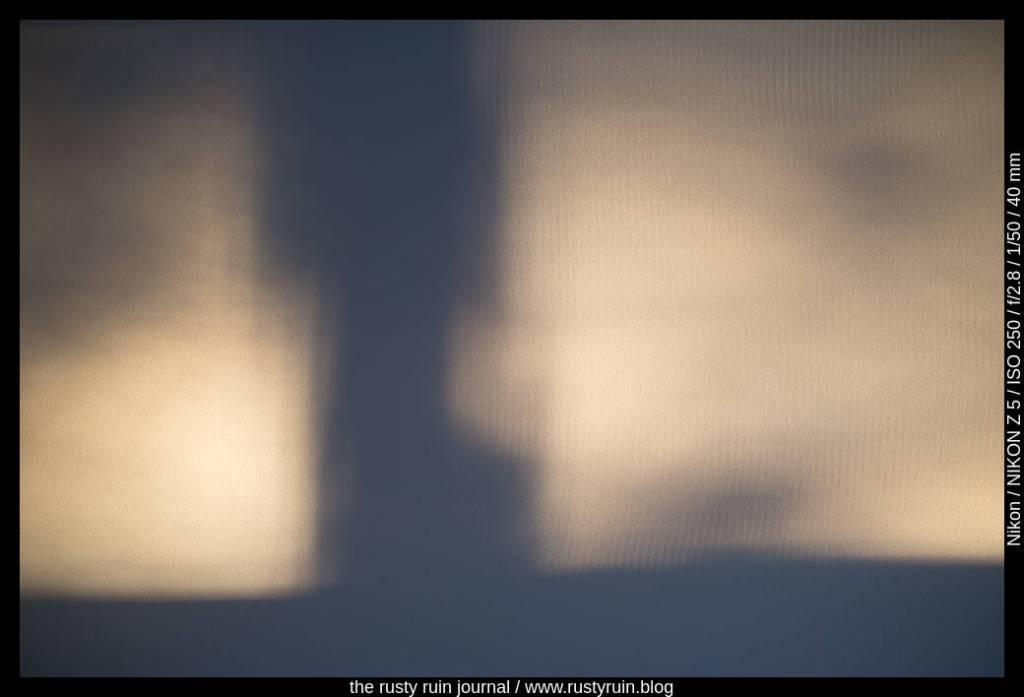
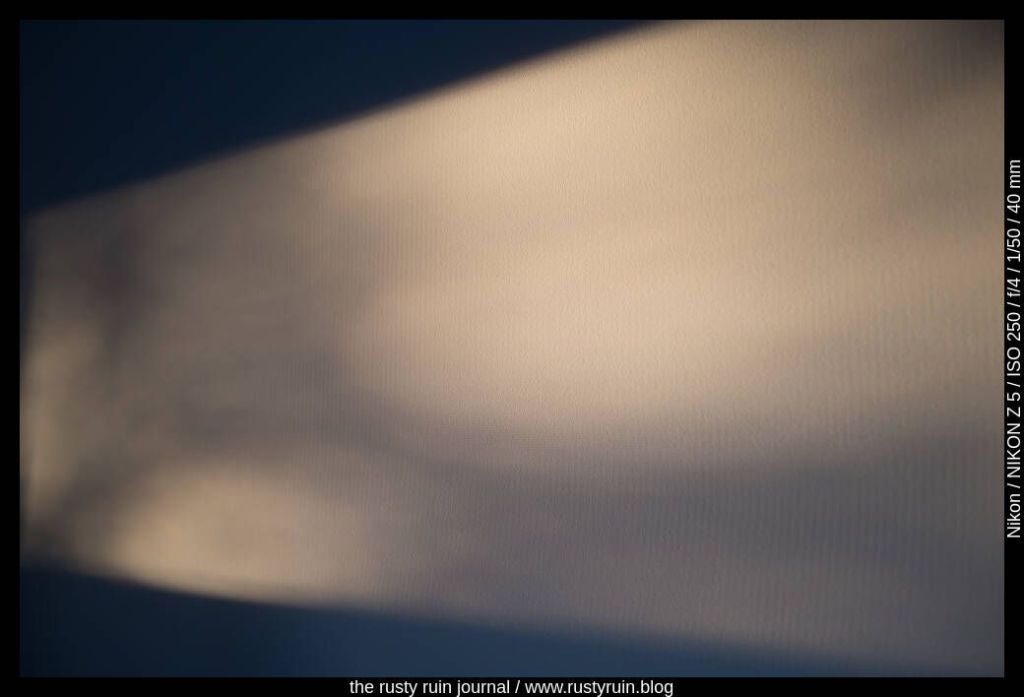
There’s nothing better than slow moving light that turns everything gold and warm, especially in small coastal towns where the rough sea meets rocky beaches. The regular opacarophile might love every sunset, but I fear that not every sunset is so easily framed as to be visually interesting. Maybe I’ve just seen too many sunsets? Maybe too much time spent looking through the viewfinder pondering settings turns the mind to a need to make every photo a winner? I suspect the latter is closer to the truth and is another story worth exploring.
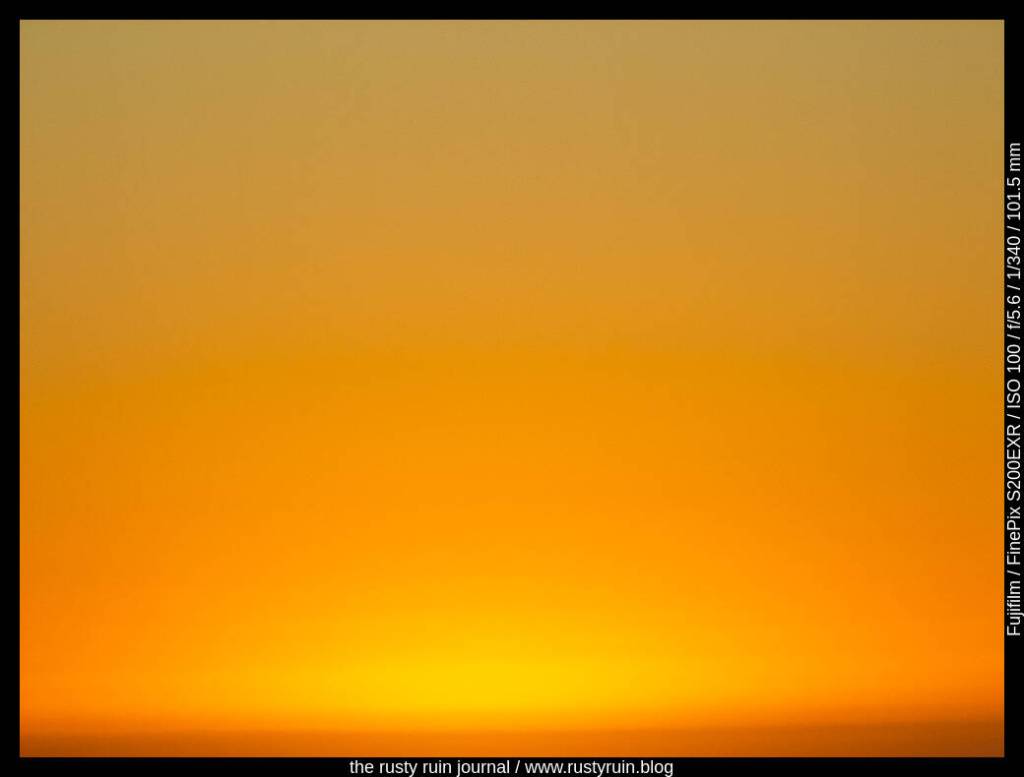
Sunset glow below – Fujifilm Finepix S200 EXR
Another sunset and another horizon. How to make this one something different? How to avoid the same bright sun and carefully placed horizon line composition?
I filled the frame with the orange glow of the sun just as that bright sphere dipped out of sight. The Finepix S200 EXR is an old camera and is quite soft at the long end, but who needs sharpness for the photo above? It’s all about the colour field and the deep orange glow. Underexposing by two-thirds of a stop deepened the colours. Everything is smeared to a sunset abstraction to fill the frame.
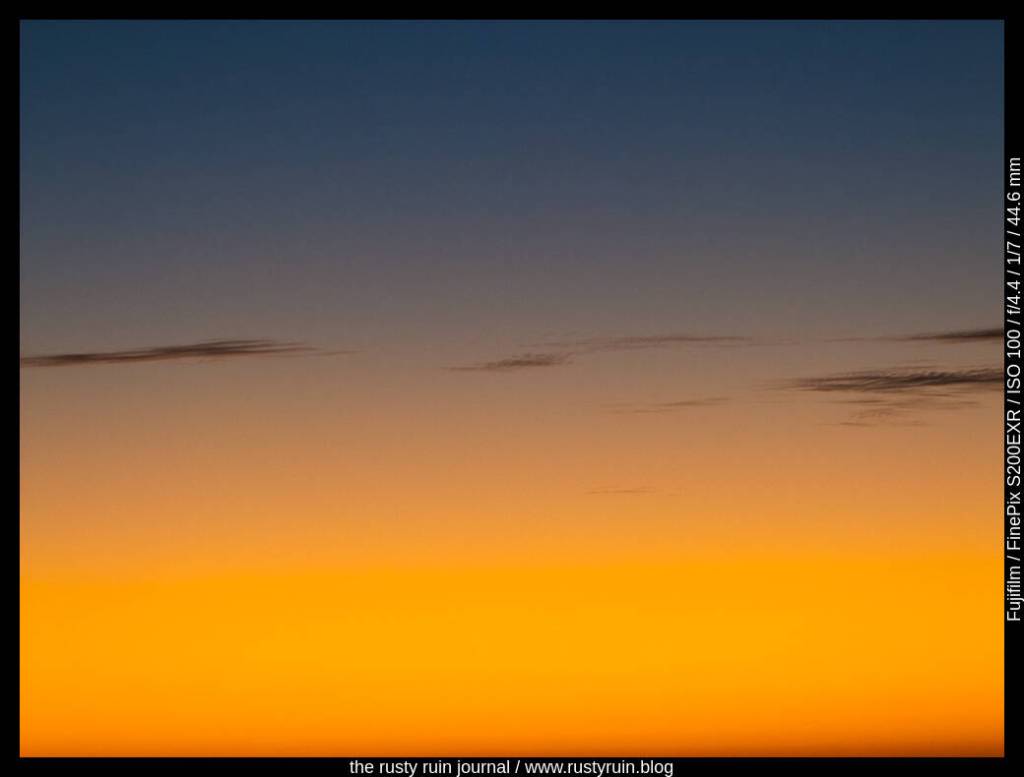
Minutes later, I caught a line of rough dark clouds marking the transition from golden hour to blue hour:
Suspended between orange and blue – Finepix S200EXR
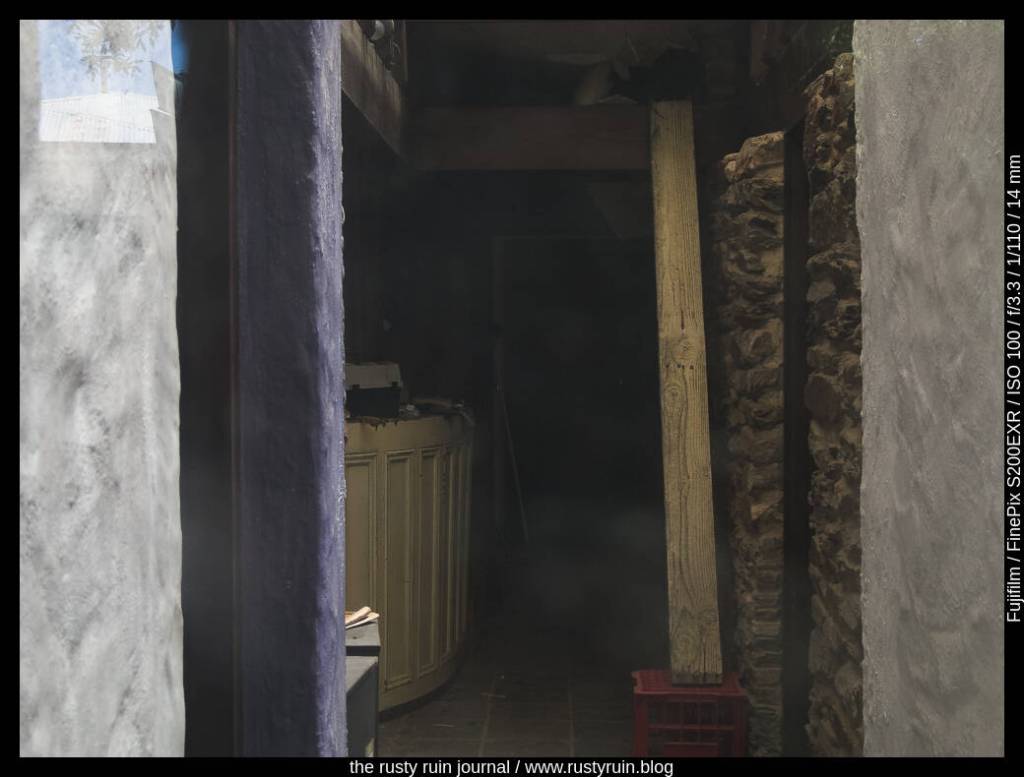
Sometimes, even on the sunniest day in a busy tourist town, you find an abandoned corner filled with dust and old newspapers yellowing at the edges. Once a licensed restaurant, the empty windows were of immediate interest and led to a hastening of my pace. I switched on the old Finepix camera and thought about initial settings and composition.
The old restaurant #1 ~ Fujifilm Finepix S200EXR
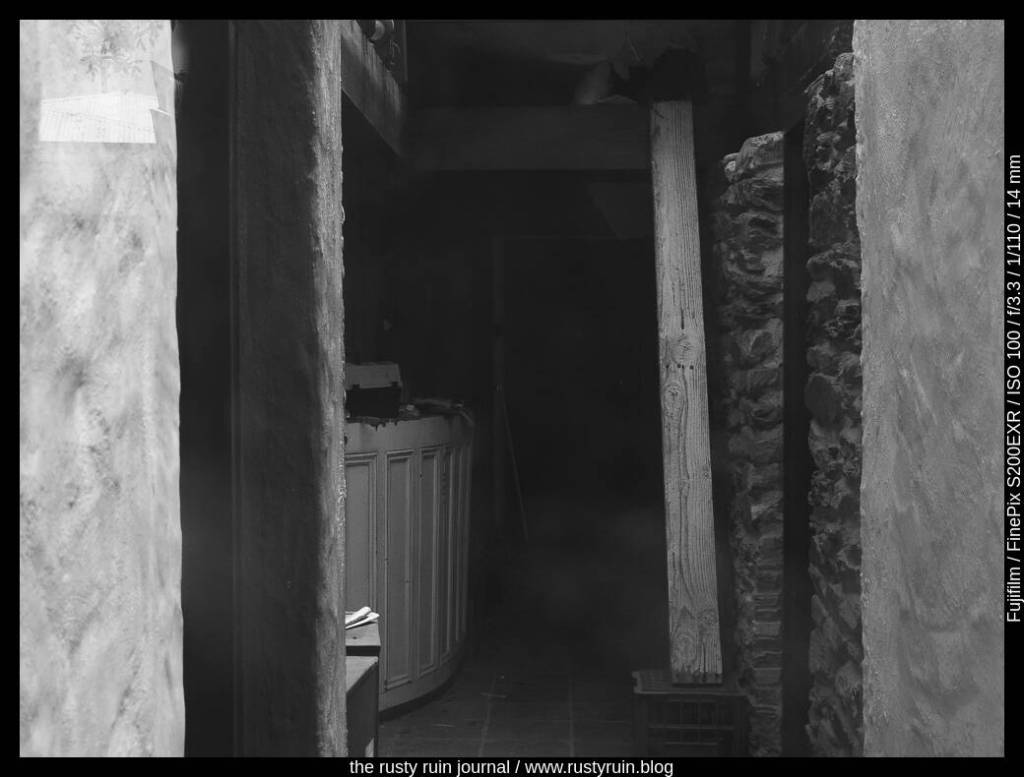
I like the way the sunlight illuminates key parts of the image and creates borders and frames: the white textured walls, the plank of timber, the blue wall, the papers stacked on a table, and a ceiling joist. Curious how this photo would look in a black and white conversion, I adjusted settings in Lightroom:
The old restaurant #2
Light and shadow tell much of the black and white photo story. I always start with those foundations. The contrast here is bumped a little more, the sunlight spilling gently over timbers and walls is pushed, and the shadows are pulled down to create depth and mystery. The plank of wood resting on the crate becomes more of a focal point and draws the eye further into the dust and darkness of the rooms beyond.










 The Rusty Ruin Journal