Exploring four mountain landscapes ~ thoughts on aesthetic choices and gear limits

In my previous post, I touched on the idea that gear limitations can have an impact on subject matter and aesthetic choices. Rather than work against the glass, it’s personally more rewarding to adapt to limits and consider other ways to make interesting photos. In this context, limits drive creative growth and learning.

As there was an abundance of wondrous mountains draped in heavy clouds, I made a decision to focus on the scale, shape, colour, and tonality of the landscape rather than the sharpest details. Knowing the optical limits of my telephoto lens changed my perspective.

Mountain landcape – Nikon D3400 and Nikkor 200mm DX VR lens

Distant landscapes are often hazy, and the details are difficult to record. Conditions were also overcast and regularly dull, further encouraging me to adapt and make deliberate  aesthetic choices.

My objective in this mountain series was to simply focus on framing form, shape, scale, and tone. Having a rough final image in mind, I made photographs that provided me the raw material for editing post-holiday.

Mountain landcape – Nikon D3400 and Nikkor 200mm DX VR lens

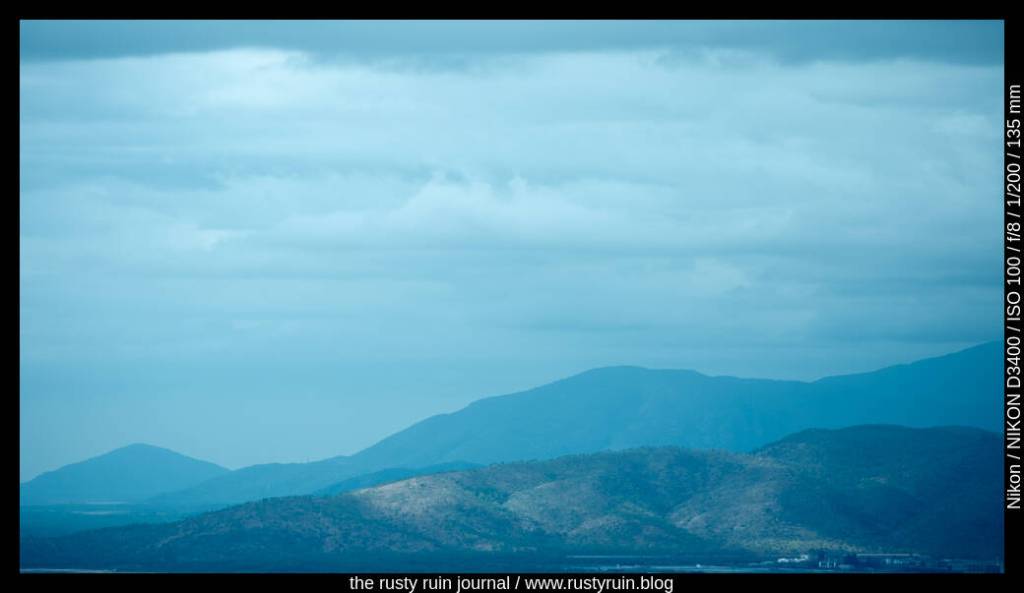
I set the White Balance to Fluorescent in Lightroom to make everything cold and slightly mysterious, emphasising the cloudy conditions. The 16:9 ratio crop choice also amplifies the scale of the mountains and encourages the viewer’s eye to travel their length, taking in tone, layering, and form.

During initial composition for the above photo, I deliberately framed it so the three visible mountain layers travelled to the right edge of the frame and terminated together. This provides visual interest, harmonises with the bulky layering at the leftmost edge of the frame, and serves as both entry and exit point for the viewer’s eye.

Mountain landcape – Nikon D3400 and Nikkor 200mm DX VR lens

In the photo above, you can just make out tiny white buildings at the bottom right of the frame, They sit at the foot of the mountains and look small, thus providing a sense of scale. I also like the dapples of sunlight near them, made muddy and indistinct by the Fluorescent White Balance choice.

Mountain landcape – Nikon D3400 and Nikkor 200mm DX VR lens

Blue mountains, orange clouds ~ two photo themes informed by limitations

When deciding what camera gear to pack for a long holiday on the road, it’s true that I’ve never quite packed right. One can’t be prepared for all occasions and there’s always the thought in my mind that I need to pack light, lest I strain a muscle or two. As it turns out, I could have packed the optically superior 70-300mm Nikkor ED VR lens over the Nikkor 200mm DX VR. I should know by now that when deciding between packing light or packing heavier, but optically better, lenses, I should prioritise the better glass, even if it means a sore shoulder at the end of the day.

It’s not that the Nikkor 200mm is a terrible lens, it’s just old and performs better on older Nikon bodies that don’t demand so much resolving power from lenses. Even though the Nikon D3400 is a lightweight consumer-grade camera, Nikon still managed to squeeze in a top class crop sensor.

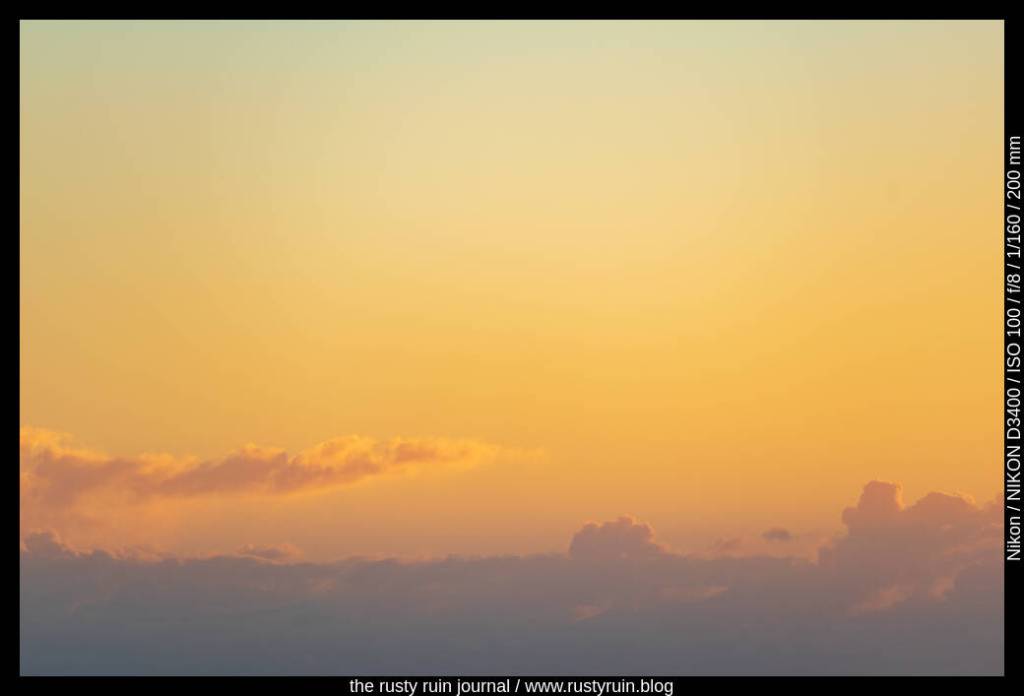
So, what to do when I need the extra reach that an optically questionable telephoto lens gives me, but it’s going to produce soft photos with lower contrast? This is where the available gear informs thought, idea, behaviour, and photographic practice. Optically inferior lenses are useful in their way ~ the shape and tonality of distant mountains shrouded in haze and evening mist – the colour of enormous clouds at sunrise. Even old glass is capable of good photos when limits are understood. If sharp detail isn’t possible, colour, tone, and shape may present as important themes, as in this case.

Mountains of blue, Townsville QLD – Nikon D3400 and Nikkor 200mm DX VR lens
Long morning clouds near the Gulf of Carpentaria, QLD – Nikon D3400 and Nikkor 200mm DX lens

A waterfall, tourists, and different camera generations

Finally, I’ve started to edit some of the photos from the recent road-trip. I made so many that I’ll probably have editing fodder for the next two years! The recent laptop upgrade has taken up most of my spare time ~ copying thousands of files across, wrangling new software installs, and adapting to a non-OLED screen. The upside is that the new laptop features desktop power in a portable plastic shell, so any photo editing software runs as smooth as glass made by NASA for the latest Space Shuttle build.

The third of three waterfalls, Atherton Tableland – Nikon D3400 and Nikkor 35mm lens

On this day, we were driving through the Atherton Tableland, via Atherton and Herberton. Somewhere along the road, we happened on short walking trails for three waterfalls. Not having had an opportunity for hiking up to this point in the road-trip, we leapt at the chance to enjoy the cool forests in the area.

As serene as the waterfall looks, the mess of tourists waiting on the viewing platform to make photos was anything but quiet! Having made my way to the front, I hurriedly reached for my Nikon D3400 and made some quick photos. I’d screwed in the Circular Polariser to minimise the stray reflections on foliage and water. Using a slower shutter speed of 1/60th of a second blurred the fast-running water to give it a milky effect. Because I was using the Nikkor 35mm lens, such a slowish shutter speed was unlikely to cause a blurry image, as long as I was still enough. Even if I’d wanted to use a tripod for extra stability, finding room in the crowd was not going to be easy.

Within moments of completing those initial photos with the D3400, I pulled out the Nikon Z5 and made some more. After a minute or two of switching settings and trying different positions on the muddy viewing platform, I felt the pressure of the tourists behind me waiting for their turn.

Just as I was about to put away the camera, a guy approached me casually swinging his Sony A7III and asked me to make a photo of him and his family – “Always best to ask a person with a good looking camera, right?”, he said (I wondered what he might have thought if I’d been using a glacially slow 20 year old Finepix). After checking the settings – shutter priority and face recognition – I obliged and handed it back. Almost as soon as I’d done this, a young woman walked up to me and handed me a one-shot film camera. I made a photo of her and her young overseas tourist group and wound on the film.

From a Nikon D3400 to a Nikon Z5 to a Sony A7II and then a cheap film camera. As I was the last of our group still lingering, I quickly left the scene and made my way back to the waiting car.

The quiet walls speak of soft light and secret corners

When the body is tired and sleep is needed – when the grey clouds amass and the wind blows – when the camera feels heavy and the ideas diminish – what to do? I stared into the corners of our sky-high holiday apartment and found inspiration in the artificial light. Thus, a mini-series of photographs presented themselves: quiet walls on quiet days.

More Nikon Z5 night photos ~ pushing ISO

It’s challenging to attain sharp photos when hand-holding a camera in low light, but I’m comfortable pushing the ISO on the Nikon Z5 to 6400 to force a faster shutter speed to avoid blur. Furthermore, the in-body stabilisation of the Z5 helps to ward off the worst of the shakes and vibration.

As I’ve admitted previously, I’m still guilty of using shutter speeds that are too slow at times! Maybe I’ve become too accustomed to large sensors and vibration reduction technology? It’s a good thing the Nikkor 40mm lens I had with me opens up to f2 ~ not super fast, but fast enough to allow more light to hit the Z5’s 35mm sensor in low light situations.

Sacred Heart Church – Nikon Z5

Between the black bars of the heavy gates, I positioned the camera, opened the aperture wide to f2, set to ISO 6400, and glanced at the exposure readout in the electronic viewfinder to see a measly shutter speed of 1/15th of a second. Knowing that a blurry photo was one tiny movement away, I braced myself with my arms tucked into my sides, held my breath, leaned against the fence, and left the rest to the in-body stabilisation of the Nikon Z5.

Apart from the softness at F2, the photo is acceptably sharp. I’ll always say that you can make great photos with all kinds of cameras, even film in tin boxes, but tools like sensor-based stabilisation do make some situations easier.

Red light/secure door – Nikon Z5 and Nikkor 40mm F2 lens

When framing up this photo, I noticed that lights from passing traffic illuminated parts of the door and wall. With my back to the road and my eye pressed against the viewfinder glass, I waited until I heard the diesel-stutter of a loud engine that likely signalled a truck. I half-pressed the shutter button to focus. A few seconds later, the vehicle’s lights created red shadows and streaks. I timed the shutter click just right.

A night-walk with the Nikon Z5 ~ some thoughts on the quality of light

A few nights ago, I was parked on a busy main road near the city, scoffing a greasy burger and fries and washing it all down with a lukewarm decaf. I needed to fill several hours while I waited for the Katy Perry concert to finish so I could ferry home a car full of tired and content family members. I’d packed my Nikon Z5 so I could take a walk in the cold and make some photos. Opportunities to wander unfamiliar neighbourhoods don’t present themselves too often, so it was a great opportunity to challenge my eye.

Rainbow rotunda – Nikon Z5 and Nikkor 40mm F2 lens at 5000 ISO

When I use my older Nikon DSLRs, I temporarily forget how technically capable the Nikon Z5 is. Nikon were slow to enter the mirrorless market after a false start with the petite CX system, but their Z cameras are high quality devices that are a joy to use. I’m often amazed at how clean the Nikon Z5’s photos can be. The Z lenses have a reputation for being very sharp, with the Nikkor 40mm F2 being a good example.

Behind the shops

Photos made at night are often challenging to edit because the quality of light is so different to photos made during daylight hours. Where we might raise shadows to reveal more detail during the editing process for a day-time photo, it usually makes more sense to obscure the details in dark areas of a night-time photo where the absence of light defines the image.

In the photo above, the inky shadows obscuring the ground and part of the fence define areas of the image that are illuminated. Brightening the shadows not only weakens the impact of the photo but also makes little sense when part of the goal is to communicate the quality and feel of the night hours – the difference between light and shadow, the quality of artificial light running across metal and brick, and the darkness of the hour. If the versimilitude of the photo is important, as it is in this case, it’s as important to communicate the quality of absent light as it is to communicate how and where light falls.

Through the clouded shop-window

Soft light, plastic lenses, and bokeh ~ back to the Sima Soft Focus lens and others

In my haste to post examples from the all-plastic Sima lens, I forgot to post one of the nicest examples of how the single plastic lens bends the light. Adam, over at Driftwood Imagery, has also been inspired to mess around with his own recently acquired copy of this lens.

Nikon D7100 and Sima lens into the sunlight

I’m not sure if I was paid in cash or gratitude (probably in gratitude, knowing my eagerness to experiment with old glass at the time), but it was nice to use the Sima lens at sunset. In the photo above, you can see how the plastic element creates blue, green, and purple chromatically aberrant auras around strong light sources. Everything blooms wonderfully. And while I’m in the mood to post portraits – a rare genre for me – here’s another from the same session. I swear to you that even though the pose and angle looks the same, I did actually take time to switch lenses!

Nikon D7100 and Pentacon AV 80mm 2.8 Diaplan projector lens

Note the bokeh bubbles in the photo above ~ a good example that’s sure to inspire interest from people who love characterful out of focus areas. The Meyer-Optik Trioplan range of lenses is known to produce such pleasant hard-edged background bubbles. A recent obsession with such bubbly bokeh has pushed second-hand prices up dramatically, though I’ve not checked recent figures.

I was lucky to snag the Pentacon AV 80mm 2.8 Diaplan some years ago ~ a projector lens made by Pentacon (Meyer-Optik was part of the company merger that formed Pentacon). It has the same optical triplet formula as the famous early Trioplans. The only downside: being a projector lens, you need to mount it and focus it, somehow. I used some PVC tubing and glued it to a cheap mount adapter to form a simple push-pull focus mechanism.

Bokeh is just another tool in the kit-bag of the photographer. Sometimes you want everything in-focus and sharp, and sometimes you want great seperation between the subject and a super smooth background formed by a 16-bladed vintage lens iris. There are people who find Trioplan bubbles distracting and others who appreciate those gentle geometries. If we have the right tools to suit our photographic vision, and we understand their qualities and how to use them, we are a long way down the road to making the photos we imagine. Rather than favour a single tool, better to continue adding tools to our bag and treat them as equals on our journey.

And the model in question? Well, after I made some initial safety photos with what many people would call a normal modern lens and then experimenting with the Diaplan and the Sima, she ended up choosing the safe photo! I guess the bubbles don’t always appeal to the eye.

Notes from the warm side ~ another crappy photo

I recently acquired a Photape 85A warming filter (amber) – a colour correction filter normally used on film cameras to correct a mismatch between the colour cast of the scene and the colour temperature of the loaded film. It’s of not much use on modern digital cameras, especially if Automatic White Balance is used, since the camera’s software corrects for the colour cast. If using a custom or preset White Balance, the filter should have an impact, but it’s easier to do this in editing.

In my continuing quest to degrade the photos from the Camp Snap camera, I put the 85A in front of the softening filter, and discovered that the Automatic White Balance of the Camp Snap is not overly sophisticated. It may also be that this cheap toy camera uses a custom White Balance setting. Whatever the case, the old Photape filter does warm things up to a nice amber colour.

Gold Train – Camp Snap Camera with Photape 85A Warming Filter

Dreamy photos from the Yongnuo 25mm 1.7 lens

As much as I enjoy my Olympus EM5 Mark 2, I rarely invest in the system. Since the imaging arm of Olympus was sold off and rebranded under the OM Digital Solutions name, I admit that Micro Four Thirds has lost some lustre. It is, of course, a fantastic lightweight system and it would be nice to see Panasonic continue the format under their Lumix brand, though I fear that many camera manufacturers see 35mm sensors as the biggest cash-cow at this point.

It was with some surprise that I discovered the Yongnuo 25mm 1.7 lens for Micro Four Thirds. It’s a Chinese-made product and features a quiet auto-focus motor, which is unusual in such a cheap lens. The body is all-plastic, but it feels and looks good. It’s also the fastest Micro Four Thirds lens I own.

Dreamy vibes from a cheap lens

I made the photo with the lens wide open at F 1.7. The sun flared across the frame, resulting in a soft and dreamy look. It’s pretty sharp in the centre at an aperture setting of 1.7, with the edges and corners looking soft. There’s also plenty of chromatic aberration, especially in high contrast areas, but I think all of this adds to the mood of the photo.

Siloes at sunset – Yongnuo 25mm 1.7 lens

Just before the sun dipped below the horizon, I set the Yongnuo lens to F 2.2, just to sharpen things up a little, and made this photo. I really like the rendering of this lens so far and I think I’ll be packing it for our upcoming roadtrip.

Nitmiluk National Park ~ awe-inspiring gorges, a kit lens, and harsh light

To the local Jawoyn people, the amazing gorges in Nitmiluk National Park (Katherine Gorge) hold special significance. We were fortunate enough to book a short cruise to see some of the many wondrous gorges in the area and view the ancient sandstone rock formations, calm waters, and freshwater crocodiles. This is an area teeming with life and Dreamtime stories.

Nitmiluk National Park, one of the gorges – Olympus OMD EM5 Mark 2 and 14-42 kit lens

Sunlight at the height of the Australian afternoon can be harsh. This is one reason I prefer viewfinders rather than the big LCD screens on so many cameras that get washed out in these conditions. 

The soft golden light of dawn or dusk brings out the best colours in the outback landscape, but trip timing doesn’t always permit, and you have to work with the tools you have and the light available when the opportunity arises. One quality this strong afternoon light does emphasise: all the textures on the ancient sandstone.

On the day, I packed lightly since I’d been lugging a not insignificant amount of camera gear around on other days (hello Lowepro Nova 200). The Olympus EM5 provides good image quality and lots of control in a small package. It’s just a small pity I’d also decided to take the 14-42 kit lens with me. That’s not to say that kit lenses are bad at all. Nikon makes some great kit lenses, such as the 18-55mm. And this Olympus Zuiko kit lens is no slouch in the image quality stakes – it does pretty well for a cheapish plastic lens. But at times when I want more sharpness to record all of the landscape’s details, it gets a bit fluffy and squishy at the edges of the frame. Still, you work with what you have and the conditions of the day.

Nitmiluk National Park – Olympus OMD EM5 Mark 2

I’ll always say that eye-watering sharpness is generally overrated in photography, but there are times when sharpness is another tool you want in order to communicate certain qualities – the texture of the rocks in this case. Despite some of the shortcomings of my kit lens, careful subject selection, use of exposure compensation to retain as much detail as possible in high dynamic range scenes, and some boost to the red/orange/yellow colour channels during editing helps to make the photos shine. I also reduced highlights to reveal the details of the ancient sandstone.

A patch of sunlight illuminates ancient rock – Olympus OMD EM5 Mark 2 and Zuiko 40-150mm lens

As the clouds grew heavy, the light conditions became a little more forgiving. As you can see in the above photo, clearing clouds also provided an opportunity to record sunlight as it illuminated sections of rock. I used the so-called plastic fantastic 40-150mm Olympus Zuiko lens for this photo – small, light, and really quite sharp at most focal lengths. I guess the message is to know your camera gear and accept and make best use of your tools and the conditions. I’ll freely admit to not knowing all of my gear well enough at times!