The Nikon D50 appeals to me because it sits somewhere between the small Nikon D40 and the prosumer Nikon D70/D70s. With a plastic body that’s closer in style to 1990s Nikon film SLRs like the F65, it seems a world away from Nikon’s current black, sleek, industrial-feel mirrorless cameras and Z-mount lenses. The silver-bodied D50 I have may be technologically long in the tooth, but the 6.1 megapixel sensor still packs an imaging punch when used with careful intent.
Looking at you – Nikon D50 and Nikkor 50mm AF-D 1.8 lens
The Nikkor 50mm 1.8 AF-D is one of my favourite lenses, and I can use it on the D50 because the body includes a screw-drive motor. Not only is the lens light and small, but the glass happens to be sharp and practically distortion-free. On the D50, it’s a perfect match, squeezing everything from the 6.1 megapixel CCD sensor. Even at base 200 ISO, the D50 is very quiet when it comes to digital noise.
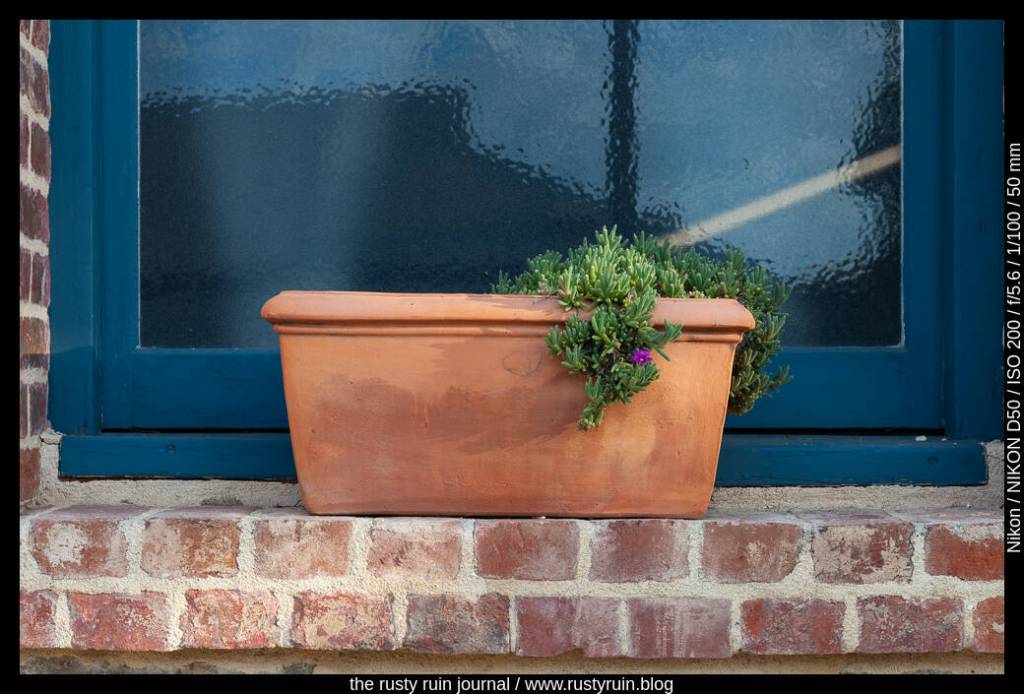
Against the blue window, green foliage spills over warm terracotta – Nikon D50
This is the sort of camera and lens combination that invites contemplative photography at sunset on an overly warm eve. Old buildings, weathered window frames, and glowing reflections put me in mind to simply wander and open my eyes to vast possibility. Something about the terracotta on blue, framed by red brick, drew my imagination – ordinary, understated, usually unnoticed, and quiet.
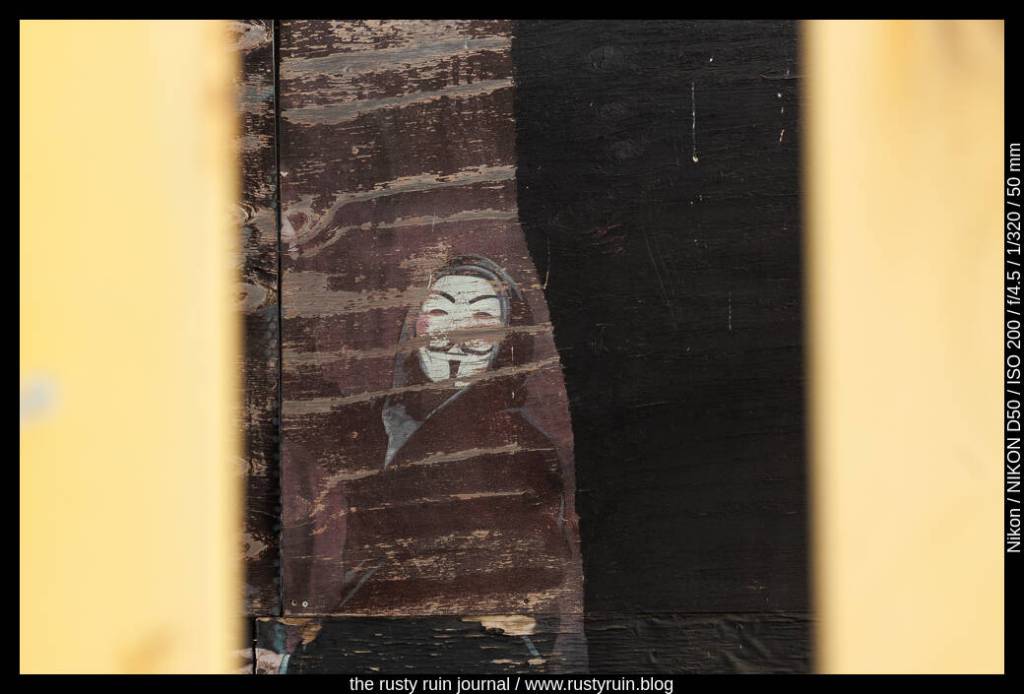
The face between the yellow bars – Nikon D50
Getting close to the yellow bars and setting the aperture to F4.5 allowed me to sufficiently blur them, communicate depth and dimensionality, and still maintain excellent sharpness in the peeling paint and the smiling figure – the subject of the photo.
The Nikon D50 fills an old DSLR usage gap for me – small and light enough to pack with another camera for the day; the ability to use AF-D lenses like the aforementioned Nikkor 50mm 1.8 due to the included screw-drive focus motor; and a top-plate LCD that communicates the most common camera settings at a glance.
A big optical zoom that starts at 30.5 mm and ends at 436mm (F2.8 to F5.3),
DSLR-like styling and external buttons,
A largish, by bridge camera standards, 8x6mm (1/1.6th inch) sensor,
And a 200 000 dot electronic viewfinder.
In many ways, it feels modern, though the speed of processing is definitely of the 2009 variety. Still, I can save in both JPG and CCD-RAW, unlike previous Fujifilm bridge cameras.
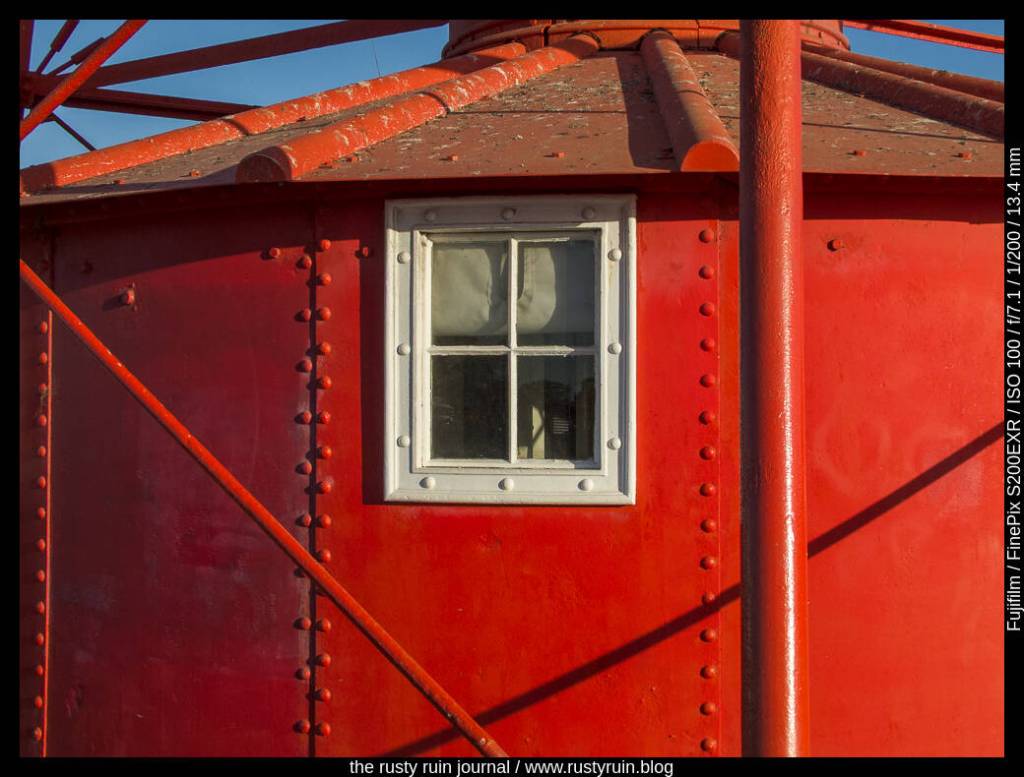
The old red lighthouse – Fuji Finepix S200 EXR
The octagonal pixels that Fujifilm packed into these old sensors might seem odd by today’s standards, but the tech produces photos said to contain extra highlight information. It’s not terribly easy to verify this, as I’m still trying to work out the weird digital alchemy that results in:
Strange cross-hatch image artifacts in some 12 megapixel images,
12 megapixel TIFF files that can only be created from RAF files in an aging program called S7raw – built almost exclusively to read CCD-RAW files from these later Fuji cameras,
JPGs and RAF files that are 12 megapixels in any of the PASM modes and High ResolutionEXR mode, or 6 megapixels in the Dynamic Range or Low Noise EXR modes.
It’s a lot to digest and also explains why some people describe this camera as a JPG machine ~ they clearly have better things to do with their time than mess with TIFF and RAF files. This makes it a complex camera on the inside. And as much as I like that the S200EXR offers classic Fujifilm JPG recipes – Provia, Astia, Velvia, and BW – the menu organisation also reflects the complexity of options available.
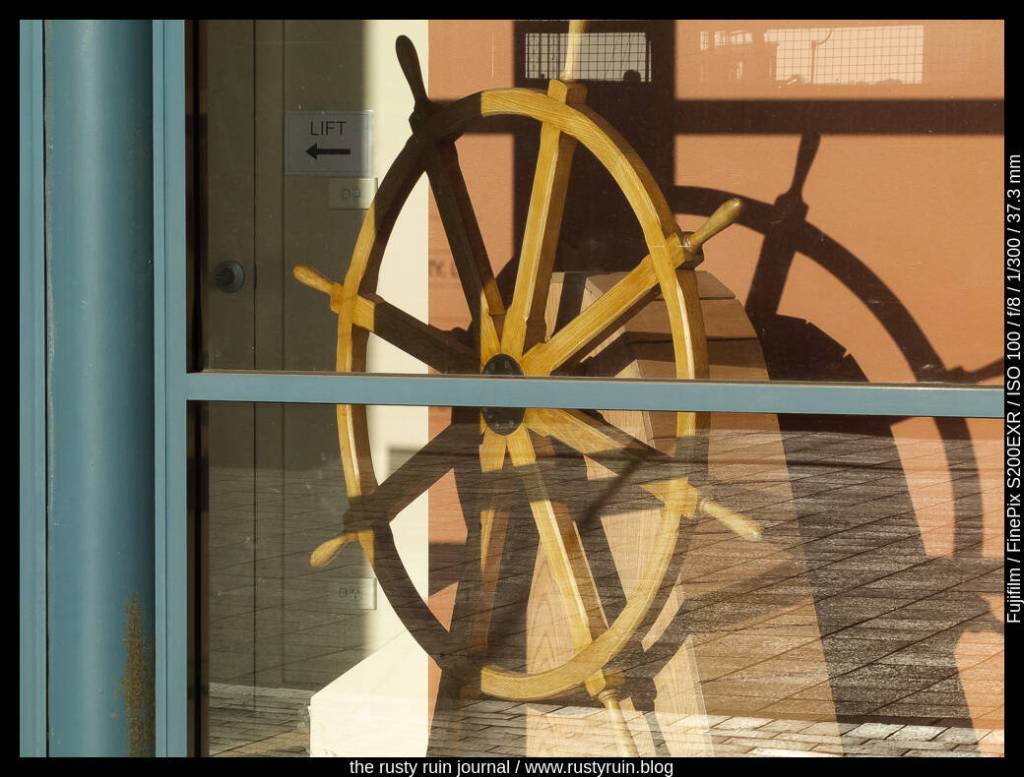
Ahoy Captain! – Finepix S200EXR
The seperate EXR option on the dial offers three special modes: 12 megapixel High Resolution photos that use all of the sensor pixels, 6 megapixel Dynamic Range photos that preserve more detail in shadows and highlights, and 6 megapixel images in the High ISO Low Noise mode. Weirdly, the regular PASM functions don’t offer any of the three EXR special modes and create regular 12 megapixel photos that use a different kind of dynamic range preservation technology.
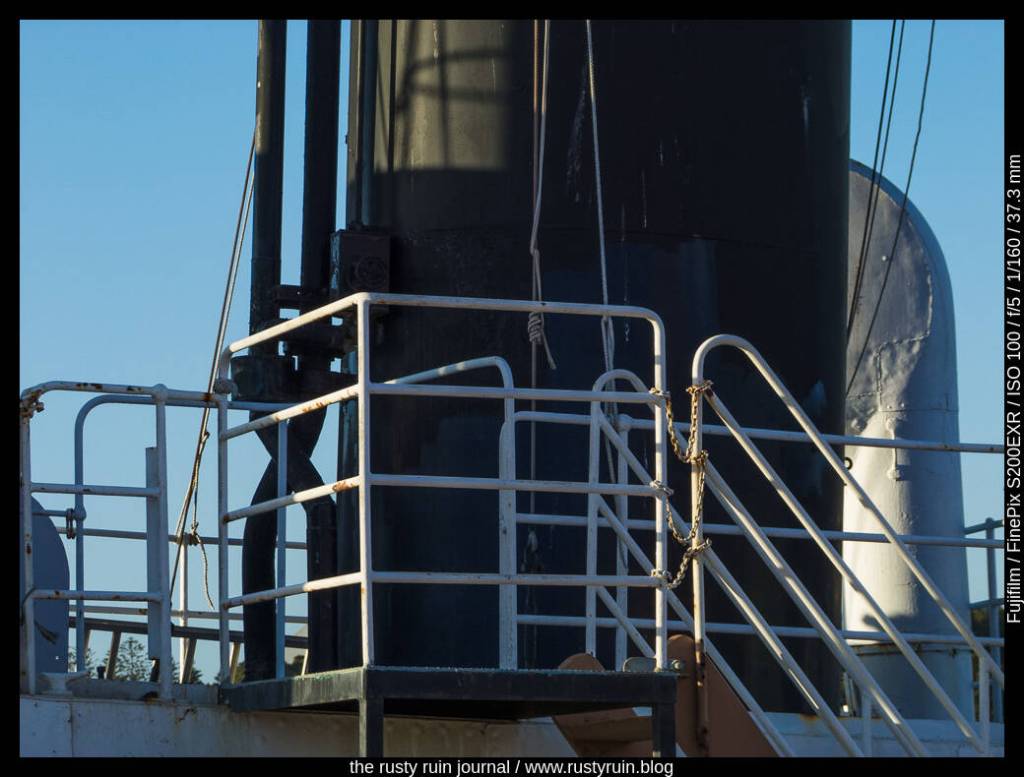
Rails and pipes – Fuji Finepix S200 EXR– plenty of detail in the shadows, even in this 6 megapixel image
I’ve found that importing the RAF files into Lightroom is the most convenient option in all cases. The imported 6 megapixel images from RAF files recorded in two of the EXR modes seem to be the darker of two exposures – or at least the darkest part of whatever data lives in the mystical RAF files. It seems likely that Lightroom is throwing away some of the data from the smaller octagonal pixels that preserve extra highlight information. A RAF file recorded in any of the PASM modes results in a 12 megapixel image, and Lightroom imports them just fine – this is my preference going forward.
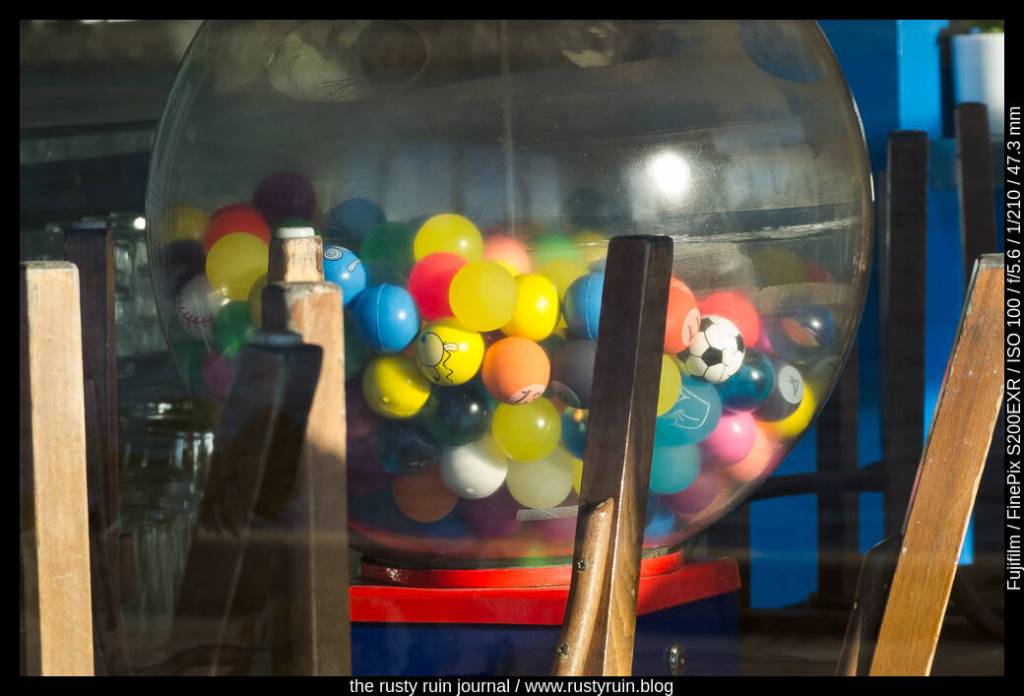
Balls balls balls – Fujifilm Finepix S200EXR
It seems that the EXR line of cameras represented the pinnacle of Fujifilm’s longstanding SuperCCD sensor technology. Not too long after these premium bridge cameras and their strange alchemical sensors, the company moved to CMOS and their X-Trans technology. Despite the complexities of the camera, I find the images very pleasant.
Just as I once developed a taste for the Fufifilm Finepix series of bridge cameras, it seems that I’ve developed a similar taste for old Olympus bridge cameras. I blame it on the recent resurrection of my Olympus C-725!
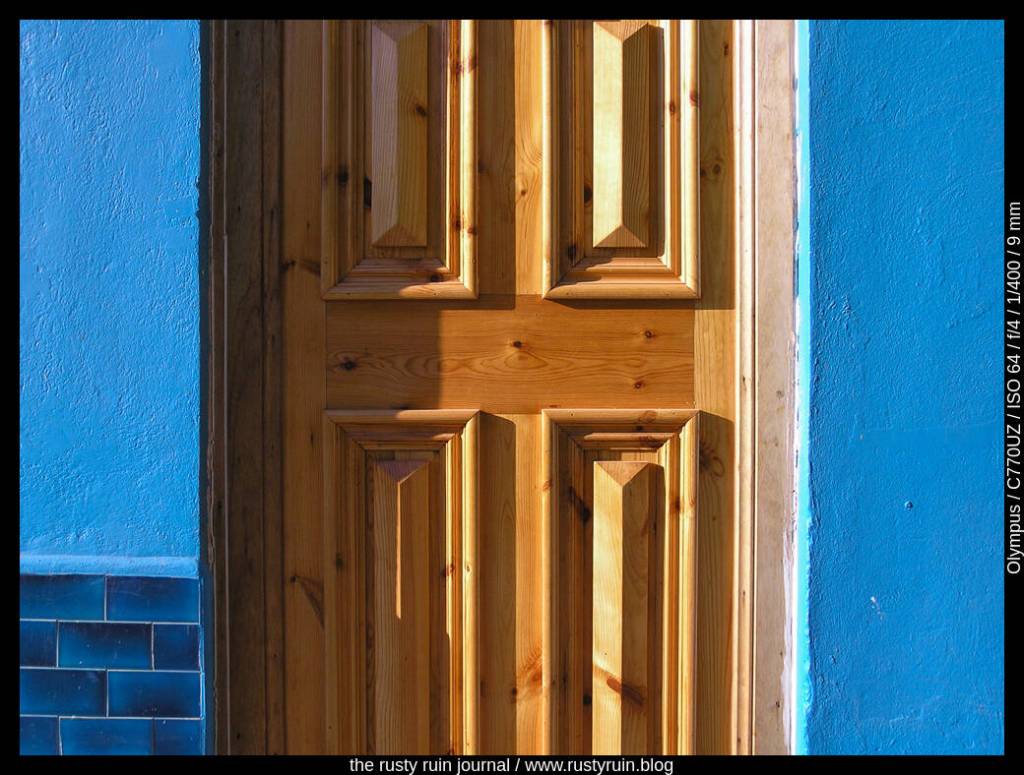
Behind the varnished door – Olympus C-770
On paper, the Olympus Camedia C-770 doesn’t seem like much: 4 megapixels, shutter lag that would annoy today’s impatient camera users, a 1.8 inch TFT screen, a longer start-up time than you’d hope for (good for those with a contemplative photography bent), and the need to use an XD card as a means of storage – let me tell you, those XD cards aren’t especially cheap.
Despite the negatives, there are surprising positives: an excellent lens with a sluggish 10x zoom; a decently fast 2.8 aperture at the wide end; a double (yes, double) flash for nuclear tests with unsuspecting portrait subjects; a respectable Electronic Viewfinder (yes, these old digital cameras carried the DNA of modern mirrorless cameras); a very readable EVF information overlay that includes a live Histogram; level settings for Sharpness, Contrast, and Saturation; the capability to record TIFF files if you can deal with the slow write times to the XD card (only 8 bit, unfortunately); and an enlarge feature that seems to engage an upsizing algorithm and makes those 4 megapixel files into 8 megapixel-sized files.
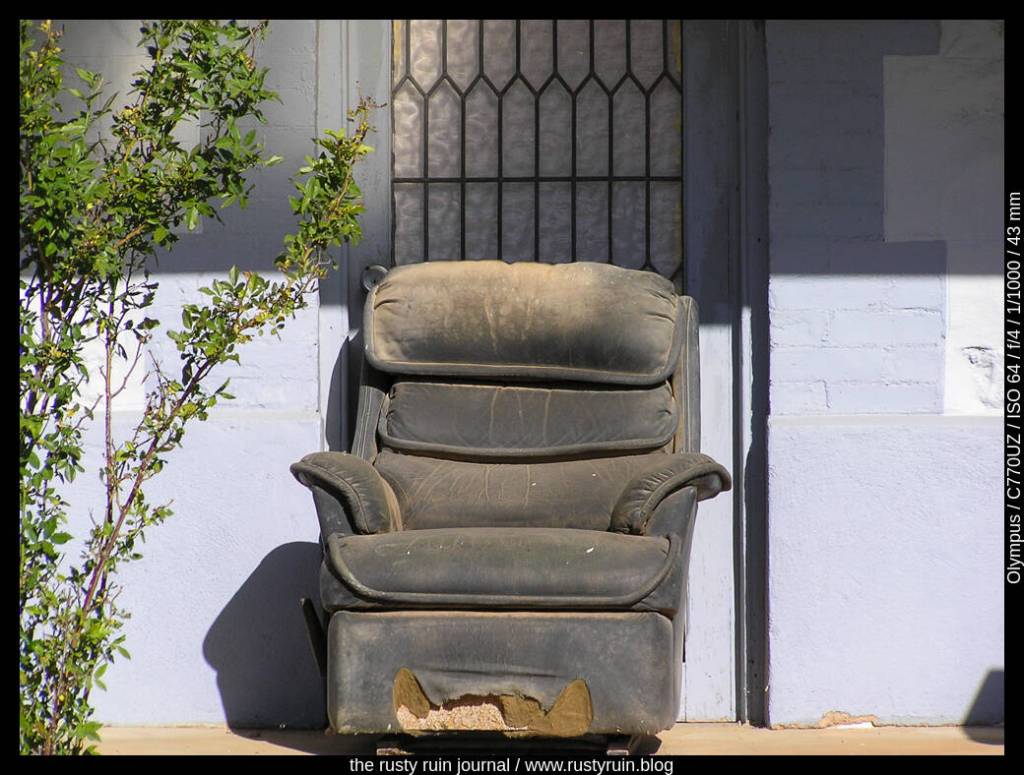
Have a seat – Olympus C-770 Ultra Zoom
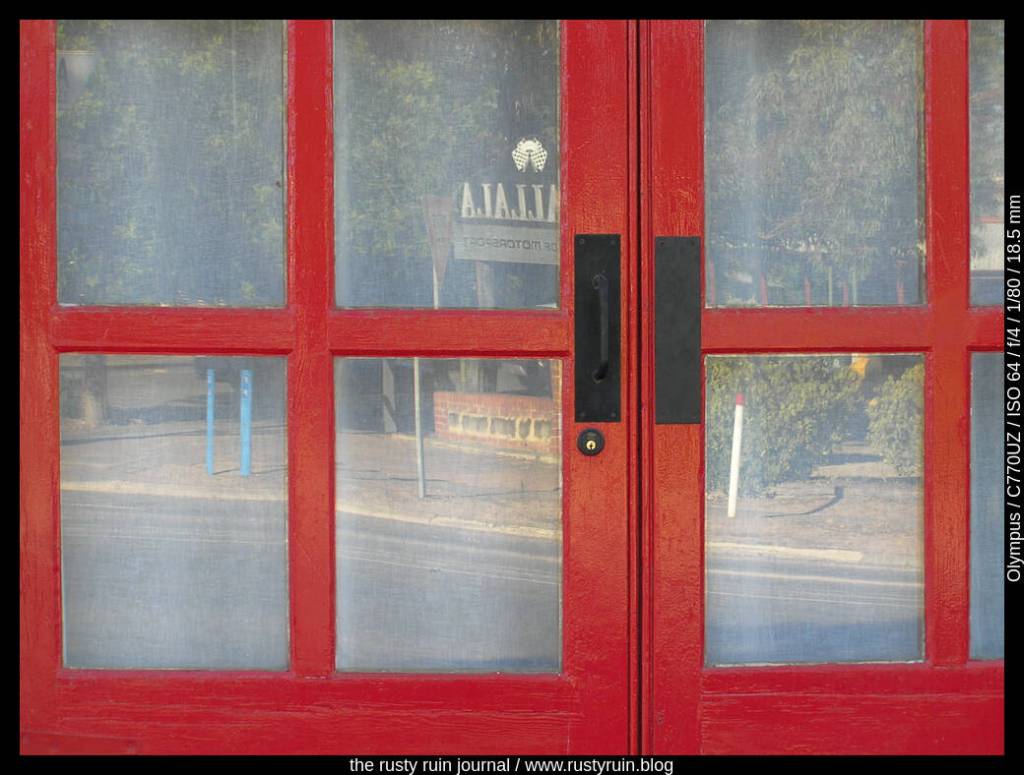
I set the camera to record Super High Quality JPG files, dialled back the Sharpness and Contrast by -1, and increased the Saturation +1. Out of the camera, the images are pleasing. At 64 ISO, the digital noise pattern is so fine that it’s negligible. Of course, you wouldn’t want to push such an old camera beyond ISO 400 anyway, unless more digital noise is your goal. Nor would you want to entertain a low shutter speed when zooming enthusiastically, as there’s no vibration reduction or image stabilisation.
Red door corner – Olympus C-770
LIke the Olympus E-1, the Olympus bridge cameras are great little image makers when used within optimal limits ~ high dynamic range scenes will punish these old sensors and you’ll be forced to crush blacks or blow highlights. To compensate for these limits, I choose my scenes carefully – evaluating the dynamic range before putting the camera to my eye. Often, I’ll recompose, making decisions on how many shadows/highlights to include and how this will affect my vision for the final photo.
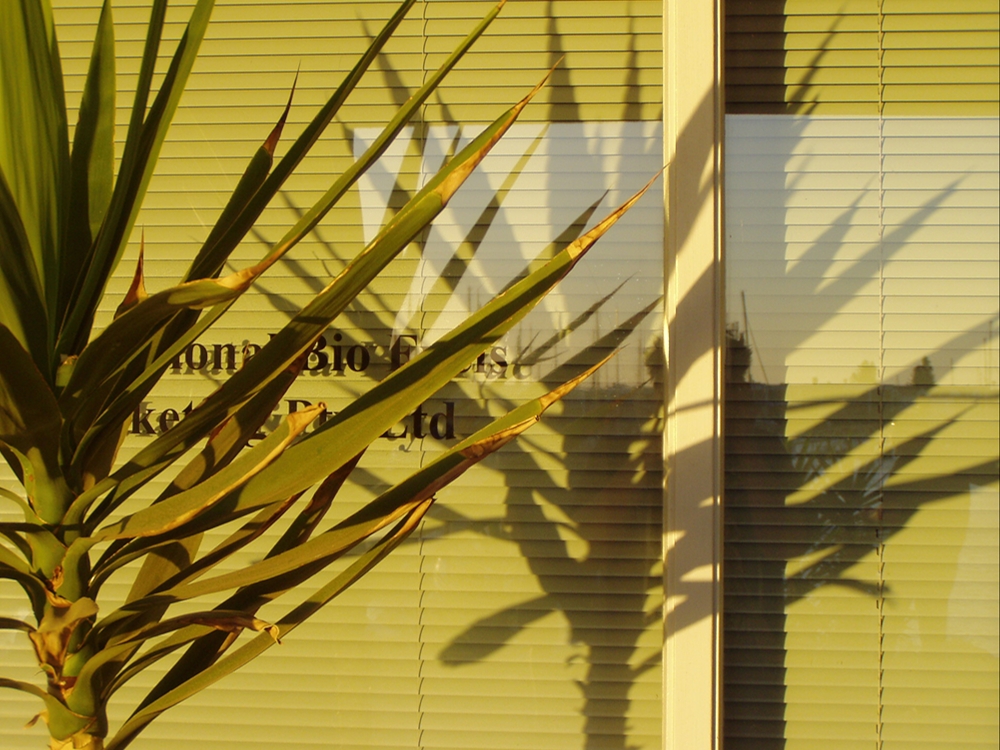
Worn and weathered gear behind the old shop window – Olympus Camedia C-770 UZ
I purchased the Olympus C-725 Ultra-Zoom sometime in 2004, excited by the prospect of the included manual modes and extra features as a step-up from my Kodak. At the time, I was eager to improve my minimal knowledge and explore the mode dial and learn the basics of photography. As it turns out, this silver all-plastic Olympus proved to be my bugbear. It would not be until 2013 that I picked up another camera more complex than this one.
Through the use of various cheap film cameras in the 1990s, I came to realise I had more than a passing interest in visual artforms. As digital photography started to take-off, I decided to nurture this growing interest and paid a lot of money for the Kodak. It was fun, but I decided I needed a more capable camera so I could brush up on the technicalities.
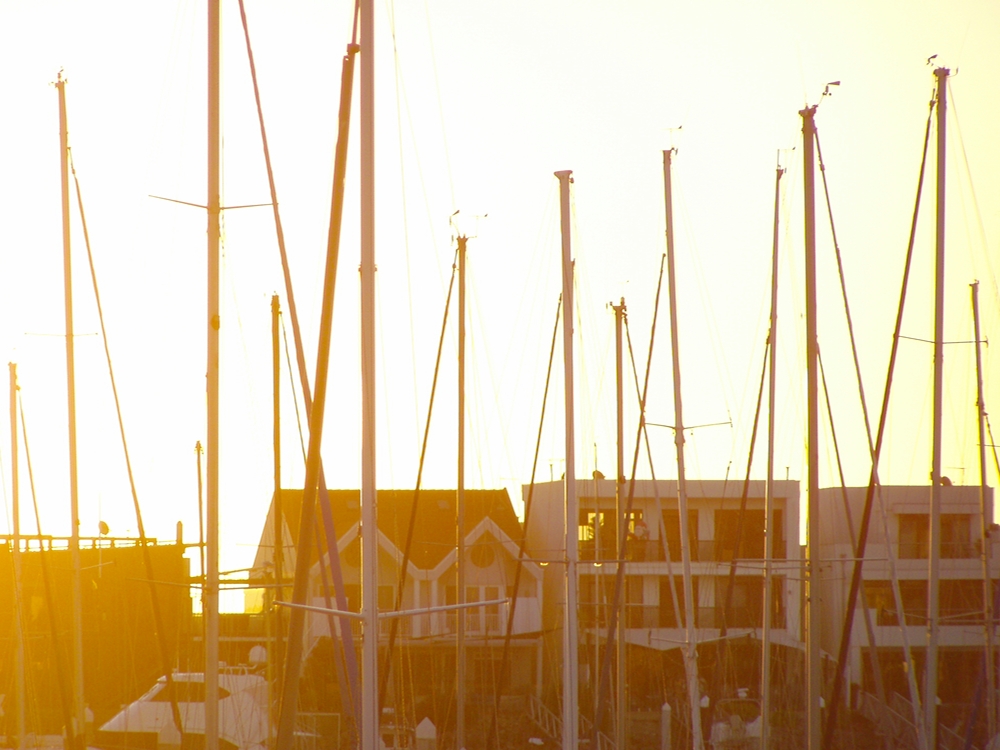
Homes and masts at the marina – Olympus Camedia C-725 Ultra-Zoom
I remember going out with my father, in mid-2004 perhaps, with the express intention of us both buying a new digital camera. He was always keen on new technology. As we browsed the shelves, we picked up every model from Fujifilm to Olympus to Kodak to Sony to Minolta. The model number particulars of the 4 megapixel Fujifilm camera that he purchased escape me now, and I’ve been unable to locate it in his boxes of things. It was the Olympus that appealed to me though.
The Olympus name resonated with me. It spoke of quality and longevity – something that seems both trivial and naive now in the context of the sale of their imaging arm in recent years and the rebrand under OM Digital Solutions. But 2004 was a different time in photography. It was the weird and confusing intersection of more than a century of film culture and the new digital kid on the block.
A silver finish, a boxy plastic design that would make modern mirrorless camera users weep, a mere 3 megapixels, PASM modes, and a huge 8x zoom caused me some excitement. Here, I thought, was a camera that could really teach me about photography! As it turns out, my father had a lot more easy fun with his pale gold plastic Fujifilm Finepix camera.
Sunset colours reflected in office windows – Olympus C-725 UZ
The heart of the problem is that I didn’t allow myself to have fun with this camera. Rather than focus on playful image making and the development of my eye and imagination, I placed enormous pressure on myself and turned the mode dial to Manual and left it there. That’s where I thought I had to be to learn properly. Not only did some early web forums demand this practice of newcomers, but I was also wont to be overly harsh with myself at the time. It may be that I used the mode dial to sabotage my learning.
After struggling for a week or two, all the fun drained away and my initial enthusiasm turned sour. I put the Olympus in a drawer and told myself sternly I’d never be able to learn proper photography. I limited myself to easy one-button point and shoot cameras until I purchased a Nikon DSLR in 2013 – almost a decade after buying the Olympus.
The Olympus was synonymous with my failure until I dusted it off last night and made some photos. I finally made my peace with myself and the camera. Maybe the experience also taught me I wasn’t ready for that type of learning at the time and that using easy cameras for a while was the best thing I could do because it was fun.
So, I’ve come back to the boxy silver Olympus and, having once discarded it in the throes of self-disgust and wasteful gadget buying that speedy technological transitions in consumer societies encourage, I’m finding it a joy. It may be a cumbersome and slow thing, with a design that speaks to the early 2000s, but the photos are quite pleasing I think.
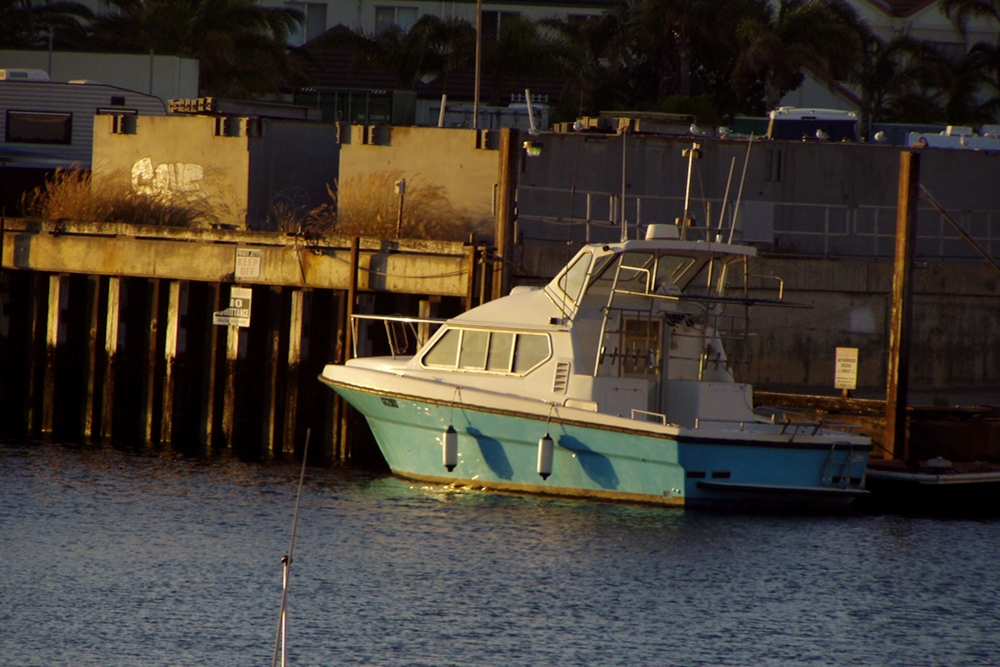
Blue boat at sunset
Limited to a maximum shutter speed of 1/1000th of a second and ISO that tops out at 400, it demands the right conditions for the best results. My fingers fudged over the various buttons without the benefit of muscle memory last night, but I think the photos have a nice quality about them. I set the Sharpness and Contrast to Low, so as to provide maximum editing flexbility. I don’t mind the softness of the images though. The lens gets pretty mushy around the edges of the frame, especially at maximum zoom, and there’s plenty of chromatic aberration in backlit scenes, but after using so many cameras in the twenty years since I hid the Olympus away in self-despair, I’ve broadened my aesthetic sensibilities enormously.
Here’s a photo that’s overexposed. I like the dreamy look of it and that the optics picked up the nice veiling orange flare from the setting sun:
Dreams of the marina by the sea – Olympus C-725 UZ
When deciding what camera gear to pack for a long holiday on the road, it’s true that I’ve never quite packed right. One can’t be prepared for all occasions and there’s always the thought in my mind that I need to pack light, lest I strain a muscle or two. As it turns out, I could have packed the optically superior 70-300mm Nikkor ED VR lens over the Nikkor 200mm DX VR. I should know by now that when deciding between packing light or packing heavier, but optically better, lenses, I should prioritise the better glass, even if it means a sore shoulder at the end of the day.
It’s not that the Nikkor 200mm is a terrible lens, it’s just old and performs better on older Nikon bodies that don’t demand so much resolving power from lenses. Even though the Nikon D3400 is a lightweight consumer-grade camera, Nikon still managed to squeeze in a top class crop sensor.
So, what to do when I need the extra reach that an optically questionable telephoto lens gives me, but it’s going to produce soft photos with lower contrast? This is where the available gear informs thought, idea, behaviour, and photographic practice. Optically inferior lenses are useful in their way ~ the shape and tonality of distant mountains shrouded in haze and evening mist – the colour of enormous clouds at sunrise. Even old glass is capable of good photos when limits are understood. If sharp detail isn’t possible, colour, tone, and shape may present as important themes, as in this case.
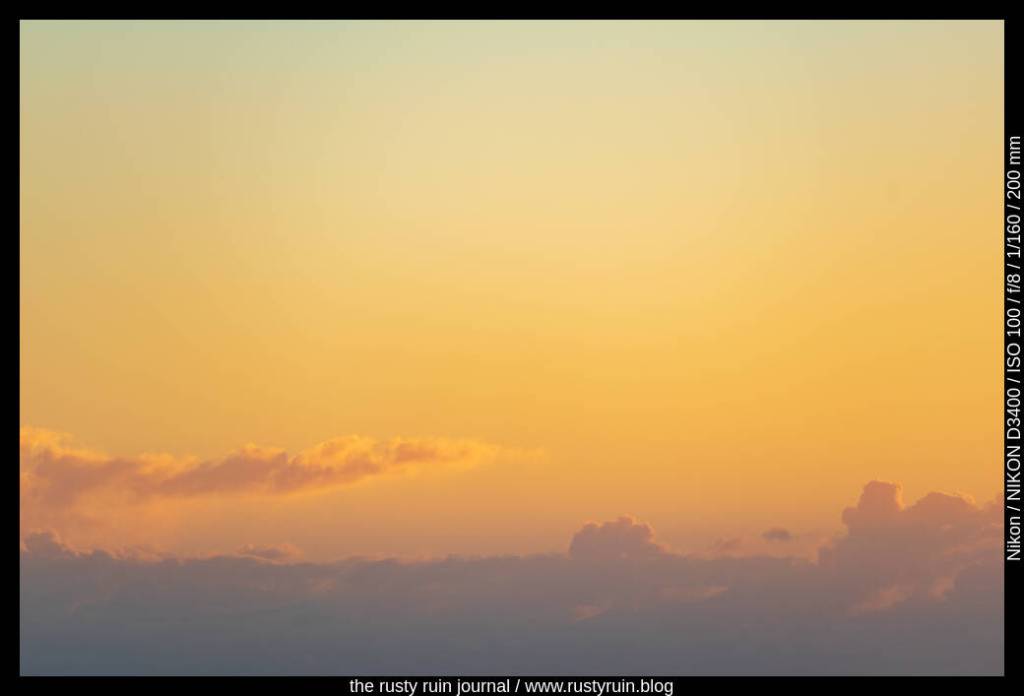
Mountains of blue, Townsville QLD – Nikon D3400 and Nikkor 200mm DX VR lensLong morning clouds near the Gulf of Carpentaria, QLD – Nikon D3400 and Nikkor 200mm DX lens
Finally, I’ve started to edit some of the photos from the recent road-trip. I made so many that I’ll probably have editing fodder for the next two years! The recent laptop upgrade has taken up most of my spare time ~ copying thousands of files across, wrangling new software installs, and adapting to a non-OLED screen. The upside is that the new laptop features desktop power in a portable plastic shell, so any photo editing software runs as smooth as glass made by NASA for the latest Space Shuttle build.
The third of three waterfalls, Atherton Tableland – Nikon D3400 and Nikkor 35mm lens
On this day, we were driving through the Atherton Tableland, via Atherton and Herberton. Somewhere along the road, we happened on short walking trails for three waterfalls. Not having had an opportunity for hiking up to this point in the road-trip, we leapt at the chance to enjoy the cool forests in the area.
As serene as the waterfall looks, the mess of tourists waiting on the viewing platform to make photos was anything but quiet! Having made my way to the front, I hurriedly reached for my Nikon D3400 and made some quick photos. I’d screwed in the Circular Polariser to minimise the stray reflections on foliage and water. Using a slower shutter speed of 1/60th of a second blurred the fast-running water to give it a milky effect. Because I was using the Nikkor 35mm lens, such a slowish shutter speed was unlikely to cause a blurry image, as long as I was still enough. Even if I’d wanted to use a tripod for extra stability, finding room in the crowd was not going to be easy.
Within moments of completing those initial photos with the D3400, I pulled out the Nikon Z5 and made some more. After a minute or two of switching settings and trying different positions on the muddy viewing platform, I felt the pressure of the tourists behind me waiting for their turn.
Just as I was about to put away the camera, a guy approached me casually swinging his Sony A7III and asked me to make a photo of him and his family – “Always best to ask a person with a good looking camera, right?”, he said (I wondered what he might have thought if I’d been using a glacially slow 20 year old Finepix). After checking the settings – shutter priority and face recognition – I obliged and handed it back. Almost as soon as I’d done this, a young woman walked up to me and handed me a one-shot film camera. I made a photo of her and her young overseas tourist group and wound on the film.
From a Nikon D3400 to a Nikon Z5 to a Sony A7II and then a cheap film camera. As I was the last of our group still lingering, I quickly left the scene and made my way back to the waiting car.
Spending two weeks on the road, driving through multiple states, and racking up around 10 000 kilometres seems to have fuelled the desire to squeeze the most out of each day before the day job resumes. At 3 am on a cold Wednesday, we arose, grabbed the bags, and boarded a plane for Brisbane. This was in the week after returning from our two week 10k holiday!
I decided to take the Nikon Z5, the 24-70 F4S lens, the Nikkor 40mm F2 lens, and a recently acquired Tiffen Glimmerglass 1/8 filter.
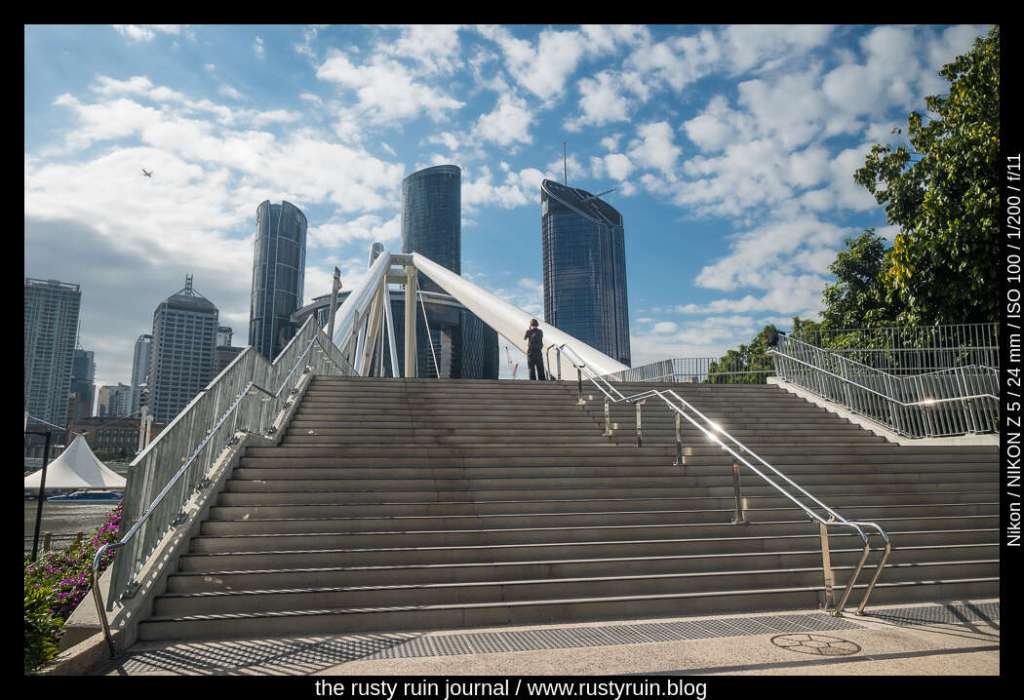
Sleek, tall and modern – Nikon Z5
I was curious about what the Glimmerglass could do. I kept it on the Nikkor 24-70 F4S lens during the day and was pleasantly surprised at the results. The filter lowers contrast and smears light in the brightest areas of an image. This can create flaring when strong and direct light sources are involved, but I found the filter well-behaved for the most part.
Plane-spotting around Queen’s Wharf – Nikon Z5
I really enjoyed the lines and angles around the Queen’s Wharf area of the city. It seems that others were also enjoyng the lines and angles of the bridge, as you can see in the photo above. A keen young man approached us to chat about the city and asked what kind of photography I was doing – “I really like the lines and angles around here.” I said with a smile. He was holding a Nikon D3xxx series camera and clicking away happily.
You can see how the Glimmerglass filter has lowered the overall contrast of the photo above. The light in bright areas, like the clouds and parts of the metal grab rails, is spread around. When some people suggest this filter results in a filmic look, I suspect they are referring to the halation around these bright areas. I like it. The result is not as obvious as some diffusion filters, like the Tiffen Black Pro-Mist. And at 1/8 strength, I think the Glimmerglass is regularly usable during the day and won’t announce itself strongly.
The road-trip is only days away and the table is covered in camera gear. I’ve already rushed out to test the Viltrox 28mm pancake lens on the Z5 and found it to be unexpectedly sharp and unusual. I’m intending on packing the Nikon D3400 for the holiday because it’s light, small, and offers excellent quality images. With this in mind, I tested it at the local wetlands.
Yellow reeds at sunset – Nikon D3400 and Nikkor DX 55-200mm 4-5.6 G lens
I’ve always nurtured a soft spot for the Nikkor 55-200mm DX lens – the largely plastic construction belies better than expected optical quality. I sold my original version and purchased the 55-300mm DX Nikkor some years ago, thinking I needed the extra reach. Even though it’s not optically poor, it never had the personality of the 55-200mm. It was mushy and unattractive at 300mm unless stopped down to f8 at a minumum. The 55-200mm also offers more pleasing out of focus areas – or bokeh.
In use, the Nikon D3400 feels as plastic as it looks. The external buttons are functional and generally well-placed but offer hollow haptics beneath fingertips. I also kept moving the focus point because I was smushing the four-way pad on the back accidentally. It was one of Nikon’s lightest and cheapest entry-level cameras and certainly feels it.
Despite the build quality, the image quality is excellent. I have no complaints in my rushed testing. My outing was less about the characteristics of the attached lens and more about checking whether the camera itself was in good order after picking it up second-hand with just over 1000 shutter clicks. So far, so good…
When processing the raw file above, I found some odd behaviour in Lightroom. When choosing any one of Daylight, Cloudy, or Shade White Balance presets to see how they looked, a lot of green was added to the image, as you can see below. I don’t mind it, but I’m not sure why it’s happening.
As much as I’d like to buy everything Nikkor, it’s an expensive exercise. Luckily, companies like Viltrox are doing interesting things in the world of camera lenses by providing inexpensive alternatives to Nikon’s offerings for the Z mount. The tiny Viltrox 28mm f4.5 is a lightweight, very flat, and slightly strange lens. Seeing as I’m planning to pack it for the road-trip, I thought I’d take it out for a few rushed test photos.
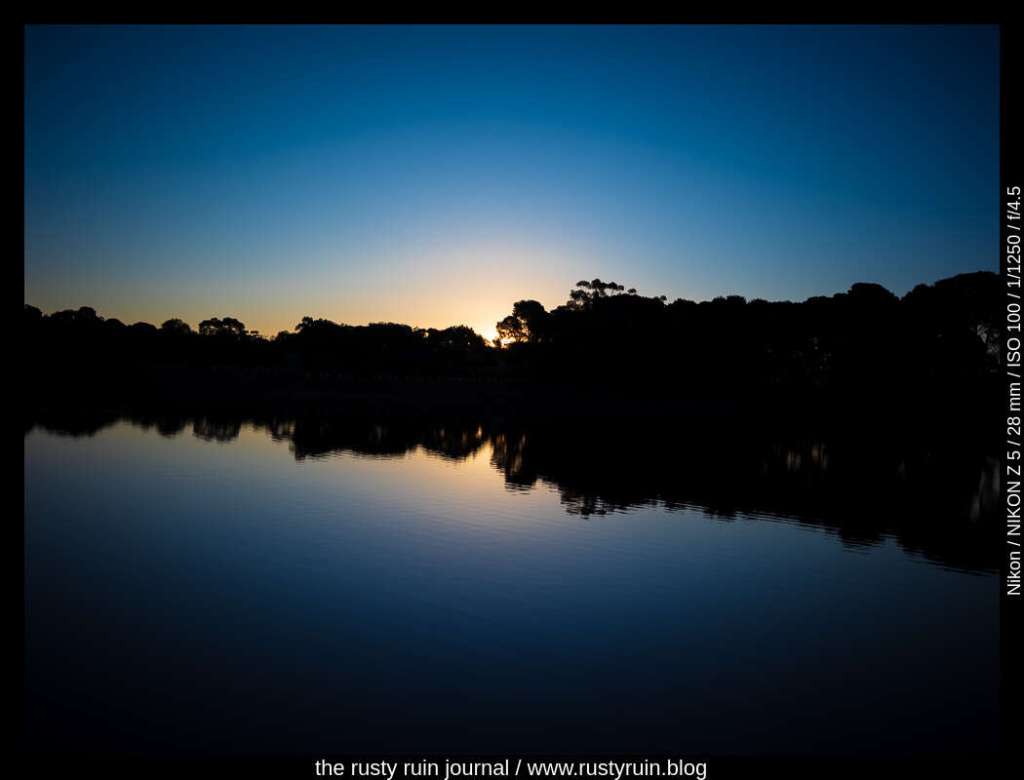
Catching last colours over the pond – Nikon Z5 and Viltrox AF 28mm f4.5 pancake lens
The lens is sharper than I thought it would be for the price. As with many lenses, the central area is the sharpest, with the corners and edges being less sharp. However, nothing is awfully mushy or unacceptable. There’s no aperture mechanism in the lens, so it’s always operating at f4.5. This can either be liberating or frustrating. I found it a nice change from my usual approach because the lack of aperture control alleviated some of the technical cognitive load. Since it’s a 28mm focal length, f4.5 provides pretty good depth of field for most purposes.
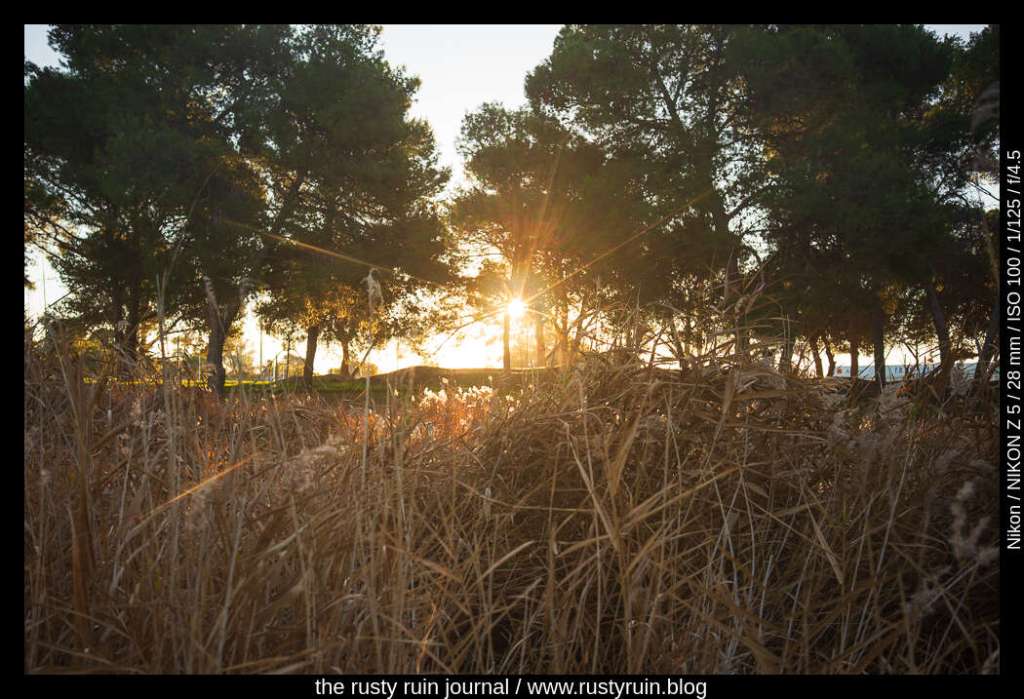
Sunstars and brown reeds
It’s not the greatest photo, but you can see the dramatic sunstar the lens created around the setting sun. Viltrox have included an octagonal mask inside the lens that produces sunstars with long rays. In practice, I found the light needs to be quite strong to produce a visible effect, so it’s not going to be apparent in every photo. Some people won’t like it, but I think it’s a nice point of difference. I also like the accompanying veiling flare across the frame. I imagine this lens is capable of producing some dreamy images in the right light.
How many cameras do you pack when you go on a road-trip/holiday/vacation/adventure? If you’re not a photographer, you might pack one camera. Or maybe you just pocket your smartphone and use that for all photos?
In my previous post, I was thinking aloud about what camera gear to pack for our impending road trip. In the comment section, another blogger, Disperser Tracks, asked me why I’d pack as much as I’m planning to if the goal is to pack light? It’s a great question and one that has often crossed my mind.
Bags everywhere – Nikon D5100 and Tamron 17-50
If my ultimate goal is to pack lightly, why not just pack the smallest and lightest camera I have and be done with it? Why bother packing anything else? Why cram gear into bags that are bursting at the seams?
Is it about ego and vanity? Am I trying to look impressive in the field? I don’t think so. I rarely meet other photographers on my travels. I’ve used all kinds of cameras, crappy lenses, and pieces of plastic when standing near photographers with expensive lenses and cameras. I’m interested in what they’re using and what they’re doing, but I don’t think about how I look next to them. Feeling insecure was an issue when I first started with a DSLR, but not now. I’m comfortable with my photographic approach. I make vast efforts to be aware of my inner world, my motivations, my reason for doing something, my intent, and my beliefs.
What about being prepared? Photo opportunities on the road are often last-minute stops. There isn’t much time to swap lenses and fiddle about. Having two camera bodies with different lenses mounted allows me to choose the best option quickly. Do I need a fast prime lens? Got that on my Nikon Z5. Do I need a telephoto? Got that mounted on the Nikon D3400 today.
It’s about the game of mounts. I actually don’t have a telephoto lens for my Nikon Z5 in the native Z mount but I do have one in F mount for my older Nikons. It makes sense to use the right lens for the right body. Likewise, I have a wide 20mm Z mount lens for my Nikon Z5 but not one for my older F mount Nikon cameras.
Yes, I’m a bit of a novelty seeker. I love cameras and I love photography. I enjoy all of my cameras and like to have options when on the road. Sometimes a Nikon Z5 will serve the moment and other times a Nikon D40X will bring me joy. If something makes a photo, I’m interested. I’ll also pack the Campsnap for some lo-fi fun.
Unfortunately, cameras have failed on me. Last year, I had my amazing Sigma Foveoncamera fail me in the field as the shutter mechanism malfunctioned. Several years ago, my Olympus EM5 Mark 1 failed me on a day-trip. Call it bad luck, I guess. I pack other cameras just in case something breaks. Call it paranoia!
Surrounded by stuff – Nikon D7100 and Nikkor 50mm 1.8 lens


















 The Rusty Ruin Journal