In my continued quest to find beauty in the photos made by toy cameras, I’ve come to broaden my views on what makes for an interesting photo. Growing up with cheap 35mm film cameras, disposable plastic boxes from Kodak and Fujifilm, 110 cameras, and APS cameras, I was never about technical perfection because I couldn’t afford the gear anyway.
Chasing megapixels is a fool’s adventure powered by marketing departments. One of my favourite film cameras back then was a Fujifilm APS camera – low on image quality, but high on ease of use and fun. Before that, my father’s old motor-drive 35mm Chinon, originally purchased in Singapore, beloved by him, and eventually passed to me.
Bricks and concrete in the morning sun – Kodak Chamera with added film grain
It must have been truly magical to see images appear on film plates more than a century ago. Now, image recording is a daily routine ~ surveillance cameras all around, smartphones, digital keychain cameras that fit in pockets, AI that can generate talking flying pig animations, social media platforms saturated by snaps of the junk of day-to-day life, the latest and greatest from Sony. Image-making is so commonplace, we hardly notice the magic of being able to freeze time inside a frame.
Shadow ladder – with film grain added in Exposure X7
Of course, a good photo is about more than technical perfection and the money spent on gear ~ light and shadow, shape and angle, an interesting subject, framing and composition, emotion and vibe, story-telling ~ all of these elements can be communicated through even the cheapest of cameras.
Once synonymous with photography and the venerable Kodak Moment, the Kodak company has undergone multiple transformations over the last century. Having once dominated the film era, Kodak found itself in a war with Fujifilm in the 1990s whilst it awkwardly straddled the analog and digital imaging worlds.
It’s too simplistic to say that Kodak struggled because it didn’t adapt quickly enough to digital photography. Having researched and invented early digital imaging in the 1970s, the common view is that failure to invest in digital technologies caused their downfall. But Kodak did, in fact, produce many consumer digital cameras in the early 2000s and did manage to gain reasonable market share for a while. Even industry titans like Nikon and Canon struggled to devise a winning strategy in the digital imaging market as smartphones rose to prominence, so Kodak wasn’t alone.
Kodak may not have been agile enough to pivot completely from a huge historical investment in chemicals and film production, but in recent years, after Chapter 11 Bankruptcy, they have managed to make some headway in a difficult market. It helps that the Kodak brand is still so strong and sought after by their partners and licensees.
Just quickly, if you like this post and want to read more of my words on photography, old cameras, and such, just fill in your email below. I’m grateful for every connection in this digital abyss!
And so, we come to the intriguing Kodak Charmera ~ a teeny tiny digital toy camera that can live with the car keys in your pocket or get lost down the back of your couch. I received one as a Christmas gift this year. It’s made by RETO Production Ltd, who have a license from Kodak to use their well-known name on products.
Even though image quality from the 1.6 megapixel sensor isn’t anything special, it also records choppy video with sound, has a LED flash, a hole-in-body optical viewfinder, and features the cutest and smallest colour LCD on the back I’ve ever seen, making it a real charmer of a camera.
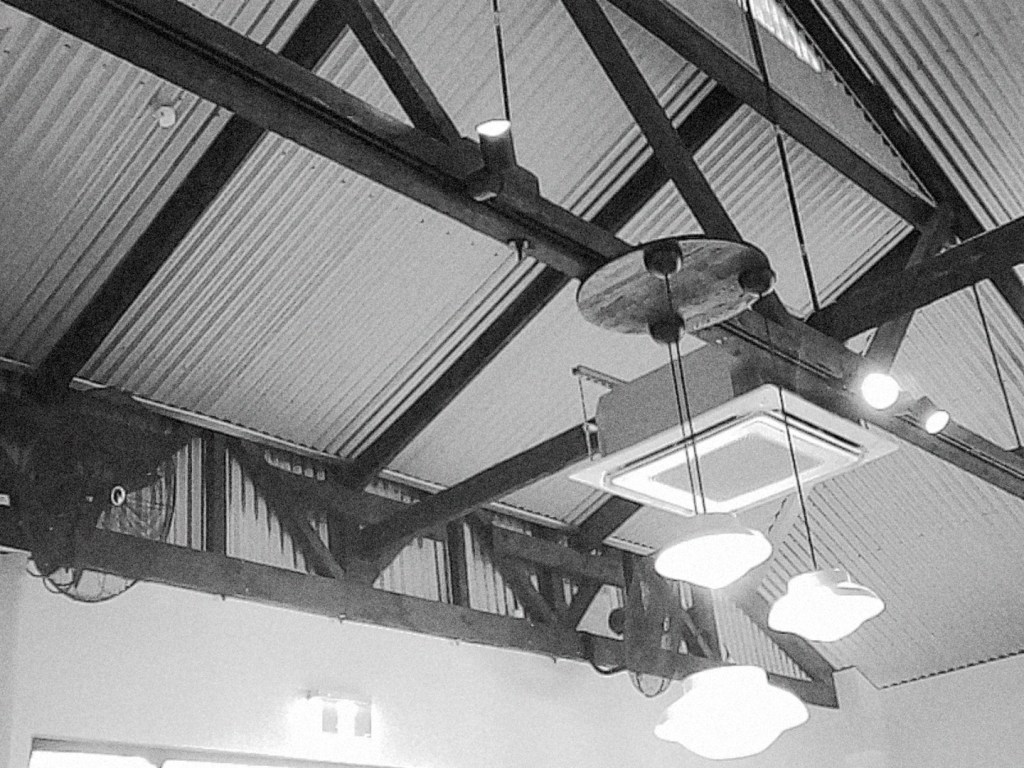
Structures in lo-fi ~ Kodak Charmera set to Black and White, with added Tri-X grain
The Charmera features a number of filters and frames. I like using it in black and white mode, if only to disguise some of the worst noise. Adding some film grain in editing leans into the lo-fi aesthetc and also covers up some of the oversharpening and oversmoothing that toy cameras aggressively apply. Of course, pixel peeping is not what this camera is about, and even adding some simulated film grain in post-processing feels like a bit too much effort! The Kodak Charmera is, if nothing else, a neat fun toy. It’s also stealthy enough to take out for some gritty street photos.
Corrugations and blown highlights in the coffee shop
The Kodak Charmera reminds me of seeing pictures for the first time from cheap old phones and early digital cameras. Maybe it’s not quite the same as seeing an image appear after washing chemicals over a long strip of film, but it does take me back to the early days of digital imaging when we realised we didn’t need to use flatbed scanners anymore to save images of film prints to hard drives so we could email them.
In the last two weeks, we drove ten thousand kilometeres, taking in numerous towns both dusty and tropical. It has been a holiday very long in the planning and the waiting! Now we’re all back home, the old routine is dominant, and our first night in outback accommodation, surrounded by red dust and diesel fumes, seems a distant memory. The ennui associated with returning home from such a journey has certainly hit!
I did make many spur of the moment photos with the plastic Camp Snap. While most of them are mediocre, some are distinctly charming. As I spend time organising and editing the many photos made by my Nikon cameras in the coming months, here are some of the Camp Snap photos I like most:
Seen on an outback road in Queensland – Camp Snap
The warming and softening filters I tacked to the Camp Snap really add some mood to the scene and match well with the outback sun.
An old home in Augathella, QLD
One of my favourite towns from the trip is Augathella. Located in outback Queensland, it had a population of 321 as of 2021. The local cafe operator was eager to say that the town has a crime rate of zero.
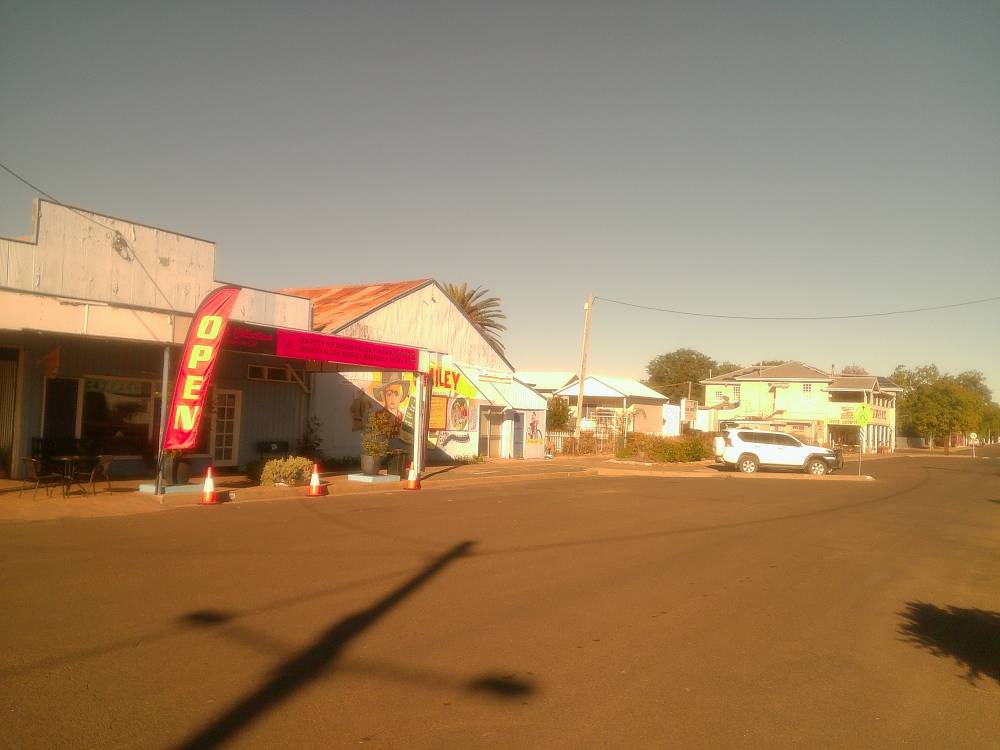
Main street in Augathella
I always sense a feeling of state pride in Queenslanders, as though they represent the best of Australia and every other state is a pale cultural imitation. Every town seems to feature a gimmick, narrative, or site of historical significance to attract the nomads and tourists.
I recently acquired a Photape 85A warming filter (amber) – a colour correction filter normally used on film cameras to correct a mismatch between the colour cast of the scene and the colour temperature of the loaded film. It’s of not much use on modern digital cameras, especially if Automatic White Balance is used, since the camera’s software corrects for the colour cast. If using a custom or preset White Balance, the filter should have an impact, but it’s easier to do this in editing.
In my continuing quest to degrade the photos from the Camp Snap camera, I put the 85A in front of the softening filter, and discovered that the Automatic White Balance of the Camp Snap is not overly sophisticated. It may also be that this cheap toy camera uses a custom White Balance setting. Whatever the case, the old Photape filter does warm things up to a nice amber colour.
Gold Train – Camp Snap Camera with Photape 85A Warming Filter
In my ongoing efforts to further crappify photos from the Camp Snap camera in the quest for feel and vibe, I’m definitely finding a grungy digital look with soft edges. I might not be able to tame the woeful oversharpening and noise reduction of the firmware, but I can absolutely stick some terrible pieces of glass and plastic in front of that tiny lens. Here’s where I really lean into the bad – the soooo bad, it might even be good. Maybe…
Arriving at the station – Camp Snap V105 with double softening filter in low light
Low light, two filters, and a tiny sensor, made through a car windshield – that’s a recipe for an image so grainy you could almost eat it with a spoon. I think it delivers some special digital vibe in a very lo-fi way.
Speeding through digital existence – Camp Snap with all the bad digital stuff
I’m really encouraging all the grain and the blown out highlights in the photo above. Those two stacked diffusion filters and low light conditions have slowed the shutter down so that the train is blurred. Add some spicy high ISO to the mix and this is the sort of image that most photogs would thumb their noses at. I like it. My favourite of the lo-fi digital train series.
I ended up reviewing the Camp Snap camera in my last post ~ a toy camera made for kids on camp who aren’t allowed to take phones. For this purpose, it’s pretty cool, even if it’s overpriced here in Australia. But it also seems that a growing number of youngsters and lomo-hipsters have seen the value in it as an easy-to-use toy camera that makes vibey photos. In reality, the photos are awfully oversharpened and smoothed, but I see the appeal.
In my side-quest to improve the photos by degrading them further, I’ve toyed with some cheap filters. Here are two photos ~ the first without the softening filter and the second with it:
No filterWith cheapo diffusion filter(the cheaper the filter the better, for this purpose)
Already, the results are looking better! The filter spreads highlights around and results in a soft focus effect. Yes, the oversharpening is still there (unless the firmware can be hacked, this remains) but I think the image has more vibe and the sharpening is less obvious. I’m going to continue playing.
I recently purchased something I don’t usually look at – a toy camera that’s been doing the rounds on social media and seems to be popular with Gen Z and others who are looking for some kind of vintage-film-vibe from a digital camera. The Camp Snap is founded on some solid principles: an easy to use camera that kids can use on Summer Camps. In that context, the Camp Snap is actually kind of cool. So, is it any good? Is it worth picking up?
I can thank a gift card for bringing down the price to a level where I was actually interested. Otherwise, this is definitely an overpriced hunk of light plastic for what is essentially a cheap webcam in a shell. And if that sounds like bad news, then it’s likely only bad news if you’re looking for a quality camera that makes quality pictures. But if you’re in the mood for something that could be fun, and you also have a flexible attitude to image-making, then the Camp Snap might be of interest.
Tree at sunset – Camp Snap with my custom filter
Camp Snap camera features
It’s a simple plastic camera for kids with a shutter button that lights up in green, a USB C port for image transfers and charging, a LED flash that’s quite weak, a tiny CMOS sensor that produces 8 megapixel JPGs, and no screen for image reviews apart from a single readout that tells you how many photos you’ve made. Oh, it also comes pre-installed with a 4GB Micro SD card/TF Card. You can change the card if you unscrew a small panel. About the most annoying thing I’ve so far found is that the rubber covering over the USB port is recessed and hard to get my too-short fingernails underneath to lift up.
One thing I like is that it’s possible to use an online tool to create your own filters, spit out a *.flt file, and then drag it across to the root directory of the SD card. When you switch it on, the operating system reads the custom filter and applies the values – contrast, saturation, brightness, hue, RGB gamma – to every photo. In the photo of the tree above, I used a custom filter where I’d altered the RGB gamma values and emphasised mostly greens. It’s a quick experimental filter, so I’ll see how it goes.
Just quickly, if you like this post and want to read more of my words on photography, old cameras, and such, just fill in your email below. I’m grateful for every connection in this digital abyss!
Two trees – Camp Snap V105 with my custom filter
The bad news
If you’re looking for quality images, don’t buy a Camp Snap camera. It’s as simple as that. Hard to believe that anyone would think a cheap toy camera would make quality photos, of course. The photos have plenty of digital noise, are waaaaay oversharpened, and are aggressively denoised. This terrible combination results in photos that look like impressionist paintings when you zoom in. And even if you don’t zoom to look at the aggressive smoothing, you can see distinct sharpening haloes in high contrast scenes. I suspect all of this is to combat the teeny-tiny-noisy CMOS webcam sensor. In modern digital camera terms, it’s a piece of crap.
Vintage vibe?
I guess if you’re into that oversharpened and oversmoothed digital photo look from a 2007 mobile phone, then you’ll consider the Camp Snap a vintage photo-maker. I’ve read claims of it looking film-like and vintage, but this is not film. It really doesn’t look like film. Online claims of the photos looking vintage beyond the results of an old phone camera are a stretch. It’s a maker of jaggy digital images. If you want the film-look, buy a cheap consumer film camera from the 90s. Just be aware that it’s gonna cost you a bunch in film and development costs.
The good news
I bet you’re thinking this is a truly awful camera and I have some premium regrets, right? Actually, no. Apart from the fact that a gift card saved my bank account from what I think is an overpriced and slightly overhyped product, I didn’t buy it thinking it was going to make me quality photos (I have enough Nikon cameras for the whole neighbourhood, frankly). And that’s kinda the point of the camera.
The Camp Snap is easy to use. Really easy. A full battery charge is supposed to last for around 500 photos. That means you can slip it in your pocket day after day and make so many spur of the moment photos that you’ll forget about them until you come to download them – a bit like making film photos and then discovering undeveloped rolls in your drawer much later.
Speaking of spur of the moment, that’s probably the best thing about the Camp Snap. A cheap camera with no screen for reviewing images, a single plastic shutter button, and focus-free operation is a recipe for making photos without the mind being overburdened. It actually promotes a mindful-in-the-momentapproach to making photos. You’ll likely make photos of things you wouldn’t even normally bother with, just to see how they turn out.
That scene of a rubbish bin at sunset? You’re probably not wasting time grabbing your Nikon DSLR to record that moment. But you’ll probably slip the Camp Snap from your pocket, make a quick photo, and then move on. There’s a certain liberation in that. And as long as you don’t expect good quality, some of those photos might even have some digital charm.
Corrupted green – Camp Snap and a corrupted filter
The other cool thing is that you can make your own photo filters and drop them into the root directory. Want to push the greens? You can do that. Want more contrast and saturation? You can do that too. It’s nothing more complex than the sort of thing you can do in any half-decent image editor or phone application, but it does contribute to the fun factor.
That bad looking photo above was made using a filter that, I believe, became corrupted when I used Lightroom to apply tweaks to a PNG file provided by Camper Snapper (a custom third party Camp Snap filter maker) and then truncated to an 8 bit file instead of 24 bits on the file save. It reminds me of a grainy photocopy. What this little mistake tells me is that the Camp Snap provides room for experimentation, and I think that’s fun.
Light on the wall – Camp Snap camera V105 and my custom filter
Room to have fun
The Camp Snap camera might make bad photos, mostly, but I don’t think the makers lean into the bad quite enough. Rather than excessive smoothing and sharpening, I’d rather see more noise and softer images. I’d rather see less quality! This is not quite the digital version of the Diana camera!
You definitely don’t want to zoom in on these photos and pixel-peep, but at small print or web-viewing sizes, you’ll hardly notice the noise patterns or the excessive smoothing. That said, I doubt this is aimed at anyone who’s considering printing these photos out. As a way to focus purely on the moment, put it in a pocket, and return to the bad old days of terrible phone photos surrounded by friends and family and moments, I think the Camp Snap offers some value.
What I will be doing is degrading the photos further. In my short testing with an old Kodak Hawkeye lens in front of the Camp Snap’s tiny lens, the results are soft and colourful and very very blurry. I’ll be striving to make the photos dreamier in future.
There’s a place for a product like this, even if I disagree with the pricing. I can definitely see a lot of young people taking this out to use with friends to record some crazy moments. This is the real appeal of Camp Snap – a simple camera that harks back to the screenless disposable film camera, minus the development costs, and encourages experimentation and fun in the moment.
One common criticism I hear is: “Why would you want such bad and unsharp photos when you have sharp lenses and modern cameras?”
This question assumes that one should only care about sharp and technically perfect photos, as though cameras from yesteryear couldn’t make good photos. There are times when I want sharp photos with lots of latitude for editing and other times when I’m primarily interested in vibe and feel. Toy cameras like this fall into the feel and the vibe category. Even technically poor images can communicate something worthy to a viewer. In the end, it’s the images that matter and not the gear.
Kodak Hawkeye life – Camp Snap camera, freelensing with a Kodak Hawkeye lens














 The Rusty Ruin Journal