I need a distraction from thoughts more serious and sobering, so here I am on Christmas Eve scanning the latest batch of film prints from my Nikon F80. One of the most endearing (or potentially annoying, depending on when you were born) things about using film is the journey of getting through a roll so it can be developed. There’s a prevailing attitude that each frame of film is to be savoured – each shutter press is an adventure in the slow, deliberate, and mindful approach to making photos. But sometimes, you just want to blow through the last few exposures to get the canister into the local lab.
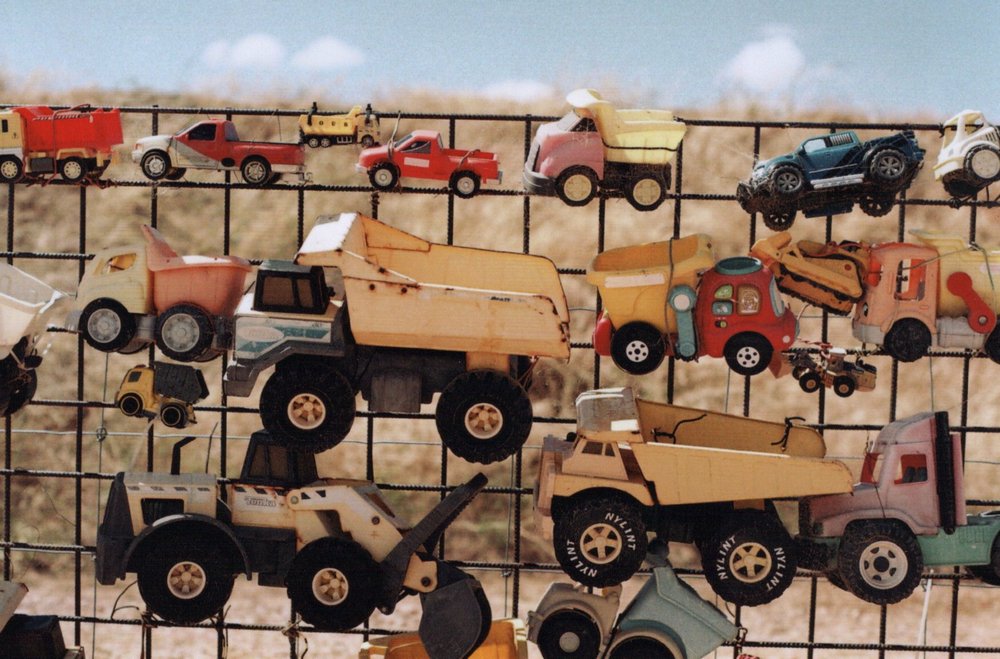
Tiny toy trucks in the sun – Nikon F80 and Fuji Superia 35mm colour film, overexposed by 1 stop
I think I fared a little better with this roll than my last. I was quite frugal and deliberate this time around with the old Nikon, resulting in several more keepers. The expired Fuji Superia film features a lovely fine grain and exposure latitude. As much as Kodak Ultramax 400 is the everyperson of the modern consumer film world, Fuji have made some superb emulsions over the years.
Graffiti on The Tanks, near Whyalla South Australia
I’ll admit that using the Nikon F80 in recent weeks seems to have revived my interest in rehabilitating my film cameras. Sadly, I have found so far that some of them are simply not working any longer. Some are victims of my forgetfulness ~ a lesson in never leaving cheap batteries inside cameras to leak rivers of toxic sludge and potassium carbonate. Others have succumbed to the dusty decades and have slow shutters, wonky gears, faded rangefinder markings, and internals that have simply kicked the bucket. Happily, I seem to have successfully revived my Yashica Electro 35. I’ll have to put a roll through it to really test it out.
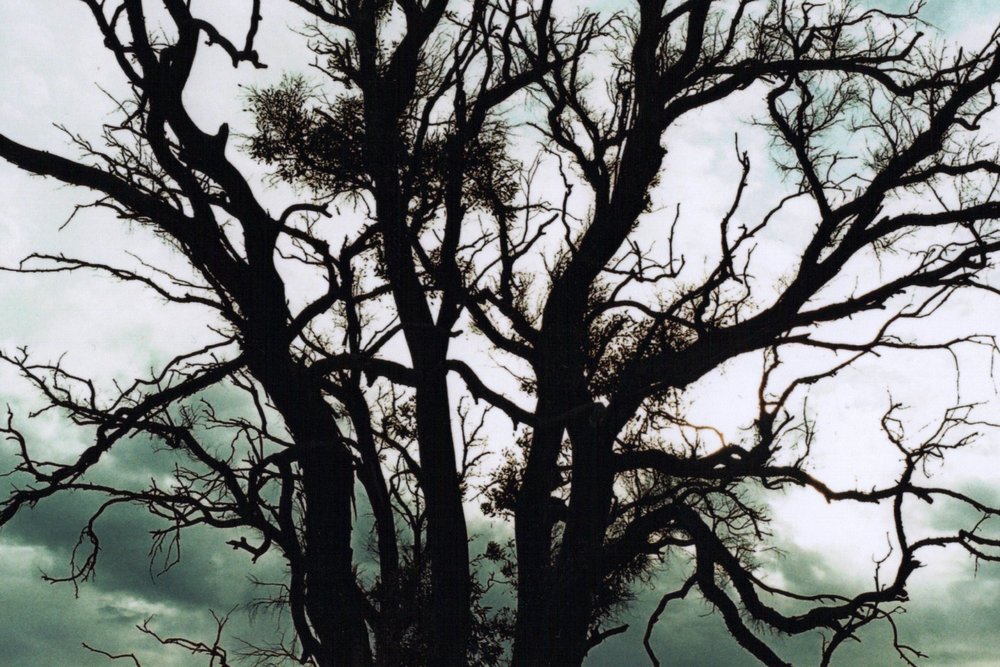
Moody tree near the old train-line, late in the afternoon
I’ve briefly mentioned elsewhere that I used film cameras growing up. They were nothing too special though. I think my last film camera was an APS (Advanced Photo System) camera from Fujifilm. I liked that this format offered features like extra frames, easy-loading, and panoramic view. In some ways, it was the easy-to-use precursor to digital. It didn’t last long in the camera world as photographers didn’t like the reduction in frame size or the noticeable grain due to the crop. The market take-up of digital was not too far behind either, so APS remains the last turn of the millennium gasp of companies trying to squeeze every final buck out of film.
Sometimes, photographers say they have a relationship with film. I suppose that you might have a fondness for it if photography had been a big part of your life growing up. For me, film cameras were just there for special occasions. I knew exactly one person who had any professional camera gear, and I never saw them use it. My parents were certainly never interested in cameras, other than to document birthdays and other events. Rarely, I might receive a 110 format camera, the aforementioned APS camera, or go out and buy one of the cheapo plastic disposables. The best 35mm film camera I ever owned was given to me by my late father – a Chinon with a tiny lens and auto-rewind. I used it for a while until the film motor broke down.
I didn’t nurture a passion for photography from a young age, partly due to not having the financial means or the inspiration around me. Some of it also has to do with the fact that I’ve never been very technically minded or confident in my ability to learn such things. I always saw high-end photography as the pursuit of those who could afford it and those who could understand the numbers behind it.
When I was gifted my first APS camera, I enjoyed the ease of the exercise. I probably made more photos with that camera than with any other previously. I’ve since lost those photos, but I do remember becoming very interested in framing scenes and doing so in a way that pleased me. I think this is when I really started to develop an interest in the wider world of photography, though my bank account wasn’t always up to the challenge.
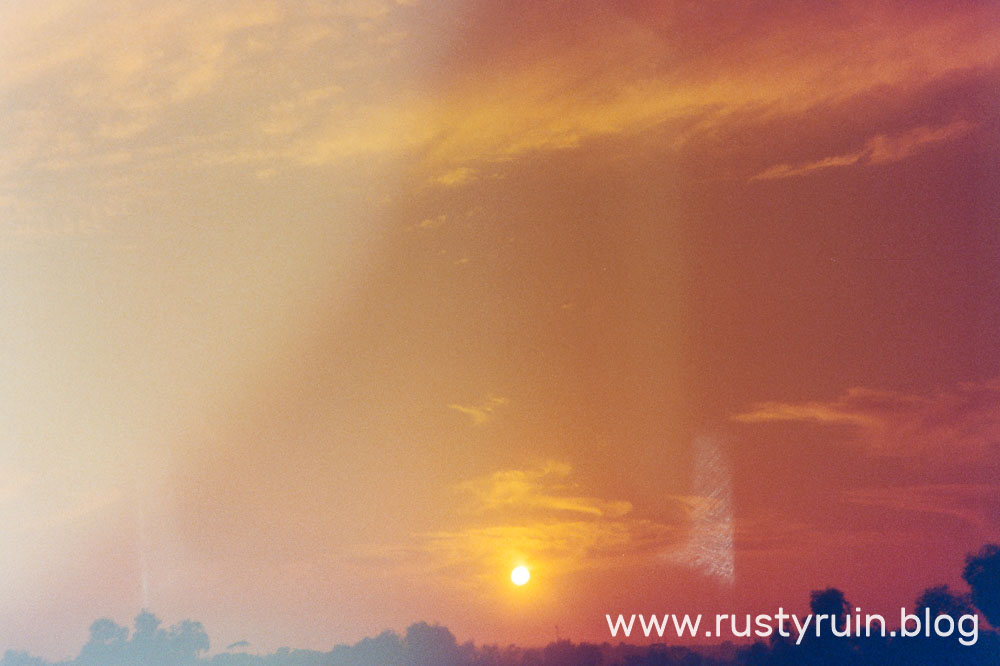
Very OrangeSunset – Smena 8 with home-made redscale film
When digital cameras came along, I was pretty excited. Though my first was a Kodak with a measly 1 megapixel and terrible battery life, I loved the immediacy of the experience. There’s something to be said for waiting for film to develop and unwrapping it like a gift, but digital offered me the chance to learn how to make better photos through immediate feedback. That’s when things started to really make sense to me and my, up to that point, nebulous and undefined interest in photography solidified.
Many people think that 35mm, or so-called full-frame, sensor cameras are the final destination in terms of photo gear. Nikon, for example, has pursued a marketing strategy of dragging users towards entry-level full-frame cameras over the years, with the DX line of lenses suffering as a result. Of course, a 35mm sensor is simply one size, and certainly not even the largest size that photographers use. Lets not forget medium format or large format film.
Glow above the Arafura Sea – Nikon Z5
I’m no stranger to APS-C cameras, Micro Four Thirds, and smaller. I have plenty of film cameras, including medium format. The idea that 35mm is the ultimate has never been of much concern to me. So, why did I buy the Nikon Z5 only several months ago?
Why use a 35mm camera?
I don’t think that a 35mm digital camera is the right choice for everybody. In fact, I don’t think it’s the right choice for most people who enjoy the more casual side of photography. And even then, superb images can be made with smaller cameras and smaller sensors, especially due to the kinds of advances that have been made in sensor design.
Here are some reasons why I was interested in the Nikon Z5:
Better low-light performance: A bigger sensor means that more light can be soaked up by the photo-sites, making low light photography easier at lower ISOs, thus resulting in less noise. In practice, I found myself still using my Nikon Z5 at 100 ISO at dusk with reasonably fast shutter speeds.
Depth of field: Though a 50mm lens is still a 50mm lens whether it’s on a Micro Four-Thirds camera or a Nikon Z5, you need to move closer to your subject to get the equivalent field of view with that same lens on a 35mm format camera. This also means that you can get shallower depth of field more easily because you’re closer. That said, I’m really more of a deep depth of field kind of person, mostly.
Old lens character: Not only do I get to use a nifty-fifty (or any other focal length) and see what that field of view actually looks like as it did back in 35mm film days, but I also get to see the entire character of the lens rather than just use the central portion of the glass, as I would when using a camera with a smaller sensor. Though, most of the time this character equals mushy edges and corners.
Cahill’s Crossing looking the other way – Nikon Z5
Is the Nikon Z5 replacing everything?
No, the Nikon Z5 is definitely not replacing my other cameras. It’s just another tool that provides certain benefits that are useful at certain times. And there are also some growing pains for me when using it. I’m so used to using smaller sensor cameras like the Olympus OMD EM5 Mark 1 and 2, that the mindset change, especially around setting the aperture, can be challenging at times.
As someone who uses a lot of deep depth of field, the idea that I can’t always set the aperture at f5.6 or f8 challenges my habits. To maintain the same depth of field at the equivalent focal length on the Nikon Z5 as I would have on a camera with a smaller sensor, I often find myself reaching for any F-stop between 8 and 16. Yes, there are times when my Micro Four-Thirds Olympus is the best camera for the job.
Having lunch among the trees – Nikon Z5
Despite the challenges around depth of field, my Nikon Z5 can produce wonderful images and I find myself thinking longer about every photo, likely because I have to also seriously think about my aperture setting versus distance to my subject. And that 24 megapixel sensor, when combined with good Z glass, is very sharp indeed.






 The Rusty Ruin Journal