West MacDonnell Ranges aglow 1 – Nikon Z5 and Nikkor 40mm F2 lens
Upon driving back to Alice Springs after a long day on the road, the sun hit the ancient earth just right, and we pulled the car over to a patch of gravel. Like a long red serpent from The Dreamtime, stretching across the land, the rocky ridges were awash in the sun’s eventide glow. The photos here really don’t do it justice. How can one encapsulate over a thousand million years of geological history? It’s a land that feels as old as Time itself.
West MacDonnell Ranges aglow 2 – Nikon Z5 and Nikkor 40mm F2 lens
In a rush to exit the car, switch on the Nikon, and frame the scene before the light faded, I was amused by my scurrying about in the shadow of those ancient red rocky giants of earth. How many people had done the very same thing – catch the red glow of sunset across the hard-edged boulders, crags, and rocky outcrops? Many millions of sunsets across that land and there I was, one small thing in the vastness, fiddling with my camera, hoping to stop time.
The clouds are slowly dissipating after several months of grey days. This weekend provided an opportunity to drive around the vibrant towns of the Murray River. I packed my bag with the Olympus E-1, Nikon Z5, and the Sony RX100.
I continue to be impressed with the output from the old E-1, but dynamic range is limited, and careful consideration of a scene is required before clicking the shutter button, I’ve discovered.
Shadows on emerald metal – Olympus E-1
Window of opportunity
Every digital sensor (and film, of course) has a limited performance window within which it can optimally render the dynamic range of a scene. If the dynamic range (brightest and darkest areas) of a scene exceed the window, then an exposure decision must be made: crush blacks or burn highlights? Modern sensors have a bigger window, so provide more latitude. The E-1, not so much.
Scenes with plenty of mid-tones and minimal strong highlights / deep shadows are good for this camera. Evenly lit scenes are great too. With excessive tonal ranges, I usually crush blacks because it’s less distracting for the eye, but it depends on how numerous the extreme tonal ranges are and the composition I’ve decided on.
Unused, catching dust and webs – Olympus E-1
The onboard tonal response of the Olympus is contrasty. Again, great for evenly lit scenes that could use a contrast bump, but not so great for extreme tonal ranges where pushing them further causes distracting visual elements. The more I use this camera, the better I get at evaluating scenes before picking the camera up. And if I can frame a scene and limit the extreme tonal ranges, I’ll do that. I also commonly dial in some negative Exposure Compensation to protect highlights but only when I want to preserve better gradation of tone over areas where distracting highlights could be a problem. Evenly lit scenes don’t need it unless that’s the look I’m going for.
Beneath the old machine – Olympus E-1
Calibrated for the old film pros?
It’s clear to me that the RAW files from the Olympus E-1 are different to the RAW files we get from modern cameras, but I don’t think this is a CMOS or CCD issue. The native tonal response of the E-1 produces files that are already contrasty and punchy. The images on this page are essentially the RAW output with barely any editing at all.
Some people might say I should use OM Workspace to get the colour goodness from this camera, but the software remains awful to use. And the few RAW files from the E-1 I’ve loaded into OM Workspace produce much the same initial result as the Adobe Standard profile in Lightroom, though my testing isn’t extensive enough to warrant strong views.
So, back to my speculation on the punchy files from the E-1. In 2003, when the camera was released, digital photography wasn’t mainstream. It’s entirely possible that early cameras like this were internally calibrated to produce images that were as close to certain film types as possible in terms of punchiness and also required less editing in software. Remember, there wasn’t a lot of RAW editing software around at the time.
None of that means these old cameras make filmic photos, but it may explain why there seem to be differences in output compared to our modern cameras. I think this is less about the inherent properties of a CCD sensor and more about what kinds of photos the film companies wanted us to see from their cameras via internal calibrations. Now that photo editing programs are numerous and commonplace, modern cameras that have more dynamic range than the E-1 are calibrated to output flat RAW files that can easily be edited. Just speculation, of course.
In my previous post, I spoke about the eerie ruins of the accommodation complex at Wycliffe Well. To the best of my knowledge, the large bush-fire in this area still rages uncontrolled. Such is the creation and destruction cycle of life in outback Australia. One day you’re listening to tourists recount stories about Min Min Lights and the next you’ve sold your long-term outback business and it now lies in ruins at the feet of new owners, unlikely to be repaired. Life moves on quickly and time is uncaring.
Anyone for the Ladies Toilets? – Nikon Z5
At this point in the road-trip, I was still getting used to the Nikon Z5. It’s a lovely camera, without doubt, but I need to get into the habit of choosing smaller F-stops to create a deeper depth of field when close to my subject. For many of these photos I used the excellent Nikkor 40mm F2 lens. I’m a sucker for prime lenses and this one is certainly good bang for the buck, despite the all-polycarbonate mount. It’s one sharp lens for sure!
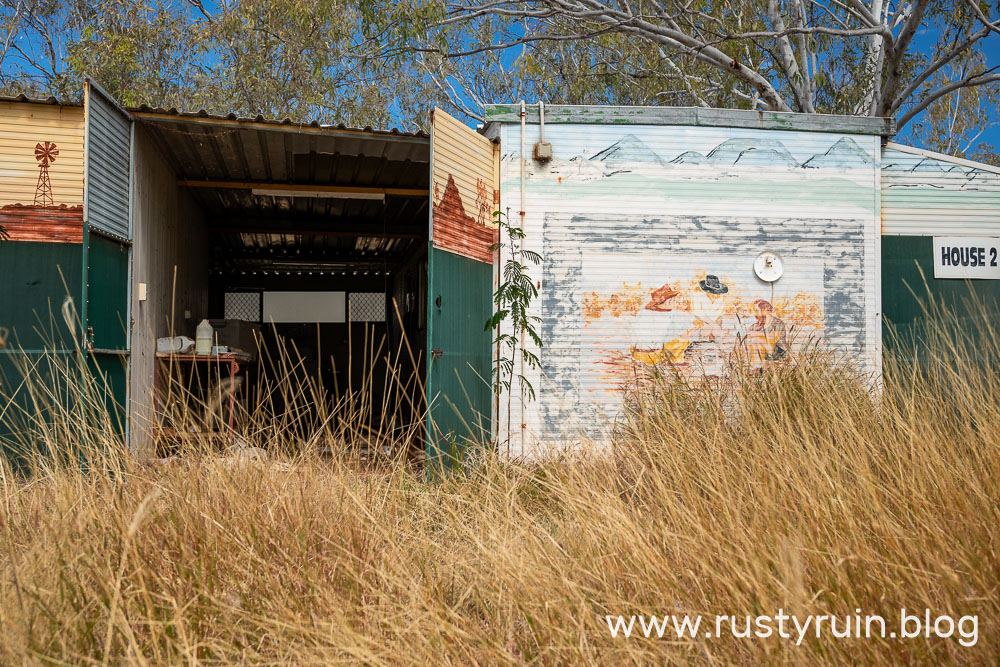
House 2 – Nikon Z5
I also used the 52mm B+W Circular Polarising Filter. This helps to cut stray reflections and saturate the colours so editing isn’t so burdensome. But using the CPL is not for every occasion. It’s great for cutting reflections, deepening the colour of foliage, and good if you want to photograph water, but it does tend to make photos look a bit flat and unnatural at times. I find that I always need to add contrast during the editing process just to cut that flatness.
Your caravan awaits – Nikon Z5
As you can see, the skies also really come alive when using the CPL. Sometimes it’s a bit too much, honestly. One year, I remember using it extensively around Alice Springs and the skies looked so dark they were almost purple. Now, I twist the brass ring of the CPL until it hits maximum effect and then dial it back a little to add some natural reflection to the scene. I think I used it quite judiciously on this outback journey.
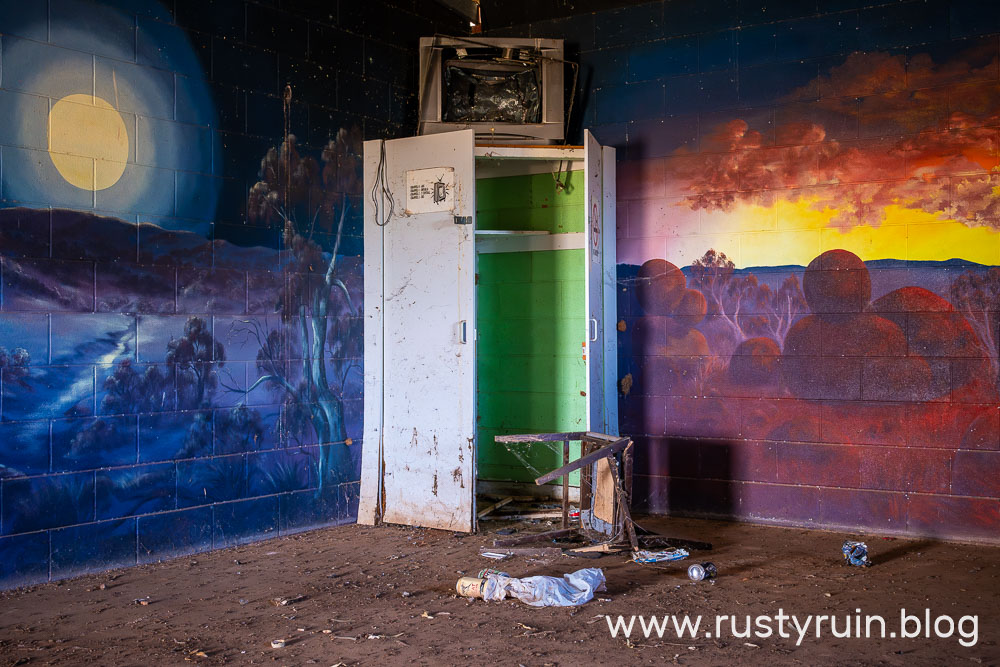
Welcome to the TV Room – Nikon Z5
The Z5 is very comfortable at ISO 6400 and I’m comfortable using it when required. I think I got away with ISO 3200 in the above photo and used Lightroom’s great AI-based noise reduction to smooth it all out. That’s a good use of AI technology, as far as I’m concerned. Really love that artwork too, though the TV has seen better days.
Sometimes, on those long and lonely roads through outback Australia, you come across things you don’t expect to see. Burned out cars flipped on the roadside are commonplace. So too are the broken bottles, campfire ashes, and plastic rubbish that litter desolate truck stops. What you don’t expect to see is an old campground and motel that lies in ruins, featuring an alien and UFO theme. This is Wycliffe Well – once known as Australia’s UFO sighting capital.
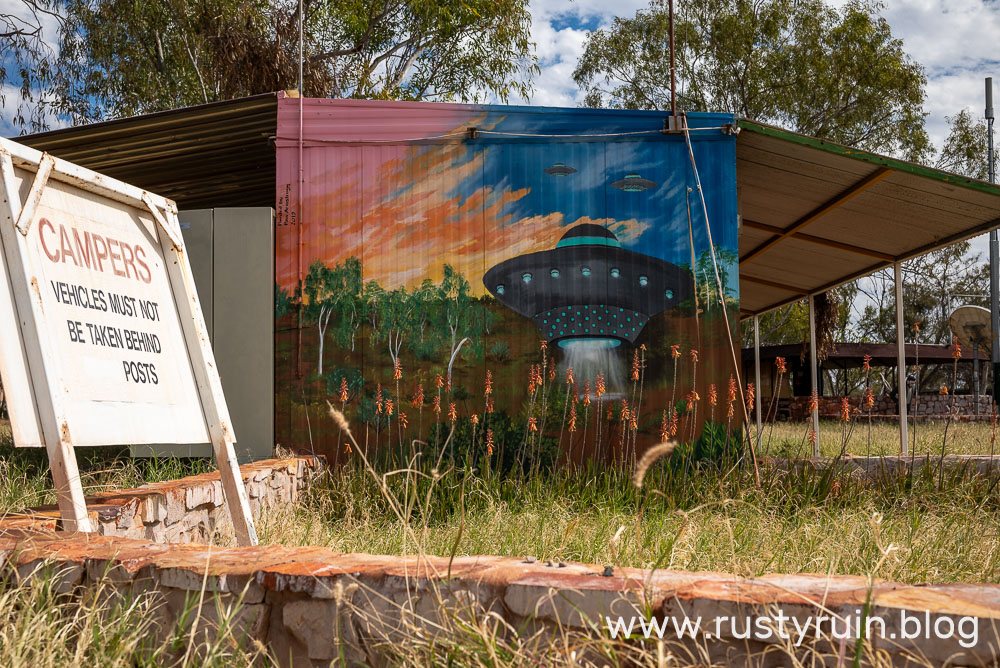
Attention Campers – Nikon Z5
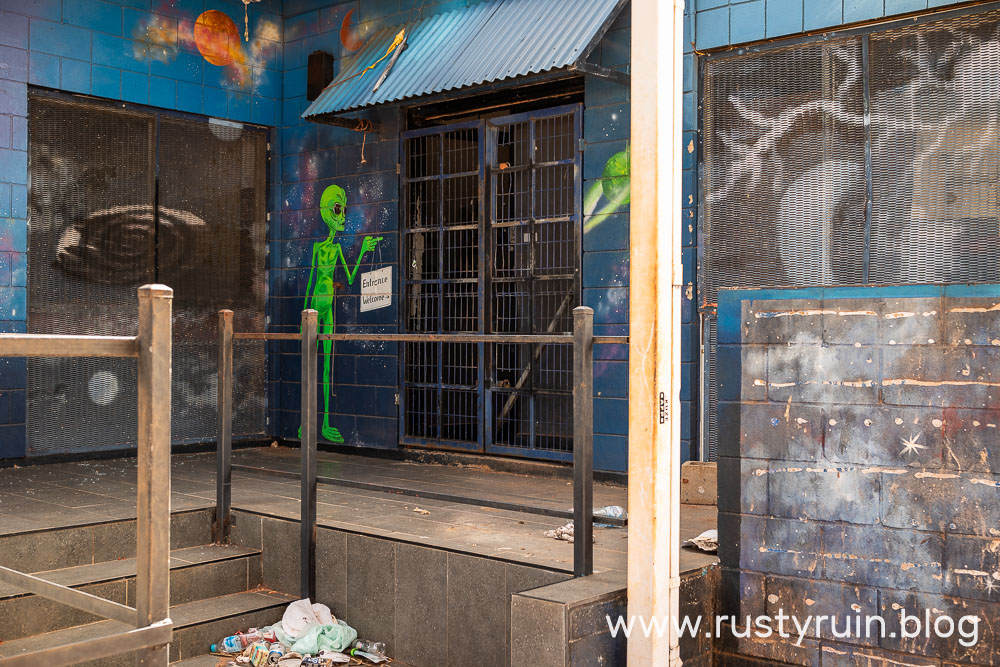
In this ruined complex of dormitories, recreation rooms, and offices, we found the remains of glory days, when the site was home to a thriving community looking for their first UFO sighting. The signs are everywhere, including alien murals and painted UFO landings, as well as enigmatic depictions of Karlu Karlu (otherwise known as Devil’s Marbles), providing the geological majesty that perhaps fired the imaginations of UFO spotters who saw lights in the sky around here decades ago.
Welcome – Nikon Z5
The story of the site is a familiar one from a business perspective. It was owned for a long time by one family and managed by an ambitious man who drew upon the UFO mystery to market the facilities effectively to tourists. There were glory days, as the bar and large on-site restaurant provided rollicking evenings of food and music to guests. Finally, they decided to sell up and less enthusiastic owners took the reins whilst promising to repair and maintain the place. It now lies in ruins after flood waters ravaged the site. And there’s little doubt that tourism dried up in the wake of the Covid pandemic.
House 1 – Nikon Z5
It’s an eerie place to explore on the way to somewhere else. Though vandals have long since taken plenty of souvenirs, the site remains a strange and melancholy tribute to outback Australia’s tourist economy and the challenges of surviving in remote locations. Sadly, it’s now at risk of further damage, as huge uncontrolled bush-fires are currently sweeping through the area.





 The Rusty Ruin Journal