In my last post, I wrote about experimenting with the Focus module in Exposure X7 to add slight blur and bloom. This goes some way towards reviving the look of old soft lenses that lack modern anti-glare coatings. It’s potentially a great fit for the low resolution results from toy cameras like the Camp Snap and others because it reduces the ugly haloes around edges that have been aggressively sharpened.
You can see in the photo of the Tree of Knowledge above that the Soften and Diffuse preset in the Focus module adds glow around the highlights, giving it an ethereal quality that contrasts well against the sharply angled boughs of the tree and the descending wooden timbers.
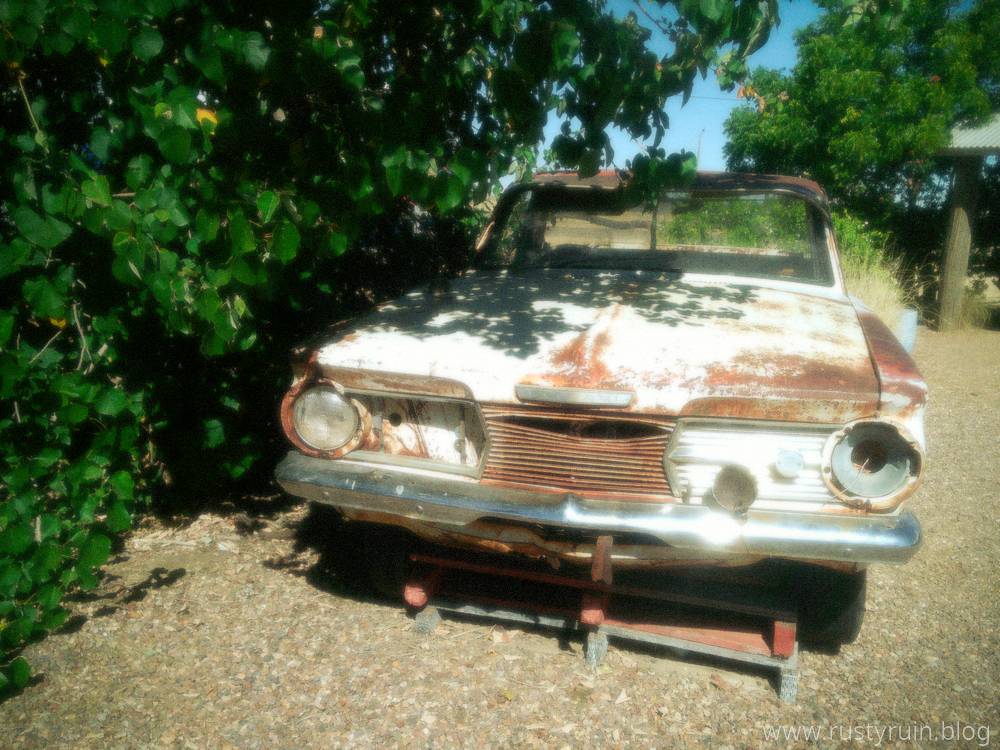
Old car in the shade – Camp Snap
Here again, the highlights take on a nice soft glow. Everything seems ever so slightly blurred and the sharpened edges are softened considerably.
I think the glow effect in some of these photos is more pronounced because I’d used the Camp Snap with two filters attached: a Photape Warming filter, and a cheap diffusion filter that adds glow and softens highlights. I’ve since removed the filters and will experiment further.
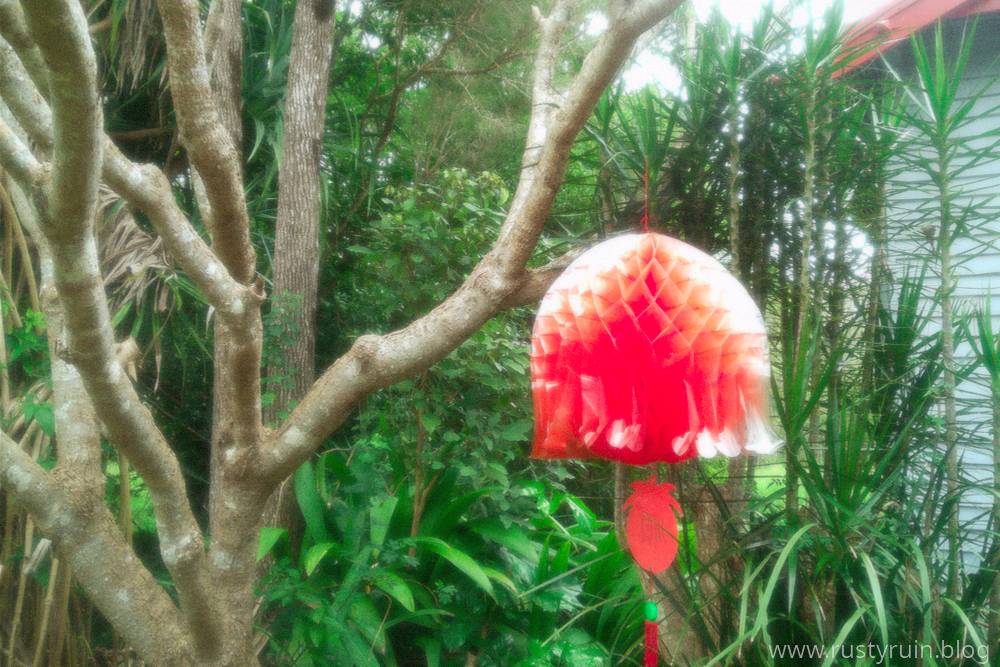
The red lantern – Camp Snap
You can see how the Camp Snap struggles to handle the strong red colour of the lantern. The result is a blown out mess where the details are lost.
A rocky coastline – Camp Snap
The Camp Snap is great for scenes like this, where there are more mid-tones than bright highlights – sky, sea, and cloud in distinct layers. It’s the kind of seascape that I might have snapped with my old Kodak 110 format film camera as a teenager.
One of my biggest issues with the Camp Snap is the aggressive noise reduction and oversharpening. The latter results in ugly haloes that are especially visible in backlit scenes. Adding film grain to the image in Exposure X7 combats this to some extent, and also effectively breaks up oversmoothed areas, but it’s not an ideal solution. But I think I might just have found a better way.
Old machinery in outback Queensland – Camp Snap plus softening and warming filters
The Focus section in Exposure X7 contains a useful preset called Soften – Diffuse Glow. This module mimics vintage lenses that are softish and bloom the highlights. I have now created a preset that adds blurring and blooming, slight vignetting, and fine film grain.
Even though the Camp Snap is a toy camera, it features good sharpness and resolution when compared to other toy cameras like the Kodak Charmera, the G6 Thumb Camera, and the Chuzhao. More importantly, Camp Snap photos don’t seem to feature obvious interpolation artifacts because I don’t think it’s resizing images beyond the native resolution of the sensor. Both the G6 and the Chuzhao feature these unattractive digital artifacts.
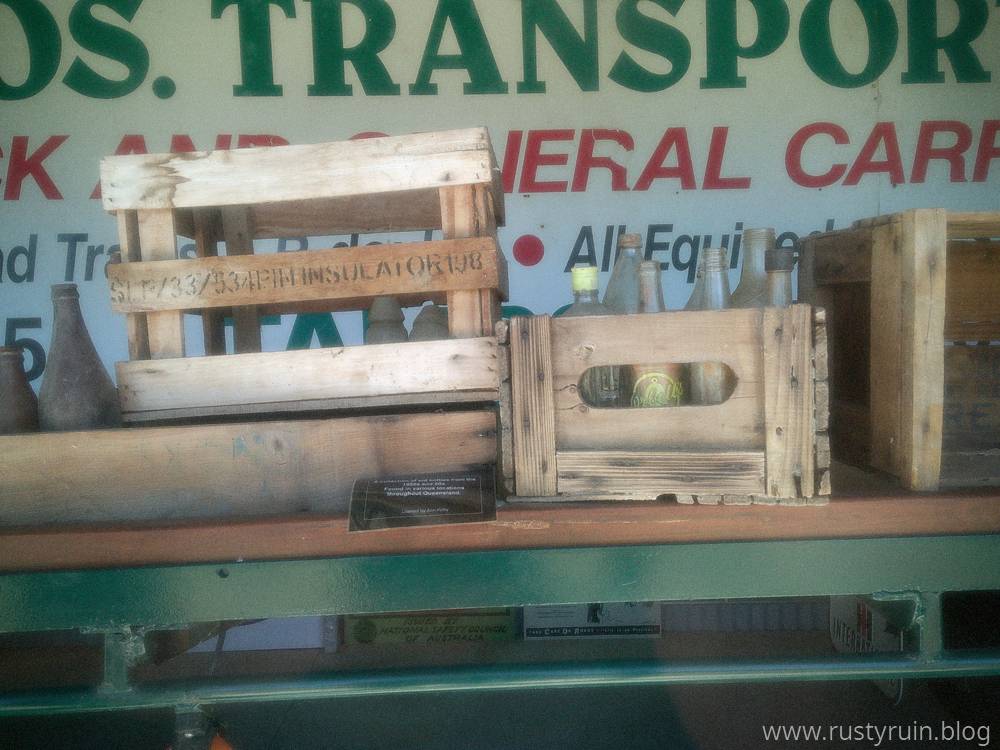
Transport museum window – Camp Snap
Tonight I went back and edited a bunch of Camp Snap photos. The Focus module seems to effectively soften the hard edges and sharpening haloes. I’ll be playing with this a lot more.
It seems I’ve barely had a moment to do anything with the hundreds of photos stored on SD cards since the recent long road-trip. I think everyone is still adapting to life back at work and home.
Additionally, I’ve just had a significant laptop upgrade. The process of moving files and installing software after a day at work is challenging for an exhausted mind and body. So, a short post to remind myself that I can still catch five minutes to do something other than work, chores, or tech-upgrades.
The old crocodile is watching – Camp Snap with cheapo filters
I’m at it with the plastic Camp Snap camera again! Having stopped at a bridge spanning one of Queensland’s many rivers, I noticed this cool looking crocodile eye staring at me. Someone really took their time painting it.
During the process of my laptop upgrade, I was reminded how cumbersome and haphazard my file organisation is – photo folders here, there, and everywhere. A long late afternoon and evening was spent removing old drives from old computers and locating important folders. This was after the included Windows 11 install failed on the new laptop! I gave the go-ahead for a friend to install Windows 10 instead.
It also reminds me how much I don’t like Lightroom’s photo catalogue system. Using Microsoft OneDrive (yes, we pay for it and it offers a lot of space even though it’s maddening to use at times and isn’t nearly as competent as other such services) was meant to simplify my photo-storage life. While it does offer peace of mind through back-up, the sheer volume of photos is getting out of hand. I must delete more!
Deleting more of our personal digital stuff, or at least minimising the digital junk that trail behind us, seems like a good idea in a world where too many things sit on forgotten storage around the world. The digital footprintswe leave behind serve as both a record of our online travels and a resource that may be extracted by faceless profiteers, marketers, and criminals – something we should certainly be wary about.
In the last two weeks, we drove ten thousand kilometeres, taking in numerous towns both dusty and tropical. It has been a holiday very long in the planning and the waiting! Now we’re all back home, the old routine is dominant, and our first night in outback accommodation, surrounded by red dust and diesel fumes, seems a distant memory. The ennui associated with returning home from such a journey has certainly hit!
I did make many spur of the moment photos with the plastic Camp Snap. While most of them are mediocre, some are distinctly charming. As I spend time organising and editing the many photos made by my Nikon cameras in the coming months, here are some of the Camp Snap photos I like most:
Seen on an outback road in Queensland – Camp Snap
The warming and softening filters I tacked to the Camp Snap really add some mood to the scene and match well with the outback sun.
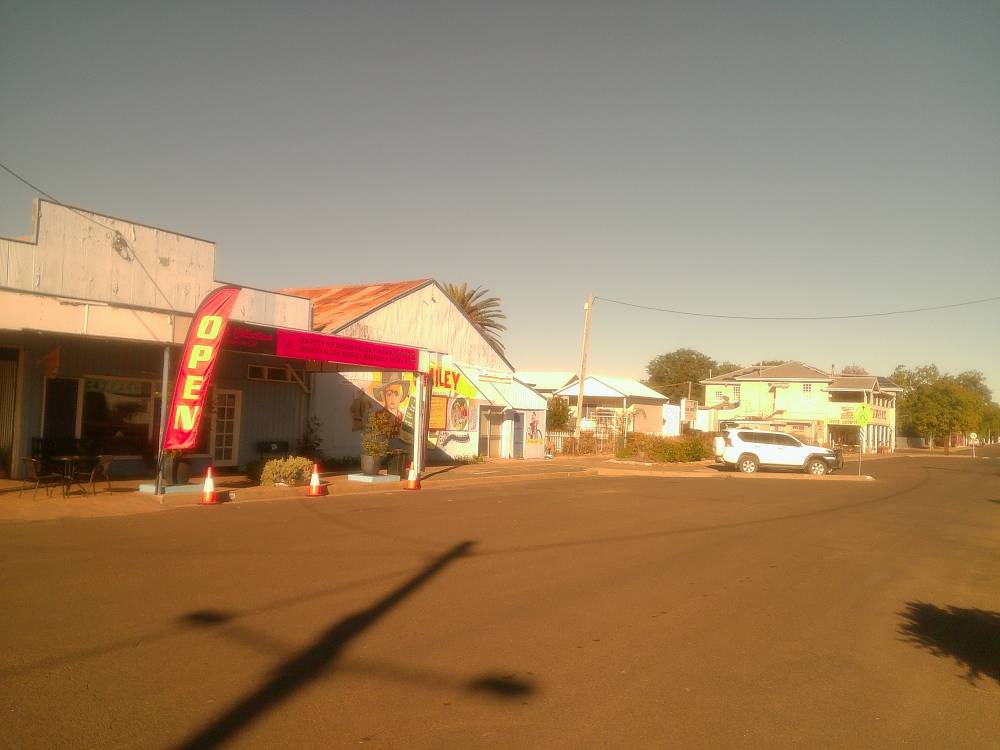
An old home in Augathella, QLD
One of my favourite towns from the trip is Augathella. Located in outback Queensland, it had a population of 321 as of 2021. The local cafe operator was eager to say that the town has a crime rate of zero.
Main street in Augathella
I always sense a feeling of state pride in Queenslanders, as though they represent the best of Australia and every other state is a pale cultural imitation. Every town seems to feature a gimmick, narrative, or site of historical significance to attract the nomads and tourists.
I recently acquired a Photape 85A warming filter (amber) – a colour correction filter normally used on film cameras to correct a mismatch between the colour cast of the scene and the colour temperature of the loaded film. It’s of not much use on modern digital cameras, especially if Automatic White Balance is used, since the camera’s software corrects for the colour cast. If using a custom or preset White Balance, the filter should have an impact, but it’s easier to do this in editing.
In my continuing quest to degrade the photos from the Camp Snap camera, I put the 85A in front of the softening filter, and discovered that the Automatic White Balance of the Camp Snap is not overly sophisticated. It may also be that this cheap toy camera uses a custom White Balance setting. Whatever the case, the old Photape filter does warm things up to a nice amber colour.
Gold Train – Camp Snap Camera with Photape 85A Warming Filter
In my ongoing efforts to further crappify photos from the Camp Snap camera in the quest for feel and vibe, I’m definitely finding a grungy digital look with soft edges. I might not be able to tame the woeful oversharpening and noise reduction of the firmware, but I can absolutely stick some terrible pieces of glass and plastic in front of that tiny lens. Here’s where I really lean into the bad – the soooo bad, it might even be good. Maybe…
Arriving at the station – Camp Snap V105 with double softening filter in low light
Low light, two filters, and a tiny sensor, made through a car windshield – that’s a recipe for an image so grainy you could almost eat it with a spoon. I think it delivers some special digital vibe in a very lo-fi way.
Speeding through digital existence – Camp Snap with all the bad digital stuff
I’m really encouraging all the grain and the blown out highlights in the photo above. Those two stacked diffusion filters and low light conditions have slowed the shutter down so that the train is blurred. Add some spicy high ISO to the mix and this is the sort of image that most photogs would thumb their noses at. I like it. My favourite of the lo-fi digital train series.
I recently purchased something I don’t usually look at – a toy camera that’s been doing the rounds on social media and seems to be popular with Gen Z and others who are looking for some kind of vintage-film-vibe from a digital camera. The Camp Snap is founded on some solid principles: an easy to use camera that kids can use on Summer Camps. In that context, the Camp Snap is actually kind of cool. So, is it any good? Is it worth picking up?
I can thank a gift card for bringing down the price to a level where I was actually interested. Otherwise, this is definitely an overpriced hunk of light plastic for what is essentially a cheap webcam in a shell. And if that sounds like bad news, then it’s likely only bad news if you’re looking for a quality camera that makes quality pictures. But if you’re in the mood for something that could be fun, and you also have a flexible attitude to image-making, then the Camp Snap might be of interest.
Tree at sunset – Camp Snap with my custom filter
Camp Snap camera features
It’s a simple plastic camera for kids with a shutter button that lights up in green, a USB C port for image transfers and charging, a LED flash that’s quite weak, a tiny CMOS sensor that produces 8 megapixel JPGs, and no screen for image reviews apart from a single readout that tells you how many photos you’ve made. Oh, it also comes pre-installed with a 4GB Micro SD card/TF Card. You can change the card if you unscrew a small panel. About the most annoying thing I’ve so far found is that the rubber covering over the USB port is recessed and hard to get my too-short fingernails underneath to lift up.
One thing I like is that it’s possible to use an online tool to create your own filters, spit out a *.flt file, and then drag it across to the root directory of the SD card. When you switch it on, the operating system reads the custom filter and applies the values – contrast, saturation, brightness, hue, RGB gamma – to every photo. In the photo of the tree above, I used a custom filter where I’d altered the RGB gamma values and emphasised mostly greens. It’s a quick experimental filter, so I’ll see how it goes.
Just quickly, if you like this post and want to read more of my words on photography, old cameras, and such, just fill in your email below. I’m grateful for every connection in this digital abyss!
Two trees – Camp Snap V105 with my custom filter
The bad news
If you’re looking for quality images, don’t buy a Camp Snap camera. It’s as simple as that. Hard to believe that anyone would think a cheap toy camera would make quality photos, of course. The photos have plenty of digital noise, are waaaaay oversharpened, and are aggressively denoised. This terrible combination results in photos that look like impressionist paintings when you zoom in. And even if you don’t zoom to look at the aggressive smoothing, you can see distinct sharpening haloes in high contrast scenes. I suspect all of this is to combat the teeny-tiny-noisy CMOS webcam sensor. In modern digital camera terms, it’s a piece of crap.
Vintage vibe?
I guess if you’re into that oversharpened and oversmoothed digital photo look from a 2007 mobile phone, then you’ll consider the Camp Snap a vintage photo-maker. I’ve read claims of it looking film-like and vintage, but this is not film. It really doesn’t look like film. Online claims of the photos looking vintage beyond the results of an old phone camera are a stretch. It’s a maker of jaggy digital images. If you want the film-look, buy a cheap consumer film camera from the 90s. Just be aware that it’s gonna cost you a bunch in film and development costs.
The good news
I bet you’re thinking this is a truly awful camera and I have some premium regrets, right? Actually, no. Apart from the fact that a gift card saved my bank account from what I think is an overpriced and slightly overhyped product, I didn’t buy it thinking it was going to make me quality photos (I have enough Nikon cameras for the whole neighbourhood, frankly). And that’s kinda the point of the camera.
The Camp Snap is easy to use. Really easy. A full battery charge is supposed to last for around 500 photos. That means you can slip it in your pocket day after day and make so many spur of the moment photos that you’ll forget about them until you come to download them – a bit like making film photos and then discovering undeveloped rolls in your drawer much later.
Speaking of spur of the moment, that’s probably the best thing about the Camp Snap. A cheap camera with no screen for reviewing images, a single plastic shutter button, and focus-free operation is a recipe for making photos without the mind being overburdened. It actually promotes a mindful-in-the-momentapproach to making photos. You’ll likely make photos of things you wouldn’t even normally bother with, just to see how they turn out.
That scene of a rubbish bin at sunset? You’re probably not wasting time grabbing your Nikon DSLR to record that moment. But you’ll probably slip the Camp Snap from your pocket, make a quick photo, and then move on. There’s a certain liberation in that. And as long as you don’t expect good quality, some of those photos might even have some digital charm.
Corrupted green – Camp Snap and a corrupted filter
The other cool thing is that you can make your own photo filters and drop them into the root directory. Want to push the greens? You can do that. Want more contrast and saturation? You can do that too. It’s nothing more complex than the sort of thing you can do in any half-decent image editor or phone application, but it does contribute to the fun factor.
That bad looking photo above was made using a filter that, I believe, became corrupted when I used Lightroom to apply tweaks to a PNG file provided by Camper Snapper (a custom third party Camp Snap filter maker) and then truncated to an 8 bit file instead of 24 bits on the file save. It reminds me of a grainy photocopy. What this little mistake tells me is that the Camp Snap provides room for experimentation, and I think that’s fun.
Light on the wall – Camp Snap camera V105 and my custom filter
Room to have fun
The Camp Snap camera might make bad photos, mostly, but I don’t think the makers lean into the bad quite enough. Rather than excessive smoothing and sharpening, I’d rather see more noise and softer images. I’d rather see less quality! This is not quite the digital version of the Diana camera!
You definitely don’t want to zoom in on these photos and pixel-peep, but at small print or web-viewing sizes, you’ll hardly notice the noise patterns or the excessive smoothing. That said, I doubt this is aimed at anyone who’s considering printing these photos out. As a way to focus purely on the moment, put it in a pocket, and return to the bad old days of terrible phone photos surrounded by friends and family and moments, I think the Camp Snap offers some value.
What I will be doing is degrading the photos further. In my short testing with an old Kodak Hawkeye lens in front of the Camp Snap’s tiny lens, the results are soft and colourful and very very blurry. I’ll be striving to make the photos dreamier in future.
There’s a place for a product like this, even if I disagree with the pricing. I can definitely see a lot of young people taking this out to use with friends to record some crazy moments. This is the real appeal of Camp Snap – a simple camera that harks back to the screenless disposable film camera, minus the development costs, and encourages experimentation and fun in the moment.
One common criticism I hear is: “Why would you want such bad and unsharp photos when you have sharp lenses and modern cameras?”
This question assumes that one should only care about sharp and technically perfect photos, as though cameras from yesteryear couldn’t make good photos. There are times when I want sharp photos with lots of latitude for editing and other times when I’m primarily interested in vibe and feel. Toy cameras like this fall into the feel and the vibe category. Even technically poor images can communicate something worthy to a viewer. In the end, it’s the images that matter and not the gear.
Kodak Hawkeye life – Camp Snap camera, freelensing with a Kodak Hawkeye lens









 The Rusty Ruin Journal