
I’ve used many old manual lenses on my Olympus EM5. It’s a great way to explore old glass, even if the lenses weren’t made for modern mirrorless digital cameras. One of my favourite lenses is the Clubman 28mm 2.8 – a mass-market cheapo lens that was made by a Japanese optical manufactuer and then rebranded to be sold in camera shops and department stores at the height of 35mm film photography in the 70s, when colour film rose to prominence and new artistic styles found voice. It can also be found under the Ensinor name and likely some others. Many cheap lenses from that era were equally cheap in performance, but the Clubman is surprisingly good.
Like all of the lenses from back then, it’s an all-metal build and features an aperture ring and manual focus – quite hefty when compared to the plastic lenses we often find today. One of the best things about it is that it has a kind-of macro mode where you can focus down to about 30 cm at a 1:5 ratio. The other surprising thing about the lens is that it’s quite sharp after stopping the aperture down to f 5.6-f 8.
The lens also benefits greatly from the small sensor size of the Olympus because the softer edges and corners are mostly chopped out on the Micro Four Thirds format. This lens wouldn’t be so good on a larger format, like APS-C or 35mm, because those mushy edges and corners would form a bigger part of the visible frame. On the Olympus, I get the central part of the lens, where it’s sharpest.

For the photo above, I stopped the lens down to F 5.6 – the sweet spot for this lens/camera combination. I also used a circular polariser to cut out stray light reflections on the rocks and the foliage. This also deepens the colours.
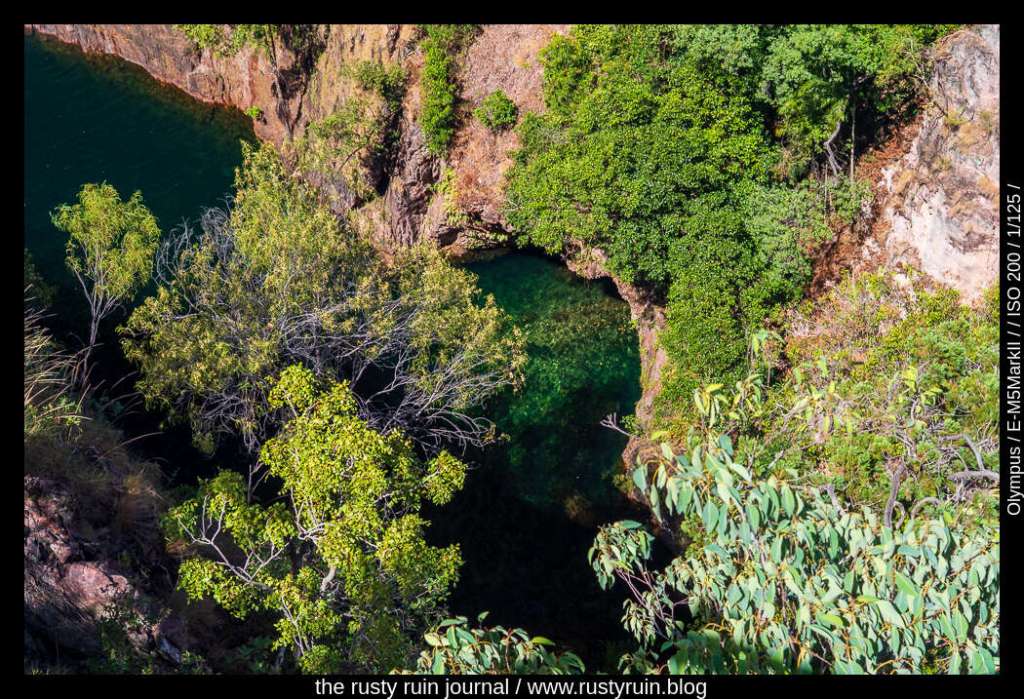
The effect of the polariser is obvious in the above photo when you look at the water. The reflections have been minimised, creating transparency and deeper colours. You can even see the cliff visible below the water’s edge and some of the rocks on the riverbed. This is when a circular polarising filter is most useful and helps to maximise the optical properties of older glass.
Here are some of my other most-used manual focus lenses:
- Takumar 35mm 3.5
- Takumar 28mm 3.5
- Macro-Takumar 50mm F4
- Fujinon 55mm 1.8
- Petri CC Auto 55mm 1.8
- Micro-Nikkor 55mm 3.5
- Nikkor 50mm F2
- Zenitar 16mm 2.8 Fisheye
- Minolta Rokkor MC 50mm F2
- Minolta Rokkor 55mm 1.7
- Vivitar 28mm 2.5
 The Rusty Ruin Journal