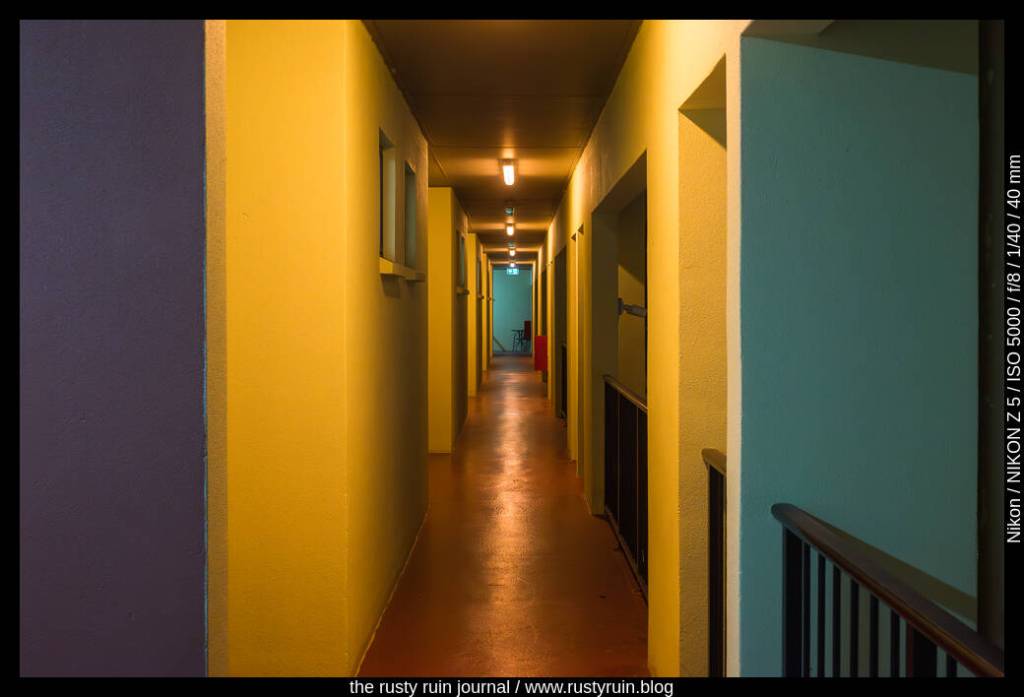
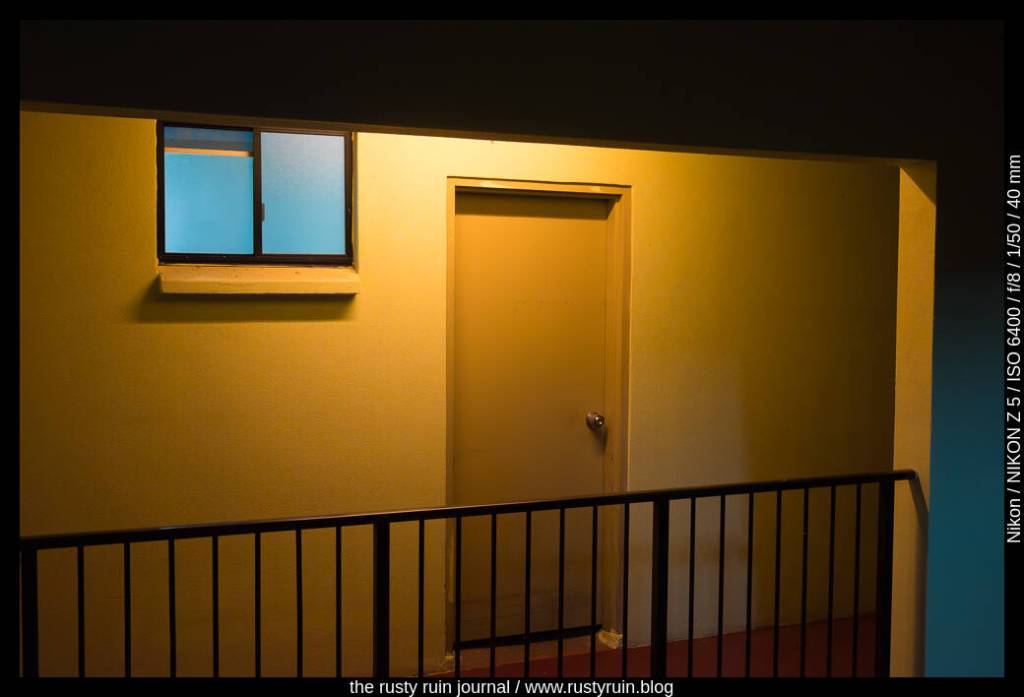
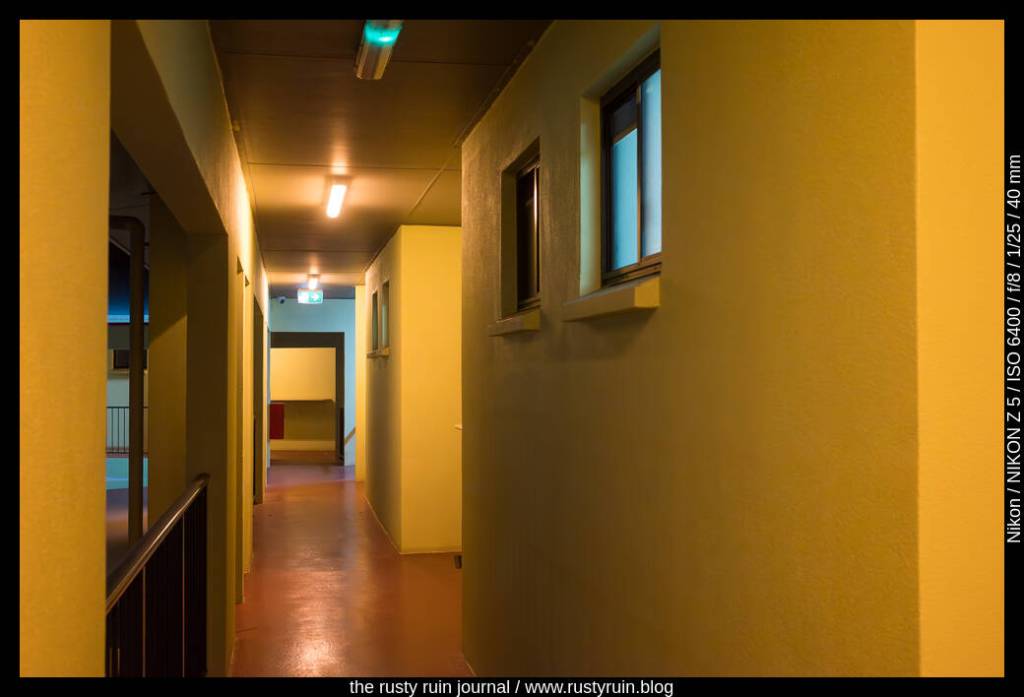
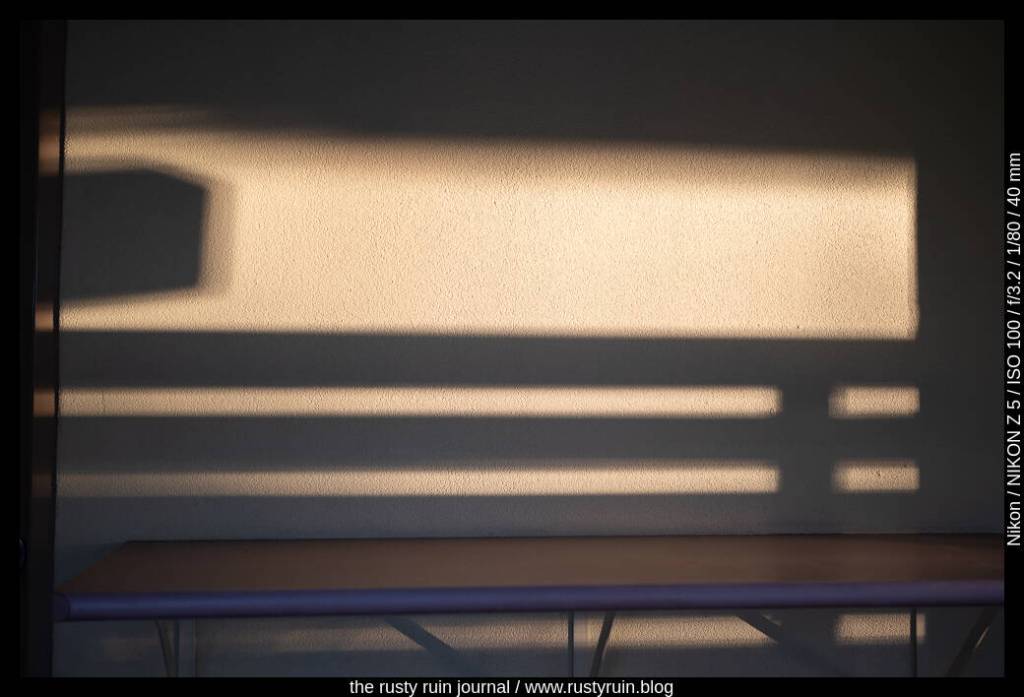
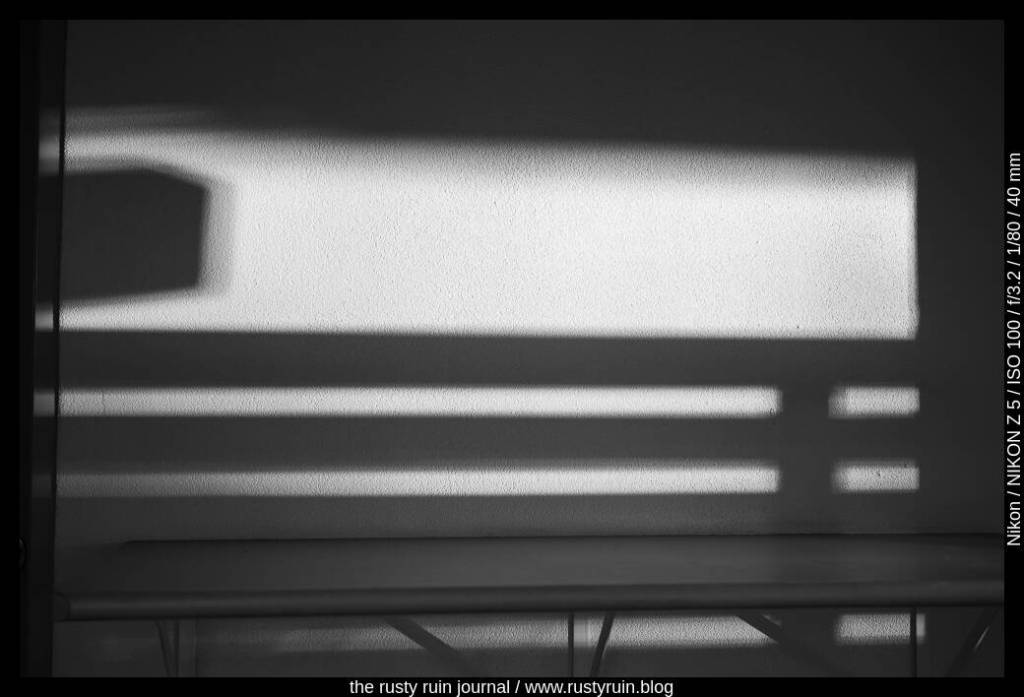
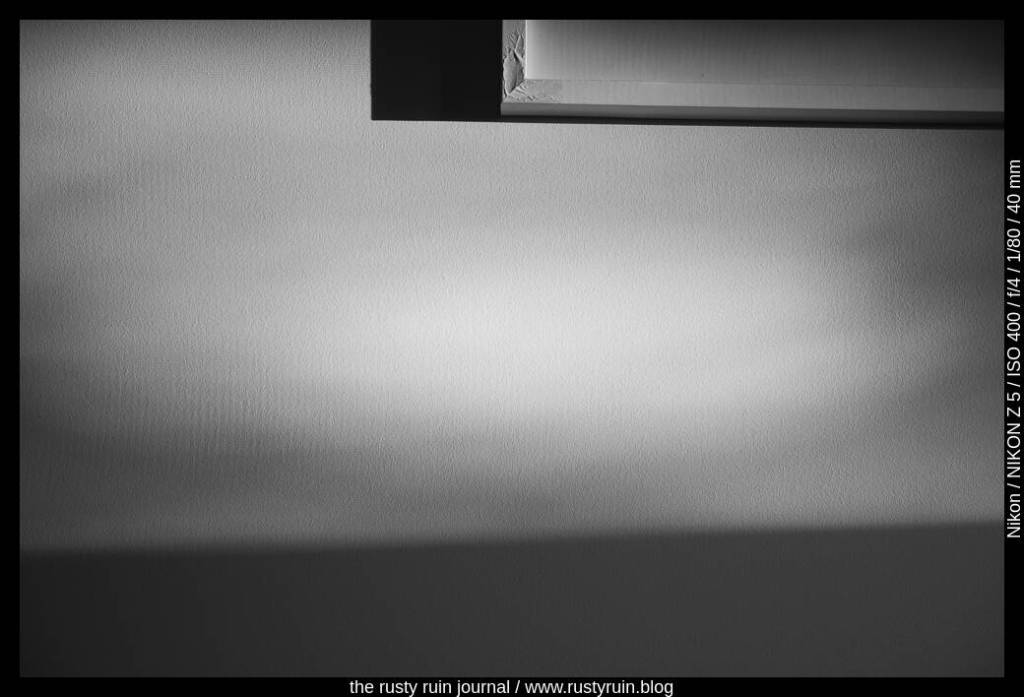
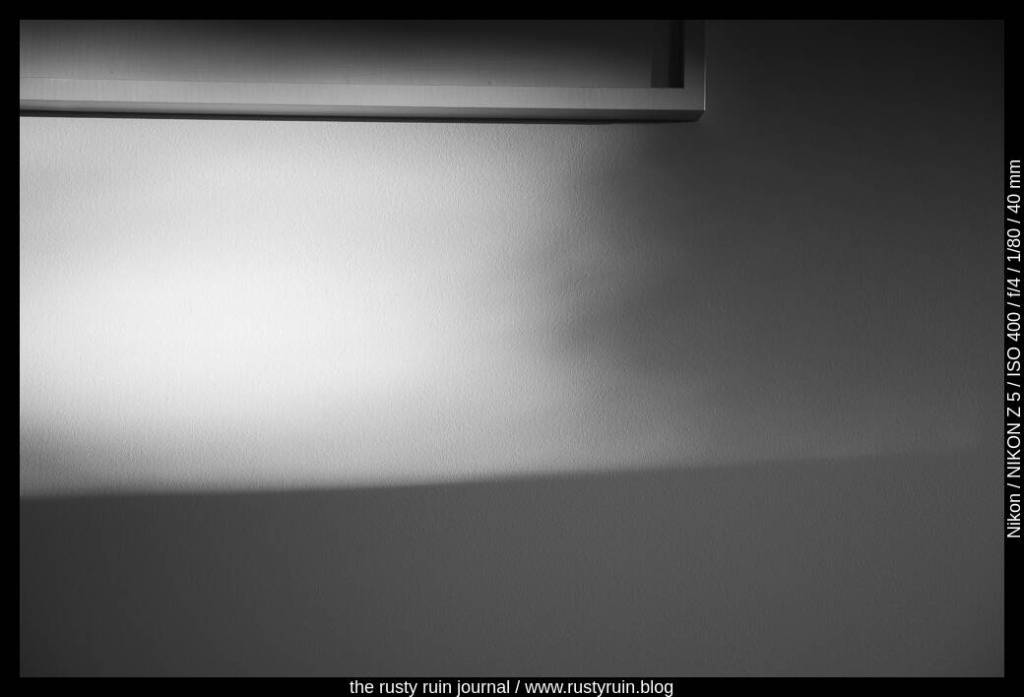
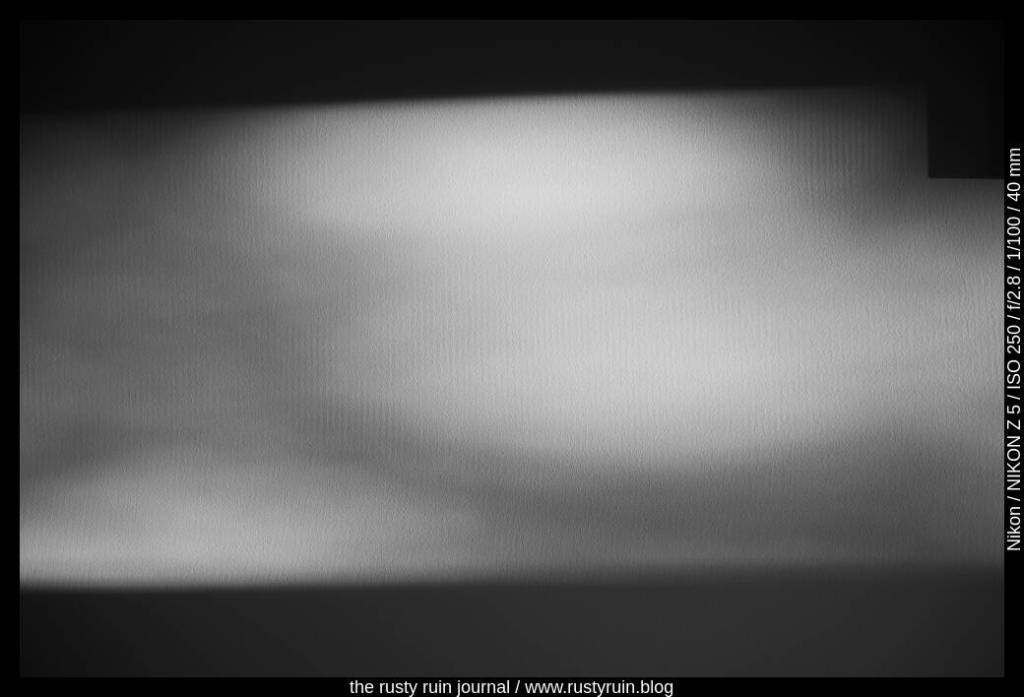
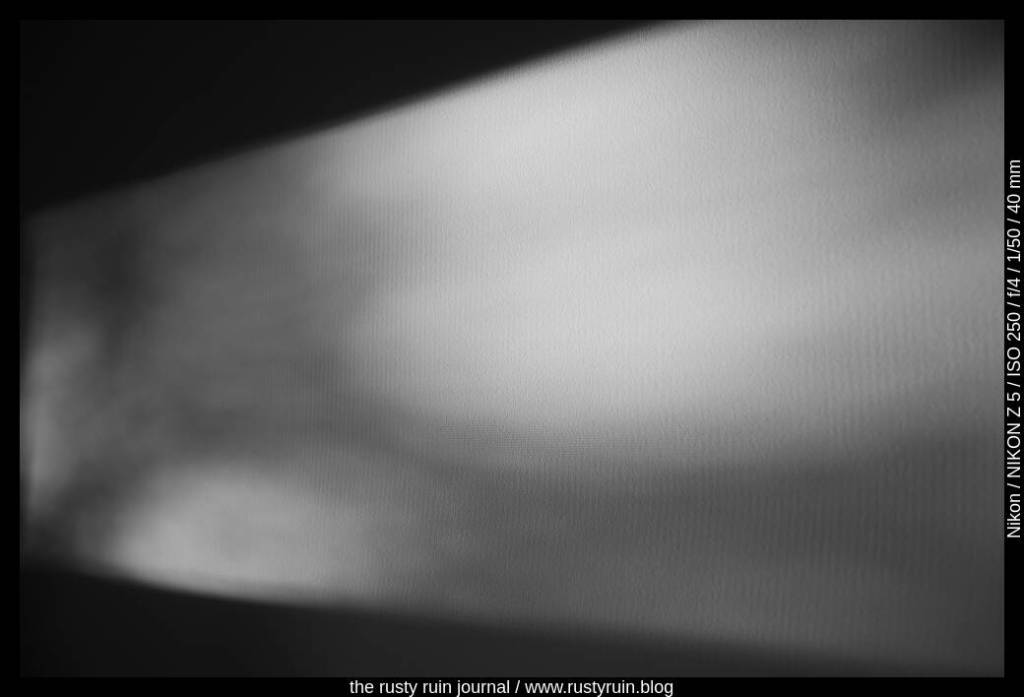
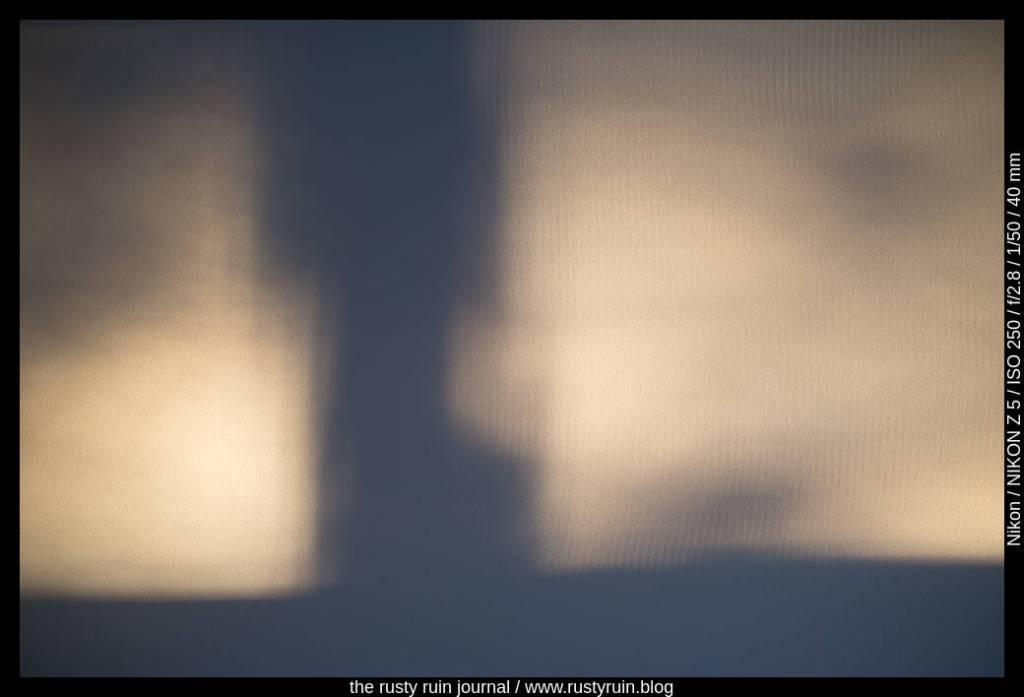
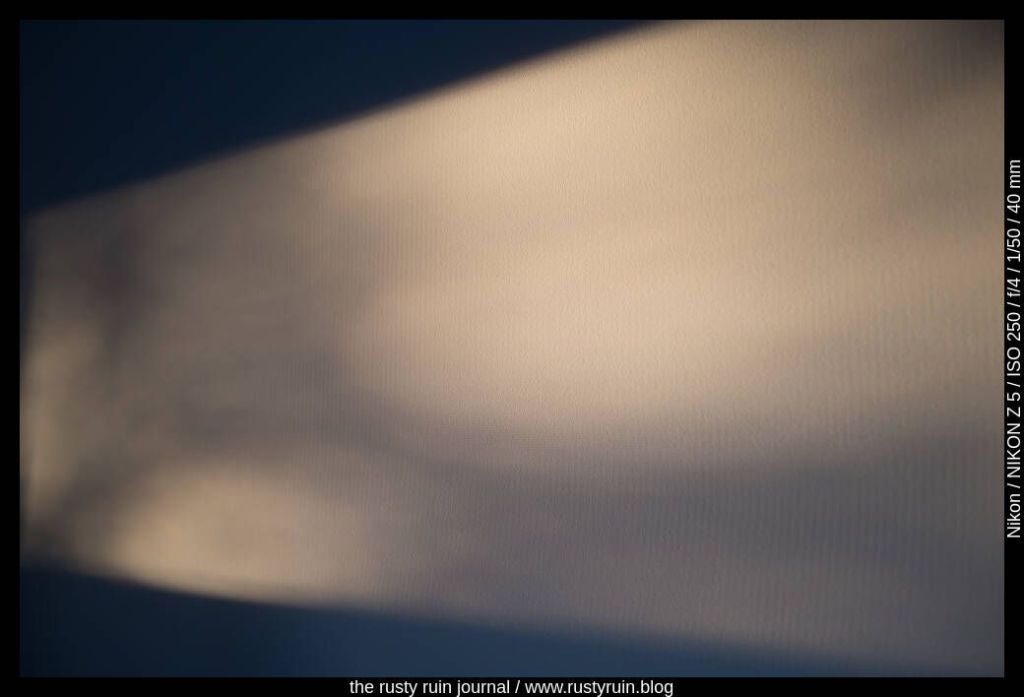
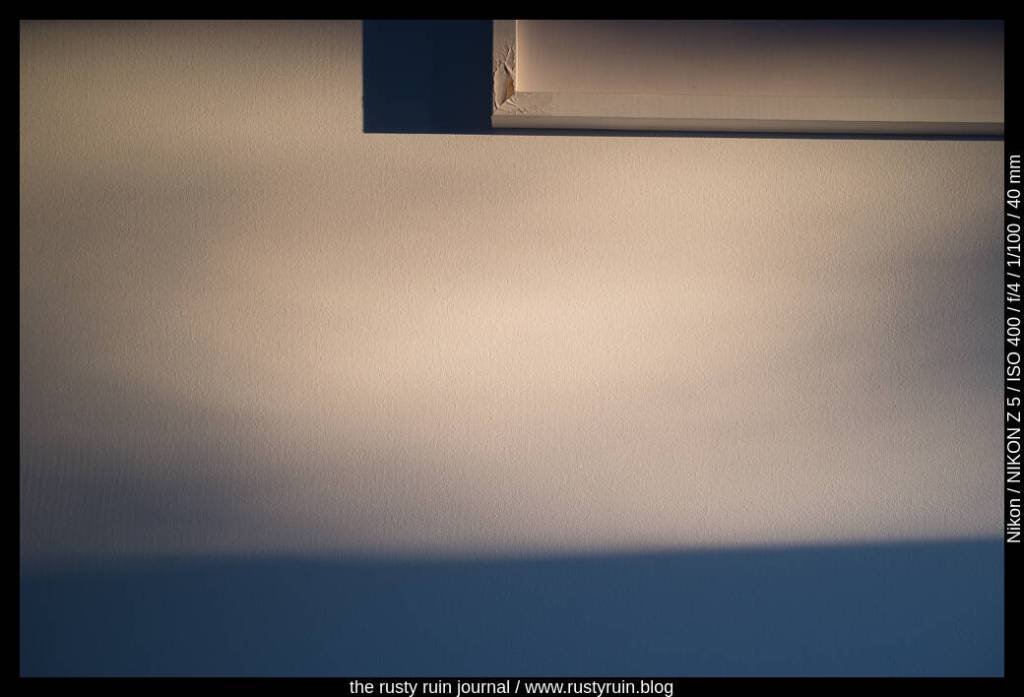
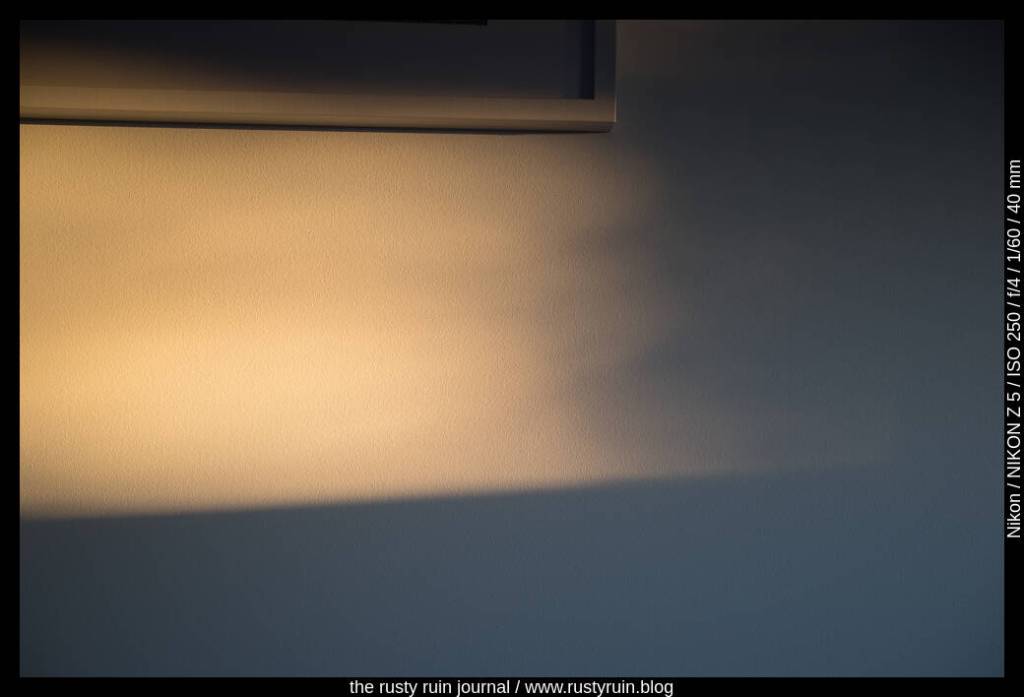
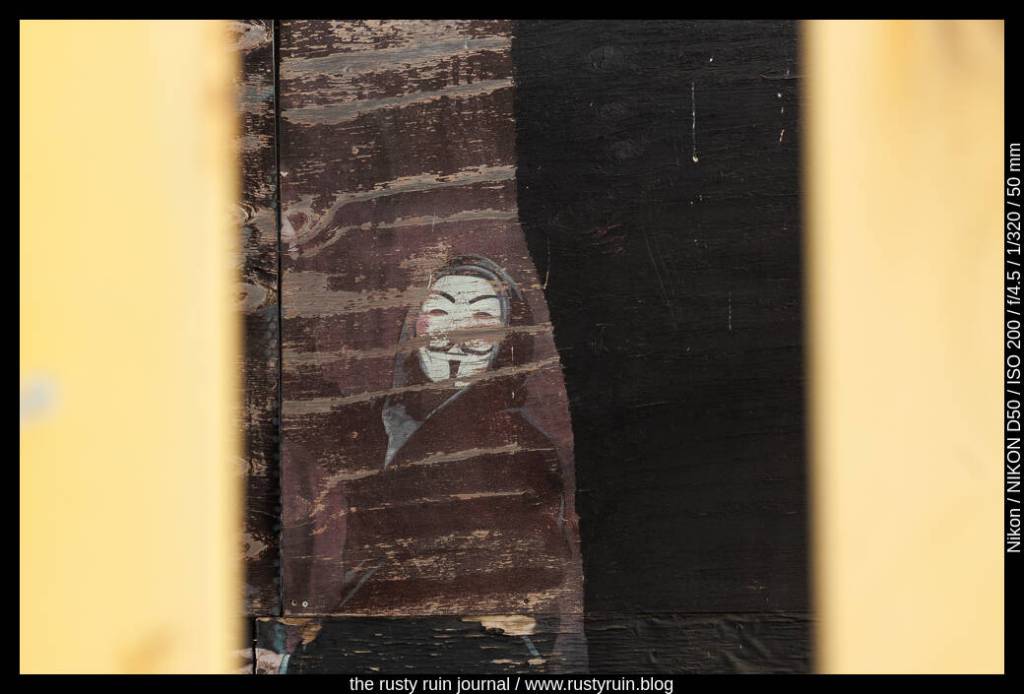
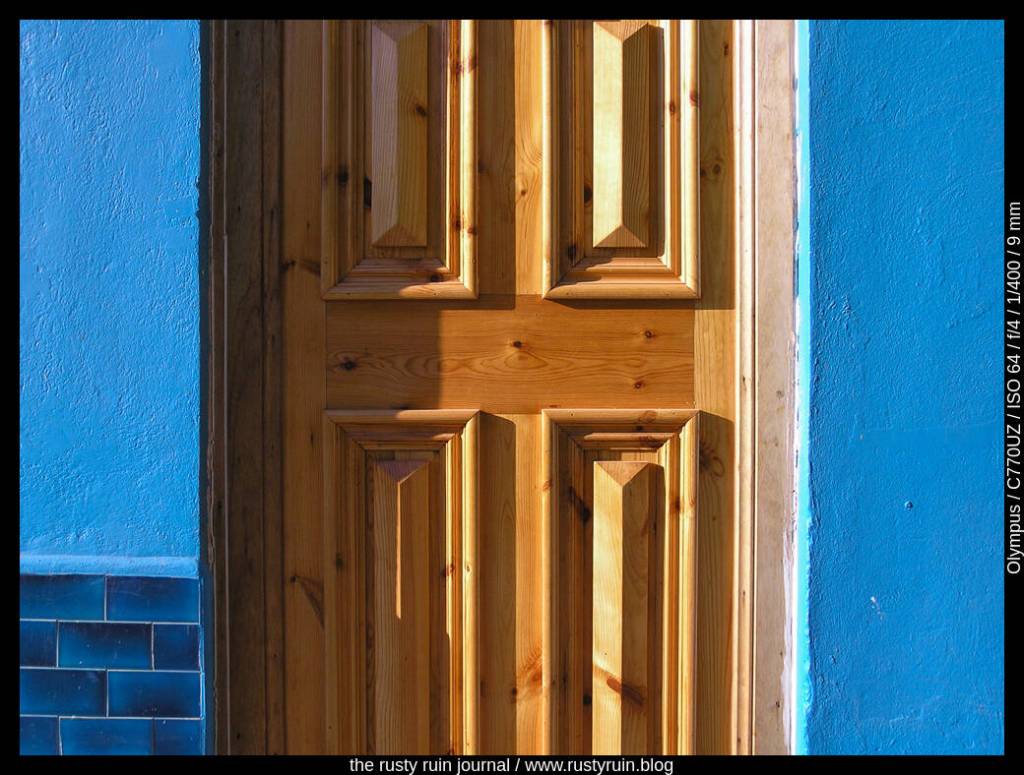
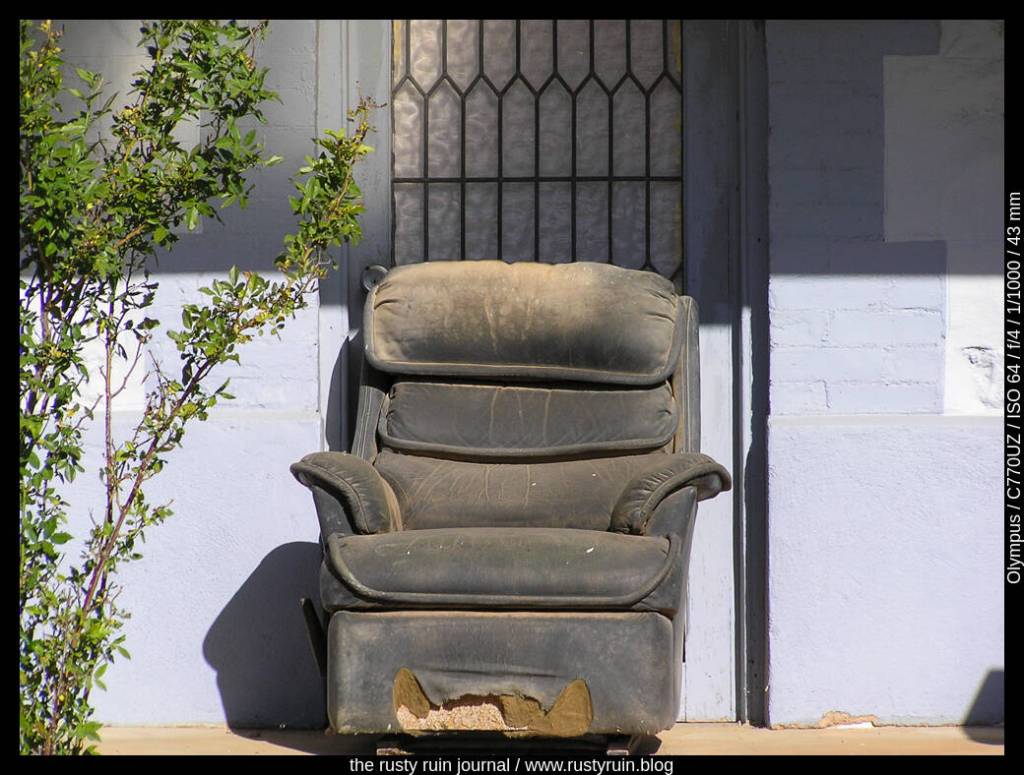
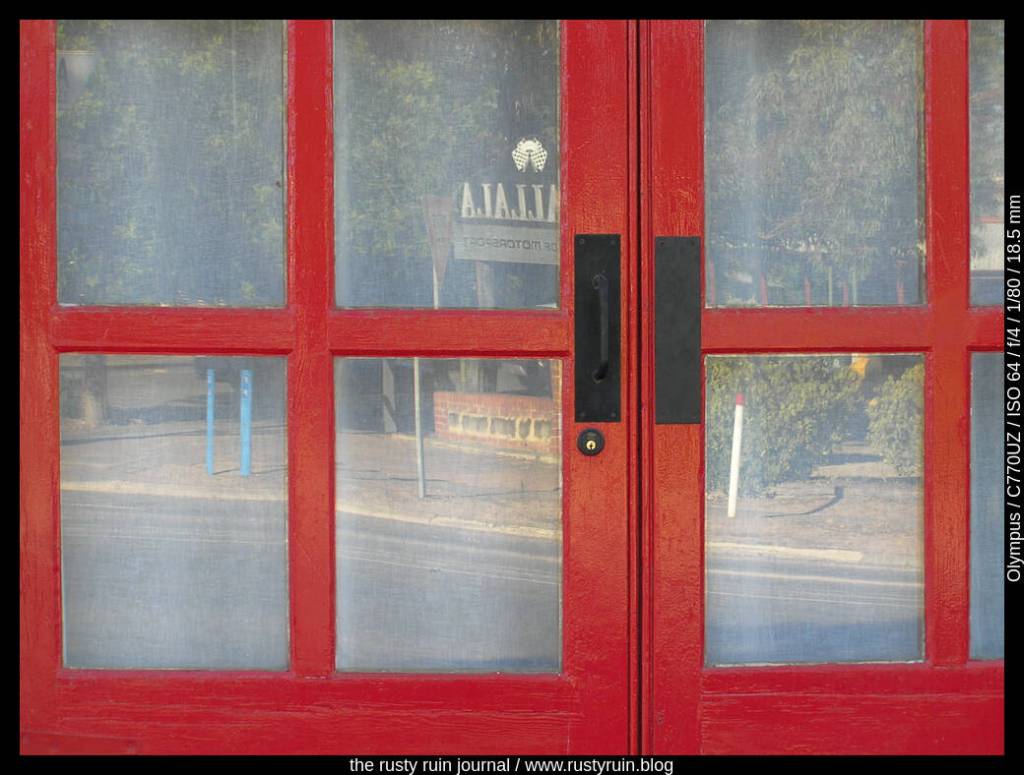
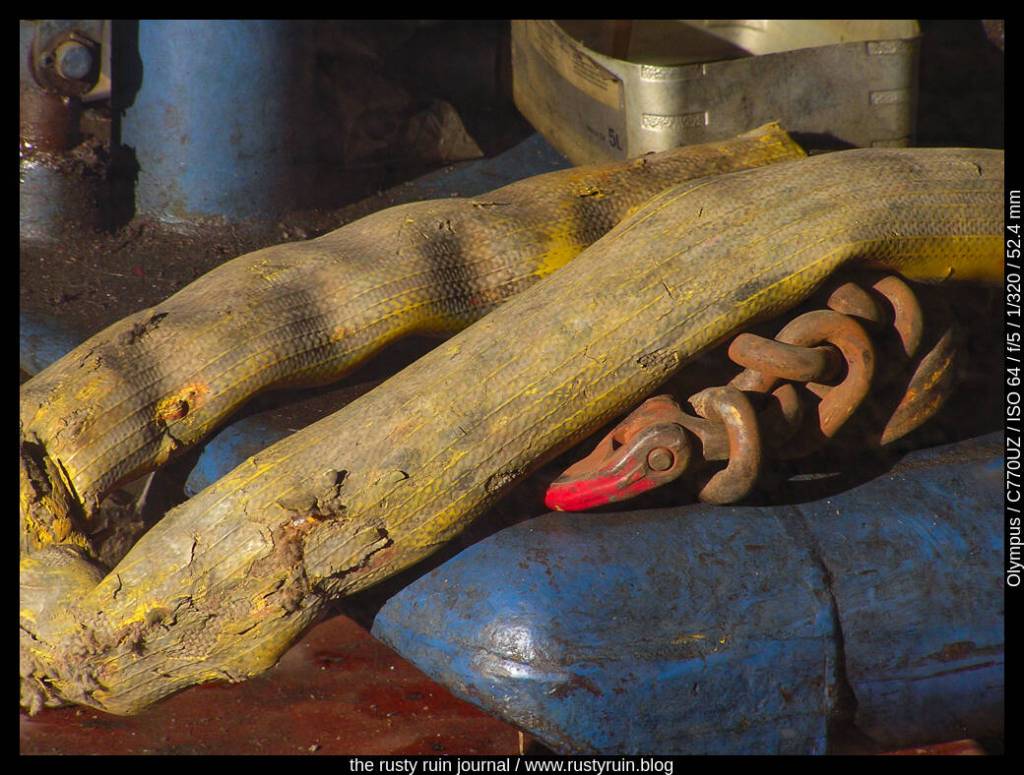
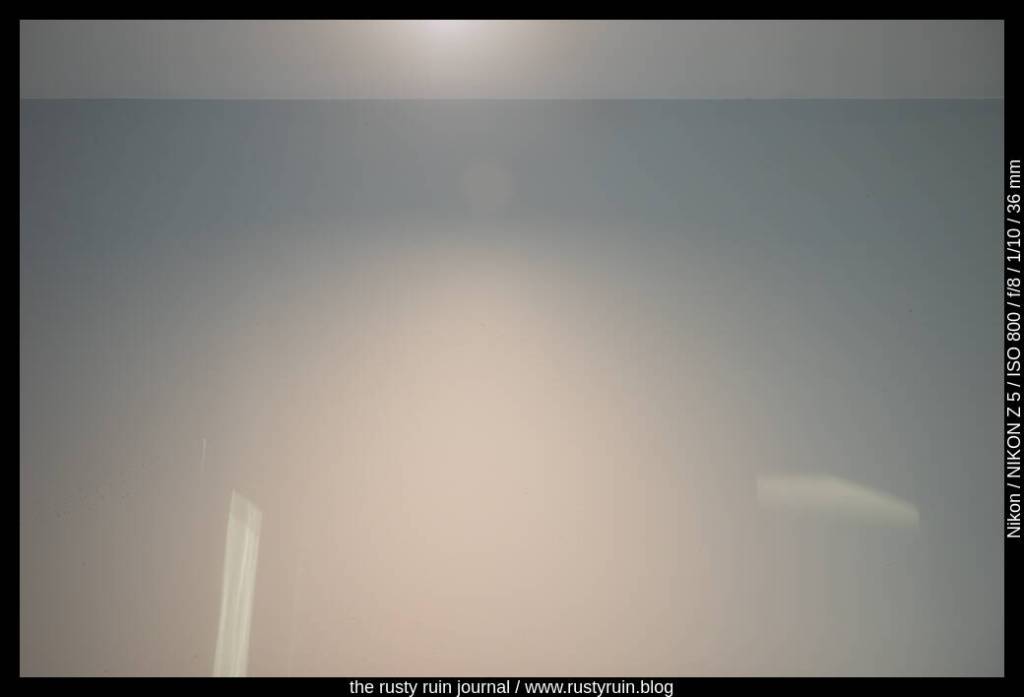
When the body is tired and sleep is needed – when the grey clouds amass and the wind blows – when the camera feels heavy and the ideas diminish – what to do? I stared into the corners of our sky-high holiday apartment and found inspiration in the artificial light. Thus, a mini-series of photographs presented themselves: quiet walls on quiet days.
Rushing into the evening with a friend, the sun quickly setting and the rain threatening, I didn’t expect much. Perhaps that was part of the problem: bearing the burden of noisy expectation rather than cultivating a mindin synchrony with the quiet moments.
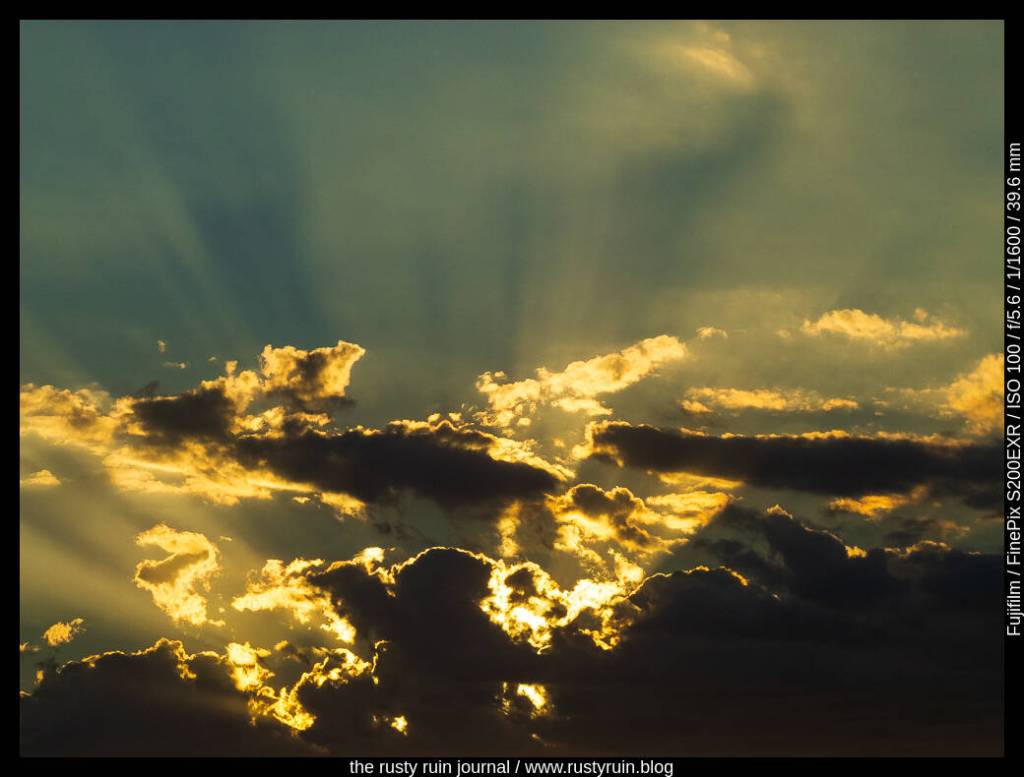
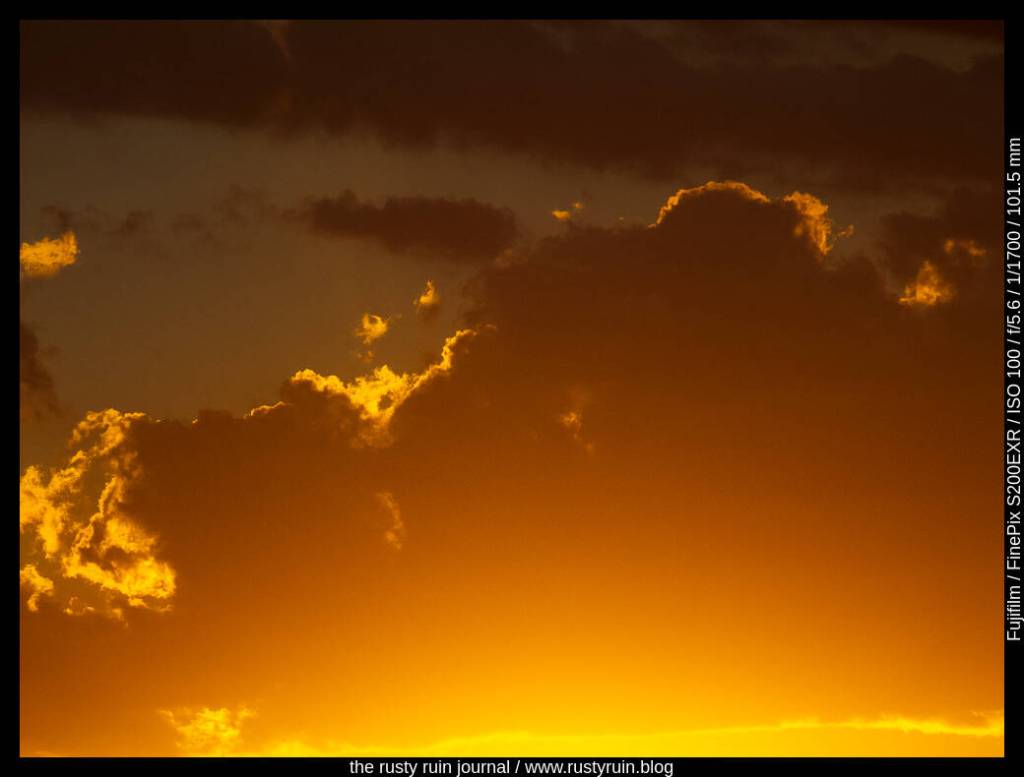
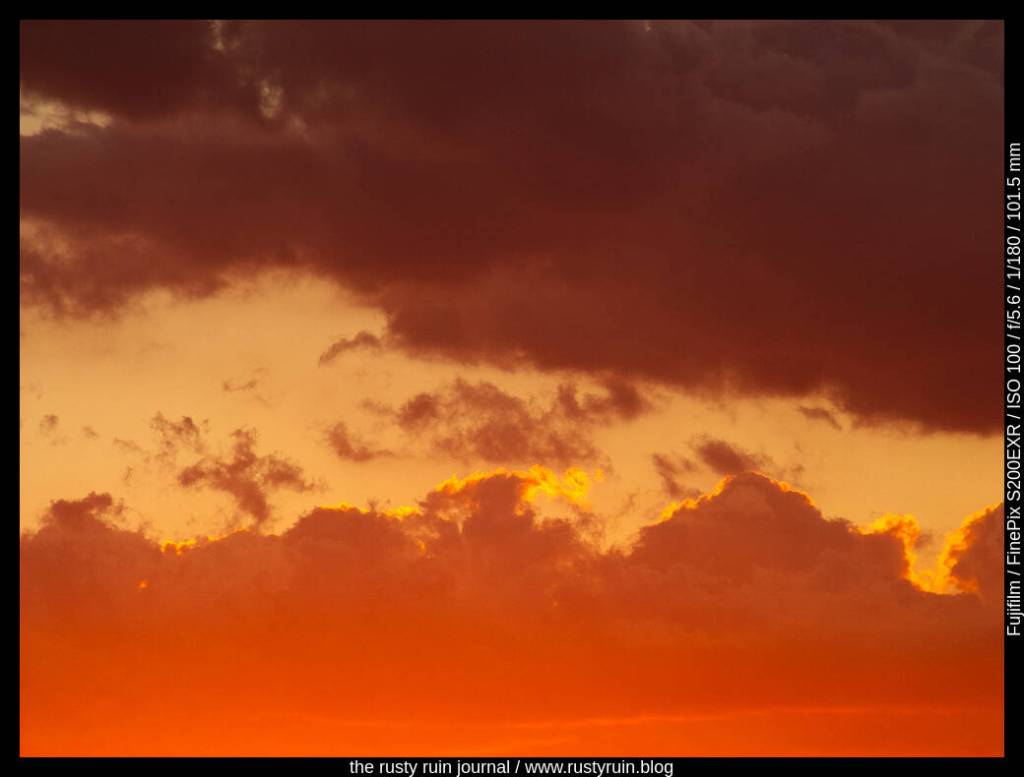
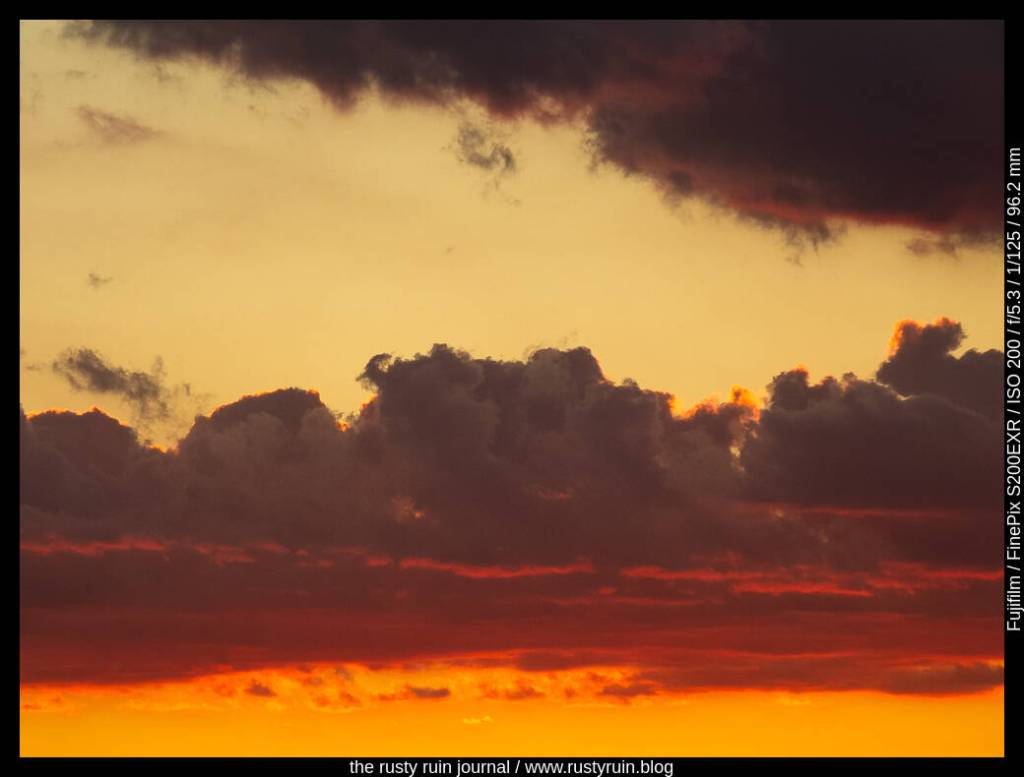
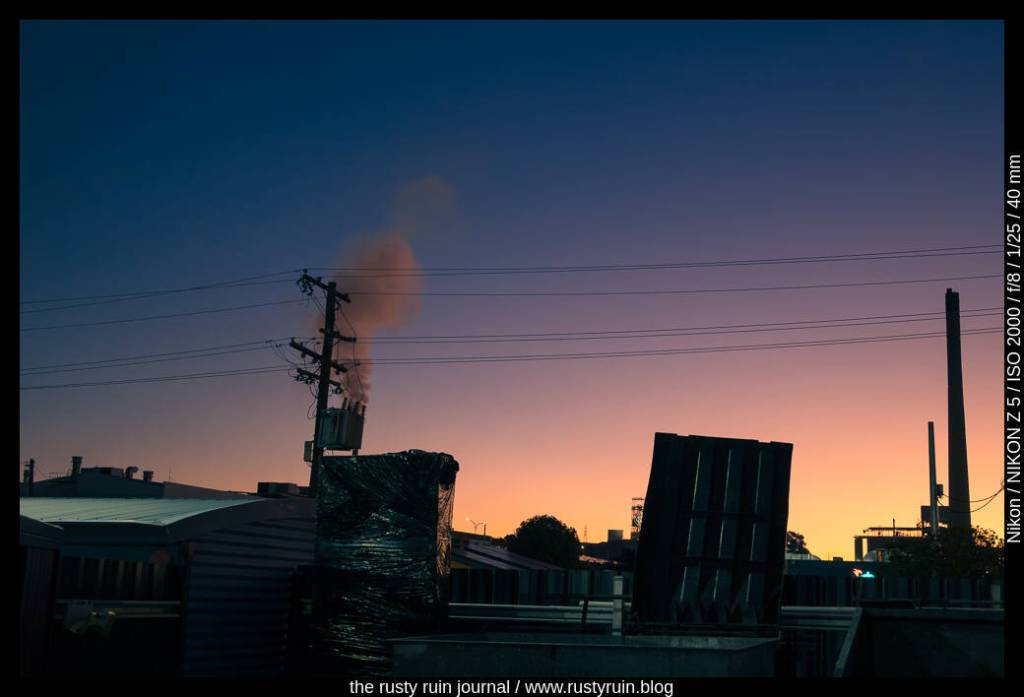
Defying prediction, the heavy clouds produced some amazing sunset colours. Having located the ruins of a house on a dirt road rarely used, we both scurried over and around twisted tin, old pipes, dark trees, sharp wood, and cracked wall sheeting.
The old chimney left standing – Nikon Z5 and Nikkor 40mm F2 lens
I dug around in my camera bag, fumbled with settings, attempted different angles, and yet I felt frustrated and rudderless. It was as though I felt both the heaviness of the fading light and the possibility of being confronted by an angry local. My movements felt too rehearsed and tired, my eye seemed jaded and stale – following the same movements and tracing the same lines it had done ten thousand times before. Perhaps there was nothing new in this scene? Nothing fresh enough?
The Old Hills Hoist – Nikon Z5 and Nikkor 40mm F2 lens
Having extra time to contemplate the scene and determine the best framing isn’t always possible when you take a last-minute opportunity to dash into the eventide glow. Sometimes, you’re not in the mood for making photos. Sometimes, you’re in the mood to watch the sun move quietly and the light turn to blue shadows without the camera at all.
Despite the weight of my expectations, or perhaps because of it, there’s an apocalyptic feel to the photos. As the world teeters on the brink of another war, it seems that the right scene found me at just the right moment with my camera, in synchrony with the world.
It seems that during prior lyrical waxings on the concepts underpinning mindful/contemplative photography and Miksang, I came to refer to it as Quiet Photography. This, without thinking for a moment that Quiet Photography might indeed be a thing out there in the world – a concept already girded by philosophies and academic essays. As it turns out, it’s a definite thingin some academic circles and is mentionedelsewhere.
Old door and dappled light – Olympus EM5 Mark 2 and Sigma 30mm 2.8 lens
For me, quiet photos don’t announce themselves. They don’t add their voice to the cascade of loud photos that speak of ego, marketing, and contrivance. They step away from noise and action. Quiet photos speak of the small things and the ordinary things. I think the best of these photos imbues the mundane subject with an imaginary life, as though revealing a mystery in a quiet place unnoticed by the noisy hubbub of humanity.
Wood bench partly in shadow – Olympus EM5 Mark 2
As in contemplative photography, the necessary mindset inhabits a moment fully but may be distracted easily. The play of autumn light over the surface of an old door, a wooden bench in shadow and light – ordinary things that convey the passing of time and a feeling of history, with the photographer as quiet witness.
In my previous post, I outlined a confrontation that had happened when revisting a ruined house nearby. In a world where the Silicon Valley business model is obsessed with surveillance capitialism, tracking online behaviour, harvesting personal data, and selling that data, it’s no surprise that a growing number of people become very touchy indeed when a lens is pointed in their direction or the direction of something they own.
Old shed on a dusty corner at sunset – Nikon Z5
Ethics is a branch of Moral Philosophy that concerns itself with morality and how people should behave and why. Despite the fact that we were on a public road at the time of the incident, doing nothing legally wrong, and making photos, was our behaviour ethical? Why were we confronted and what ethical framework, if any, should inform photographic practice?
It’s very easy to dismiss confrontations with a deft wave of the legal hand: making photos from public spaces of things visible from those spaces is not legally wrong. Yet, doing so can provoke a strong reaction in many people. It may not be illegal, but is it ethical? Is it right or wrong to make photos of a property owned by someone else? And how should we react, as photographers, when we’re confronted?
Keep Out – Nikon Z5
I think self-reflection is a useful tool for personal growth and change. It allows us to consider our system of beliefs, our thoughts and feelings, and our behaviours in the larger context of culture and society. What beliefs inform our behaviours? And when those beliefs are challenged by someone else who thinks, believes, and behaves differently, what should we do? I’ll be coming back to these questions…
When I decided to dive headfirst into photography as a hobby, I was anxious about the technical jargon and understanding the myriad camera settings. The good news is that it wasn’t all that bad. I read and watched and learned a lot through trial and error.
Owning up to failure is always important. Being able to move on from a mistake to the next moment is even more important for continued growth in any field. I’ll tell you something, honestly: I still make plenty of mistakes!
Falling down – Nikon D40 and Nikkor 35mm 1.8 DX lens
Here are some of the most common photographic errors I continue to make:
Not resetting important camera settings: All too often, I’ve forgotten to change ISO when entering different light situations, or I’ve missed resetting exposure compensation.
The camera mis-pack: I’ve packed not enough when I needed extra gear and packed too much gear when I should have packed less.
SD card woes: Yes, I’ve filled up an SD card and forgotten to pack a backup. The only solution is to go through the recorded files and be brutal about deletion decisions.
ISO stubborn: Have you ever been stubborn about pushing your ISO in poor light situations? Base ISO is optimal for less digital noise in a photo, but a blurry photo just isn’t worth the stubborn refusal to UP the ISO a bit more to force a faster shutter speed! It’s better to have a noisy photo over a blurry one. Digital noise can be dealt with far more easily now using software tools. I can’t even tell you how many times I’ve stubbornly refused to move from base ISO in fast-fading light, standing there with my arms tucked and not breathing just to cut as much movement as possible to achieve perfection at a too-slow shutter speed in hopes of a sharp image.
Reverse dialling: Older Nikon bodies dial positive and negative exposure compensation values in reverse to other cameras, so when my muscle memory becomes accustomed to the opposite dial movement of another camera, I find myself cursing the over or under-exposed photo on an old Nikon camera. At worst, I just forget the reverse dial motion completely until I’ve long moved on from the scene, at which point I sigh. Thankfully, the new Z-mount Nikons have changed both the exposure value dial direction and the reverse F-mount lens twist they had going for decades.
The old green gate of J. Martin & Co. – Nikon D40
I’ve been tough on myself in times past when it comes to making photographic mistakes. I think part of that was not feeling comfortable with the equipment and not believing I could learn enough to make good photos. In fairness, I still make plenty of stinky photos, but every poor photo teaches me something new, even if it’s a lesson I thought I’d already learned.
We can always improve our photography, but learning and living isn’t some easy linear path. It’s full of twists and turns and ups and downs. There are rocks of many different sizes littering the paths we walk. One of the hardest things to develop is self-compassion. We’re often kinder to strangers than we are to ourselves. But, why? We’re just as fragile and just as prone to mistakes as anyone else. All that truly matters is that we experience and inhabit the moment meaningfully, in whatever mode we choose: Auto, Program, Aperture Priority, Shutter Priority, or Manual.
How do you store your digital photo files? In this modern world, it’s a regular concern – how to safely and securely store all of the digital detritus that builds up around us. It used to be so easy when we just had to remember a few passwords. There was no such thing as 2 factor authentication years ago. Security breaches and cyber-hacks have put paid to having an easy life when it comes to digital security. And you know something? I’m a bit burned out on all of it…it feels a bit too much some days.
Stacked for the night – Nikon D70s
Just trying to organise photo files feels like a burden. I’ve had hard drives go bust over the years. The ever-swelling trove of files gets bigger and the voice gets louder: “Find an easy way to store all this crap or delete more!” – as if I’m stuck playing a simulation game and the goal is just to move shit around every minute of every day and night. Like Sisyphus pushing the boulder up the hill.
As I said previously, I use Microsoft One Drive these days. At the very least, I can use the cloud to quickly backup DNG files and TIFFs for future download. I know lots of people feel like they shouldn’t have to pay, but in the age of information overload, I think it’s a good idea to find a reasonable solution that offers enough storage for a good price. It’s the business model that Google tends to run with: offer generous freemium cloud storage, but not too much, so that people come to rely on it for their photo and file backups. Then offer paid tiers for more storage room.

Diesel back in the day – Nikon D70s
I suppose we’re always looking to organise something – photos, files, music, our lives. And truthfully, sometimes all of those files feel like too much of a weight – like a digital albatross. I can’t even tell you how many sites I’ve been locked out of because an old paid email address went bust and now the site is sending the password I’ve forgotten to an email address that doesn’t exist. Or software license codes that got lost in the shuffle of hard drives and file moves. The 21st century has the feel of a password-protected version of copy of a copy of a copy, featuring tiny beige plastic parts that need to be glued together against a time-limit. So, I guess this is my rant about simplicity and complexity, as if there was ever a simple time. And since I work with vulnerable people, many of whom live really tough lives, I must say that I feel a little queasy even making a small complaint about any of it. Life moves and changes and we’re just the floating leaves flung by the ripples and waves as it goes.
I’ve previously written about the Nikon D70. As I seem to have some affinity for older Nikon cameras, and as my D70 is also pretty beaten up, I couldn’t resist a good deal on a Nikon D70s with an attached Nikkor lens that has long been on my list: the Nikkor 35-70mm 3.3-4.5 AF lens. First released in 1986, the 35-70mm is most definitely a lens made for film cameras of the time as a cheap walk-around unit.
Some detractors say the focal length of 35-70mm isn’t especially useful on an APS-C sized sensor, but I disagree – 35mm is a popular wide, not not too wide, focal length, and 70mm can most certainly get you close or give you a decent portrait. Even if you consider equivalence (and a 50mm lens is still a 50mm lens on any sized sensor), the lens gives us 35mm eqivalent focal lengths of 52mm, 85mm, and 105mm – all three of them very useful lengths on any camera.
Snapping plant monsters in the suburbs – Nikon D70s
As for the D70s, it was announced in August 2005 and came hot on the heels of the original Nikon D70. The differences between the two models are minor, with the back-screen of the S iteration being 2 inches rather than the 1.8 inches of the original. The other features remain the same really: a 6.1 megapixel CCD APS-C-sized sensor, a top LCD screen with settings information, and an array of useful external controls, including ISO and White Balance, among others. Though it’s an all-black-plastic affair and has that familiar hollow feel of Nikon’s cheaper offerings, it definitely has a prosumer feature-set. Sure, the Nikon D200 is the professional upgrade, with a solid magnesium-alloy skeleton that feels like a giant warm buttered scone in the hand, but the D70s still remains a competent DSLR even in 2025.
The old blue van – Nikon D70s
All the photos were made using the lens at F-stops 5.6 – 8. As you can see, the photos are sharp and punchy, even using a 6.1 megapixel sensor from yesteryear. Need I go on about the competent image-making capabilities of these older cameras?
Covered in cactus – Nikon D70s and Nikkor 35-70mm 3.3-4.5 lens
I was helped by heavy cloud-cover, as there wasn’t a lot of dynamic range for the old CCD sensor to manage. Even though you can print pretty large from a 6 megapixel camera easily without much loss, the lack of cropping room makes one slow down and compose deliberately – there’s no running and gunning here. No lazy composition and fix it in the edit mentality. Old lenses, lack of high ISO, and fewer megapixels is good for getting back to the basics of photography: seeing clearly, connecting to the world through imagination, subject choice, composing deliberately, correct settings to suit scene and intent, and good hand-held technique.
If you print a 1 megapixel photo at billboard size, it will look like badly made bricks up close. If you stand 50 feet away instead, where just about everyone will be viewing it from, that 1 megapixel image will look pretty good. Viewing distance makes all the difference, and this is what we also need to consider when it comes to resolution and print sizes. Are you standing two inches away to view your photo prints? Even so, I don’t want to needlessly toss pixels away if I can help it, especially on these old cameras. I slow down, look, reflect, imagine, think through settings, check the histogram for exposure, and adjust if necessary.
I think contemplative photography has always appealed to me at some level. As photographers, we’re sometimes too focussed on making photos that announce our presence to others. That makes sense when looking at things through an economic or self-marketing lens. There’s a space for that, of course. But photography is about more than the next Like or Follow on the latest social media platform.
Illuminated – Sony RX100
I’m not so interested in mass appeal, exposure, ego-stroking, or money. I’m certainly interested in people and ideas and connections, but the idea that I’d need to specialise and market and propel myself in front of others just feels wrong. It goes against my grain, I suppose. The foundation of my practice finds expression through wandering, seeing, imagining, and purpose in the moment. Seeing the world differently in a single moment is at the heart of photographic practice, for me.
Sunrise and silhouettes – Sony RX100
It’s not always an easy thing to enter the mind-state of reacting instinctively to a scene. We so often judge what we see: is it a good photo? How can I make it better when editing it? How can I crop it? What camera settings should I use? When such thoughts take over, like a virus, they interrupt the flow of the moment and remove some of the joy. Is it truly important that we frame a scene so precisely that it attracts comments? Is it truly important that we even make the photo in the first place? Do we really need the camera to see the world?
On this last point: it’s true that we require no camera to experience the joy of the moment. And I think that as photographers, we’re prone to feeling as though we must capture everything and see the world through the lens. Still, the camera is integral to photography and there’s some consideration to be afforded technical settings. It’s the tension between the camera and inhabiting the world in the moment without distraction that can be the tricky tightrope for me to walk at times.
West MacDonnell Ranges aglow 1 – Nikon Z5 and Nikkor 40mm F2 lens
Upon driving back to Alice Springs after a long day on the road, the sun hit the ancient earth just right, and we pulled the car over to a patch of gravel. Like a long red serpent from The Dreamtime, stretching across the land, the rocky ridges were awash in the sun’s eventide glow. The photos here really don’t do it justice. How can one encapsulate over a thousand million years of geological history? It’s a land that feels as old as Time itself.
West MacDonnell Ranges aglow 2 – Nikon Z5 and Nikkor 40mm F2 lens
In a rush to exit the car, switch on the Nikon, and frame the scene before the light faded, I was amused by my scurrying about in the shadow of those ancient red rocky giants of earth. How many people had done the very same thing – catch the red glow of sunset across the hard-edged boulders, crags, and rocky outcrops? Many millions of sunsets across that land and there I was, one small thing in the vastness, fiddling with my camera, hoping to stop time.
When the noise and dust of the day settles into quiet night, the mind turns inward. No longer are we distracted by the daily scramble. Night heralds a time when we have the opportunity to reflect on our day and ourselves.
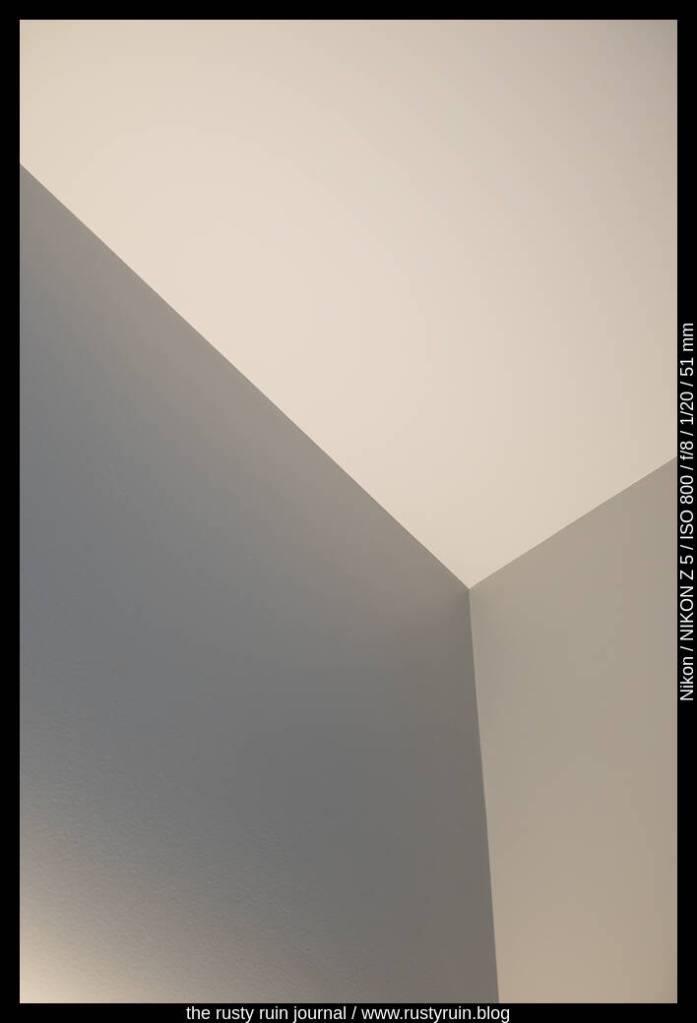
A solitary light bulb glows dimly behind the window of a closed shop on a quiet street; leaves are rustled by a warm zephyr along a familiar laneway as distant stars shine above; during a long drive at night alone, the music on the radio synchronises perfectly with your thoughts and the world gliding by outside. Have you experienced similar scenes and feelings of melancholy, peace, serenity, deep thought, and reflection? If so, you’re likely familiar with The Night Feeling.
Crushed Ice 24 Hours – Nikon Z5
What’s The Night Feeling?
I came across a Reddit group called The Night Feeling last year. It’s dedicated to photos that encapsulate those kinds of scenes and feelings. I’d never heard it called that before, but I’ve certainly had those emotions and thoughts, especially at night. I even remember discussing this with a friend many years ago in relation to the sorts of emotions we’d sometimes experience when driving long distances alone late at night, with just the right piece of music playing in the background.
We’re usually so busy and distracted during the day that we forget how we’re feeling and who we truly are when we’re not serving others, doing our jobs, shopping, socialising, and so on. Being busy can help us endure tough times but we often forget to self-reflect and get in touch with who we are without the distraction and noise. When everything is quiet and night falls, we have an opportunity for self-reflection and thought. And there are certainly links between night and strong emotions and darker mental states. In the Mind After Midnight Hypothesis, for example, the hours between midnight and early morning are associated with disinhibition, risky behaviour, darker emotional states, poor judgement, and depression.
The end of the aurora – Nikon Z5
When the world is quiet
I associate certain kinds of scenes with the sort of calm, observational, slightly melancholic self-reflection that falls under the umbrella of The Night Feeling – walking through light rain on deserted streets that are usually busy; city lights reflected in water at night; a warm wind blowing through trees as I walk through a quiet part of town; an old machine lit up and no-one around. It’s as though the elements of nature announce themselves softly, emerging briefly through the haze of our urban environments to remind us that we need closer contact with our origins.
As nature reminds me that it’s bigger than any human-made urban environment and any trouble of my own, I feel that momentary sense of peace and calm ~ the moment that my own problems melt into the vast scale of the world and the stars beyond. In this expanded state of awareness, the small worries and quotidian tasks of daylight hours retreat and true self-reflection can occur, as one’s inner world becomes infinitely larger and more clearly focussed.
After the laundry is done – Nikon Z5 with Viltrox 20mm