It seems that during prior lyrical waxings on the concepts underpinning mindful/contemplative photography and Miksang, I came to refer to it as Quiet Photography. This, without thinking for a moment that Quiet Photography might indeed be a thing out there in the world – a concept already girded by philosophies and academic essays. As it turns out, it’s a definite thingin some academic circles and is mentionedelsewhere.
Old door and dappled light – Olympus EM5 Mark 2 and Sigma 30mm 2.8 lens
For me, quiet photos don’t announce themselves. They don’t add their voice to the cascade of loud photos that speak of ego, marketing, and contrivance. They step away from noise and action. Quiet photos speak of the small things and the ordinary things. I think the best of these photos imbues the mundane subject with an imaginary life, as though revealing a mystery in a quiet place unnoticed by the noisy hubbub of humanity.
Wood bench partly in shadow – Olympus EM5 Mark 2
As in contemplative photography, the necessary mindset inhabits a moment fully but may be distracted easily. The play of autumn light over the surface of an old door, a wooden bench in shadow and light – ordinary things that convey the passing of time and a feeling of history, with the photographer as quiet witness.
Lately, I’ve been contemplating ethical questions in photography. According to Wikipedia, ethics is the study of moral phenomena and “…investigates normative questions about what people ought to do or which behaviour is morally right.”
At the risk of being ultracrepidarian, I’ll just say this: I’m not an expert in ethics or philosophy, but I believe that self-reflection is an important part of not just photography, but also generally. It’s crucial to ask questions and seek answers to discover what drives our photographic practice. What beliefs inform our behaviour? What do we consider to be right and wrong and why? Where are the moral lines for us?
Bruce Gilden and Mark Cohen – well-known street photographers who hold the camera in one hand, the flash-gun in the other, and get right into the personal space of their subjects – may be at the behavioural far end of what street photography encompasses. Here’s a great video of Gilden at work: Bruce Gilden.
This in-your-face methodology has variously been called innovative, invasive, bullying, and unethical. There’s no denying it can produce some amazing photos of people doing everyday things on the street, but is it ethical? Ethics is about what behaviour is morally right. But just because something is legal, like making photos of people in public spaces where the law says there is no expectation of privacy, that doesn’t make it ethical.
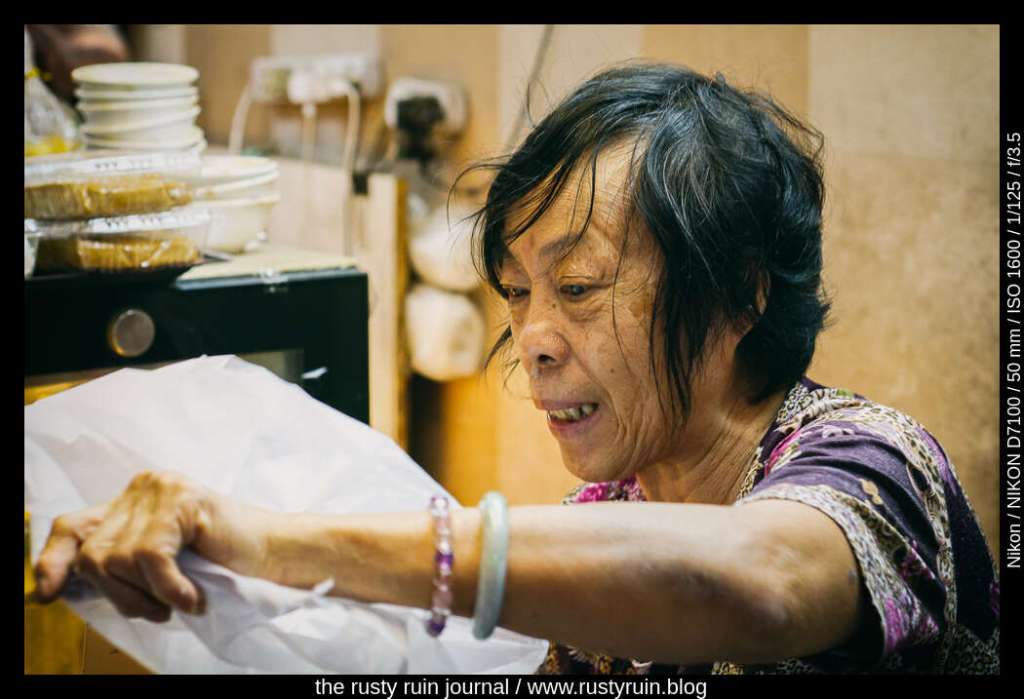
All smiles at midnight – Nikon D7100
Consent and ethical frameworks
Consider the photo of the two ladies above. You can see they’re happy and smiling. In fact, they saw me with the camera and posed for me, thereby providing consent. There aren’t too many people who’d have an ethical issue with this photo.
What complicates matters is that what we consider to be ethical, or morally right and wrong, is based on our ethical framework – a set of core beliefs, culturally embedded and varying across time and place – that inform the way we behave, the way we think and feel, and what we consider to be right and wrong. If all of my street photos were made with consent, such as the one above, my ethical framework might be Care-Based, where I consider the feelings of others, care for others, and my relationship to others.
Street photographers like Bruce Gilden may be considered unethical by a majority, but the truth is that their thoughts, feelings, and behaviours are driven by belief systems that may not be in accordance with the mainstream. One might argue they work to a type of Utilitarian ethical framework that values a good outcome above questionable methods – art as the good outcome in this case. But if people that Gilden photographs are startled, offended, or unhappy with his method, is it a good outcome from their perspective? Should one set of ethics override another?
Perhaps it’s the goal of making good art that drives the photographer’s impulse to shove a camera into personal space. Or the goal to be well-known, with money in the pocket and exhibition space for the work. Would you think differently if you thought of Gilden’s work as great art? Or if you didn’t like his photos, would you find his practice unethical instead?
Kneeling with nothing – Nikon D7100
I thought for some time before posting the photo above. I photographed a vulnerable person and for many people, making photos of vulnerable people on the street is a big no-no and crosses an ethical line. What drove my behaviour here? Obviously, I feel uncomfortable posting the photo but do I feel discomfort because I fear possible bad reactions to it? I’m certainly not one to dive into conflicts.
The idea of a person with nothing, surrounded by people in a busy city, appeals to my sense of exploring the effects of capitalism and urbanisation – a fragile human being in a concrete and glass city, looking to survive the grinding day. The potential cruelties of modern life appeal thematically and drive an aesthetic. I’m driven to this as I’m driven to photos of decaying buildings and ruin.
It’s easy to be seduced by photo opportunities on the street in a big city where few people care about others with cameras. It’s easier still to exercise power as a photographer and frame a vulnerable person who gave no consent, telling a momentary story about them that can’t represent them in totality. Perhaps in making this photo, I also touched the edges of what I’m comfortable with. That, in itself, is a valuable lesson and self-reflection.
Charles de Gaulle at work on the streets – Nikon D7100
It’s important to understand that ethical frameworks vary across culture, time, geography, and individuals. The behaviour that one person feels comfortable with will not be in accordance with the ethical framework that drives someone else. We may argue that some ethics are universal, and perhaps they are, but prior civilisations have believed it a good thing to sacrifice virgins to appease deities, or have seen fit to expose weakling babies to create a stronger society.
Ethical frameworks are, in this context, subjective. The law seeks to be universal and pragmatic, but ethics remain separate and personal. And when my ethics disagree with yours, conflict may ensue, even though neither of us is wholly right or wrong. According to Descartes, we can never truly know if other minds exist since we can only truly know our own minds. We’re trapped within our own minds, and for all we know, other people are zombies, illusions, or mindless automatons. Slipping into Solipsism for a moment, we can never know another person’s ethical framework because we can never know if other minds exist beyond our own and we are therefore doomed to cross ethical boundaries at every moment and every step. In this context, it may be more relevant to depend on laws rather than subjective ethics.
Diving into Solipsism is, perhaps, at the deep end of the pool, but it serves to illustrate a simple point: ethics are indeed personal and subjective and we often can’t know the ethical framework of another person. We may minimise this confusion by seeking consent, and this is a perfectly reasonable solution, but we also change what street photography is by doing so: it then becomes a set of poses and forced half-smiles for the stranger’s camera, thereby losing the interesting spontaneity that defines the genre.
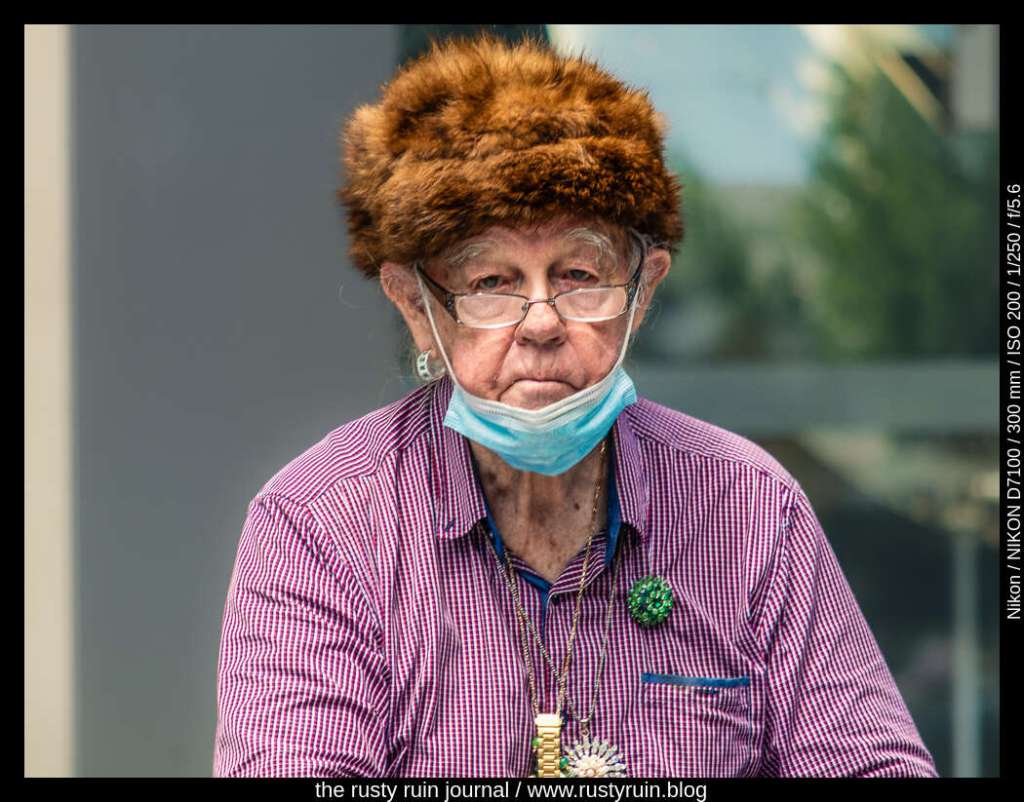
Covid-safe and unhappy – Nikon D7100 and 55-300mm Nikkor lens
It’s clear the person in the photo above isn’t very happy. Was he unhappy with me pointing the lens in his direction or was he unhappy with something unrelated? I found his look interesting and decided to make the photo before moving on. I admit it’s not an especially good photo but I share it in hopes of provoking thought about the ethics of street photography.
If a person isn’t comfortable with me making their photo but I’m ethically comfortable doing so, should one ethical framework override the other? Should there be an expectation that within a time, place, and culture, where photographing people in a public place may be legal but sometimes morally questionable, the ethics that favours asking consent or not making the photo at all should always take precedence?
Ethical choices and geological wonders
In a previous post, I posted photos of Uluru – a magnificent natural wonder that started to form over 500 million years ago. There are parts of Uluru where clear signs forbid photography based on the cultural beliefs of the local indigenous Arrernte people. I didn’t make any photographs in the aforementiomned signed areas, choosing instead to pay respect to those local beliefs.
My belief system allows me to view the world around me as not owned by any single person or group. It allows me to view nation-states, governments, and fortunes as illusions in the sense they are consensually understood and agreed-upon narratives. These beliefs inform my ethical framework, but I understand that such frameworks are purely subjective and personal. For me, Uluru is an amazing example of geological processes that existed millions of years before any human being set foot on the shores of the ancient inland sea. Yet, despite my belief, I chose not to make photos anyway, partly because I also respect the value of indigenous culture.
Ethics in photography is like a huge bowl of spaghetti on a first date – you’re probably going to spill it on yourself and look awkward while slurping up the pasta. It’s a messy and often uncomfortable area that’s filled with subjectivity and declarations of universal moral truths by stubborn individuals. Perhaps the best we can do is our best in understanding other people, occasionally override our own ethics to get along better with others, and hope that we find people that share some of our own ethics.
In my previous post, I outlined a confrontation that had happened when revisting a ruined house nearby. In a world where the Silicon Valley business model is obsessed with surveillance capitialism, tracking online behaviour, harvesting personal data, and selling that data, it’s no surprise that a growing number of people become very touchy indeed when a lens is pointed in their direction or the direction of something they own.
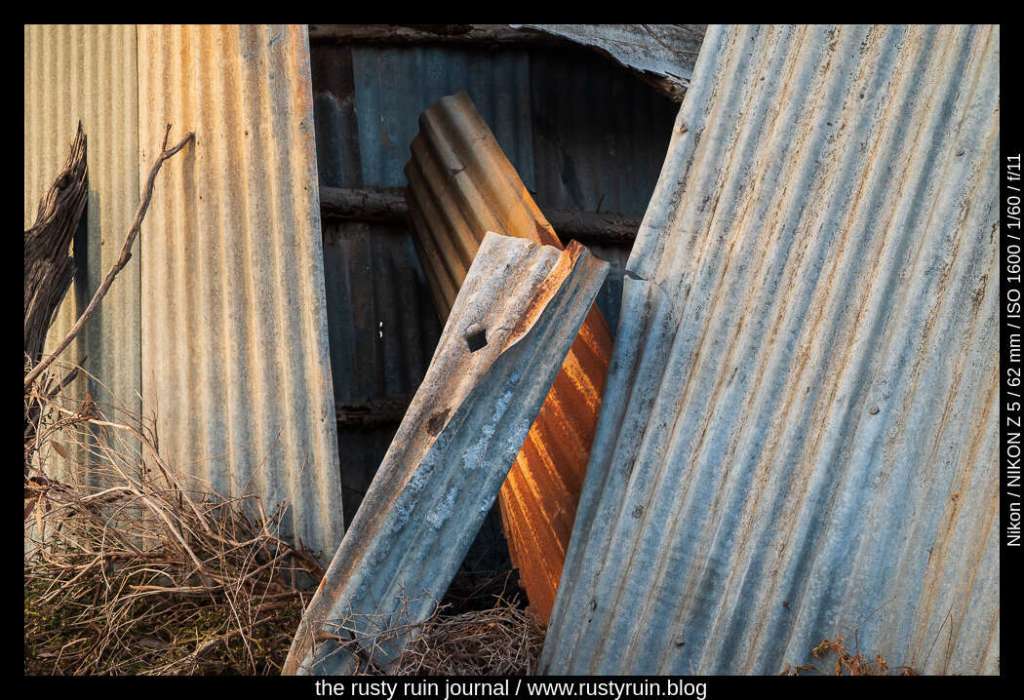
Old shed on a dusty corner at sunset – Nikon Z5
Ethics is a branch of Moral Philosophy that concerns itself with morality and how people should behave and why. Despite the fact that we were on a public road at the time of the incident, doing nothing legally wrong, and making photos, was our behaviour ethical? Why were we confronted and what ethical framework, if any, should inform photographic practice?
It’s very easy to dismiss confrontations with a deft wave of the legal hand: making photos from public spaces of things visible from those spaces is not legally wrong. Yet, doing so can provoke a strong reaction in many people. It may not be illegal, but is it ethical? Is it right or wrong to make photos of a property owned by someone else? And how should we react, as photographers, when we’re confronted?
Keep Out – Nikon Z5
I think self-reflection is a useful tool for personal growth and change. It allows us to consider our system of beliefs, our thoughts and feelings, and our behaviours in the larger context of culture and society. What beliefs inform our behaviours? And when those beliefs are challenged by someone else who thinks, believes, and behaves differently, what should we do? I’ll be coming back to these questions…
I was a little way up the dusty side-road with my Nikon Z5 and Nikon D40 when a big white 4-wheel drive roared past me and stopped next to our car, dust kicking up from the wheels. I knew it was a bad sign. I’d been here before. A few moments later, the car belted away down the dirt and turned onto the bitumen. Everything was quiet again and I gazed in the direction of the setting sun, hoping we’d be left alone long enough to make some more photos in the best light of the day.
Covered in old vines – Nikon Z5
I went back to work with the Z5, dialling back the exposure to preserve the highlights and waiting eagerly for the golden light to bathe the dusty corner we’d chosen for some evening photos. The quiet didn’t last very long…
Another big vehicle pulled up next to the ruined building we’d been training our lenses upon. I packed up my gear and started to walk back up the road to my buddy, suspecting he’d have to deal with a mouthful of abuse from the locals. I wasn’t wrong.
“What the FUCK do you think you’re doing???!”
I get it. There we are on a normally quiet road and we’re loitering outside his property. I made it there just in time for the tirade. My mate was very calm in the face of it, de-escalaing the situation and rightly pointing out we weren’t trespassing on his property and had no intention of entering or wrecking anything. Some minutes of back and forth and the property owner was still gruff but calm enough to take some mouthfuls of beer from the bottle he was swinging about.
Collapsing shed – Nikon D40 and Nikkor 35mm 1.8 lens
I contributed the odd word or two, reinforcing the argument that we were innocently making photos in great light and staying outside the fence-line.
“Yeah…I s’pose that’s OK if you’re into photography…”
Clearly his own mate was just there for moral support, as he’d said not a word the whole time. The golden light was fast fading and we were still locked in heated discussion about kids stealing copper from the old house and cutting the barbed wire fencing. The anger’s understandable, of course.
“Next time, ask me for permission! I’m just up the road, there.”
The problem with so many of these ruined places is that you just don’t know where the landowners are. Properties beyond urban areas can be big and it’s not always obvious who owns what. So, we stick to the public areas – the pathways and the roads, usually. Legally, you can make a photo of just about anything if you’re in a public space and you can see the subject from that public space. Permission isn’t required unless you’re planning to enter the property. I’ve never needed to say any of this to an angry onlooker or property owner, mostly because it doesn’t result in calm conversations.
A sea of cactus – Nikon D40
Finally, we made our peace and drove off. We’d missed the best light of the day. It would have been amazing too – pink clouds and soft golden highlights bathing all the dusty old corners and abandoned places.
Some days it’s hard to ignore the culture wars that shoot back and forth viciously on digital threads or the hurried whispers of people who feel the uncomfortable cultural shift beneath their feet. I wonder whether we’re just living through especially tumultuous times or whether this has always been so? It has always been so, of course, because nature is change. Even the universe changes from moment to moment. It’s a truth some try to resist and others embrace. Often, we embrace it when young and ossify with age. That’s our nature too. Today’s passionate culture warriors become tomorrow’s slow-moving dinosaurs.
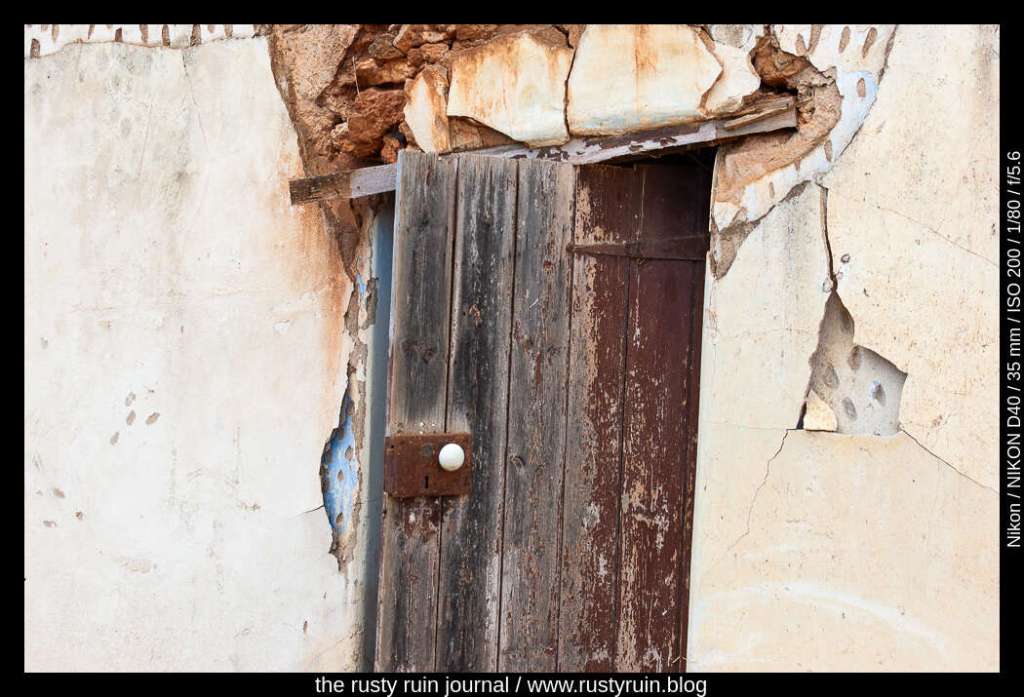
A door used no more – Nikon D40 and Nikkor 35mm 1.8 lens
I’ve always thought it unwise to commit too fully to a rigid set of beliefs. This is not to say belief systems are unreasonable or bad – humans seek meaning in all areas, and belief provides the framework for living in a universe that’s so vast as to cause us terror in dark and quiet moments – if you subscribe to Terror Management Theory. We cling to each other for warmth, just as we cling to belief like a security blanket.
We so often make the mistake of assuming our own beliefs are real and true and that they transcend time. Rather than understanding others deeply and cultivating compassion, we too easily find the beliefs of another person wrong, placing it on a rigid moral spectrum that functions as our own personal guide to undertsanding a seemingly random existence we seek desperately to understand, contain, and explain. In this way, we comfort ourselves.
The old entryway – Nikon D40
If we believe the universe has a moral structure inherent, we also tend to find a moral structure in the world and find our beliefs aligning strongly with it. If we believe the universe is mechanistic and chaotic, without moral structure, we align our personal narratives to this view instead. We find that life’s purpose and meaning is tied inextricably to our most basic beliefs about reality. We may be trapped within them at the expense of understanding other people. Either we’re islands of meaning, separated by uncrossable gulfs, or human beings attached to each other by common bonds. Perhaps both.
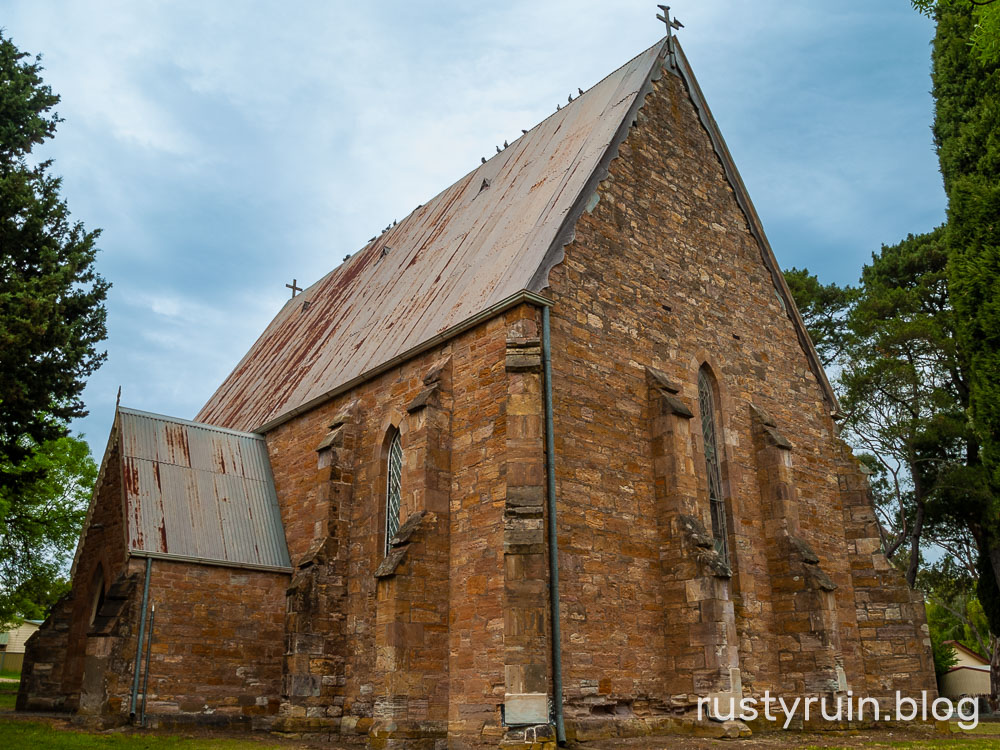
The tall church along the old road – Olympus E1
You don’t want to be on the wrong side of history, people sometimes say. For me, there is no right or wrong side, just people who have their own personal narratives, clinging to meaning. We’re all in the vast river of history together. It flows all around us. We’re part of the change happening from moment to moment, whether we embrace it or resist it. Neither approach is right or wrong – just ways of living and surviving and finding purpose and meaning.
Uluru at sunset – Nikon Z5
I love geology and astronomy. I like the feeling of placing myself in the context of deep time – the kind of time that barely notices our existence because we’re fresh and new. In this way, I place human life in the context of more ancient things. Uluru, the famed monolithic red rocky heart of Australia, started to form 550 million years ago. It was here long before we were. It started to form when multicellular life dominated the planet, long before dinosaurs roamed. Imagine that?
When you look up at the stars, those photons hitting your retina have travelled for countless light years. They’ve struggled and twisted up through impossibly dense super-heated layers of distant suns – the forges of our universe – careened through the cold depths of deep space, entered your eye, hit your retina, and then been processed as a visual signal by your amazing mammalian brain. In this way, we’re all connected to the stars. I love that thought.
How do you store your digital photo files? In this modern world, it’s a regular concern – how to safely and securely store all of the digital detritus that builds up around us. It used to be so easy when we just had to remember a few passwords. There was no such thing as 2 factor authentication years ago. Security breaches and cyber-hacks have put paid to having an easy life when it comes to digital security. And you know something? I’m a bit burned out on all of it…it feels a bit too much some days.
Stacked for the night – Nikon D70s
Just trying to organise photo files feels like a burden. I’ve had hard drives go bust over the years. The ever-swelling trove of files gets bigger and the voice gets louder: “Find an easy way to store all this crap or delete more!” – as if I’m stuck playing a simulation game and the goal is just to move shit around every minute of every day and night. Like Sisyphus pushing the boulder up the hill.
As I said previously, I use Microsoft One Drive these days. At the very least, I can use the cloud to quickly backup DNG files and TIFFs for future download. I know lots of people feel like they shouldn’t have to pay, but in the age of information overload, I think it’s a good idea to find a reasonable solution that offers enough storage for a good price. It’s the business model that Google tends to run with: offer generous freemium cloud storage, but not too much, so that people come to rely on it for their photo and file backups. Then offer paid tiers for more storage room.
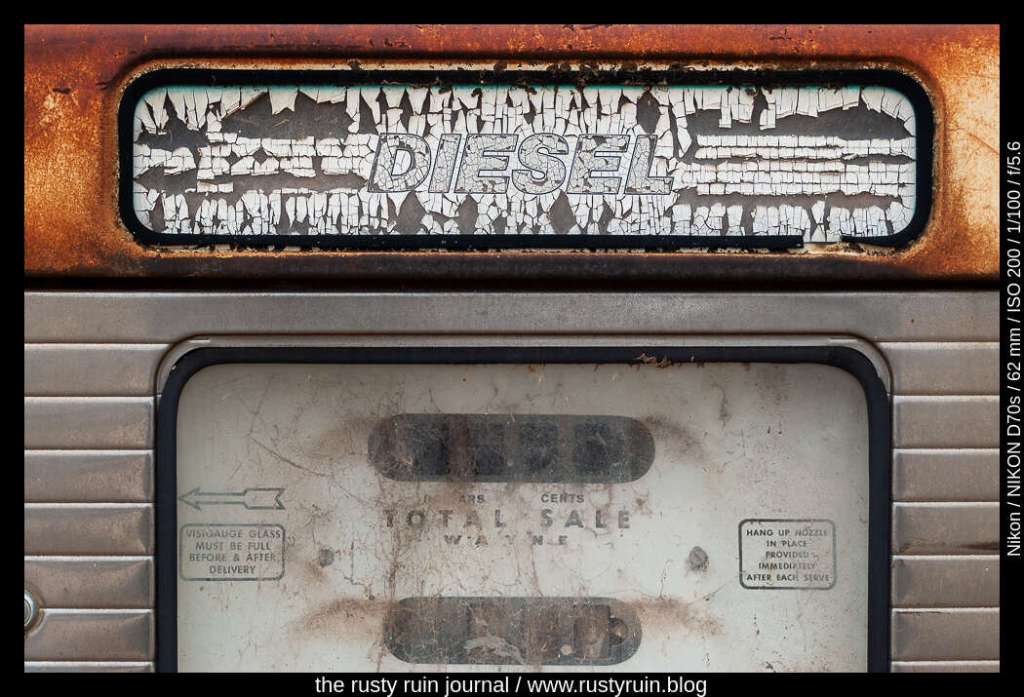
Diesel back in the day – Nikon D70s
I suppose we’re always looking to organise something – photos, files, music, our lives. And truthfully, sometimes all of those files feel like too much of a weight – like a digital albatross. I can’t even tell you how many sites I’ve been locked out of because an old paid email address went bust and now the site is sending the password I’ve forgotten to an email address that doesn’t exist. Or software license codes that got lost in the shuffle of hard drives and file moves. The 21st century has the feel of a password-protected version of copy of a copy of a copy, featuring tiny beige plastic parts that need to be glued together against a time-limit. So, I guess this is my rant about simplicity and complexity, as if there was ever a simple time. And since I work with vulnerable people, many of whom live really tough lives, I must say that I feel a little queasy even making a small complaint about any of it. Life moves and changes and we’re just the floating leaves flung by the ripples and waves as it goes.
Do you remember waiting for a roll of film to be developed? I used to enjoy going to the photo lab and collecting those envelopes filled with photos. I’d sit down on a bench somewhere and pore through them excitedly. Sometimes, they’d be from rolls of film I’d been sitting on for a few years, so looking through them was a joyous exercise in reliving those memories. If I had the extra money, I might even pay for 7×5 prints or even a grainy 8×10 enlargement. We don’t experience any of that with digital photography, of course, but there is a close cousin: finding unedited RAW files on drive backups.
View of the Lighthouse 1 – Olympus EM5 Mark 2 and unknown vintage lens
I’m not especially organised when it comes to my photo backups. I’ve even lost a bunch of photos from one particular holiday due to my lack of foresight. Admittedly, I’m also a bit burned out on the tech and the multiple passwords and the platforms and…well you get the idea. In short – my fault for not listening to the hard drive that was burping and farting to let me know it was living its final days. So, it’s always nice to discover a maverick folder full of photos files I’d forgotten about.
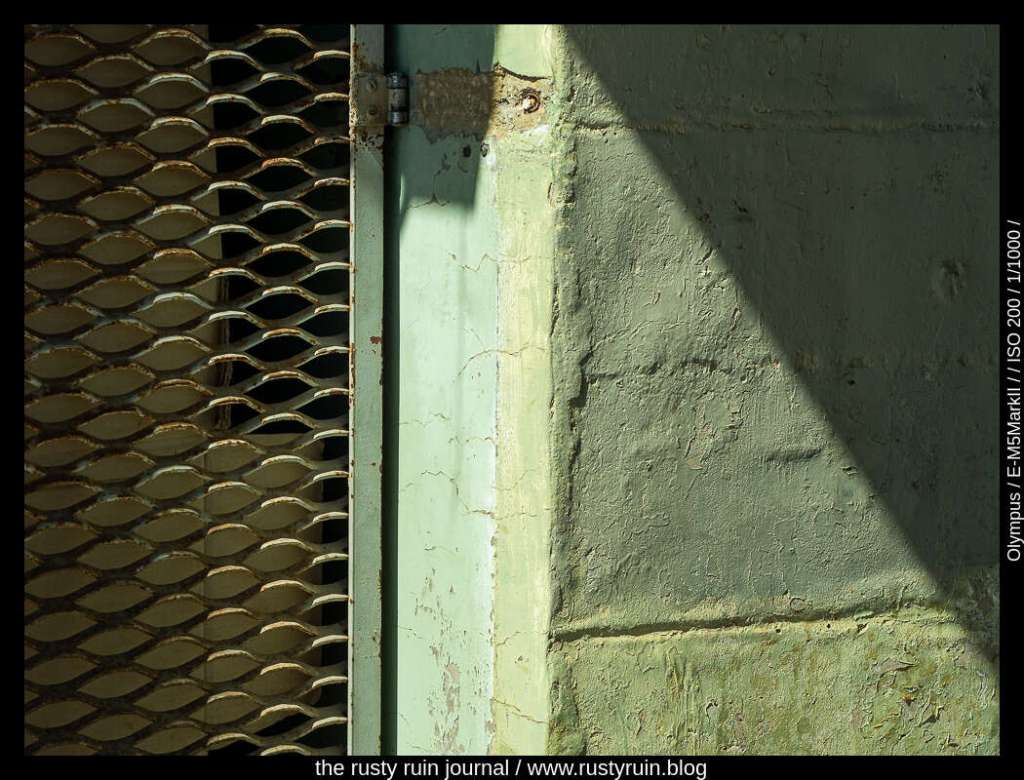
Rusty grille and green concrete – Olympus EM5 Mark 2
I use One Drive a lot for backups now. I usually save a DNG version to the cloud and save a web-ready version for this journal and for sharing (1000 px on the long side and 60% JPG quality, if you’re interested). You might also have noticed that my photos now have a neat black border with some EXIF information on the side and a URL for this place. It’s an unobtrustive way to watermark the photos, record some useful EXIF data, and make the photo pop a little more against the black border. It’s a slightly convoluted process to install and configure, but once set up, the Mogrify 2 plugin works well in Lightroom. I have a license somewhere, but it probaby went down with another bad hard drive incident.
I think contemplative photography has always appealed to me at some level. As photographers, we’re sometimes too focussed on making photos that announce our presence to others. That makes sense when looking at things through an economic or self-marketing lens. There’s a space for that, of course. But photography is about more than the next Like or Follow on the latest social media platform.
Illuminated – Sony RX100
I’m not so interested in mass appeal, exposure, ego-stroking, or money. I’m certainly interested in people and ideas and connections, but the idea that I’d need to specialise and market and propel myself in front of others just feels wrong. It goes against my grain, I suppose. The foundation of my practice finds expression through wandering, seeing, imagining, and purpose in the moment. Seeing the world differently in a single moment is at the heart of photographic practice, for me.
Sunrise and silhouettes – Sony RX100
It’s not always an easy thing to enter the mind-state of reacting instinctively to a scene. We so often judge what we see: is it a good photo? How can I make it better when editing it? How can I crop it? What camera settings should I use? When such thoughts take over, like a virus, they interrupt the flow of the moment and remove some of the joy. Is it truly important that we frame a scene so precisely that it attracts comments? Is it truly important that we even make the photo in the first place? Do we really need the camera to see the world?
On this last point: it’s true that we require no camera to experience the joy of the moment. And I think that as photographers, we’re prone to feeling as though we must capture everything and see the world through the lens. Still, the camera is integral to photography and there’s some consideration to be afforded technical settings. It’s the tension between the camera and inhabiting the world in the moment without distraction that can be the tricky tightrope for me to walk at times.
Have you been involved in a flame-war online? Have you witnessed dog-piling on social media that causes crushing anxiety in the vulnerable? If so, maybe you’ve largely retreated to safer spaces online, cozier and more comfortable spaces, like direct messaging, where you feel like you have more control over your privacy and your online interactions. In these spaces of the cozy web, we distance ourselves from the bots, data scrapers, ads, web predators, profiteers, and shills of the corporatised web.
Darkening – Olympus OMD EM5 Mark 2
The Dark Forest
If aliens exist and life in the universe is abundant, why haven’t we made contact yet? The dark forest hypothesis presents one possible answer: the universe harbours plenty of alien life, but it remains hidden and silent for fear of making too much noise and attracting predators. I guess our radio broadcasts into the darkness of space are going to be a problem then!
Yancey Strickler applies the dark forest hypothesis to the internet ~ the top layer is inhabited by predators: data scrapers, bots, surveillance capitalism, marketers, shills, and growing generative AI. The cozier web lies beneath this layer and is where many of us hang out to get away from the internet of predators. You can drill down all the way until hitting the dark web. It’s a complex digital ecosystem.
Reflections of a network – Olympus OMD EM5 Mark 2
Into this dark forest, we introduce AI, where entire websites are being populated with AI generated content in the hopes that a few stray clicks will make some coin for faceless people somewhere. Error-filled news articles, health tips, wellness blogs, crypto ads and more are being churned out at a growing rate of digital knots ~ most of it designed to make money, gain followers, and inflate reputations. It’s trashy, low-quality, dull content, generated by AI LLMs and lazy and unimaginative human parasites. This is the anti-web – the web where AI talks to itself and we remain hidden in the forest.
Hyperlinks lost
Some months ago, I watched a video that was clearly advertising a wellness product. I didn’t think much about it until I looked closely at the woman in the ad and her movements – they were looped and repeated, her facial expressions betraying the stiff smile of generative AI. It was chilling really. The stuff of cyberpunk nightmares in a world where we don’t recognise each other, question reality, and where human interactions are mediated through digital networks shaped by personal profiles that AI has built to represent each of us so huge corporations can maintain their walled gardens, their power, and their profits.
It’s hard to remember now, but I know it wasn’t always like this. The idea that the internet could be a hostile dark forest seemed far from my mind in the 1990s. The hyperlink once connected intimate digital ecosystems together ~ humble links living on obscure web pages, pointing you in a hundred different directions and encouraging you to surf the web. It was almost aimless. There’d be evenings where I’d dial-up, connect, and then see where a search would take me: a personal page, a few broken thoughts from a person living on the other side of the world, a cool-links page, onwards to another page living in the digital corners, and ending up somewhere obscure and unexpected where I might learn about dolphin language experiments. It’s not altogether different from simply wandering about with a camera, without expectation or judgement.
As Friedrich Nietzsche said: “All truly great thoughts are conceived by walking.”
There was once a time when it seemed like the web could liberate entire nations and set information free. There was a promise in the medium – a thousand thousand thousand human thoughts and feelings connected by the humble blue hyperlink in a web browser. Instead, we have tech-billionaires who have constructed platforms and closed systems and called it the modern web – Web 2.0 or 3.0, or whatever the zeitgeist and marketing departments demand. In their systems, hyperlinks are nothing more than restricted sections in a social media Bio – a way to funnel the gullible, the vulnerable, and the young to AI-written websites and empty blogs where generating income from clicks is all that matters. The click of the humble hyperlink has been twisted into a way to service the predatory machine in the dark forest. We’re sedentary now, having forgotten how to walk aimlessly, and doomscrolling our days away.
When I look in the cupboard, I see lots of cameras and lenses – some would say, rather too many! Plenty of my film cameras are still piled up in boxes, so they barely add to the shelved pile. Poring over my digital cameras and lenses specifically, I see a growing number of Nikon branded things. I wonder if I’ve become brand loyal? I’d certainly not describe myself as a person overly concerned with brands!
Coober Pedy – Nikon Z5
Identifying with brands
There are lots of people who adore certain brands. By identifying with a brand, we express something of who we are. We recognise some characteristics in the brand that strike a chord within us. We announce to the world: “This brand expresses who I am or who I want to be!”. Perhaps the brand expresses qualities we aspire to demonstrate in our own lives? Perhaps it reinforces a self-perception that we’d like others to notice? Brands are symbols that can be important to our identities, and the most successful brands resonante more strongly with larger numbers of people.
You could say that brand Nikon is doing something right after being so long in operation. The Nikon Corporation has been around since 1917 and has become a household name in that time. They know how to make great cameras, but that’s not to say that Canon or Sony don’t also make great cameras. They certainly do! And they have their own branding and marketing. Truthfully, I’ve often felt that Nikon have been pretty terrible at marketing their gear. It’s great engineering, but companies like Canon and Sony often seem to have had more attractive marketing campaigns over the years.
So, I guess I’m wondering why I open up my cupboard and see a growing bunch of Nikon cameras staring back at me – what does it say about me? Am I now a brand fan?
Through the pass – Nikon D70
How I got started
The truth is that I never thought I’d be much good with a big pro-looking camera. I was convinced that small and simple cameras would be my fate, seeming to fit better with my self-perception of not being very technically minded.
Despite this, I decided some years ago to push my limits, so I purchased a Nikon D5100 in hopes of finding a way to express myself more creatively. It was either the Nikon or the equivalent Canon, but the D5100 just seemed to have some better tech-stuff inside – a marginally bigger APSC sensor, a well-regarded sensor also featured in the D7000, and the fact that I could use so many F Mount lenses. For about the same price as the Canon, it seemed to be a slightly better camera.
Waiting after a tiring day – Nikon D5100 with Nikkor 55-200mm DX
I wasn’t at all disappointed with the D5100. On the day I received it, I set about educating myself on how to use a DSLR. I’ll be honest – it was a bit intimidating. It was a very different and more complex camera than I was used to. After reading a lot and watching a lot of how-to and exposure triangle videos, I went out and did some night photography. I can highly recommend this practice if you want to learn about the importance of light in photography. You very quickly learn that light is everything when you’re running around at night with a cheap tripod and a shutter remote that only works half of the time!
For the Nikonians and other interested parties
I don’t have the D5100 anymore, but I do have a growing bunch of Nikons that many Nikonians would be familiar with:
Nikon D40 – It’s an old and small DSLR from Nikon, featuring a 6.1 megapixel CCD sensor. I’ve written more about it here. Paired with Nikon’s older kit kens – the Nikkor 18-55mm – it’s a great lightweight camera.
Nikon D70 – My copy is a bit on the used side, but it still makes great photos with the CCD sensor. Some say it has a definite cool bias, but that can be perfect for many types of scenes.
Nikon D7100 – This was my workhorse Nikon DSLR for a long time. I upgraded to it at a good price after selling the D5100 and what a difference it felt like upon opening the box! Unlike the D5100, it has more external controls and solid ergonomics that don’t feel plastic. It feels like a professional camera when contrasted to the D5100 !
Nikon Z5 – After a long time, Nikon finally entered the mirrorless game. The Z5 is every bit a modern mirrorless camera for a good price, considering the 35mm digital sensor. After using my mirrorless Olympus OMD EM5 cameras for so long, this feels both familiar and a huge upgrade in capability. As much as I trust my D7100, the Z5 is my new workhorse.
Nikon D200 – Released in 2005, the D200 features a well-regarded Sony-made CCD digital sensor. I regard it as one of the best early DSLRs from Nikon, as the camera market was shifting from film to digital.
I know that my Nikons aren’t exactly heavy enough to bow the shelving. It just feels like they outnumber my other cameras by a long way! Maybe it’s because I use them a lot, so I feel like I’m a brand loyal Nikonian? I’ve used my share of small junk cameras over the years, so it’s nice to pick up a big-name camera that just works when I want it to. I’ve had a few cameras die on me now – I’m looking at you, Sigma DP1 and Sigma DP2M ! I still don’t think I’m a brand loyalist, but I do like my Nikons.





















 The Rusty Ruin Journal