If you’d told me 15 years ago that my 1 megapixel Kodak would become a vintage digicam fetish item for Gen Z, I might have been amused. At the time, I was looking for tech-upgrades I could afford. It was all about more megapixels, as that seemed to be the measure of a digital camera in the 2000s – a time when companies thought they had a chance to revive their fortunes after the film era.
I might not be Gen Z, but it’s nice to use these old cameras again. Exploring macro modes, slow start-up times accompanied by bell chimes, and outdated storage media (XD card, anyone?) reminds me of how exciting the digital camera market was back then. Even a company like Casio – largely known for calculators and watches –was dipping their toes into a market that was fresh and ripe for innovation.
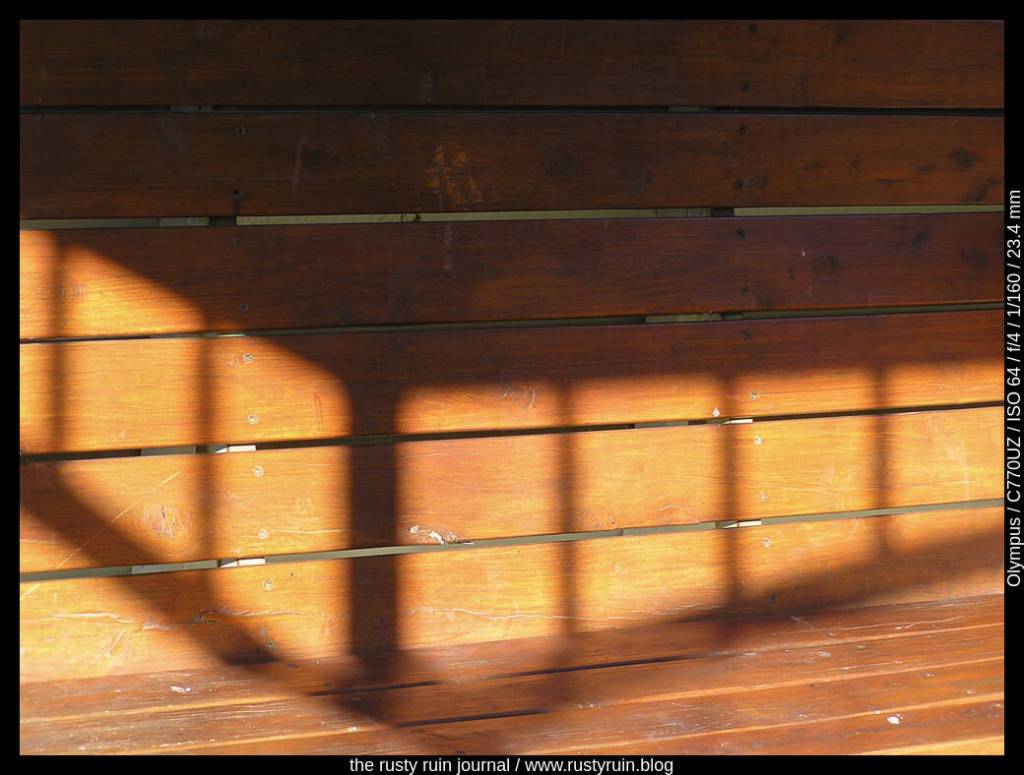
Soft shadows on wood #1 – Olympus C-770
For those of us who lived through it, this particular past doesn’t hold the mythical gold that Gen Z thinks it does, but it’s also perfectly natural to yearn for brighter yesterdays, especially when today is so obsessed with both the perfection of the image and the kind of moral purity testing that accompanies a technology layer that weaves relentlessly through our lives, recording our thoughts and feelings so that we’re not allowed to ever forget or forgive.
Despite the nostalgia, there are other benefits to reviving old digital cameras:
Save the environment by not chucking out a perfectly usable old camera. Companies tapping viciously into the dopamine hits that reliably ensure we hit the technology upgrade treadmill and spend spend spend don’t help our planet.
Use limits to learn – it might only have a maximum ISO of 400, no image stabilisation, and a sensor that goes blind as soon as a sliver of a highlight hits the photosites, but those old camera limits will teach you patience. They’ll teach you to consider dynamic range. They’ll teach you to slow down and compose each frame properly because the camera doesn’t have the same easy conveniences our modern cameras do.
An old digital camera will also teach you that photography is about more than expensive camera gear. I’ve said it before – people have been making wonderful photos for more than a century. Great photos are not restricted to the 21st century and camera gear that makes your bank account weep. If you’re not making good photos with a cheap camera, you’re not going to make good photos with a $6000 camera.
I purchased the Olympus C-725 Ultra-Zoom sometime in 2004, excited by the prospect of the included manual modes and extra features as a step-up from my Kodak. At the time, I was eager to improve my minimal knowledge and explore the mode dial and learn the basics of photography. As it turns out, this silver all-plastic Olympus proved to be my bugbear. It would not be until 2013 that I picked up another camera more complex than this one.
Through the use of various cheap film cameras in the 1990s, I came to realise I had more than a passing interest in visual artforms. As digital photography started to take-off, I decided to nurture this growing interest and paid a lot of money for the Kodak. It was fun, but I decided I needed a more capable camera so I could brush up on the technicalities.
Homes and masts at the marina – Olympus Camedia C-725 Ultra-Zoom
I remember going out with my father, in mid-2004 perhaps, with the express intention of us both buying a new digital camera. He was always keen on new technology. As we browsed the shelves, we picked up every model from Fujifilm to Olympus to Kodak to Sony to Minolta. The model number particulars of the 4 megapixel Fujifilm camera that he purchased escape me now, and I’ve been unable to locate it in his boxes of things. It was the Olympus that appealed to me though.
The Olympus name resonated with me. It spoke of quality and longevity – something that seems both trivial and naive now in the context of the sale of their imaging arm in recent years and the rebrand under OM Digital Solutions. But 2004 was a different time in photography. It was the weird and confusing intersection of more than a century of film culture and the new digital kid on the block.
A silver finish, a boxy plastic design that would make modern mirrorless camera users weep, a mere 3 megapixels, PASM modes, and a huge 8x zoom caused me some excitement. Here, I thought, was a camera that could really teach me about photography! As it turns out, my father had a lot more easy fun with his pale gold plastic Fujifilm Finepix camera.
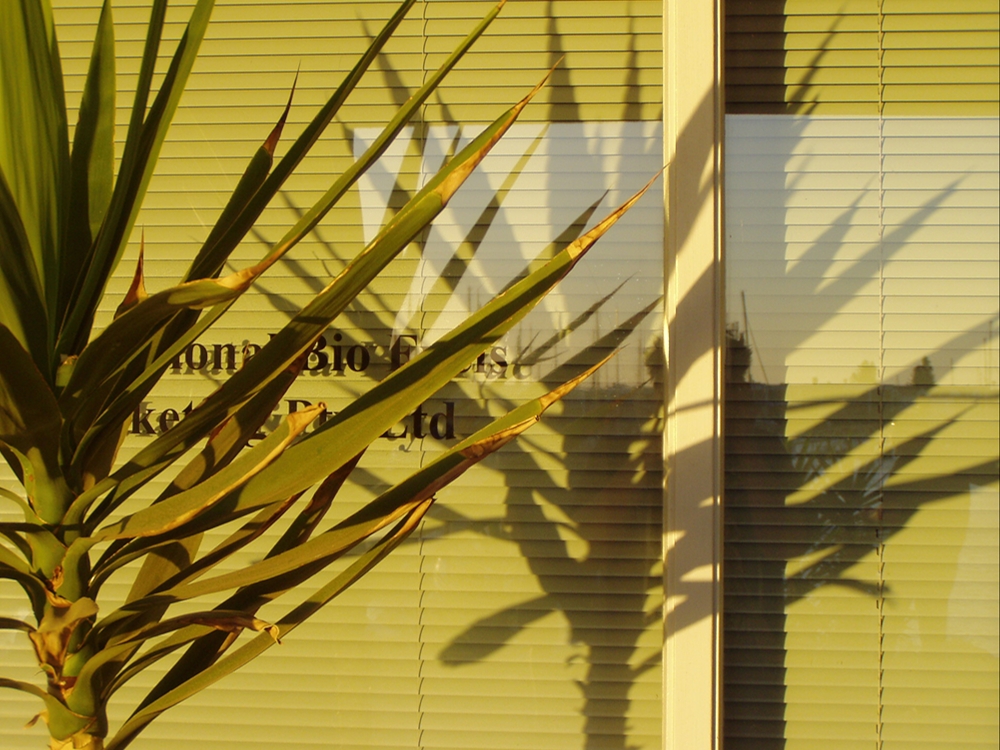
Sunset colours reflected in office windows – Olympus C-725 UZ
The heart of the problem is that I didn’t allow myself to have fun with this camera. Rather than focus on playful image making and the development of my eye and imagination, I placed enormous pressure on myself and turned the mode dial to Manual and left it there. That’s where I thought I had to be to learn properly. Not only did some early web forums demand this practice of newcomers, but I was also wont to be overly harsh with myself at the time. It may be that I used the mode dial to sabotage my learning.
After struggling for a week or two, all the fun drained away and my initial enthusiasm turned sour. I put the Olympus in a drawer and told myself sternly I’d never be able to learn proper photography. I limited myself to easy one-button point and shoot cameras until I purchased a Nikon DSLR in 2013 – almost a decade after buying the Olympus.
The Olympus was synonymous with my failure until I dusted it off last night and made some photos. I finally made my peace with myself and the camera. Maybe the experience also taught me I wasn’t ready for that type of learning at the time and that using easy cameras for a while was the best thing I could do because it was fun.
So, I’ve come back to the boxy silver Olympus and, having once discarded it in the throes of self-disgust and wasteful gadget buying that speedy technological transitions in consumer societies encourage, I’m finding it a joy. It may be a cumbersome and slow thing, with a design that speaks to the early 2000s, but the photos are quite pleasing I think.
Blue boat at sunset
Limited to a maximum shutter speed of 1/1000th of a second and ISO that tops out at 400, it demands the right conditions for the best results. My fingers fudged over the various buttons without the benefit of muscle memory last night, but I think the photos have a nice quality about them. I set the Sharpness and Contrast to Low, so as to provide maximum editing flexbility. I don’t mind the softness of the images though. The lens gets pretty mushy around the edges of the frame, especially at maximum zoom, and there’s plenty of chromatic aberration in backlit scenes, but after using so many cameras in the twenty years since I hid the Olympus away in self-despair, I’ve broadened my aesthetic sensibilities enormously.
Here’s a photo that’s overexposed. I like the dreamy look of it and that the optics picked up the nice veiling orange flare from the setting sun:
Dreams of the marina by the sea – Olympus C-725 UZ
OK, I pushed it today. I really did. And it didn’t really work. I should have known better, but I like to risk it sometimes. What am I risking? A blurry photo in conditions that should attract higher ISO/wider apertures.
The S7000 came with us for a hike today. The weather wasn’t great for old cameras with visible noise at what would be considered only moderate ISO ranges these days. The S7000 operates at a base ISO of 200, which is already a touch noisy. Add in a few rain drizzles and heavily overcast skies, and the problems become apparent.
I managed a few decent macro shots at lower than ideal shutter speeds, one of which is pictured above. What I noticed was that even on the F-chrome picture setting, the JPG output was decidedly dull. It lacked any punch or saturation, even in the greens. I’ll put that down to the overcast day and the even lighting conditions. At the very least, the clouds enabled some nice detail in macro photos.
Admittedly, I did add some Clarity, Vibrance, and Texture in Lightroom for these photos, but nothing overboard. I’m fortunate that the teeny 1/1.7 inch sensor is fairly forgiving of movement, as my shutter speeds just weren’t fast enough for most of the hike. This is because I really didn’t want to push to ISO 400 for fear of noise. Still, I should have widened the aperture more often. Perhaps I’m just too used to any form of stabilisation in my cameras.
Overall, a bit of a down day with the Finepix S7000. Today was as disappointing as last time was surprising. I’m pleased enough with the three photos that worked though. Looking at them now, they’re quite pleasant. My favourite is the arrangement of tree branches. I should certainly know better, of course, and I didn’t adapt. I was stubborn about my approach.
I suppose today just wasn’t the day for it. Next time I may take out the Sony RX100 and flip that to Vivid picture mode. No doubt, Sony’s sensor would handle a day like today with sufficient aplomb. I did also have my Olympus OMD EM5II with me, but it was the Finepix that I wanted to use, given the success I had the first time.
What did I learn today?
Older cameras like this love a lot more light,
Always watch shutter speed,
Even when I think I can hold steady, watch the shutter speed!
Be more flexible in my photographic approach,
Don’t be too hard on myself because there’s nothing wrong with learning and experimenting.
When I became serious about developing skills in photography, I was drawn to the practice of contemplative photography with small and simple cameras in Auto mode. The idea that I can re-frame the world and see it with fresh eyes is attractive because it anchors the mind in the moment. There’s no struggle with too many buttons or camera settings in Auto, and there’s no complex exposure puzzle to solve because the camera does the heavy lifting.
When I purchased my first DSLR – a Nikon D5100 – I was thrust into the world of camera gear. My formerly simple photo walks turned into knotted thoughts about dynamic range, sharpness, and aperture settings. I sought out videos and online forums so I could learn. I purchased even more gear, knowing all the while that people were making great photos with primitive boxes over a century ago.
There’s a joy in this sort of learning curve, and it’s important, but there’s also a cognitive load that removes some of the pleasure of inhabiting the moment – at least for me. Others, I suppose, may find sustainable joy in complexity.
So, how can I re-enter the moment with camera in hand? This is where old digital cameras are useful. Enter the Fuji Finepix S7000 – a prosumer camera announced in 2003 that features full auto and manual modes, a fixed zoom lens with a maximum aperture of 2.8, great ergonomics, a nice EVF, and Fujifilm’s take on the digital CCD sensor: a 6.3 megapixel Super CCD generation IV sensor.
Super CCD – the secret sauce?
Before CMOS digital sensors went mainstream, CCD sensors could be found in most older digital cameras. Most camera reviews at the time focussed on whether colours out of the camera were natural or over-saturated, providing clues as to how camera makers programmed their on-board software to make JPG photos more vibrant and attractive to buyers. There’s a current trend where some people believe that CCD sensors contain “techno-magical” properties and produce film-like results, but as someone who grew up with film cameras – only film looks like film. I suspect that those who believe this are young enough to think they missed out on a digital technology that offers long-lost superiority over current camera output. Frankly, there were plenty of trashy, low quality CCD sensor cameras back then too.
The Fujifilm Finepix S7000 features a Super CCD sensor with a honeycomb patterned Colour Filter Array (CFA) overlaid. Some people think CCD sensors create better colours than CMOS sensors, but people who know a lot more than me are pretty certain they don’t. Anyway, there are other reasons to use old cameras like the S7000.
Using the S7000
I purchased the S7000 for a fraction of its original retail price. Here in Australia, it would have been a top-shelf digital camera at the time of release – the likes of which I’d not have been able to afford. Back then, I’d only just moved on from my first digital camera: a boxy Kodak DSC with 1 megapixel, an awfully tiny LCD screen, no manual controls, and the worst battery life I’ve ever encountered in any modern electrical device.
Oh, what a camera I’d missed! The S7000 is pleasingly ergonomic. The grip is comfortable and the myriad buttons are within easy reach. What surprises me is the EVF – a pretty immersive experience, even by today’s standards, despite comparatively low resolution. Honestly, I had no idea that a 20 year old digital camera could be this advanced! This is mirrorless before we had modern mirrorless.
OK, the camera has some annoying quirks: the slow start-up time, washed out LCD and EVF, the tinny start-up sound I’d forgotten about on these old devices, the photo playback button located on the power switch, 2 separate menu buttons, a maximum shutter speed of 1/1000th of a second unless in full manual mode (where it’s a whopping 1/10000th), and the screen that nags you to update the date/time. You can turn off the tinny sounds, including the focus beep and the fake shutter sound, but when you change the 4xAA batteries, the camera forgets all user settings and you have to go in and do it all again. So, I just leave the annoying camera sounds on now.
SOOC – Straight out of the camera
I usually set all my cameras to RAW and edit the photos later, but in the interests of removing cognitive load, enjoying the moment, and exploring the manufacturer baked-in colour profiles of the S7000, I set it to the Fujichrome colour setting at 12 megapixel, Fine JPG. It’s the best way, I think, to experience what most people used at the time and just enjoy a day out.
All of the photos on this page are the S7000’s JPG output. In F-chrome mode the output is high contrast, high colour saturation, and a green bias in the white balance. I think they look pretty nice. In fact, I think the output is remarkable from a 2003 digital camera.
Older CCD sensors aren’t great when it comes to strong highlights in high dynamic range scenes, so I made most of these photos between -0.3 and -1.0 exposure compensation, just to protect the highlights. As you can see on the hulls of the boats above, the detail is preserved well. I do wish the giant black solar panel wasn’t blocking the boat at the back, but that’s life.
Blues and greens are especially nice using the Fujichrome setting, and the contrast is punchy. I barely touched these images in Lightroom – some cropping when required, some image straightening, and the barest highlight recovery and black point. Not that JPGs provide much latitude for recovering shadows or highlights, but I’m happy with that because it means I don’t need to mess around much in editing after enjoying the day out.
For such an old camera, the resolution and detail is excellent, though pixel peeping reveals the sort of softness that most modern photographers would be seriously troubled by. There’s also visible chromatic aberration around strong contrast areas. Still, there’s a pleasantness and immediacy to the images I can’t deny. They’re sharp enough without making the eyes water.
The S7000, through clever software and the honeycomb structure of the CFA, interpolates 6 megapixels to a 12 megapixel output, though you can choose 1, 3, or 6 megapixels if required. It can also output CCD RAW files at 12 megapixels only. I set it to 12 MP Fine JPG setting, as this seemed to be the preferred setting of many users at the time.
A surprising performer
The Fujifilm Finepix S7000 ticks a lot of boxes for me: it’s easy to use, has advanced settings if I want, has fantastic Macro and Super Macro modes (I’d forgotten about the dedicated macro button featuring the cute flower symbol on these old cameras), and satisfies the itch to stop thinking about settings too much and instead focus on the world and the image. The 12 megapixel output is certainly usable, even today, and would easily yield a good 8×10 inch print. It would have been an amazing camera at the time of release and I’m sure it would have blown my mind in 2003. It also proves that today’s complex mirrorless cameras had perfectly capable precedents.








 The Rusty Ruin Journal