There’s a common view that blowing out or burning highlights is a bad practice. There are times when a lack of detail in areas of a photo due to burnt highlights is problematic if the details in those areas are integral to the feel and story the photo communicates. There are also times when it doesn’t matter at all. For example, is it important to see the filament in a light bulb? And forget about any detail in a bright light source like the sun – that’s not going to happen without special expensive filters.
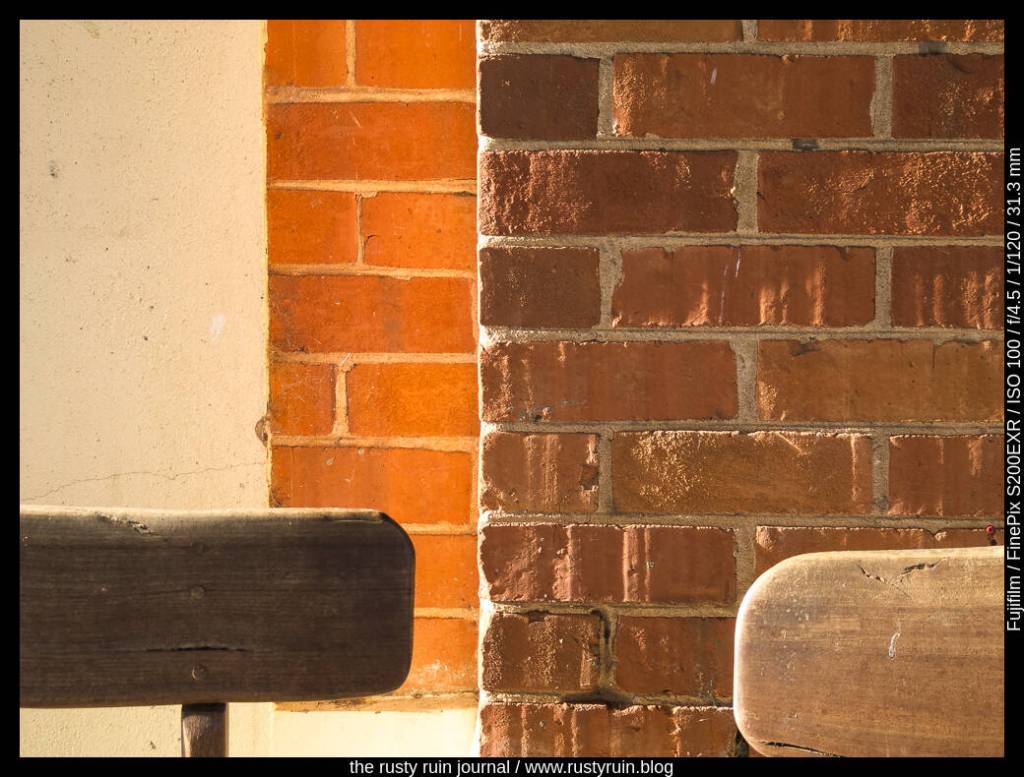
Sunset glow on wood chairs and bricks – Finepix S200 EXR
Consider the above photo. To reveal some of the wood grain detail on the leftmost chair, I bumped up the exposure a touch and allowed more light to hit the sensor. Doing this also burnt the highlights on the edge of some of the bricks. The tradeoff was worth it because it was more important to reveal detail on the chair than to preserve the texture on those small sections of the bricks. The other benefit is that the slightly overexposed highlights also communicate the glow of the sun at the time.
A big optical zoom that starts at 30.5 mm and ends at 436mm (F2.8 to F5.3),
DSLR-like styling and external buttons,
A largish, by bridge camera standards, 8x6mm (1/1.6th inch) sensor,
And a 200 000 dot electronic viewfinder.
In many ways, it feels modern, though the speed of processing is definitely of the 2009 variety. Still, I can save in both JPG and CCD-RAW, unlike previous Fujifilm bridge cameras.
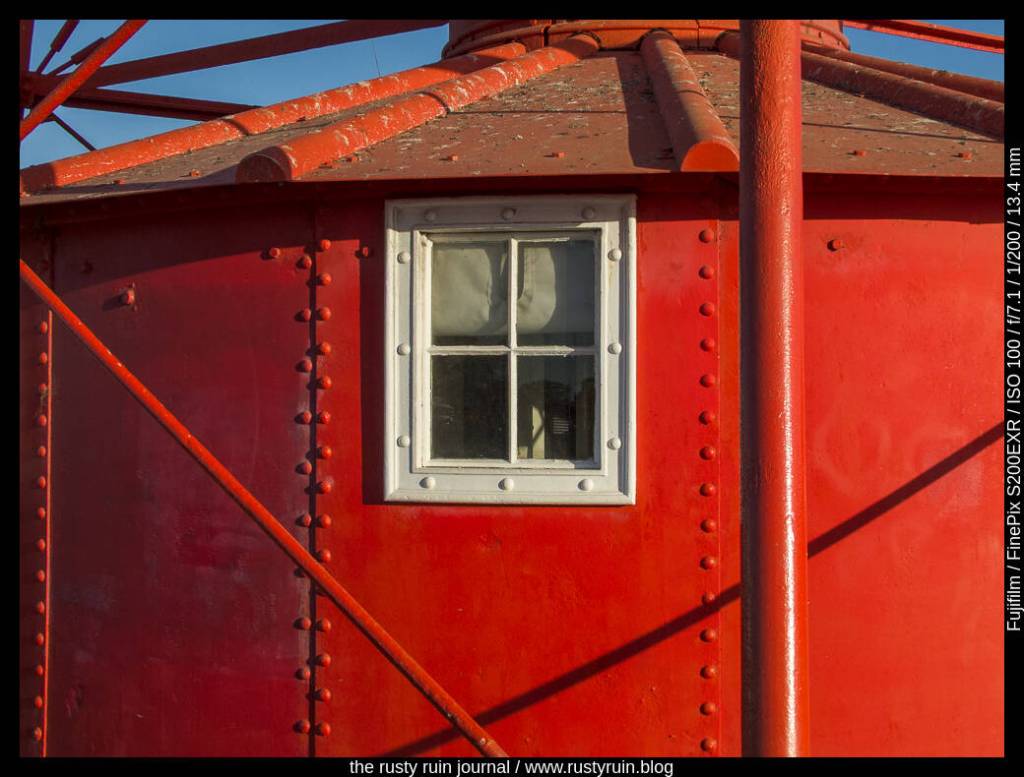
The old red lighthouse – Fuji Finepix S200 EXR
The octagonal pixels that Fujifilm packed into these old sensors might seem odd by today’s standards, but the tech produces photos said to contain extra highlight information. It’s not terribly easy to verify this, as I’m still trying to work out the weird digital alchemy that results in:
Strange cross-hatch image artifacts in some 12 megapixel images,
12 megapixel TIFF files that can only be created from RAF files in an aging program called S7raw – built almost exclusively to read CCD-RAW files from these later Fuji cameras,
JPGs and RAF files that are 12 megapixels in any of the PASM modes and High ResolutionEXR mode, or 6 megapixels in the Dynamic Range or Low Noise EXR modes.
It’s a lot to digest and also explains why some people describe this camera as a JPG machine ~ they clearly have better things to do with their time than mess with TIFF and RAF files. This makes it a complex camera on the inside. And as much as I like that the S200EXR offers classic Fujifilm JPG recipes – Provia, Astia, Velvia, and BW – the menu organisation also reflects the complexity of options available.
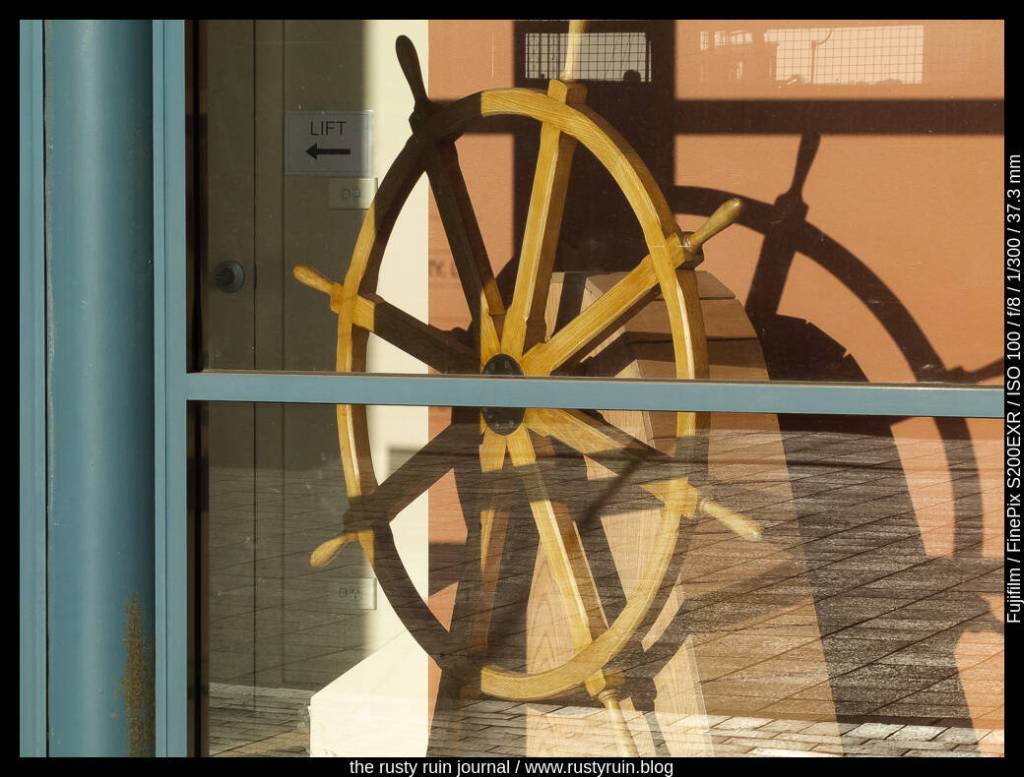
Ahoy Captain! – Finepix S200EXR
The seperate EXR option on the dial offers three special modes: 12 megapixel High Resolution photos that use all of the sensor pixels, 6 megapixel Dynamic Range photos that preserve more detail in shadows and highlights, and 6 megapixel images in the High ISO Low Noise mode. Weirdly, the regular PASM functions don’t offer any of the three EXR special modes and create regular 12 megapixel photos that use a different kind of dynamic range preservation technology.
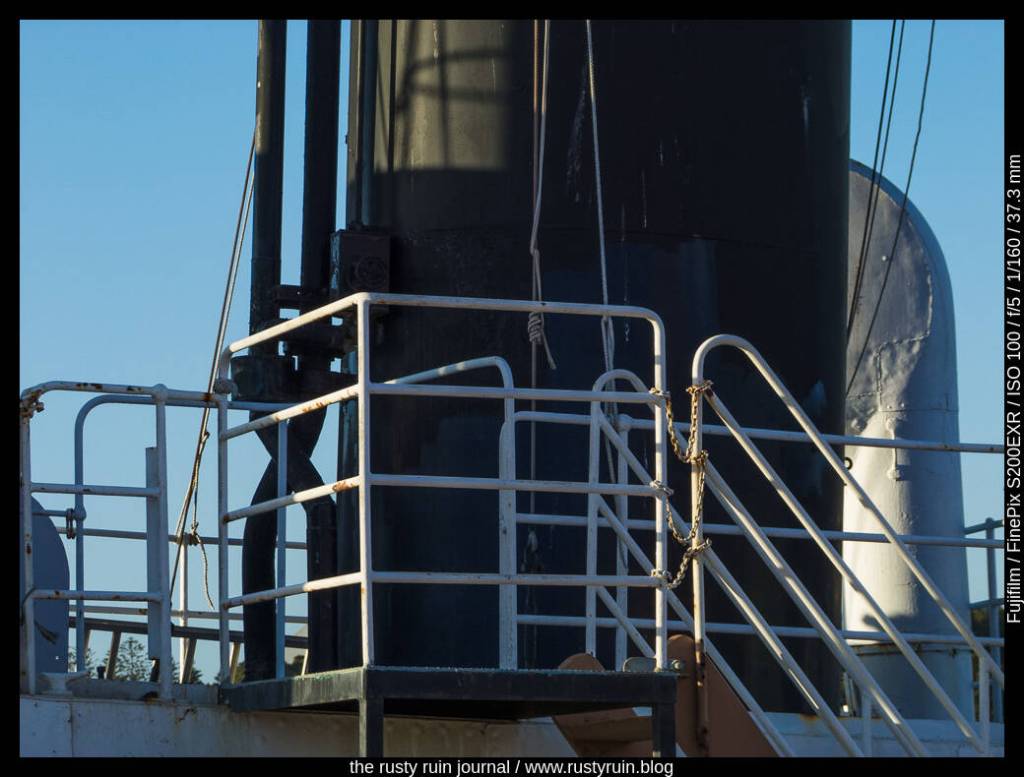
Rails and pipes – Fuji Finepix S200 EXR– plenty of detail in the shadows, even in this 6 megapixel image
I’ve found that importing the RAF files into Lightroom is the most convenient option in all cases. The imported 6 megapixel images from RAF files recorded in two of the EXR modes seem to be the darker of two exposures – or at least the darkest part of whatever data lives in the mystical RAF files. It seems likely that Lightroom is throwing away some of the data from the smaller octagonal pixels that preserve extra highlight information. A RAF file recorded in any of the PASM modes results in a 12 megapixel image, and Lightroom imports them just fine – this is my preference going forward.
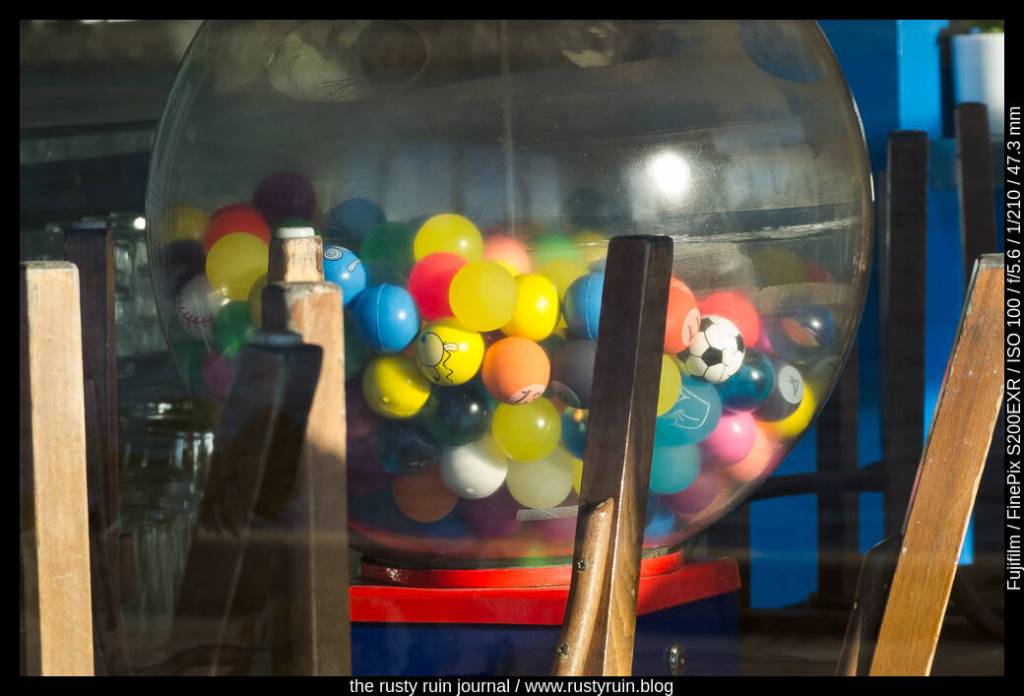
Balls balls balls – Fujifilm Finepix S200EXR
It seems that the EXR line of cameras represented the pinnacle of Fujifilm’s longstanding SuperCCD sensor technology. Not too long after these premium bridge cameras and their strange alchemical sensors, the company moved to CMOS and their X-Trans technology. Despite the complexities of the camera, I find the images very pleasant.
If you’d told me 15 years ago that my 1 megapixel Kodak would become a vintage digicam fetish item for Gen Z, I might have been amused. At the time, I was looking for tech-upgrades I could afford. It was all about more megapixels, as that seemed to be the measure of a digital camera in the 2000s – a time when companies thought they had a chance to revive their fortunes after the film era.
I might not be Gen Z, but it’s nice to use these old cameras again. Exploring macro modes, slow start-up times accompanied by bell chimes, and outdated storage media (XD card, anyone?) reminds me of how exciting the digital camera market was back then. Even a company like Casio – largely known for calculators and watches –was dipping their toes into a market that was fresh and ripe for innovation.
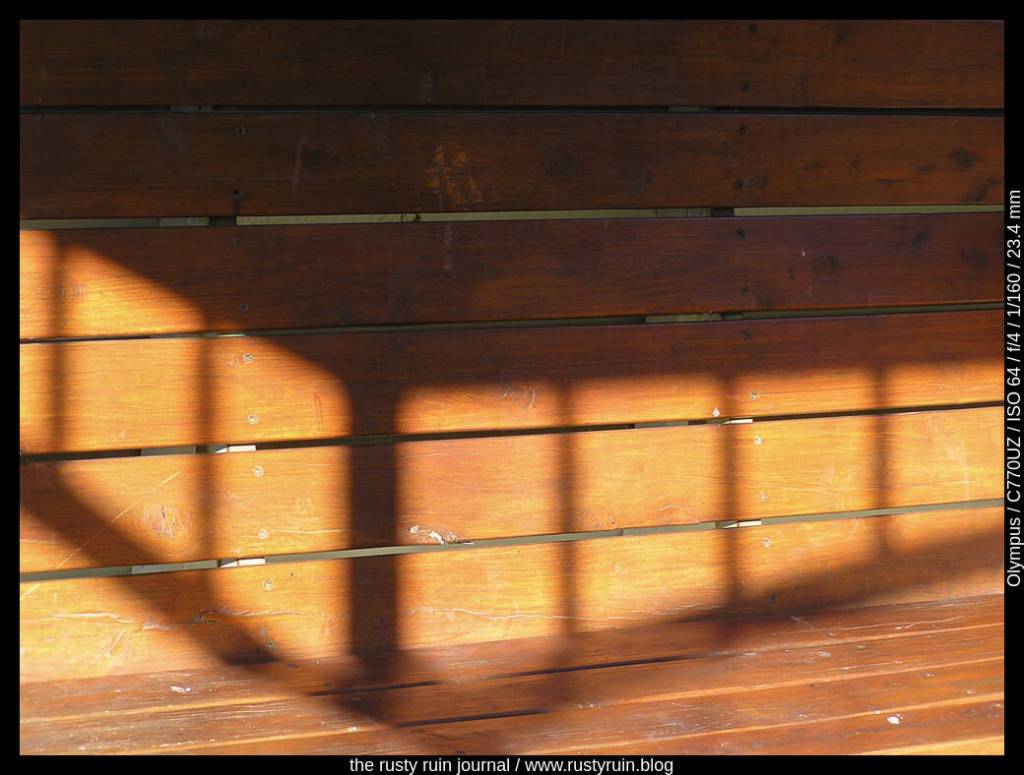
Soft shadows on wood #1 – Olympus C-770
For those of us who lived through it, this particular past doesn’t hold the mythical gold that Gen Z thinks it does, but it’s also perfectly natural to yearn for brighter yesterdays, especially when today is so obsessed with both the perfection of the image and the kind of moral purity testing that accompanies a technology layer that weaves relentlessly through our lives, recording our thoughts and feelings so that we’re not allowed to ever forget or forgive.
Despite the nostalgia, there are other benefits to reviving old digital cameras:
Save the environment by not chucking out a perfectly usable old camera. Companies tapping viciously into the dopamine hits that reliably ensure we hit the technology upgrade treadmill and spend spend spend don’t help our planet.
Use limits to learn – it might only have a maximum ISO of 400, no image stabilisation, and a sensor that goes blind as soon as a sliver of a highlight hits the photosites, but those old camera limits will teach you patience. They’ll teach you to consider dynamic range. They’ll teach you to slow down and compose each frame properly because the camera doesn’t have the same easy conveniences our modern cameras do.
An old digital camera will also teach you that photography is about more than expensive camera gear. I’ve said it before – people have been making wonderful photos for more than a century. Great photos are not restricted to the 21st century and camera gear that makes your bank account weep. If you’re not making good photos with a cheap camera, you’re not going to make good photos with a $6000 camera.
Just as I once developed a taste for the Fufifilm Finepix series of bridge cameras, it seems that I’ve developed a similar taste for old Olympus bridge cameras. I blame it on the recent resurrection of my Olympus C-725!
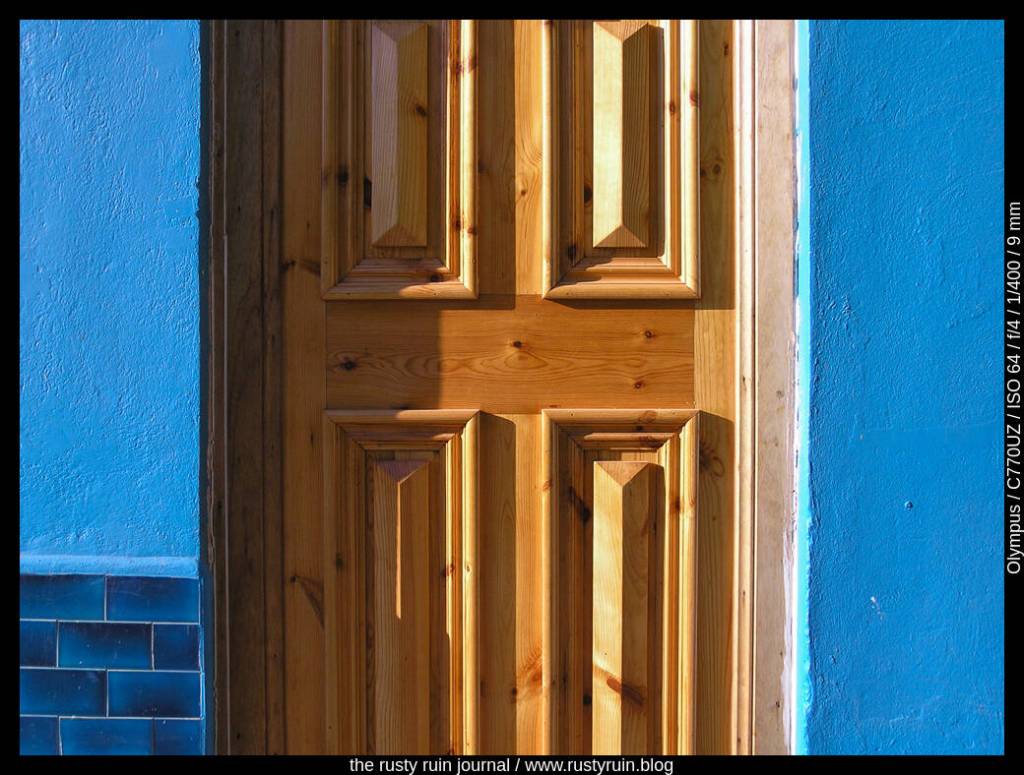
Behind the varnished door – Olympus C-770
On paper, the Olympus Camedia C-770 doesn’t seem like much: 4 megapixels, shutter lag that would annoy today’s impatient camera users, a 1.8 inch TFT screen, a longer start-up time than you’d hope for (good for those with a contemplative photography bent), and the need to use an XD card as a means of storage – let me tell you, those XD cards aren’t especially cheap.
Despite the negatives, there are surprising positives: an excellent lens with a sluggish 10x zoom; a decently fast 2.8 aperture at the wide end; a double (yes, double) flash for nuclear tests with unsuspecting portrait subjects; a respectable Electronic Viewfinder (yes, these old digital cameras carried the DNA of modern mirrorless cameras); a very readable EVF information overlay that includes a live Histogram; level settings for Sharpness, Contrast, and Saturation; the capability to record TIFF files if you can deal with the slow write times to the XD card (only 8 bit, unfortunately); and an enlarge feature that seems to engage an upsizing algorithm and makes those 4 megapixel files into 8 megapixel-sized files.
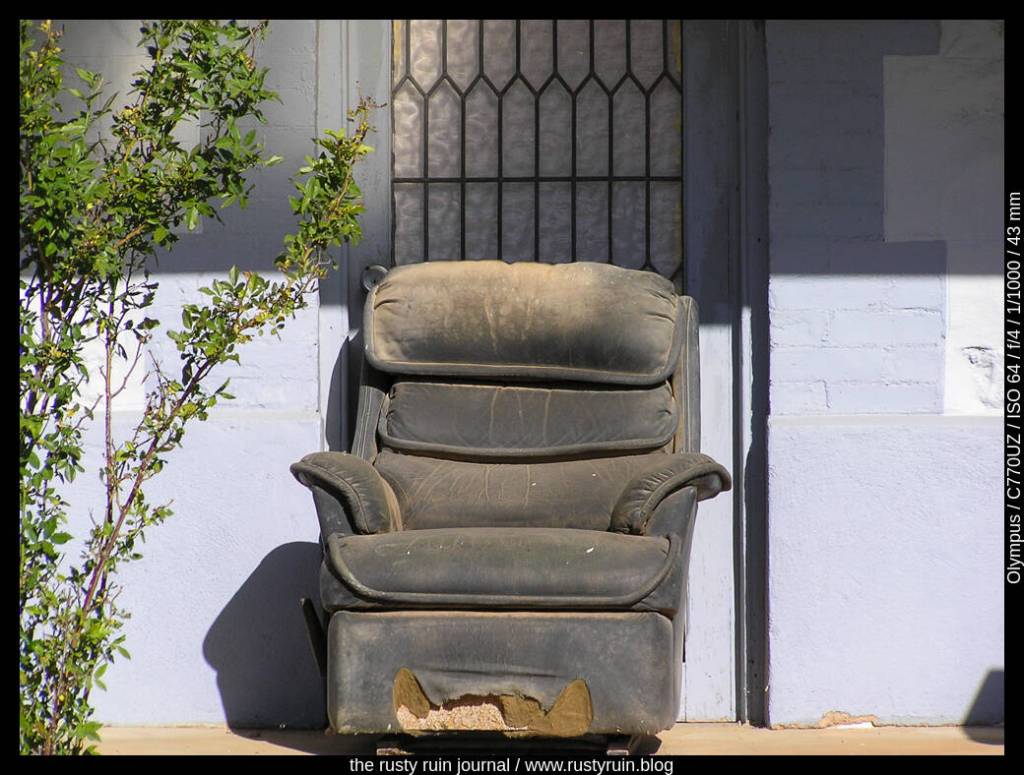
Have a seat – Olympus C-770 Ultra Zoom
I set the camera to record Super High Quality JPG files, dialled back the Sharpness and Contrast by -1, and increased the Saturation +1. Out of the camera, the images are pleasing. At 64 ISO, the digital noise pattern is so fine that it’s negligible. Of course, you wouldn’t want to push such an old camera beyond ISO 400 anyway, unless more digital noise is your goal. Nor would you want to entertain a low shutter speed when zooming enthusiastically, as there’s no vibration reduction or image stabilisation.
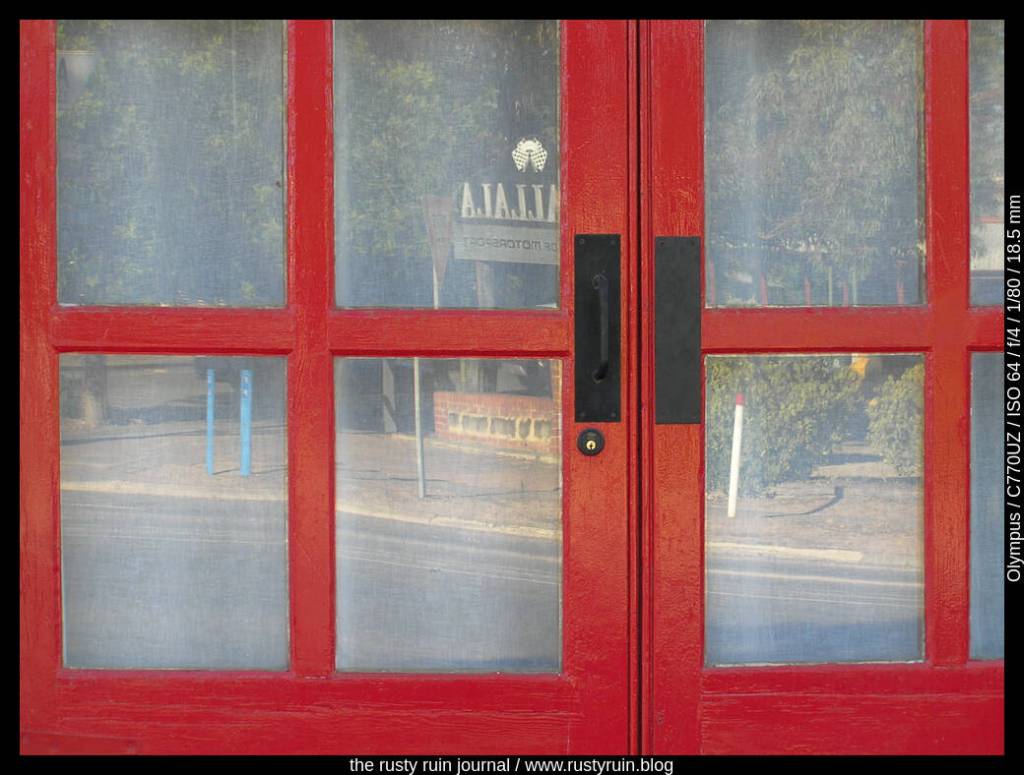
Red door corner – Olympus C-770
LIke the Olympus E-1, the Olympus bridge cameras are great little image makers when used within optimal limits ~ high dynamic range scenes will punish these old sensors and you’ll be forced to crush blacks or blow highlights. To compensate for these limits, I choose my scenes carefully – evaluating the dynamic range before putting the camera to my eye. Often, I’ll recompose, making decisions on how many shadows/highlights to include and how this will affect my vision for the final photo.
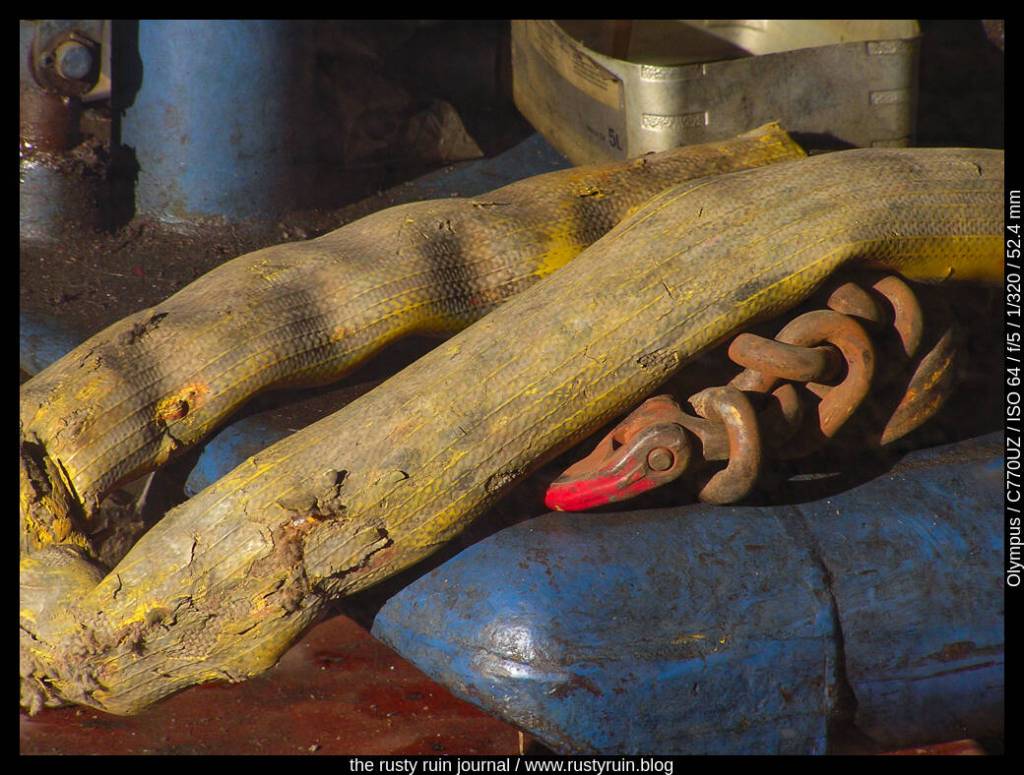
Worn and weathered gear behind the old shop window – Olympus Camedia C-770 UZ
I purchased the Olympus C-725 Ultra-Zoom sometime in 2004, excited by the prospect of the included manual modes and extra features as a step-up from my Kodak. At the time, I was eager to improve my minimal knowledge and explore the mode dial and learn the basics of photography. As it turns out, this silver all-plastic Olympus proved to be my bugbear. It would not be until 2013 that I picked up another camera more complex than this one.
Through the use of various cheap film cameras in the 1990s, I came to realise I had more than a passing interest in visual artforms. As digital photography started to take-off, I decided to nurture this growing interest and paid a lot of money for the Kodak. It was fun, but I decided I needed a more capable camera so I could brush up on the technicalities.
Homes and masts at the marina – Olympus Camedia C-725 Ultra-Zoom
I remember going out with my father, in mid-2004 perhaps, with the express intention of us both buying a new digital camera. He was always keen on new technology. As we browsed the shelves, we picked up every model from Fujifilm to Olympus to Kodak to Sony to Minolta. The model number particulars of the 4 megapixel Fujifilm camera that he purchased escape me now, and I’ve been unable to locate it in his boxes of things. It was the Olympus that appealed to me though.
The Olympus name resonated with me. It spoke of quality and longevity – something that seems both trivial and naive now in the context of the sale of their imaging arm in recent years and the rebrand under OM Digital Solutions. But 2004 was a different time in photography. It was the weird and confusing intersection of more than a century of film culture and the new digital kid on the block.
A silver finish, a boxy plastic design that would make modern mirrorless camera users weep, a mere 3 megapixels, PASM modes, and a huge 8x zoom caused me some excitement. Here, I thought, was a camera that could really teach me about photography! As it turns out, my father had a lot more easy fun with his pale gold plastic Fujifilm Finepix camera.
Sunset colours reflected in office windows – Olympus C-725 UZ
The heart of the problem is that I didn’t allow myself to have fun with this camera. Rather than focus on playful image making and the development of my eye and imagination, I placed enormous pressure on myself and turned the mode dial to Manual and left it there. That’s where I thought I had to be to learn properly. Not only did some early web forums demand this practice of newcomers, but I was also wont to be overly harsh with myself at the time. It may be that I used the mode dial to sabotage my learning.
After struggling for a week or two, all the fun drained away and my initial enthusiasm turned sour. I put the Olympus in a drawer and told myself sternly I’d never be able to learn proper photography. I limited myself to easy one-button point and shoot cameras until I purchased a Nikon DSLR in 2013 – almost a decade after buying the Olympus.
The Olympus was synonymous with my failure until I dusted it off last night and made some photos. I finally made my peace with myself and the camera. Maybe the experience also taught me I wasn’t ready for that type of learning at the time and that using easy cameras for a while was the best thing I could do because it was fun.
So, I’ve come back to the boxy silver Olympus and, having once discarded it in the throes of self-disgust and wasteful gadget buying that speedy technological transitions in consumer societies encourage, I’m finding it a joy. It may be a cumbersome and slow thing, with a design that speaks to the early 2000s, but the photos are quite pleasing I think.
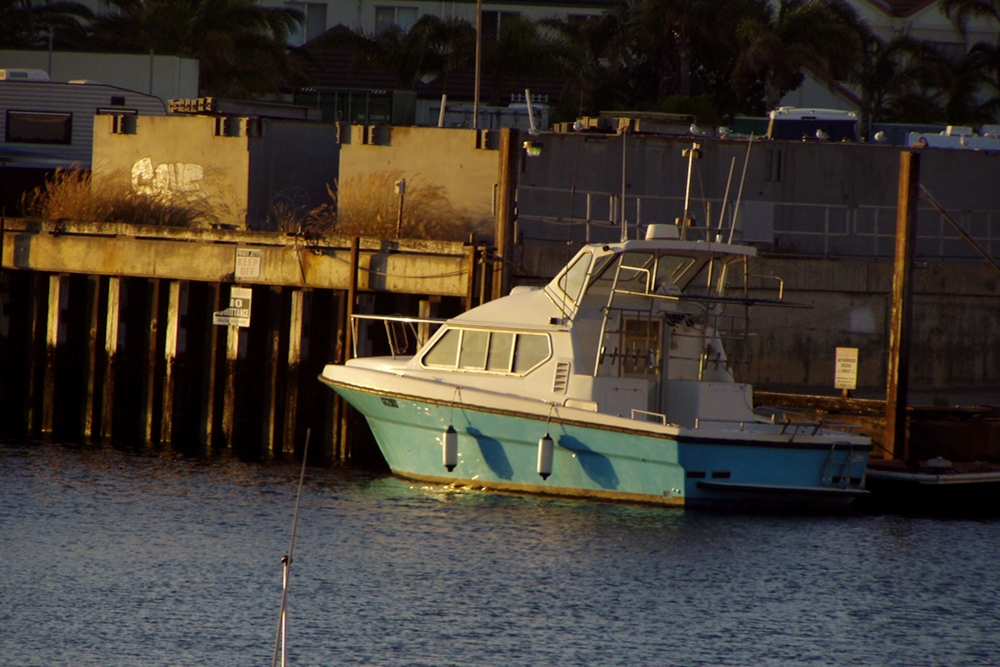
Blue boat at sunset
Limited to a maximum shutter speed of 1/1000th of a second and ISO that tops out at 400, it demands the right conditions for the best results. My fingers fudged over the various buttons without the benefit of muscle memory last night, but I think the photos have a nice quality about them. I set the Sharpness and Contrast to Low, so as to provide maximum editing flexbility. I don’t mind the softness of the images though. The lens gets pretty mushy around the edges of the frame, especially at maximum zoom, and there’s plenty of chromatic aberration in backlit scenes, but after using so many cameras in the twenty years since I hid the Olympus away in self-despair, I’ve broadened my aesthetic sensibilities enormously.
Here’s a photo that’s overexposed. I like the dreamy look of it and that the optics picked up the nice veiling orange flare from the setting sun:
Dreams of the marina by the sea – Olympus C-725 UZ
Our road-trip is just around the corner and my thoughts have turned to packing camera gear – if I’m not charging batteries, I’m agonising over lenses or bag capacity! Last year, I packed too much for the road. One evening on the aforementioned trip, I ended up clambering over red dirt-hills with two shoulder bags crammed with gear ~ each bag worn cross-bodied. I was fumbling with cameras, switching lenses at dusk in dusty conditions, jogging to catch the vanishing light, and dropping lens caps. At the time, I made a promise to pack more rationally for big trips like that. So, here I am again, with my camera stuff covering the table.
I see you in the dark corner – Nikon Z5 and Nikkor 40mm f2 lens
One thing I’ve always liked about the Nikon Corporation is that the engineers have never skimped on putting good quality digital sensors in their cameras at all pricing levels. Even in the 3xxx beginner DSLR line, the image making capacity has always been top-notch. This is why I’ve no qualms about packing a Nikon D3400 in my bag for the road ~ a 24.2 megapixel DSLR announced in 2016 that only weighs 395g without the battery or a lens. And the sensor in the D3400 is no slouch – it bests the Toshiba-made CMOS sensor in my beloved D7100. It has greater dynamic range, more colour depth, and excellent ISO range. It will sit right next to my Nikon Z5 very easily.
More importantly, the D3400 is so light! All of that photo-making capacity in such a light plastic body. For this road adventure, I think it will get a lot more use than my significantly heavier and bulkier D7100 did on the trip last year. It doesn’t have the speed of the high-end Nikon bodies and it lacks lots of external controls but none of that matters because my photography needs don’t cross into the high-speed fanaticism of sports or wildlife photography – apart, perhaps, from the odd photo of a sitting duck or two.
Empty chairs & night reflections – Nikon Z5
Since my needs are simple, a simple body will suffice. It’s a light camera that offers great image quality. The right tool for the right job, according to need. Nikon may brand it a beginner’s DSLR, but it offers more than enough control and photo-mojo for my needs: It enables me to make photos, it has a button I can program to change ISO, and it offers me plenty of control over light. Calling it a beginner DSLR is mostly about Nikon rationalising their camera lines and appealing to different kinds of photographers – you’re into fast sports? Get our super fast full–frame camera! You’re into photos of birthday parties? Get this beginner DSLR instead!
I’ve yet to really use the D3400 seriously, but it strikes me as an interesting camera. Released by Nikon at a time when small and sexy mirrorless cameras were fast taking market-share from the DSLR duopoly of Canon and Nikon, the D3400 seems like the last gasp of an old company that hadn’t quite realised the grim future of the bulky DSLR and they were desperately trying to downsize their cameras to appeal to consumers who were already buying into smaller and lighter mirrorless models.
Rushing into the evening with a friend, the sun quickly setting and the rain threatening, I didn’t expect much. Perhaps that was part of the problem: bearing the burden of noisy expectation rather than cultivating a mindin synchrony with the quiet moments.
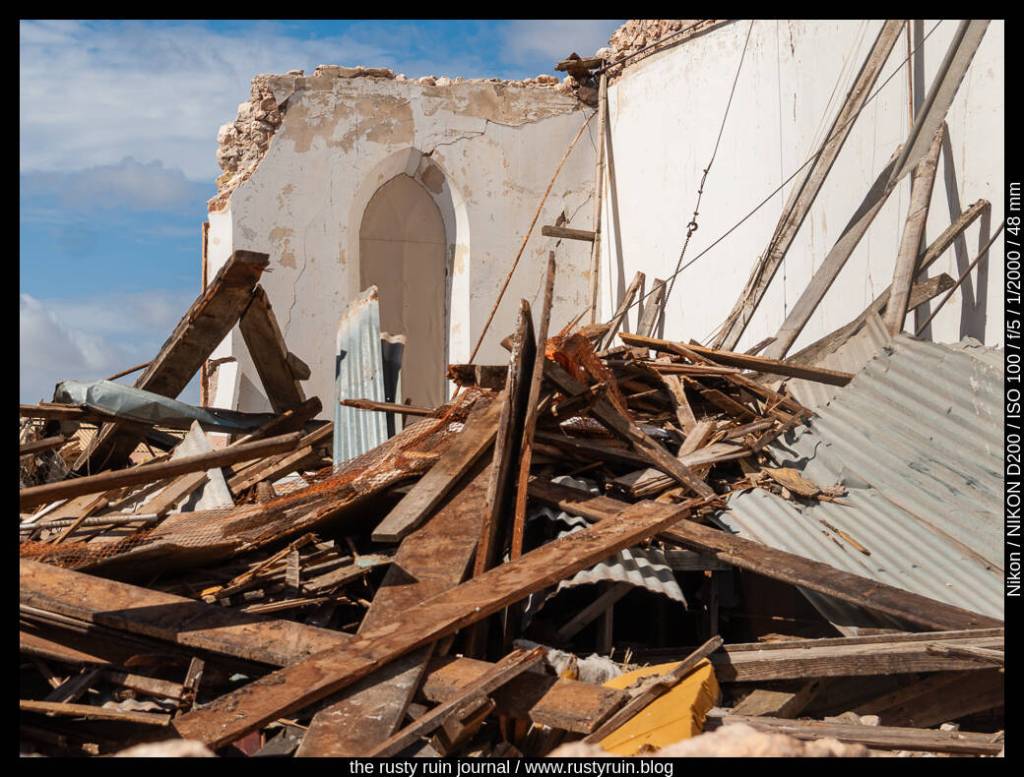
Defying prediction, the heavy clouds produced some amazing sunset colours. Having located the ruins of a house on a dirt road rarely used, we both scurried over and around twisted tin, old pipes, dark trees, sharp wood, and cracked wall sheeting.
The old chimney left standing – Nikon Z5 and Nikkor 40mm F2 lens
I dug around in my camera bag, fumbled with settings, attempted different angles, and yet I felt frustrated and rudderless. It was as though I felt both the heaviness of the fading light and the possibility of being confronted by an angry local. My movements felt too rehearsed and tired, my eye seemed jaded and stale – following the same movements and tracing the same lines it had done ten thousand times before. Perhaps there was nothing new in this scene? Nothing fresh enough?
The Old Hills Hoist – Nikon Z5 and Nikkor 40mm F2 lens
Having extra time to contemplate the scene and determine the best framing isn’t always possible when you take a last-minute opportunity to dash into the eventide glow. Sometimes, you’re not in the mood for making photos. Sometimes, you’re in the mood to watch the sun move quietly and the light turn to blue shadows without the camera at all.
Despite the weight of my expectations, or perhaps because of it, there’s an apocalyptic feel to the photos. As the world teeters on the brink of another war, it seems that the right scene found me at just the right moment with my camera, in synchrony with the world.
In the weeks leading up to our annual road-trip holidays, there’s a slow build of excitement that obliterates any pretence of work productivity during the final few days, for me at least. Questions around camera gear take root in my mind many months before setting off – what and how many cameras to bring? What lenses? Will I really need a tripod? How many bags and what kind?
In some sense, it feels as though this holiday in particular is partly about escaping the world’s current problems by escaping into and losing myself in the world. Photography can be therapeutic self-help in this way – reframing the world to suit our own narratives. As photographers, we look at things differently, composing and considering scenes and subjects before us. It’s a distraction from the pressing issues. We’re out there in the world, breathing in all that it offers, yet we’re one shutter-click away from reframing it to suit a story we want to tell so we can help ourselves.
The Panda’s exhausted – Nikon D7100 and 55-200mm Nikkor lens
Packing camera gear
Having recently purchased a Tenba Skyline V2 Shoulder Bag, I’ve been trying out different combinations of camera stuff for daytrips. I won’t have access to all the gear whilst we’re on the road, but a well-stocked easy-to-carry shoulder bag that sits with me in the passenger seat is going to be handy for quick stops along the way. Right now, I’m trying out this combination:
Nikon Z5 camera with the Nikkor 40mm F2 attached: This is going to be my workhorse camera. The 40mm Nikkor is about as sharp a lens as I need. I know there are sharper lenses, but this Nikkor is inexpensive, small, light, fast, and sharp. Ok, it’s an all plastic build, but it uses Nikon’s tough polycarbonate material, which seems to be quite durable. It may not be a classic but the results are excellent.
Viltrox 28mm 4.5 AF Pancake: It’s a third-party full-frame lens for Nikon’s Z system, nicknamed Chip, and it’s inexpensive. It’s also a strange lens – a true pancake lens (80g in weight), with a fixed aperture of 4.5, a 28mm focal length, a metal mount, part plastic and part metal body, 2 Aspherical and 2 Extra Dispersion lens elements, a USB-C port for firmware upgrades, and a mask that creates 8-pointed starbursts. I’m intrigued by this lens as it’s so odd. Auto-focus in a lens this small and this cheap is unusual. I think it will be much sought after in years to come, but what concerns me is that once the AF motor burns out, there’s no manual focus to fall back on.
Olympus OMD EM5 Mark 2 camera: Having gone back to using the Olympus lately, I’ve rediscovered the joys of a lightweight system with high quality. I use a metal grip to add a bit of heft and for better ergonomics. I’m testing out the Yongnuo 25mm 1.7 lens right now, so it’s attached to the camera. I could also pack the Sigma 30mm 2.8 DN Art lens, which is sharp and reminds me of a teeny-tiny Dalek when the hood is also attached.
Olympus Zuiko 4-5.6 40-150mm lens: This lightweight and rather small lens gives me an equivalent focal length of 80-300mm on the Micro Four Thirds system. If I want to be as lightweight as possible and give myself flexibility on the road, this lens is essential. Image quality is a bit on the soft side at 150mm, but that’s to be expected in a non-pro Zuiko lens.
Sony RX100: I generally take this with my in a day-bag whenever we go out. It’s so light and small and silent that I can use it indoors when I don’t want to bother with a larger camera and lens combination. This one fits easily in the front pocket of my Tenba bag.
Other stuff: Spare battery for the Z5, a micro-fibre lens cloth, a small wallet for 3 x 52mm filters (B+W Circular Polariser, B+W 10 Stop ND filter, and K&F Black Mist Diffusion filter), and an SD card holder for spares. I like the K&F Concept Diffusion filter at 1/4 strength.
Undecided: I’d really like to squeeze the Nikkor 24-70mm F4S lens in the bag but it’s pretty big and heavy. Finding a home for it in this bag with everything else is going to be difficult, but I think it may be a better option than carrying the Nikkor 40mm and the Viltrox 28mm. It will mean that the Zuiko 40-150mm lens has to live on the Olympus camera. Alternatively, I ditch the Olympus completely and carry the 70-300mm Nikkor ED lens attached to the FTZ adapter so I can use it on the Z5 – but this is a heavy and tall lens.
Behind the red door – Olympus OMD EM5 Mark 2 and Zuiko 40-150mm R lens – as you can see, even at 150mm, there’s acceptable sharpness available after some editing (contrast, clarity, and additional sharpening)
It was the perfect afternoon for us to ramble along a walking trail through century old goldfields nearby. I’d decided to pack the Nikon D40 and the Fujifilm S6500fd. I totally forgot about the Sony RX100 sitting in the zipper pocket of my camera shoulder-bag – the usual go-to in case an old camera flakes on me. I’ll say this about the Finepix S6500fd: the combination of the tiny Super CCD sensor – ancient in digital photography terms – and the long, sharp lens, produce some really interesting photographs at times.
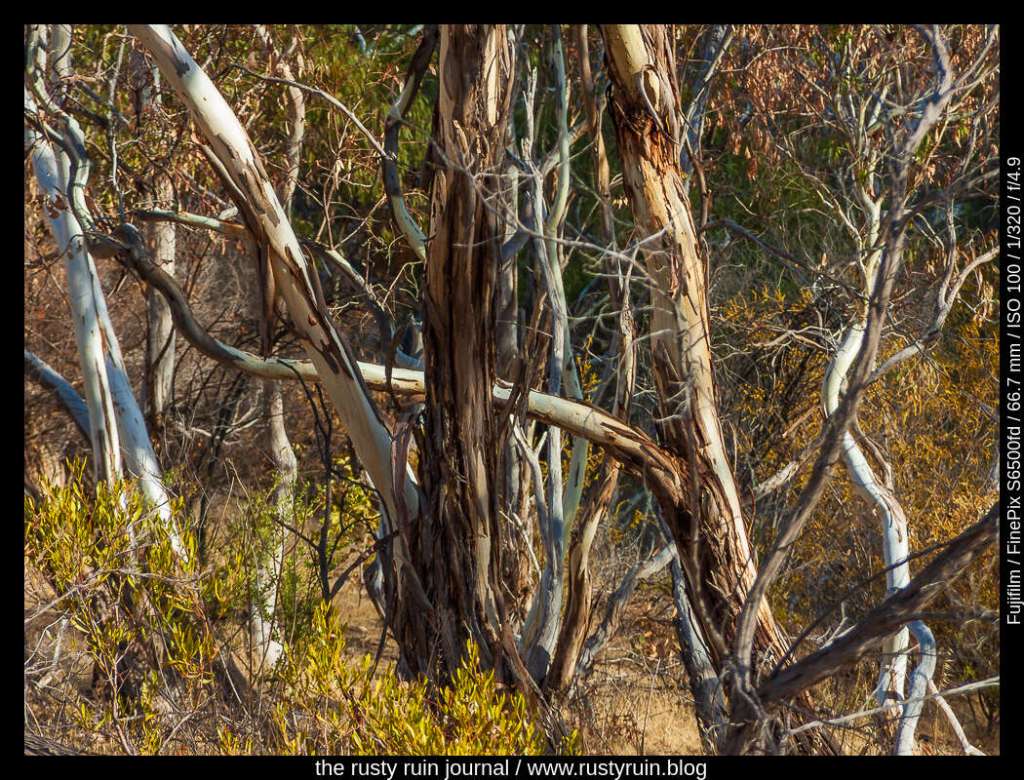
Ghostly gums – Finepix S6500fd
Setting the camera to the Fuji-chrome setting and Fine JPG seemed to enhance the blues and purples in this photo. Maybe it was the combination of the cloud, sunlight, shade, subject, and white balance, but there’s a really strong look to the image. I haven’t added additional colour in editing.
Gum trees along the trail – Fujifilm Finepix S6500fd
For the above photo, I decided to set the camera to generate RAF files – CCD-RAW in the settings menu. I wasn’t even sure they’d open in Lightroom, but they did, and I’m pretty pleased. This provides more latitude and flexibility during editing. As you can see above, I was able to draw out pretty good detail in the shadows and sharpen the image in specific areas. It’s not easy to see without magnifying in Lightroom, but there’s some beautiful detail and tonality in the bark. Hard to believe from this piece of old gear.
Beneath the bark – Finepix S6500fd
Finally, one of my favourite features on old bridge cameras is the Macro and Super-Macro modes, at the touch of a button. It’s so handy for getting up close when there’s good available light for a decent shutter speed. I usually wander handheld, so there’s no tripod involved. Steady hands and good light are a must under these circumstances. It’s a JPG (wish I’d set to CCD-RAW), but the colour and range of tonality is still impressive. The best photos from this camera, like the S7000, seem to have a versimillitude about them. Note to self: set this camera to make RAF files from now on!
Do you remember waiting for a roll of film to be developed? I used to enjoy going to the photo lab and collecting those envelopes filled with photos. I’d sit down on a bench somewhere and pore through them excitedly. Sometimes, they’d be from rolls of film I’d been sitting on for a few years, so looking through them was a joyous exercise in reliving those memories. If I had the extra money, I might even pay for 7×5 prints or even a grainy 8×10 enlargement. We don’t experience any of that with digital photography, of course, but there is a close cousin: finding unedited RAW files on drive backups.
View of the Lighthouse 1 – Olympus EM5 Mark 2 and unknown vintage lens
I’m not especially organised when it comes to my photo backups. I’ve even lost a bunch of photos from one particular holiday due to my lack of foresight. Admittedly, I’m also a bit burned out on the tech and the multiple passwords and the platforms and…well you get the idea. In short – my fault for not listening to the hard drive that was burping and farting to let me know it was living its final days. So, it’s always nice to discover a maverick folder full of photos files I’d forgotten about.
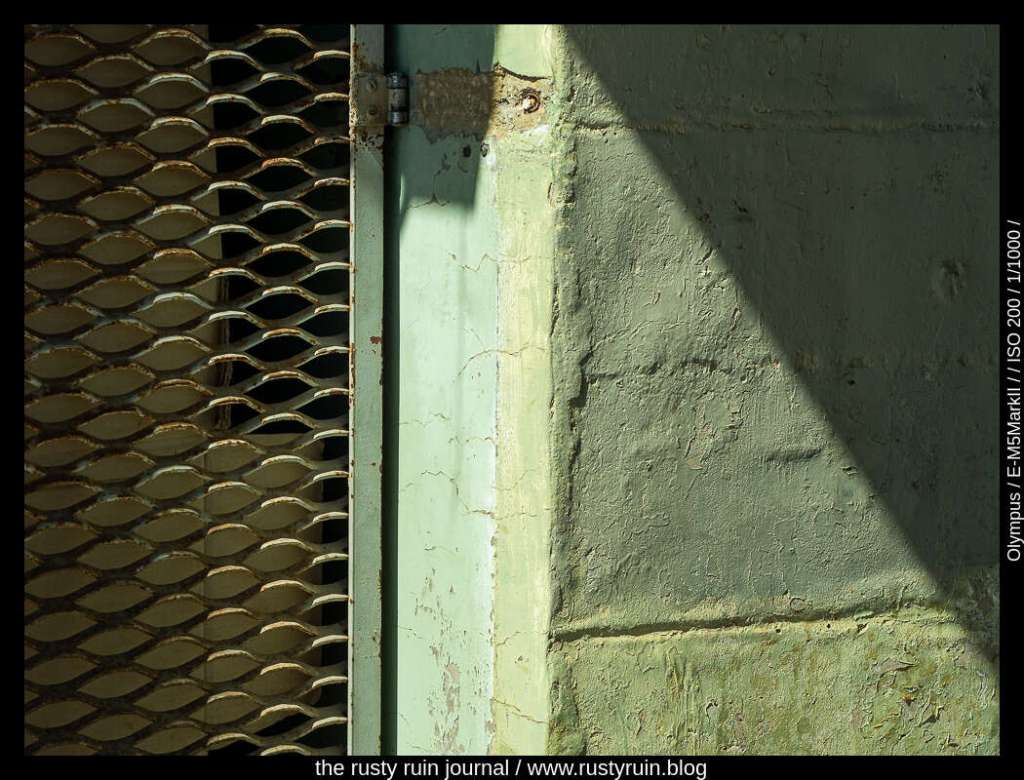
Rusty grille and green concrete – Olympus EM5 Mark 2
I use One Drive a lot for backups now. I usually save a DNG version to the cloud and save a web-ready version for this journal and for sharing (1000 px on the long side and 60% JPG quality, if you’re interested). You might also have noticed that my photos now have a neat black border with some EXIF information on the side and a URL for this place. It’s an unobtrustive way to watermark the photos, record some useful EXIF data, and make the photo pop a little more against the black border. It’s a slightly convoluted process to install and configure, but once set up, the Mogrify 2 plugin works well in Lightroom. I have a license somewhere, but it probaby went down with another bad hard drive incident.














 The Rusty Ruin Journal