Revisiting ruins and ethics – moral philosophy and photography

Lately, I’ve been contemplating ethical questions in photography. According to Wikipedia, ethics is the study of moral phenomena and “…investigates normative questions about what people ought to do or which behaviour is morally right.”

At the risk of being ultracrepidarian, I’ll just say this: I’m not an expert in ethics or philosophy, but I believe that self-reflection is an important part of not just photography, but also generally. It’s crucial to ask questions and seek answers to discover what drives our photographic practice. What beliefs inform our behaviour? What do we consider to be right and wrong and why? Where are the moral lines for us?

Bruce Gilden and Mark Cohen – well-known street photographers who hold the camera in one hand, the flash-gun in the other, and get right into the personal space of their subjects – may be at the behavioural far end of what street photography encompasses. Here’s a great video of Gilden at work: Bruce Gilden.

This in-your-face methodology has variously been called innovative, invasive, bullying, and unethical. There’s no denying it can produce some amazing photos of people doing everyday things on the street, but is it ethical? Ethics is about what behaviour is morally right. But just because something is legal, like making photos of people in public spaces where the law says there is no expectation of privacy, that doesn’t make it ethical.
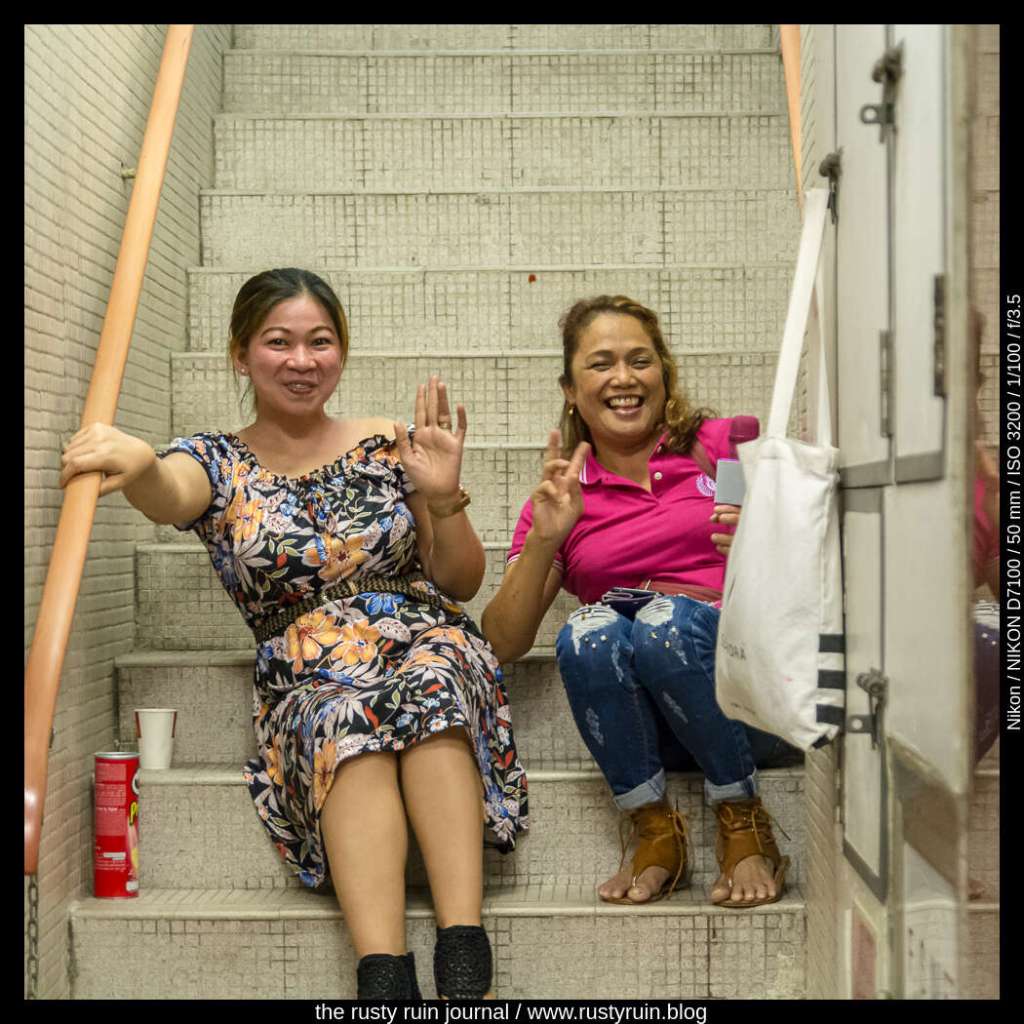
All smiles at midnight – Nikon D7100

Consent and ethical frameworks

Consider the photo of the two ladies above. You can see they’re happy and smiling. In fact, they saw me with the camera and posed for me, thereby providing consent. There aren’t too many people who’d have an ethical issue with this photo.

What complicates matters is that what we consider to be ethical, or morally right and wrong, is based on our ethical framework – a set of core beliefs, culturally embedded and varying across time and place – that inform the way we behave, the way we think and feel, and what we consider to be right and wrong. If all of my street photos were made with consent, such as the one above, my ethical framework might be Care-Based, where I consider the feelings of others, care for others, and my relationship to others.

Street photographers like Bruce Gilden may be considered unethical by a majority, but the truth is that their thoughts, feelings, and behaviours are driven by belief systems that may not be in accordance with the mainstream. One might argue they work to a type of Utilitarian ethical framework that values a good outcome above questionable methods – art as the good outcome in this case. But if people that Gilden photographs are startled, offended, or unhappy with his method, is it a good outcome from their perspective? Should one set of ethics override another?

Perhaps it’s the goal of making good art that drives the photographer’s impulse to shove a camera into personal space. Or the goal to be well-known, with money in the pocket and exhibition space for the work. Would you think differently if you thought of Gilden’s work as great art? Or if you didn’t like his photos, would you find his practice unethical instead?

Kneeling with nothing – Nikon D7100

I thought for some time before posting the photo above. I photographed a vulnerable person and for many people, making photos of vulnerable people on the street is a big no-no and crosses an ethical line. What drove my behaviour here? Obviously, I feel uncomfortable posting the photo but do I feel discomfort because I fear possible bad reactions to it? I’m certainly not one to dive into conflicts.

The idea of a person with nothing, surrounded by people in a busy city, appeals to my sense of exploring the effects of capitalism and urbanisation – a fragile human being in a concrete and glass city, looking to survive the grinding day. The potential cruelties of modern life appeal thematically and drive an aesthetic. I’m driven to this as I’m driven to photos of decaying buildings and ruin.

It’s easy to be seduced by photo opportunities on the street in a big city where few people care about others with cameras. It’s easier still to exercise power as a photographer and frame a vulnerable person who gave no consent, telling a momentary story about them that can’t represent them in totality. Perhaps in making this photo, I also touched the edges of what I’m comfortable with. That, in itself, is a valuable lesson and self-reflection.

Charles de Gaulle at work on the streets – Nikon D7100

It’s important to understand that ethical frameworks vary across culture, time, geography, and individuals. The behaviour that one person feels comfortable with will not be in accordance with the ethical framework that drives someone else. We may argue that some ethics are universal, and perhaps they are, but prior civilisations have believed it a good thing to sacrifice virgins to appease deities, or have seen fit to expose weakling babies to create a stronger society.

Ethical frameworks are, in this context, subjective. The law seeks to be universal and pragmatic, but ethics remain separate and personal. And when my ethics disagree with yours, conflict may ensue, even though neither of us is wholly right or wrong. According to Descartes, we can never truly know if other minds exist since we can only truly know our own minds. We’re trapped within our own minds, and for all we know, other people are zombies, illusions, or mindless automatons. Slipping into Solipsism for a moment, we can never know another person’s ethical framework because we can never know if other minds exist beyond our own and we are therefore doomed to cross ethical boundaries at every moment and every step. In this context, it may be more relevant to depend on laws rather than subjective ethics.

Diving into Solipsism is, perhaps, at the deep end of the pool, but it serves to illustrate a simple point: ethics are indeed personal and subjective and we often can’t know the ethical framework of another person. We may minimise this confusion by seeking consent, and this is a perfectly reasonable solution, but we also change what street photography is by doing so: it then becomes a set of poses and forced half-smiles for the stranger’s camera, thereby losing the interesting spontaneity that defines the genre.
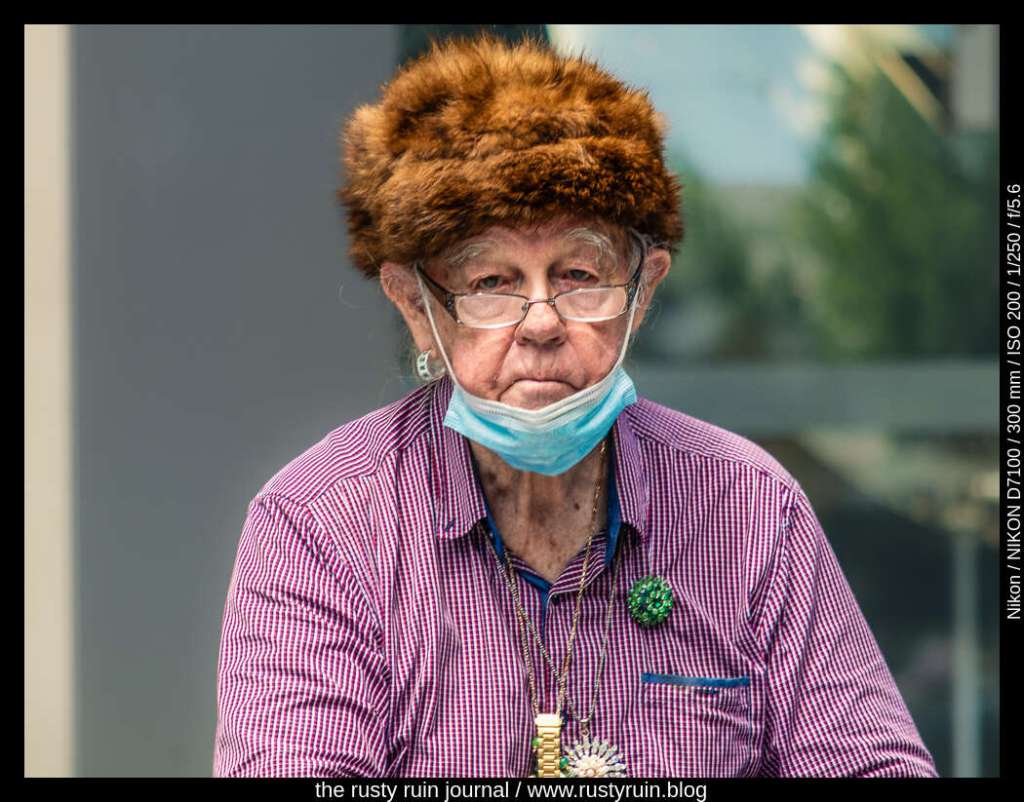
Covid-safe and unhappy – Nikon D7100 and 55-300mm Nikkor lens

It’s clear the person in the photo above isn’t very happy. Was he unhappy with me pointing the lens in his direction or was he unhappy with something unrelated? I found his look interesting and decided to make the photo before moving on. I admit it’s not an especially good photo but I share it in hopes of provoking thought about the ethics of street photography.

If a person isn’t comfortable with me making their photo but I’m ethically comfortable doing so, should one ethical framework override the other? Should there be an expectation that within a time, place, and culture, where photographing people in a public place may be legal but sometimes morally questionable, the ethics that favours asking consent or not making the photo at all should always take precedence?

Ethical choices and geological wonders

In a previous post, I posted photos of Uluru – a magnificent natural wonder that started to form over 500 million years ago. There are parts of Uluru where clear signs forbid photography based on the cultural beliefs of the local indigenous Arrernte people. I didn’t make any photographs in the aforementiomned signed areas, choosing instead to pay respect to those local beliefs.

My belief system allows me to view the world around me as not owned by any single person or group. It allows me to view nation-states, governments, and fortunes as illusions in the sense they are consensually understood and agreed-upon narratives. These beliefs inform my ethical framework, but I understand that such frameworks are purely subjective and personal. For me, Uluru is an amazing example of geological processes that existed millions of years before any human being set foot on the shores of the ancient inland sea. Yet, despite my belief, I chose not to make photos anyway, partly because I also respect the value of indigenous culture.

Ethics in photography is like a huge bowl of spaghetti on a first date – you’re probably going to spill it on yourself and look awkward while slurping up the pasta. It’s a messy and often uncomfortable area that’s filled with subjectivity and declarations of universal moral truths by stubborn individuals. Perhaps the best we can do is our best in understanding other people, occasionally override our own ethics to get along better with others, and hope that we find people that share some of our own ethics.
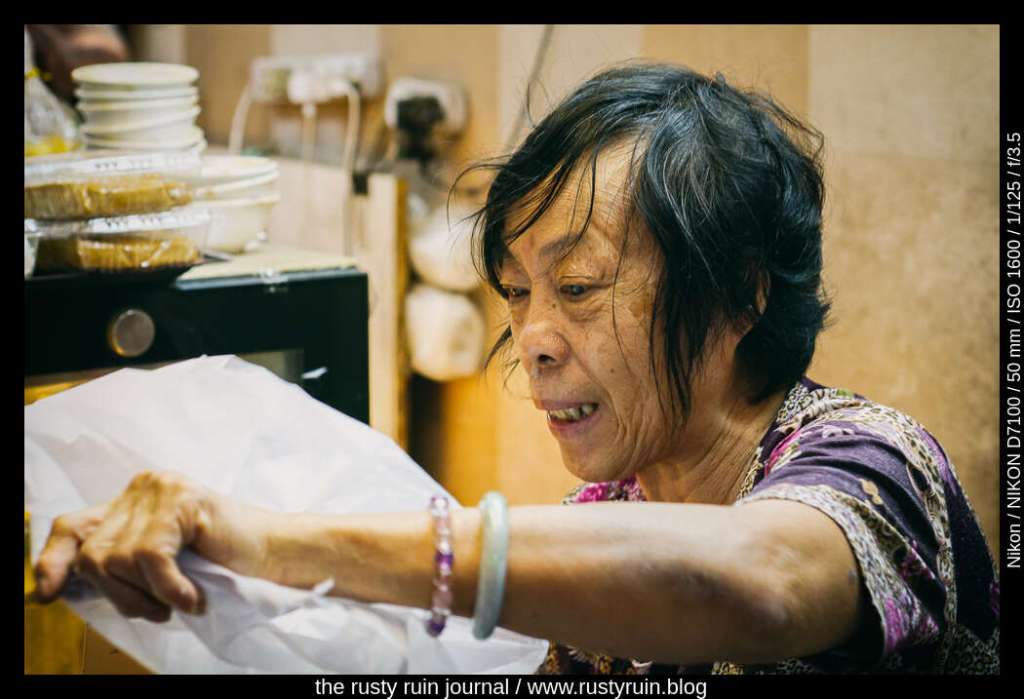
Hard at work into old age – Nikon D7100

A short self-reflection on ethics in photography in the context of a recent confrontation

In my previous post, I outlined a confrontation that had happened when revisting a ruined house nearby. In a world where the Silicon Valley business model is obsessed with surveillance capitialism, tracking online behaviour, harvesting personal data, and selling that data, it’s no surprise that a growing number of people become very touchy indeed when a lens is pointed in their direction or the direction of something they own.

Old shed on a dusty corner at sunset – Nikon Z5

Ethics is a branch of Moral Philosophy that concerns itself with morality and how people should behave and why. Despite the fact that we were on a public road at the time of the incident, doing nothing legally wrong, and making photos, was our behaviour ethical? Why were we confronted and what ethical framework, if any, should inform photographic practice?

It’s very easy to dismiss confrontations with a deft wave of the legal hand: making photos from public spaces of things visible from those spaces is not legally wrong. Yet, doing so can provoke a strong reaction in many people. It may not be illegal, but is it ethical? Is it right or wrong to make photos of a property owned by someone else? And how should we react, as photographers, when we’re confronted?

Keep Out – Nikon Z5

I think self-reflection is a useful tool for personal growth and change. It allows us to consider our system of beliefs, our thoughts and feelings, and our behaviours in the larger context of culture and society. What beliefs inform our behaviours? And when those beliefs are challenged by someone else who thinks, believes, and behaves differently, what should we do? I’ll be coming back to these questions…

Revisiting a ruin at sunset and dealing with angry people

I was a little way up the dusty side-road with my Nikon Z5 and Nikon D40 when a big white 4-wheel drive roared past me and stopped next to our car, dust kicking up from the wheels. I knew it was a bad sign. I’d been here before. A few moments later, the car belted away down the dirt and turned onto the bitumen. Everything was quiet again and I gazed in the direction of the setting sun, hoping we’d be left alone long enough to make some more photos in the best light of the day.

Covered in old vines – Nikon Z5

I went back to work with the Z5, dialling back the exposure to preserve the highlights and waiting eagerly for the golden light to bathe the dusty corner we’d chosen for some evening photos. The quiet didn’t last very long…

Another big vehicle pulled up next to the ruined building we’d been training our lenses upon. I packed up my gear and started to walk back up the road to my buddy, suspecting he’d have to deal with a mouthful of abuse from the locals. I wasn’t wrong.

“What the FUCK do you think you’re doing???!”

I get it. There we are on a normally quiet road and we’re loitering outside his property. I made it there just in time for the tirade. My mate was very calm in the face of it, de-escalaing the situation and rightly pointing out we weren’t trespassing on his property and had no intention of entering or wrecking anything. Some minutes of back and forth and the property owner was still gruff but calm enough to take some mouthfuls of beer from the bottle he was swinging about.

Collapsing shed – Nikon D40 and Nikkor 35mm 1.8 lens

I contributed the odd word or two, reinforcing the argument that we were innocently making photos in great light and staying outside the fence-line.

“Yeah…I s’pose that’s OK if you’re into photography…”

Clearly his own mate was just there for moral support, as he’d said not a word the whole time. The golden light was fast fading and we were still locked in heated discussion about kids stealing copper from the old house and cutting the barbed wire fencing. The anger’s understandable, of course.

“Next time, ask me for permission! I’m just up the road, there.”

The problem with so many of these ruined places is that you just don’t know where the landowners are. Properties beyond urban areas can be big and it’s not always obvious who owns what. So, we stick to the public areas – the pathways and the roads, usually. Legally, you can make a photo of just about anything if you’re in a public space and you can see the subject from that public space. Permission isn’t required unless you’re planning to enter the property. I’ve never needed to say any of this to an angry onlooker or property owner, mostly because it doesn’t result in calm conversations.

A sea of cactus – Nikon D40

Finally, we made our peace and drove off. We’d missed the best light of the day. It would have been amazing too – pink clouds and soft golden highlights bathing all the dusty old corners and abandoned places.

Detritus in Coober Pedy

I mentioned the town of Coober Pedy in a previous post. Going through my file folders tonight, I found some more ruins and the remains of dreams from this famous outback town. I often wonder how these places and things come to be abandoned and decaying.

No driver – Nikon D7100 with 35mm AFS Nikkor 1.8

Who once drove the bus? How did it get there? At some point, I imagine it will be nothing more than a pile of rusted metal, merging with the earth, gears and pistons embedded in thick soil. Perhaps a few blue paint flecks will provide some clue to a future explorer?

Decolonise – Olympus OMD EM5 Mark 2

Old walls become a canvas for political statements, the remains of a broken window framing the tension painted in bright pink. Thinking of photography as a voyeuristic pursuit, as Susan Sontag once wrote, such images can lend themselves to such consideration. Is there some voyeurism at work when photographing places like this? Perhaps. I certainly feel some drive to frame the political statement and focus on the socio-cultural tensions. Do I engage with it by recording it or do I step away from it by framing it as artfully as I can?

Homes not Tails – Olympus OMD EM5 Mark 2

Photography can only frame the world for others to view. Once out in the world, the audience applies their own values and beliefs. By providing the framing, the photographer must step aside for a moment to engage in the act of viewing rather than participating. But in the framing is the delightful devil – a story told by the photographer in cutting out a single view from the whole. What lies beyond the single frame and does it matter?

Making photos or taking photos?

For a while now, I’ve taken some issue with the use of the word take when it comes to describing the making of photos. After all, we don’t take photos. We make photos in collaboration with the camera and the environment. It’s pedantic, I suppose, and it doesn’t truly bother me when someone uses the term. It’s just a word I try not to use.

The other bothersome term is shooting photos. The camera isn’t a gun, is it? Maybe I’m just a bit cranky because I’m not feeling the best at the moment!

Angel & Tina – Nikon Z5

So, why do we make photos? Why do we use cameras? What is it about photography that keeps us coming back for more? I can only speak for myself of course.

Photography allows me to see the world differently. It’s not always relaxing, as I might be prioritising Aperture values and the exposure over framing a scene, but when I see something that speaks to me, it feels as though I can frame it and place a focus on it to remind myself of details in the world that we often miss. It can remind others too.

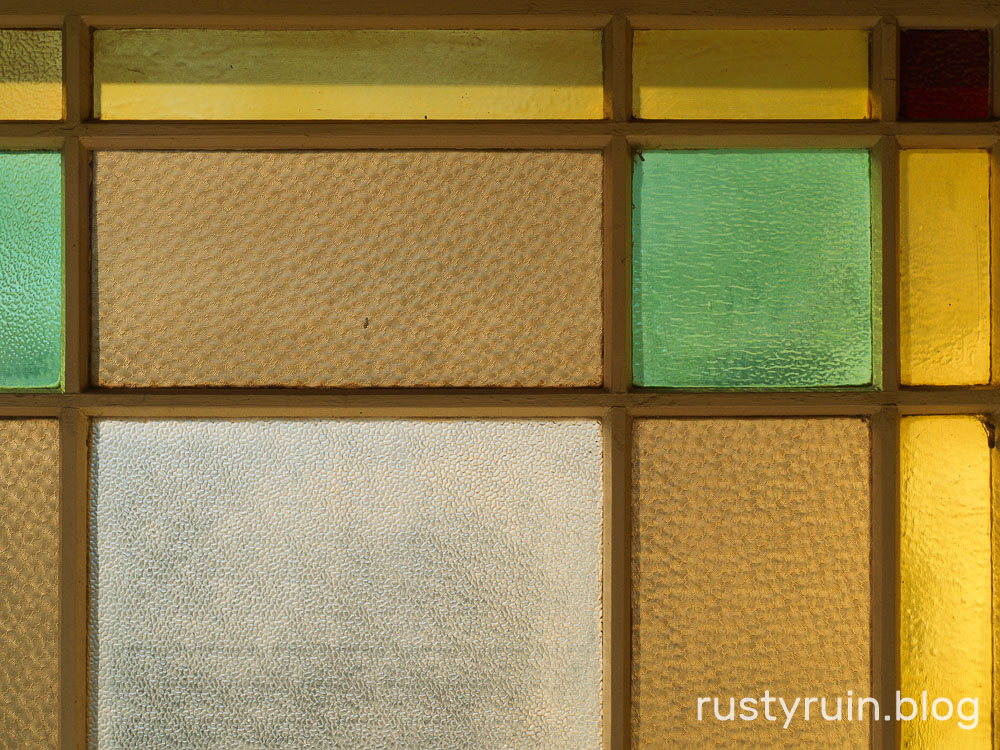
The old glass still glows – Olympus E-1

Susan Sontag once said that photography is a voyeuristic activity that removes us from the meaning of events and diminishes their importance. I can see merit in that thinking even if others think of it as inflammatory. When behind the camera, how close are we to the events around us? Arguably, we immerse ourselves in a scene more fully when we focus on it through the lens, but the goal is also to frame that scene in a specific way so it follows the rules we deem personally important – rule of thirds, art of photography, light and shadow, marketability, appeals to social media followers, and so on. A photograph may have an audience with their own set of values. In this sense, a photo is like a cut-out of a small part of the world, presented for viewing and criticism.

Ladder pathway – Sony RX100 Mark 1

Consider the photo above, for example. Is it voyeuristic? The photo of a home, possibly abandoned, but likely still owned by someone, is a deliberate cut-out of the entirety of the home that creates a separate reality. What does it say? What was my intention in making the photo? Am I merely highlighting the abandonment of buildings where people once lived and loved? Am I doing so callously and without regard for those who may still live there?

Late night contemplation in orange and blue – Nikon D7100 with 50mm 1.8 AF-D

Street photography has a long and rich history of provoking thoughts along these lines. Is it ethical, for example, to make photos of vulnerable people on our streets? In some photography classes, it’s made clear that photographers are best-advised to ask for permission first. Yet, there is nothing surer to diminish spontaneity than to create a contrived street scene through such permission seeking.

If we are to document human life across a wide range of experiences through time, then street photography is an important tool. The photographer may, at the time, be vilified for lacking ethics, but as time relentlessly moves forward from the event, new audiences may view those photographs as historical artifacts. Perhaps there is no right or wrong in these cases – merely changeable thoughts and beliefs that drive culture.

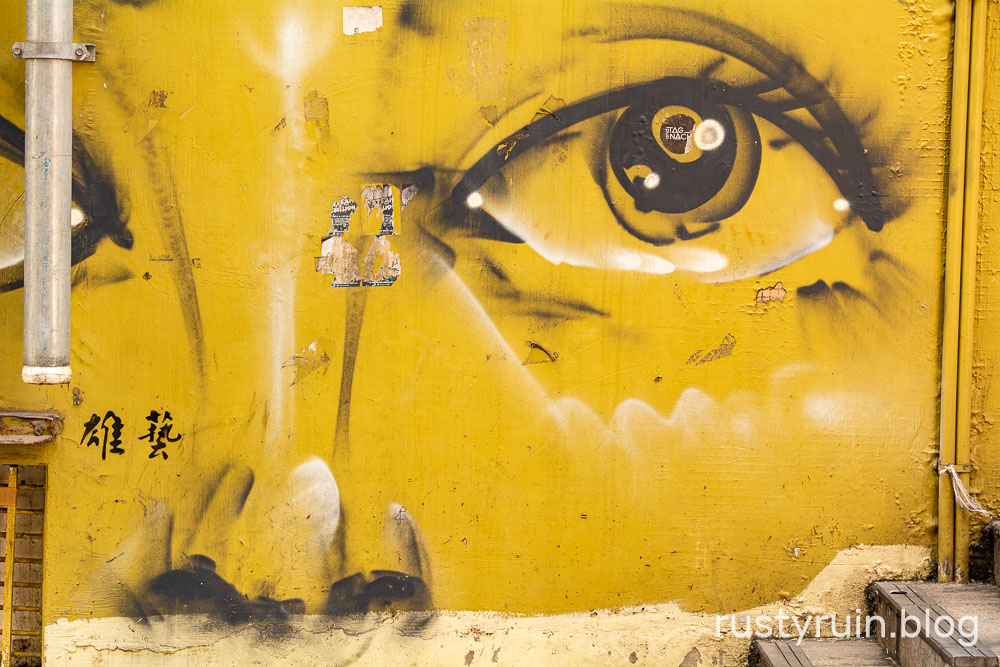
Scenes in yellow on a cloudy day

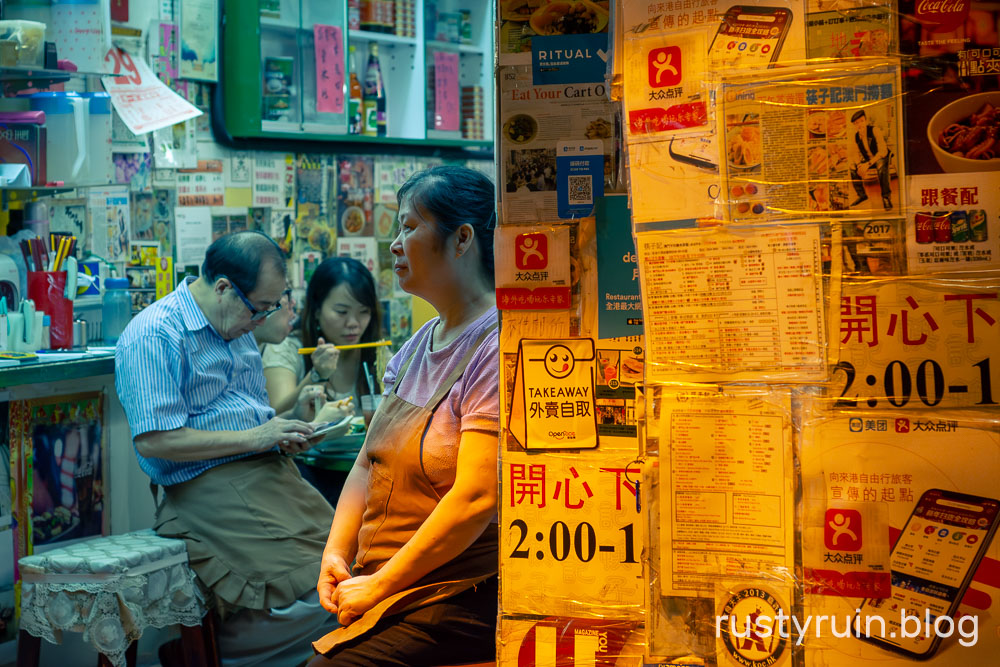
Hong Kong offers a feast of sights for those with camera in hand. Spending all day carrying the Nikon D7100 and an attached 55-300mm DX lens – since sold and replaced by the old 70-300mm ED VR lens – is not exactly the lightest task. As with most Nikon cameras, the D7100 is solid and conveys a sense of trust and comfort. Whilst not the best telephoto lens available, the 55-300mm is certainly one of the least heavy in this class, even though the image is prone to softness, especially at the long end below f8.

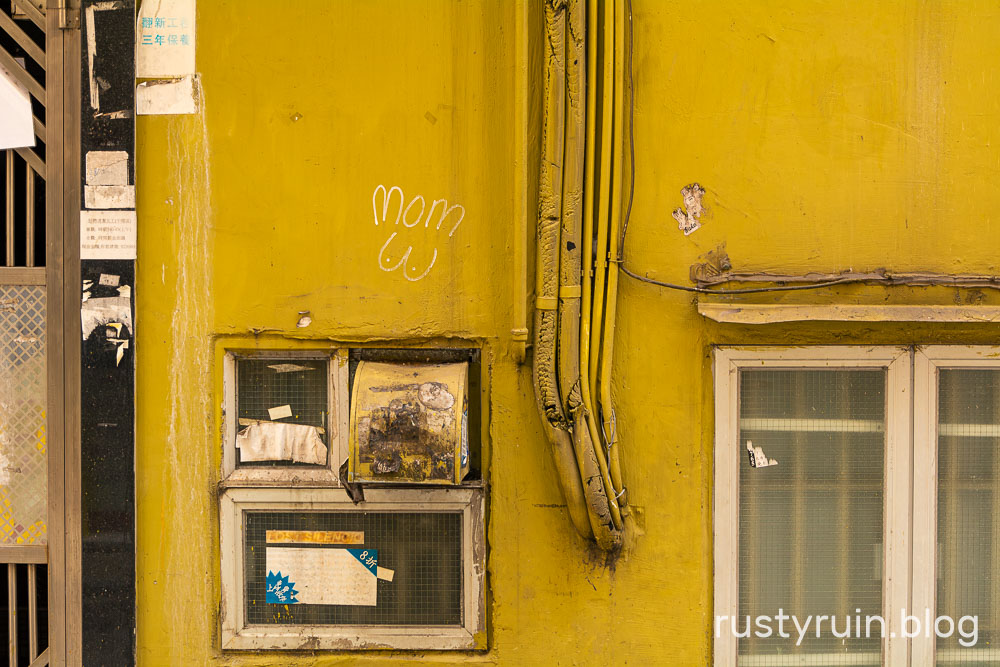
The old walls have a face in Hong Kong – Nikon D7100 and 55-300mm lens

Before I purchased the D7100, I was using the Nikon D5100 – a truly capable camera with the well-reviewed sensor found in the Nikon D7000, though much cheaper. I really liked the D5100 but moving to the D7100 felt as though I was really moving on up in terms of features and ergonomics. Just the external buttons alone gave me easy access to ISO and White Balance – two dedicated buttons the D5100 didn’t have.

As much as I was tempted to sell the D7100 when buying into the Z system with the Nikon Z5, I just couldn’t bring myself to do it. I do miss the old Nikkor 50mm f1.8 D lens though, as it’s so light, small, and sharp. It’s a reliable camera and mine has a lot of life left in it.

The old walls have personality in Hong Kong – Nikon D7100

Years of grime, torn stickers, puckered adhesive, PVC pipes, and crazy wires that lead to subterranean places adorn the walls in many parts of Hong Kong. I love the texture of the place, the hustle and bustle, and the sea of humanity. But I’m not unaware of the poverty and the cramped lives, struggling to get through each day in the wet heat. And here I am, a tourist with a big camera, framing it all up and editing in a quiet room…

Hanging out to dry

Sunsets and uncomfortable confrontations

Yes, it was another cloudy day and I was out with the Finepix 6500fd. Driving around tiny old towns, largely forgotten and left to people with desires to escape the rest of the world, can be surprising sometimes. Yes, there are plenty of interesting ruins to look at and photograph, but occasionally there are also encounters with unfriendly locals.

Old Post Office – Finepix 6500fd

Admittedly, not an awesome photo, but the old Post Office above is an interesting building. I’m always careful when it comes to remaining in public areas, as there’s largely few restrictions on what can be photographed as long as it can be viewed from a public area that one is occupying. I can walk along any public road or path and photograph buildings and most other things without a problem.

The confrontation

So, there I was in the middle of an old dirt road, pointing my camera at an old Post Office. A car pulled up and out hopped a local. She asked me in a very pointed manner: “Why are your taking photos of my house?”. A little surprised, and somewhat curious, I replied, “You live in the Post Office building?”.

It turns out she didn’t live there, but in the house next door. I assured her I had no interest in photographing her home, but only the old building because it “looks cool”. She clarified and told me that she only uses it for storage. I tried to de-escalate the situation and asked about the history of the building and when it was closed down. She responded but still was very unhappy and asked me again why I was making photos of her home. At this point I politely fare-welled her and left, knowing that it was pointless to continue the conversation.

Mangroves at sunset – Finepix 6500fd

Reflecting on feelings and laws

I knew I wasn’t doing anything illegal and this was simply a case of an unhappy and suspicious local. That’s perfectly understandable, of course. There’s a difference between what I can legally photograph and how someone feels about it. I’d tried to cool things down and assure her that I wasn’t interested in photographing her home, but rather just a nice old building with some history. Rather than argue any legal point about public land, it was simply better for me to leave.

I’m often in two minds about these, thankfully rare, situations. On one hand, I understand that someone might be suspicious of a stranger coming to town and having an interest in their property. Would I also react similarly if someone was camped outside my home with a camera pointed at it? I may, though I’d likely be mostly interested in the camera gear. On the other hand, it’s certainly not illegal to photograph things from the vantage point of public land.

If the person is open to a conversation, I think it’s reasonable to explain what you’re doing and why you have an interest. I don’t think it’s helpful to start a conversation about legalities around the act of photography because this may be more likely to cause more upset. There’s an understandable emotional response involved that does cause some personal dilemma but I think it’s wise to consider both sides.

It’s certainly perfectly reasonable to photograph the world around us, yet remain aware of the private and public boundaries that are sometimes difficult to define. It’s also reasonable to consider the potentially strident reaction that a person might have to the act of photography in an area they consider, legally or not, their turf. Despite the dilemma, I remain on the side of photographing the world within legal limits, and if there’s a confrontation, explaining why I’m there in hopes this will provide context and calm the situation.

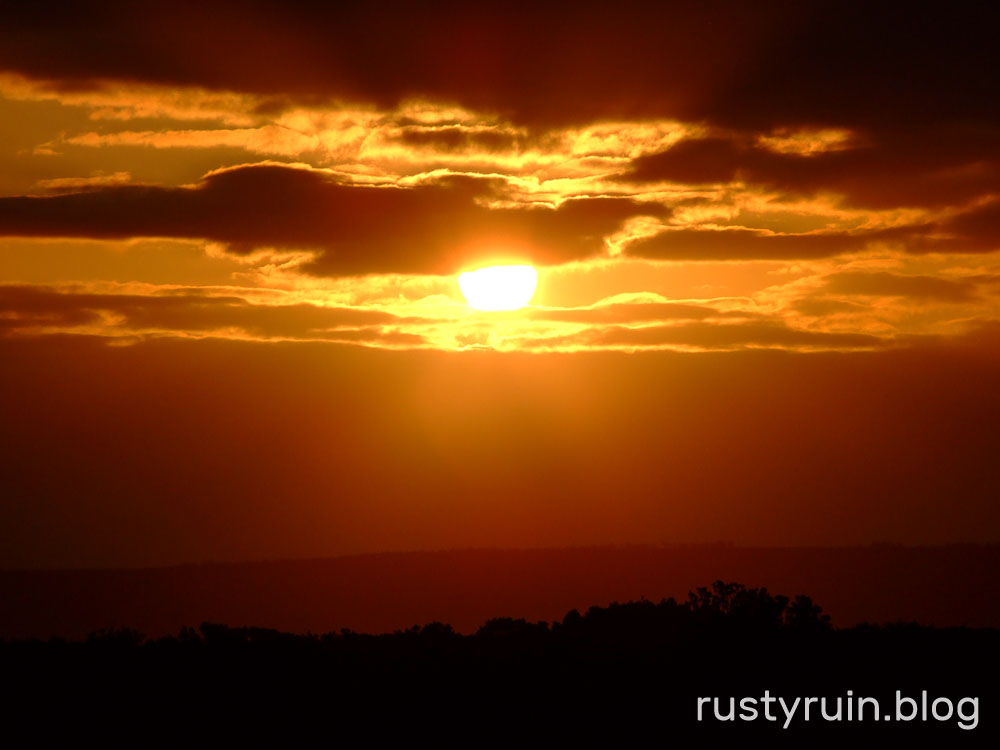
In the end, we finally saw a great sunset:

A welcome sunset – Finepix 6500fd

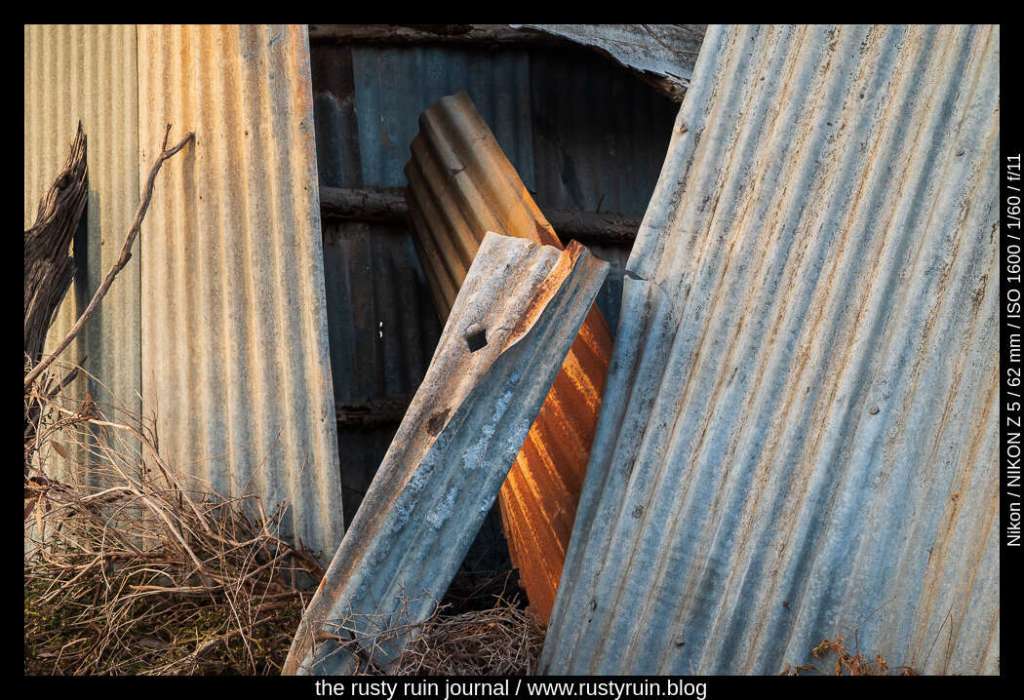
Tin, wood, and rust

There are dozens of old pictures on the SD card from my Sony RX100, many of them textures and abstracts. With these subjects, I prefer a photo that’s sharp enough to show the small details. Apart from some softness in the corners, the RX100 Mark 1 is possibly sharpest at an f-stop of 5.6. The combination of sensor and multi-coated Zeiss optics is a good match.

A nice arrangement of textures, shapes, and colours

There’s something distinctly Australian about rusty sheets of corrugated metal. In wandering around the streets looking for interesting scenes to record, a rather annoyed man asked what I was doing on his property. Though he was behind a fence, it seems that his property extended to what looked like public space. He insisted on this, despite my questions about how the area seemed to be arranged and how one could easily wander onto what he claimed was his turf. In the end, he permitted me to wander a little further as I assured him that I was uninterested in doing anything underhanded. It wasn’t worth the quarrel in the end, and certainly not worth the risk of harm.

The Australian summer can be very harsh. Though winters here are generally quite mild, climate change and extreme weather events notwithstanding, summers can be cruel to humans, animals, and building materials. Still, the combination of rust, metal, wood, and peeling paint is an eye-catcher, even on a cloudy day.

Speaking of clouds: not the greatest days in terms of golden light, but heavy clouds reduce harsh contrasts so that more detail is recorded in photos. Strong cloud-cover also means lower dynamic range, making it easier for the digital sensor to handle the highlights.

All photos were processed from Raw, though I’m keen to cut down on editing time and use a few custom JPG presets. In this context, I’ve set the RX100 to record both Raw and JPG files. This allows me to mess around with picture settings without relying on JPG output alone.

Public and private space

Whilst confrontation is often not worthwhile for photographers, there are certainly times when questioning laws and perceptions of those laws is applicable and useful. Being aware of where public space ends and where private space begins is important for photographers, especially if commercial intent is involved. And sometimes, it’s not clear where the private and public zones are.

Street photography has a long and rich history, but there’s a current cultural climate in which people are sensitive about someone pointing a camera in their direction. I can obstinately pronounce that the law and public space permits me to use my camera in this way, but laws versus people’s feelings is different. It’s also worth considering that there’s a difference between photographing a stranger in public space and being in that public space and photographing the texture of a brick. There’s far greater potential for confrontation in the former example.

I may quote my legal right to photograph strangers on the street, but often the risk of personal harm is not worth the effort to defend one’s rights. There’s also a question around ethics and recording the lives of some of the most vulnerable in society. Where does documentation end and voyeurism begin? The most vulnerable on our streets, dispossessed and struggling, are easily exploited. And is it ethical to exploit the most vulnerable for personal gain? Or should we take the longer view – that all such recording of people’s circumstances contribute to an important historical record?