30 grams of plastic charm ~ The Kodak Charmera digital keychain camera

Once synonymous with photography and the venerable Kodak Moment, the Kodak company has undergone multiple transformations over the last century. Having once dominated the film era, Kodak found itself in a war with Fujifilm in the 1990s whilst it awkwardly straddled the analog and digital imaging worlds.

It’s too simplistic to say that Kodak struggled because it didn’t adapt quickly enough to digital photography. Having researched and invented early digital imaging in the 1970s, the common view is that failure to invest in digital technologies caused their downfall. But Kodak did, in fact, produce many consumer digital cameras in the early 2000s and did manage to gain reasonable market share for a while. Even industry titans like Nikon and Canon struggled to devise a winning strategy in the digital imaging market as smartphones rose to prominence, so Kodak wasn’t alone.

Kodak may not have been agile enough to pivot completely from a huge historical investment in chemicals and film production, but in recent years, after Chapter 11 Bankruptcy, they have managed to make some headway in a difficult market. It helps that the Kodak brand is still so strong and sought after by their partners and licensees.

And so, we come to the intriguing Kodak Charmera ~ a teeny tiny digital toy camera that can live with the car keys in your pocket or get lost down the back of your couch. I received one as a Christmas gift this year. It’s made by RETO Production Ltd, who have a license from Kodak to use their well-known name on products.

Even though image quality from the 1.6 megapixel sensor isn’t anything special, it also records choppy video with sound, has a LED flash, a hole-in-body optical viewfinder, and features the cutest and smallest colour LCD on the back I’ve ever seen, making it a real charmer of a camera.

Structures in lo-fi ~ Kodak Charmera set to Black and White, with added Tri-X grain

The Charmera features a number of filters and frames. I like using it in black and white mode, if only to disguise some of the worst noise. Adding some film grain in editing leans into the lo-fi aesthetc and also covers up some of the oversharpening and oversmoothing that toy cameras aggressively apply. Of course, pixel peeping is not what this camera is about, and even adding some simulated film grain in post-processing feels like a bit too much effort! The Kodak Charmera is, if nothing else, a neat fun toy. It’s also stealthy enough to take out for some gritty street photos.
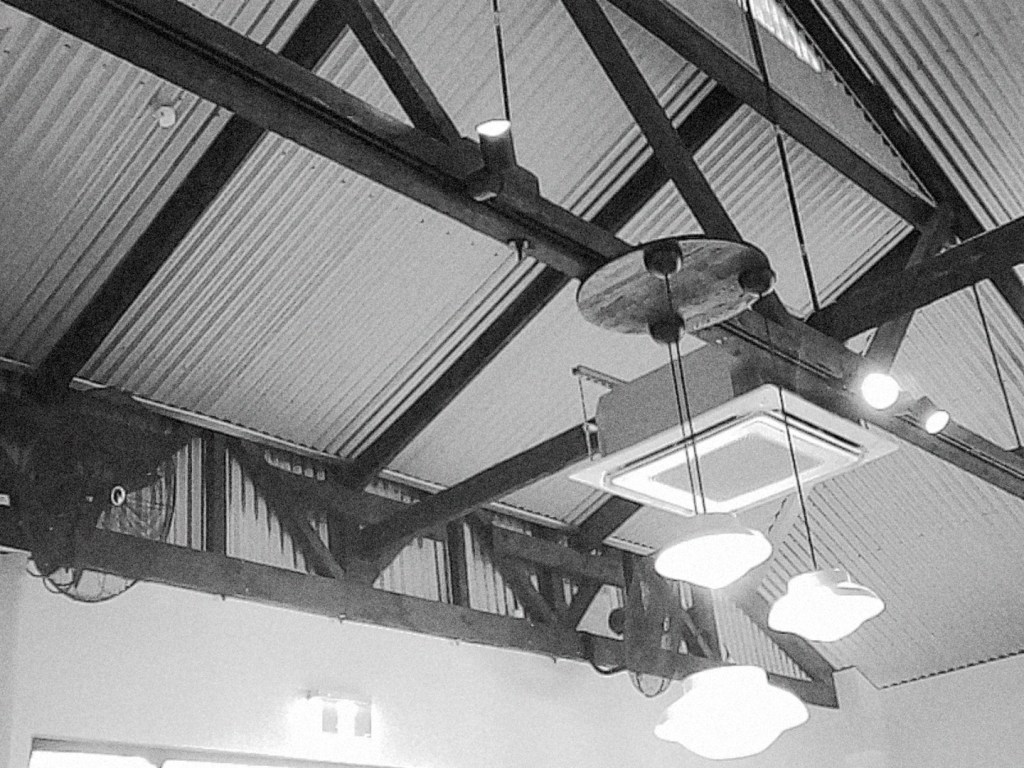
Corrugations and blown highlights in the coffee shop

The Kodak Charmera reminds me of seeing pictures for the first time from cheap old phones and early digital cameras. Maybe it’s not quite the same as seeing an image appear after washing chemicals over a long strip of film, but it does take me back to the early days of digital imaging when we realised we didn’t need to use flatbed scanners anymore to save images of film prints to hard drives so we could email them.

Anyone for a coffee?

A few more from the Olympus E-1

The Olympus E-1 is quickly becoming one of my favourite cameras. There’s a certain solidity to the photos from it. The mid-tones are strong and the tone curve applied in-camera produces really attractive images. If there’s anything to the CCD versus CMOS sensor argument, the E-1 is likely one of the best arguments for CCD being inherently superior. None of this is to suggest that modern cameras can’t produce amazing images, of course.

Crystal Lake – Olympus E-1

With my time currently limited, the fact that the RAW files from the E-1 require far less editing than expected is a big positive. And I still think that people are overpaying for cameras like this. It may be a really nice camera, but it lacks many of the niceties we’ve become accustomed to on our modern cameras. The limited dynamic range can be a problem in difficult lighting conditions and there’s no Histogram or highlight blinkies to check exposure. This does lead me to more carefully consider the tonal range of a scene and whether I use ESP or Spot metering, so it’s a good thing for learning, really.

Mine also has a few issues – a missing eye-cup and the mode dial is stuck in either Program mode or Manual mode. The eyepiece is not an issue but the mode dial is frustrating. I can live with it though. It does serve to remind me that this is an old camera now and it won’t last. Yet another reason not to overpay for old tech!

Table for Three – Olympus E-1

I’d also taken out the Finepix S5600 along with the E-1 in my camera bag, but once I opened up the Finepix files at the end of the day, I was disappointed. If I hadn’t been using the E-1 all day, the Finepix would likely have pleased me enough. But looking at those photos side by side, the E-1 completely blows the Finepix out of the water.

I feel a sense of melancholy when I use the E-1 though. Olympus isn’t the company it used to be, with the imaging arm now sold off and owned by OM Digital Solutions. The E-1 is every bit a lovely camera from a different time. It was a time when digital photography wasn’t quite yet mainstream and venerable companies like Olympus were putting every effort into the new digital market – enticing film shooters with the promise of not having to pay for film development.

I can’t help but feel that the E-1 contains as much technical mojo as Olympus could pour into it. The collaboration with Kodak represents the shared vision of two traditional companies focussed on surviving in a rapidly changing photography landscape. Ultimately, neither company managed to escape a brutal market where smartphone cameras defined the new rules, with severe decline causing them either to be sold off piece by piece or handed over to new owners divorced from company tradition.

Antiques – Olympus E-1

Editing Olympus E1 files – What’s happening here?

It seems that every weekend is cloudy lately, but that’s not a bad thing when you have an old camera that doesn’t handle high dynamic range scenes well. I took out the Olympus E-1 recently and found it a really interesting device – it feels great and has the gentlest shutter sound I’ve ever heard. I had another opportunity to use it yesterday and set it to record RAW and JPG. The results surprised me.

Old Methodist Church – Olympus E-1

I’ve questioned the idea of CCD sensors rendering colour differently to their CMOS counterparts, but ultimately I couldn’t be entirely sure there was nothing going on. There really shouldn’t be, as digital imaging sensors themselves are colour-blind and it’s only the Colour Filter Array atop them that could influence colour, apart from usual suspects like White Balance and lens quality.

Imagine my surprise when I found that the RAW files from the E-1 look almost identical to the JPG and TIFF outputs, apart from some extra sharpening. Normally, you’d expect RAW files to look flatter and less saturated when contrasted to processed JPGs from the same camera, but this is not so with the E-1.

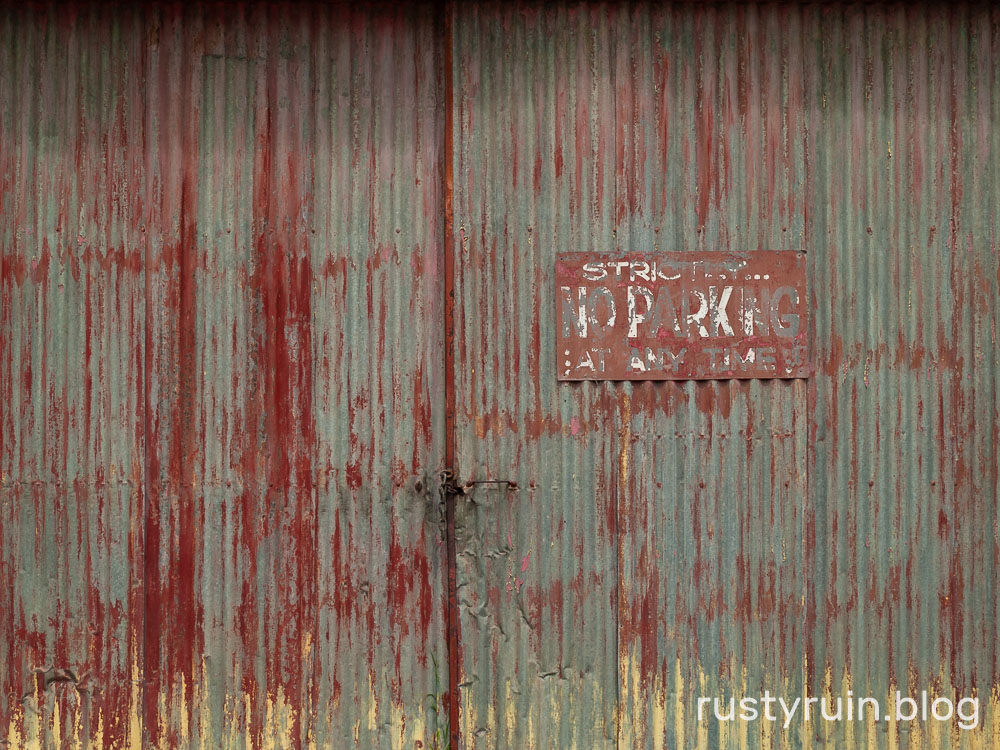
Strictly No Parking – Olympus E-1

I know that Lightroom applies a colour profile to each import, of course. I know that it does some sharpening and processing up-front to create a workable image. But what I’m finding with the E-1’s RAW files is that I don’t actually need to do much additional processing at all. The RAW files already look good and don’t look as flat as you’d expect a demosaiced file to look. So, what’s happening? Why do the E-1’s ORF files (Olympus’ naming convention for RAW files) look so similar to the processed JPGs?

Keep Clear – Olympus E-1

I have a theory – I think the E-1 is not doing much JPG processing at all, apart from some sharpening. Where we’d normally see a flat RAW image and a punchy JPG file, I suspect the E-1 is converting the ORF and applying minimal processing. This may be why the files look similar.

Please bear in mind that none of this is scientific. I’ve not sat for hours and tested side-by-side photos. I also know that processors like Lightroom make substantial changes when importing photos. I write all this knowing that it’s simple first impression and could be an error in my perceptions/technical set-up. This is a journal and sometimes my thoughts meander, so please be kind!

Restricted – Olympus E-1

Back to Kodak Colour Science

I have my doubts about CCD sensors and their supposed inherent colour superiority. As I’ve said before, there are plenty of old junk CCD cameras out there too, so it may not be a property of the CCD sensor at all. Yet, I can’t help but think that there’s something interesting happening inside the Olympus E-1. There’s no doubt that in the right lighting conditions it can produce superb images.

So far, and I may be completely wrong here, the Olympus E-1 is the only digital camera I have that even comes close to the output of my Sigma DP2 Merrill camera (now with a sticky leaf shutter, sadly). That’s high praise, considering the Sigma uses a Foveon sensora very different image recording technology. Of course, when I say close, the E1’s photos are still not really like the Foveon produced images, but the E1 does have the feel of needing to be treated like a camera with old slide film loaded, where you have to really look after wide tonal ranges.

Old town waterways – Olympus E-1 with Zuiko 14-42 mm kit lens

It’s not as though my E-1 sports a spectacular lens that makes the photos look great. It’s the old Four-Thirds system Zuiko kit lens – 14-42 mm 3.5 to 5.6. Not that Zuiko lenses are poor at all, as even the so-called kit lenses are truly respectable. So, is there some Kodak colour science happening here? At the very least, it looks like a tone curve is being applied to create a punchier image and this is translated to the demosaicing process. I really don’t know what it is, but I’m certainly happy to keep using this camera. It may not replace my faulty Sigma, but it’s very satisfying to use.