30 grams of plastic charm ~ The Kodak Charmera digital keychain camera

Once synonymous with photography and the venerable Kodak Moment, the Kodak company has undergone multiple transformations over the last century. Having once dominated the film era, Kodak found itself in a war with Fujifilm in the 1990s whilst it awkwardly straddled the analog and digital imaging worlds.

It’s too simplistic to say that Kodak struggled because it didn’t adapt quickly enough to digital photography. Having researched and invented early digital imaging in the 1970s, the common view is that failure to invest in digital technologies caused their downfall. But Kodak did, in fact, produce many consumer digital cameras in the early 2000s and did manage to gain reasonable market share for a while. Even industry titans like Nikon and Canon struggled to devise a winning strategy in the digital imaging market as smartphones rose to prominence, so Kodak wasn’t alone.

Kodak may not have been agile enough to pivot completely from a huge historical investment in chemicals and film production, but in recent years, after Chapter 11 Bankruptcy, they have managed to make some headway in a difficult market. It helps that the Kodak brand is still so strong and sought after by their partners and licensees.

And so, we come to the intriguing Kodak Charmera ~ a teeny tiny digital toy camera that can live with the car keys in your pocket or get lost down the back of your couch. I received one as a Christmas gift this year. It’s made by RETO Production Ltd, who have a license from Kodak to use their well-known name on products.

Even though image quality from the 1.6 megapixel sensor isn’t anything special, it also records choppy video with sound, has a LED flash, a hole-in-body optical viewfinder, and features the cutest and smallest colour LCD on the back I’ve ever seen, making it a real charmer of a camera.

Structures in lo-fi ~ Kodak Charmera set to Black and White, with added Tri-X grain

The Charmera features a number of filters and frames. I like using it in black and white mode, if only to disguise some of the worst noise. Adding some film grain in editing leans into the lo-fi aesthetc and also covers up some of the oversharpening and oversmoothing that toy cameras aggressively apply. Of course, pixel peeping is not what this camera is about, and even adding some simulated film grain in post-processing feels like a bit too much effort! The Kodak Charmera is, if nothing else, a neat fun toy. It’s also stealthy enough to take out for some gritty street photos.
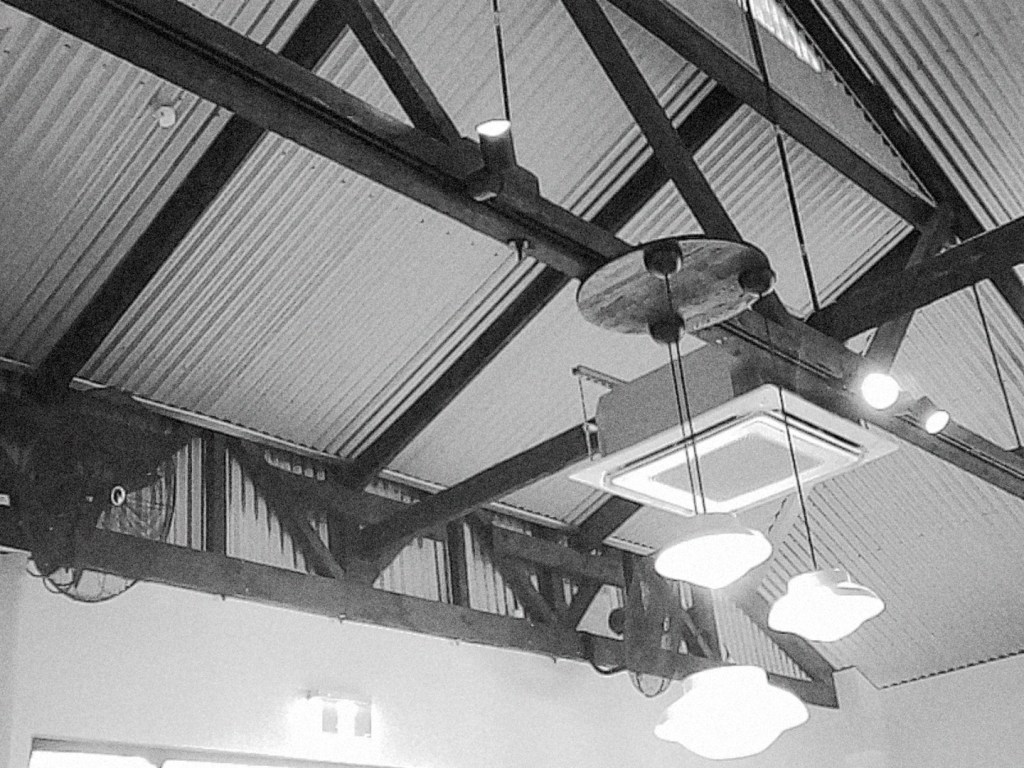
Corrugations and blown highlights in the coffee shop

The Kodak Charmera reminds me of seeing pictures for the first time from cheap old phones and early digital cameras. Maybe it’s not quite the same as seeing an image appear after washing chemicals over a long strip of film, but it does take me back to the early days of digital imaging when we realised we didn’t need to use flatbed scanners anymore to save images of film prints to hard drives so we could email them.

Anyone for a coffee?

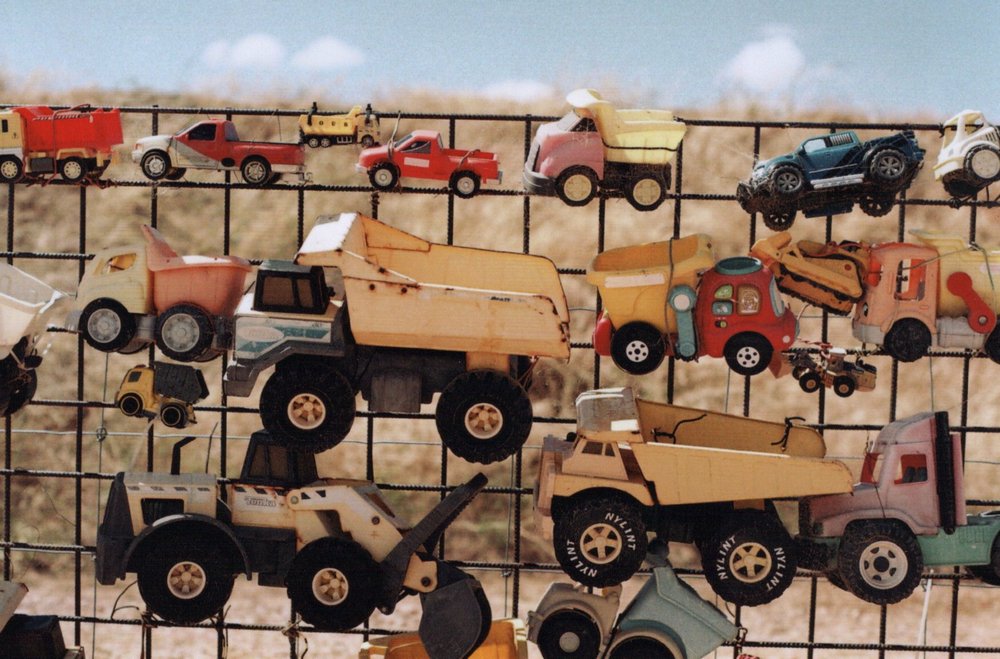
Graffiti and toy trucks late in the day ~ Nikon F80 loaded with Fuji Superia 200 colour 35mm film

I need a distraction from thoughts more serious and sobering, so here I am on Christmas Eve scanning the latest batch of film prints from my Nikon F80. One of the most endearing (or potentially annoying, depending on when you were born) things about using film is the journey of getting through a roll so it can be developed. There’s a prevailing attitude that each frame of film is to be savoured – each shutter press is an adventure in the slow, deliberate, and mindful approach to making photos. But sometimes, you just want to blow through the last few exposures to get the canister into the local lab.

Tiny toy trucks in the sun – Nikon F80 and Fuji Superia 35mm colour film, overexposed by 1 stop

I think I fared a little better with this roll than my last. I was quite frugal and deliberate this time around with the old Nikon, resulting in several more keepers. The expired Fuji Superia film features a lovely fine grain and exposure latitude. As much as Kodak Ultramax 400 is the everyperson of the modern consumer film world, Fuji have made some superb emulsions over the years.

Graffiti on The Tanks, near Whyalla South Australia

I’ll admit that using the Nikon F80 in recent weeks seems to have revived my interest in rehabilitating my film cameras. Sadly, I have found so far that some of them are simply not working any longer. Some are victims of my forgetfulness ~ a lesson in never leaving cheap batteries inside cameras to leak rivers of toxic sludge and potassium carbonate. Others have succumbed to the dusty decades and have slow shutters, wonky gears, faded rangefinder markings, and internals that have simply kicked the bucket. Happily, I seem to have successfully revived my Yashica Electro 35. I’ll have to put a roll through it to really test it out.

Moody tree near the old train-line, late in the afternoon

Exploring Iron Knob with a Nikon F80 and Kodak Ultramax film

Perhaps not quite a decade has passed since I last had a roll of film developed. Such is the easy lure of digital imaging, I suppose. Still, it didn’t take me long to get used to not looking at the back of the camera for an image review. It’s as though I was quietly slipping back to the old film camera habits and movements of my childhood. The slowness of photographic practice demanded by the Nikon F80 on this day – taking in the scene and the light – matched the eerie end of the earth silence of the town of Iron Knob.

I said to a friend that the Nikon F80, made in the year 2000 at the end of the mainstream film era as digital was fast taking hold, feels every bit Nikonian. What I mean is that for someone used to handling and holding modern Nikon cameras, the F80 feels ever so familiar – the button placements make sense, the hand grip is deep and comfortable, and the working philosophy is the result of decades of Nikon engineering and knowledge. The sleek, black Nikon Z5 digital camera was nestled next to it in my bag, looking like it had come from a different century, but the two share the same DNA.

No fuel left in town – Nikon F80, Kodak Ultramax 400, and Nikkor 50mm 1.8D lens

The Kodak Ultramax film I’d loaded had expired some years ago, so I used the ISO function of the camera to fool the exposure system and set it to treat the loaded film as 200 speed ~ slower than the box rating of 400. Doing this slows the shutter speed down and allows more light to hit expired film that’s less sensitive due to age related degradation.

Abandoned long ago – Nikon F80

Iron Knob was established in 1915 and was the birthplace of the Australian steel industry ~ something I didn’t know and a fact that certainly surprised me. I’d seen the town on maps over many years and had developed a curiosity, but hadn’t had the chance to visit until recently. As it happens, I was also testing the F80 for use at our daughter’s upcoming 21st, and it seemed a good idea to load some batteries and run film through it.

Half a ghost town

The Iron Monarch mine looms over the town, forming a red and dusty backdrop. When the Hematite poured from the earth, the town thrived and was no doubt filled with macho banter, drinking, and the dirt-filled sweat of hot days. You can still see those halcyon days in the closed roads where Keep Out signs warn travellers – wider than would seem appropriate for the minimal traffic in town today – barely recognisable bitumen strips that are crumbling and lead nowhere, flanked by corrugated iron homes that may or may not be inhabited. The only food takeaway shop in town is closed – old faded stickers in the window advertise Chiko Rolls ~ that most Australian of junk food icons. The sign on the door says that the shop is temporarily closed, but it seems to have been there a long time.

Iron, steel, and wood make a home – Nikon F80

The Sima 100mm f2 Soft Focus Lens ~ photos from your dreams

Some years ago, I made another blog that was about film cameras, vintage lenses, and digital cameras. That blog is long since gone, but having discovered a few recent archived posts, I’m resurrecting some of them:

Before the digital camera takeoff, before Adobe Photoshop, before the Holga was a thing, before Lomography, and before plastic lenses were considered trendy, there was the Sima Soft Focus lens. It’s a 100mm f2 all plastic affair with a versatile T-mount (for maximum compatibility), deeply recessed single plastic lens element, and a manual trombone type focussing mechanism (otherwise known as – two cheap plastic tubes sliding over each other).

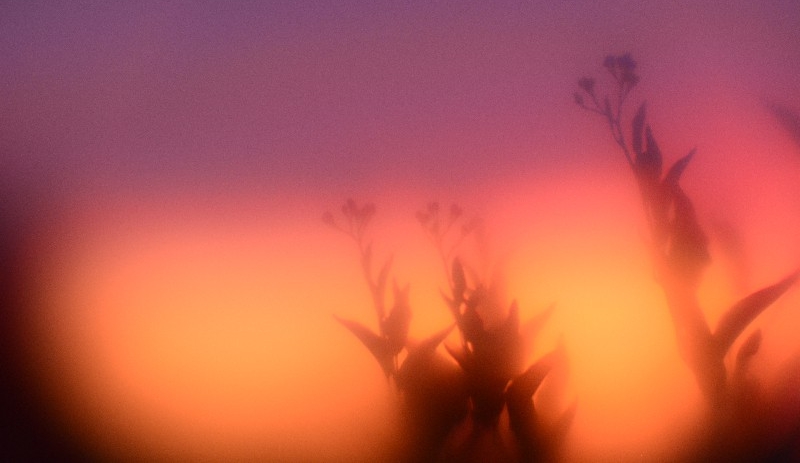
Mine is in pretty good condition but didn’t come with the original aperture disks. Still, they’re easy enough to make out of black card and can be slotted into the screw on plastic ring at the end of the lens. Sliding in smaller apertures will increase depth of field and cut out some of the dreamy effect of the soft focus shenanigans. But where’s the fun in that? The real retro charm of this lens is in using it for wide open dreamy photos that can’t be easily (if at all) reproduced in a program like Photoshop. Here are some gorgeous sunset photos from a garden:

That glow and bleed is pretty gorgeous, right? Sima lens on the Nikon D7100
Yeah, kinda hankering to use the lens again after seeing these!
Definitely not a multiple exposure. The lens created foliage ghosts.

The photo above almost looks like a multiple exposure doesn’t it? The highlights bloom and bleed and contrast is low, but the thin depth of field, chromatic aberration and ghosting lend this image an unusual character.

Resurrecting this post makes me want to use the Sima lens again! My apologies for the smallish example photos.

I discovered a cache of unedited photo files ~ backups and bad sectors

Do you remember waiting for a roll of film to be developed? I used to enjoy going to the photo lab and collecting those envelopes filled with photos. I’d sit down on a bench somewhere and pore through them excitedly. Sometimes, they’d be from rolls of film I’d been sitting on for a few years, so looking through them was a joyous exercise in reliving those memories. If I had the extra money, I might even pay for 7×5 prints or even a grainy 8×10 enlargement. We don’t experience any of that with digital photography, of course, but there is a close cousin: finding unedited RAW files on drive backups.

View of the Lighthouse 1 – Olympus EM5 Mark 2 and unknown vintage lens

I’m not especially organised when it comes to my photo backups. I’ve even lost a bunch of photos from one particular holiday due to my lack of foresight. Admittedly, I’m also a bit burned out on the tech and the multiple passwords and the platforms and…well you get the idea. In short – my fault for not listening to the hard drive that was burping and farting to let me know it was living its final days. So, it’s always nice to discover a maverick folder full of photos files I’d forgotten about.

Rusty grille and green concrete – Olympus EM5 Mark 2

I use One Drive a lot for backups now. I usually save a DNG version to the cloud and save a web-ready version for this journal and for sharing (1000 px on the long side and 60% JPG quality, if you’re interested). You might also have noticed that my photos now have a neat black border with some EXIF information on the side and a URL for this place. It’s an unobtrustive way to watermark the photos, record some useful EXIF data, and make the photo pop a little more against the black border. It’s a slightly convoluted process to install and configure, but once set up, the Mogrify 2 plugin works well in Lightroom. I have a license somewhere, but it probaby went down with another bad hard drive incident.

View of the Lighthouse 2 – Olympus EM5 Mark 2

A day with the Pentax K10D ~ my short time as a Pentaxian

When I was growing up, we’d spend time with another family on special occasions. They’d emigrated at the same time as us to Australia, and we’d maintained the sort of cultural bond with each other that immigrants often do when they’re finding their feet in a new country. Even though my brother and I didn’t have much in common with their two girls, we always found a way to have fun, whether it was hide and seek, boardgames, or exploring the nearby school on weekends.

I have a vivid memory of going to their home one day and looking up to see a large camera I’d never seen before sitting on a shelf in the dining room – a Pentax. Bigger and more professional looking than the usual plastic film cameras I was used to seeing, it seemed to suggest that someone in their family was a bit more serious than most about making photos. I never had the courage to ask, but that bold white Pentax font was burned into my memory.

A few weeks ago, I came into possession of my own Pentax – a K10D. Released in late 2006, it was a nice semi-pro DSLR with some interesting features ~ weathersealing, sensor-based shake reduction, and the same well-regarded CCD sensor as the Nikon D200. It even came to me in a Lowepro Nova 160 AW camera bag that still looks to have plenty of life left in it as a daily shoulder carry. As Ricoh-Pentax has, to me, always seemed a brand doing it’s own thing regardless of the trends, and bearing in mind the curiosity stoked in me since seeing that serious looking camera on the shelf, you can imagine I was quite excited to take it out for a day of use.

Closed up in Redhill – Pentax K10D with Sigma 17-50mm lens

We should be cautious about rushing into what seems like a good deal, especially online. I’ve been pretty lucky with my purchases, but sometimes old gear comes with problems. Despite a body in good condition and a shutter about a third of the way through its average life, my K10D isn’t in the best shape internally. Mine seems to have front and back focus problems, likely related to the dreaded mirror drop issue that plagued so many of these units. It took Pentax ages to own up to the problem officially.

Of course, the soft and slightly out of focus photos could also be due to the Shake Reduction system not playing nice, bad glass, or user error – though you’d expect that making a photo at 1 / 750th of a second in good light with plenty of depth of field wouldn’t be the cause of visual mush. And I know of no Sigma glass that’s so poor as to make everything soft even at an F-stop of 8. Given the inconsistency of the focal plane from photo to photo, I suspect one side of the mirror has tilted downwards slightly, thereby affecting sharp focus. I think this because every single photo comes out with the same tilt no matter how well I frame it: the right side tilted down. It’s easily corrected in Lightroom, but still annoying. The only other culprit could be the interchangeable focus screen being slightly askew – something that’s easier to adjust. Disappointment aside, these are some of the best photos from the day…

Inside the old farm-house – Pentax K10D

In some ways, I don’t mind slightly soft photos. Whilst I had to do more than my usual sharpness adjustment in Lightroom to compensate, they remind me a little of photos from a cheap old film camera.

Abandoned garage – Pentax K10D

The K10D is a nice camera to hold. The body seems to have more organic curves than the upright and serious looking Nikons I’ve grown accustomed to. The LCD screen is nice and bright, as is the optical viewfinder. It has a different hand-feel to my Nikons – slightly more refined in some ways, but lacking the external controls of the D200. If Nikon is the serious-looking man at the local bar drinking only tap water and green tea in the corner, Pentax is the loose fellow pressing buttons for fun on the jukebox after a few exotic beers.

Shipping container patina – Pentax K10D

Problems aside, it was good to finally use a Pentax after all those years of wondering about the camera on the shelf. Will I get another Pentax? I definitely won’t be rushing to do so. One of the hazards of picking up old cameras is that sometimes there are unreported faults. I have a Nikon D70 that’s very worn, but still makes great photos. The Pentax looks great and clean, but it’s not a trustworthy companion I’m afraid. I was a Pentaxian just for a day, and it was kinda nice. I’ll keep the nice Lowepro shoulder bag though!

Is film photography special to me?

I’ve briefly mentioned elsewhere that I used film cameras growing up. They were nothing too special though. I think my last film camera was an APS (Advanced Photo System) camera from Fujifilm. I liked that this format offered features like extra frames, easy-loading, and panoramic view. In some ways, it was the easy-to-use precursor to digital. It didn’t last long in the camera world as photographers didn’t like the reduction in frame size or the noticeable grain due to the crop. The market take-up of digital was not too far behind either, so APS remains the last turn of the millennium gasp of companies trying to squeeze every final buck out of film.

Sometimes, photographers say they have a relationship with film. I suppose that you might have a fondness for it if photography had been a big part of your life growing up. For me, film cameras were just there for special occasions. I knew exactly one person who had any professional camera gear, and I never saw them use it. My parents were certainly never interested in cameras, other than to document birthdays and other events. Rarely, I might receive a 110 format camera, the aforementioned APS camera, or go out and buy one of the cheapo plastic disposables. The best 35mm film camera I ever owned was given to me by my late father – a Chinon with a tiny lens and auto-rewind. I used it for a while until the film motor broke down.

Red Tree – Winpro 95 film camera, made by Webster Industries

I didn’t nurture a passion for photography from a young age, partly due to not having the financial means or the inspiration around me. Some of it also has to do with the fact that I’ve never been very technically minded or confident in my ability to learn such things. I always saw high-end photography as the pursuit of those who could afford it and those who could understand the numbers behind it.

When I was gifted my first APS camera, I enjoyed the ease of the exercise. I probably made more photos with that camera than with any other previously. I’ve since lost those photos, but I do remember becoming very interested in framing scenes and doing so in a way that pleased me. I think this is when I really started to develop an interest in the wider world of photography, though my bank account wasn’t always up to the challenge.

Very Orange Sunset – Smena 8 with home-made redscale film

When digital cameras came along, I was pretty excited. Though my first was a Kodak with a measly 1 megapixel and terrible battery life, I loved the immediacy of the experience. There’s something to be said for waiting for film to develop and unwrapping it like a gift, but digital offered me the chance to learn how to make better photos through immediate feedback. That’s when things started to really make sense to me and my, up to that point, nebulous and undefined interest in photography solidified.

Blue light railway – Winpro 95 film camera