A big optical zoom that starts at 30.5 mm and ends at 436mm (F2.8 to F5.3),
DSLR-like styling and external buttons,
A largish, by bridge camera standards, 8x6mm (1/1.6th inch) sensor,
And a 200 000 dot electronic viewfinder.
In many ways, it feels modern, though the speed of processing is definitely of the 2009 variety. Still, I can save in both JPG and CCD-RAW, unlike previous Fujifilm bridge cameras.
The old red lighthouse – Fuji Finepix S200 EXR
The octagonal pixels that Fujifilm packed into these old sensors might seem odd by today’s standards, but the tech produces photos said to contain extra highlight information. It’s not terribly easy to verify this, as I’m still trying to work out the weird digital alchemy that results in:
Strange cross-hatch image artifacts in some 12 megapixel images,
12 megapixel TIFF files that can only be created from RAF files in an aging program called S7raw – built almost exclusively to read CCD-RAW files from these later Fuji cameras,
JPGs and RAF files that are 12 megapixels in any of the PASM modes and High ResolutionEXR mode, or 6 megapixels in the Dynamic Range or Low Noise EXR modes.
It’s a lot to digest and also explains why some people describe this camera as a JPG machine ~ they clearly have better things to do with their time than mess with TIFF and RAF files. This makes it a complex camera on the inside. And as much as I like that the S200EXR offers classic Fujifilm JPG recipes – Provia, Astia, Velvia, and BW – the menu organisation also reflects the complexity of options available.
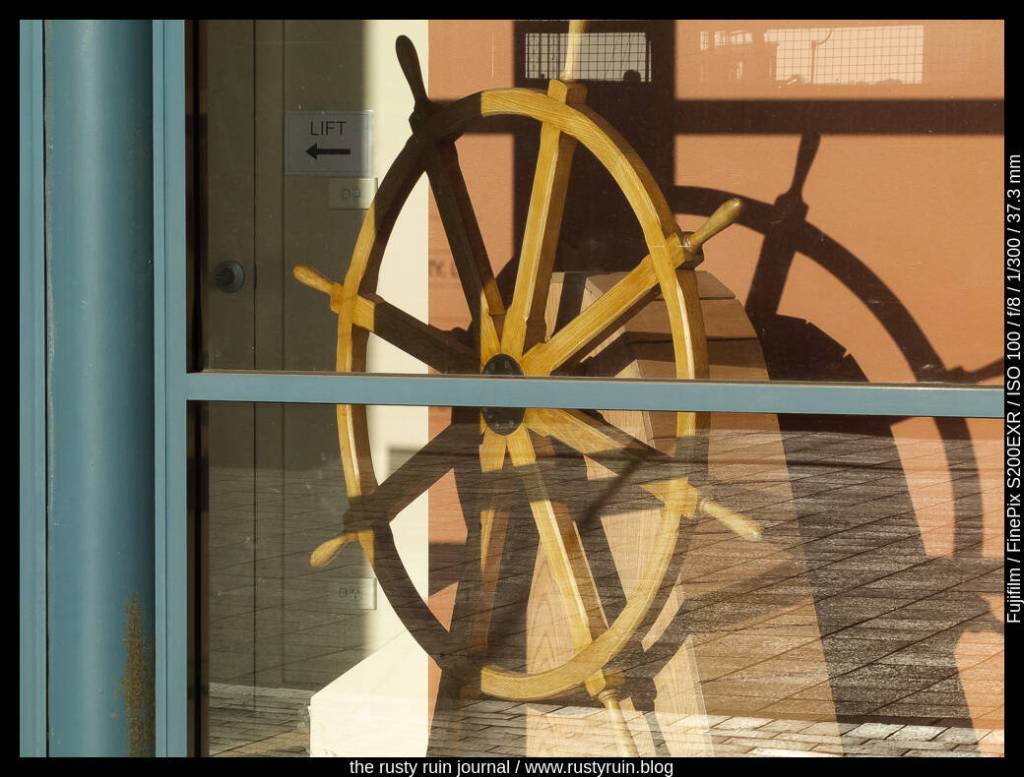
Ahoy Captain! – Finepix S200EXR
The seperate EXR option on the dial offers three special modes: 12 megapixel High Resolution photos that use all of the sensor pixels, 6 megapixel Dynamic Range photos that preserve more detail in shadows and highlights, and 6 megapixel images in the High ISO Low Noise mode. Weirdly, the regular PASM functions don’t offer any of the three EXR special modes and create regular 12 megapixel photos that use a different kind of dynamic range preservation technology.
Rails and pipes – Fuji Finepix S200 EXR– plenty of detail in the shadows, even in this 6 megapixel image
I’ve found that importing the RAF files into Lightroom is the most convenient option in all cases. The imported 6 megapixel images from RAF files recorded in two of the EXR modes seem to be the darker of two exposures – or at least the darkest part of whatever data lives in the mystical RAF files. It seems likely that Lightroom is throwing away some of the data from the smaller octagonal pixels that preserve extra highlight information. A RAF file recorded in any of the PASM modes results in a 12 megapixel image, and Lightroom imports them just fine – this is my preference going forward.
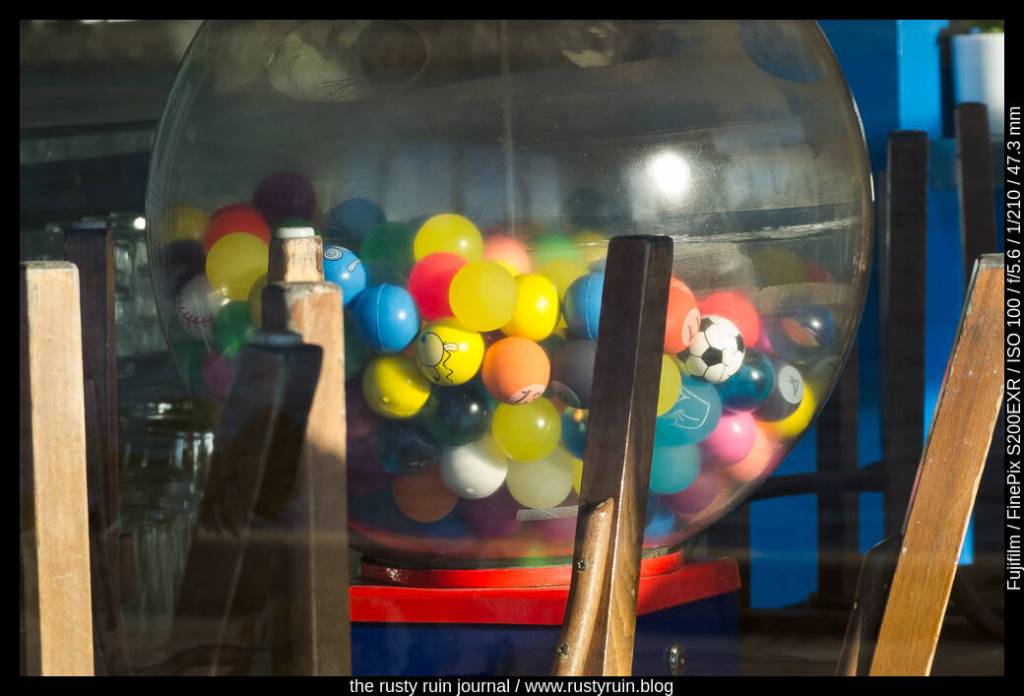
Balls balls balls – Fujifilm Finepix S200EXR
It seems that the EXR line of cameras represented the pinnacle of Fujifilm’s longstanding SuperCCD sensor technology. Not too long after these premium bridge cameras and their strange alchemical sensors, the company moved to CMOS and their X-Trans technology. Despite the complexities of the camera, I find the images very pleasant.
I need a distraction from thoughts more serious and sobering, so here I am on Christmas Eve scanning the latest batch of film prints from my Nikon F80. One of the most endearing (or potentially annoying, depending on when you were born) things about using film is the journey of getting through a roll so it can be developed. There’s a prevailing attitude that each frame of film is to be savoured – each shutter press is an adventure in the slow, deliberate, and mindful approach to making photos. But sometimes, you just want to blow through the last few exposures to get the canister into the local lab.
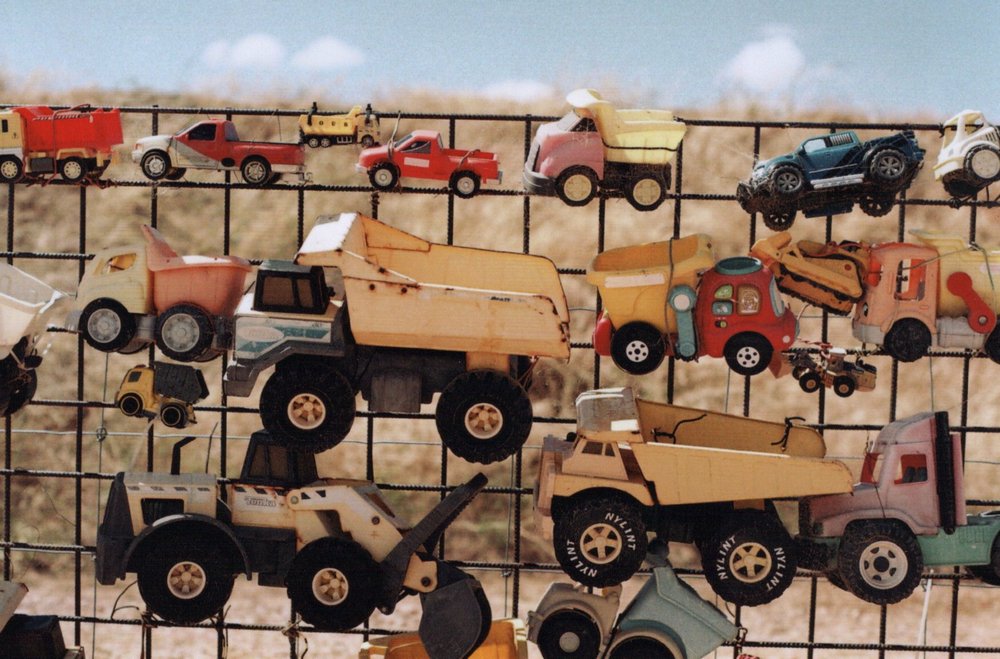
Tiny toy trucks in the sun – Nikon F80 and Fuji Superia 35mm colour film, overexposed by 1 stop
I think I fared a little better with this roll than my last. I was quite frugal and deliberate this time around with the old Nikon, resulting in several more keepers. The expired Fuji Superia film features a lovely fine grain and exposure latitude. As much as Kodak Ultramax 400 is the everyperson of the modern consumer film world, Fuji have made some superb emulsions over the years.
Graffiti on The Tanks, near Whyalla South Australia
I’ll admit that using the Nikon F80 in recent weeks seems to have revived my interest in rehabilitating my film cameras. Sadly, I have found so far that some of them are simply not working any longer. Some are victims of my forgetfulness ~ a lesson in never leaving cheap batteries inside cameras to leak rivers of toxic sludge and potassium carbonate. Others have succumbed to the dusty decades and have slow shutters, wonky gears, faded rangefinder markings, and internals that have simply kicked the bucket. Happily, I seem to have successfully revived my Yashica Electro 35. I’ll have to put a roll through it to really test it out.
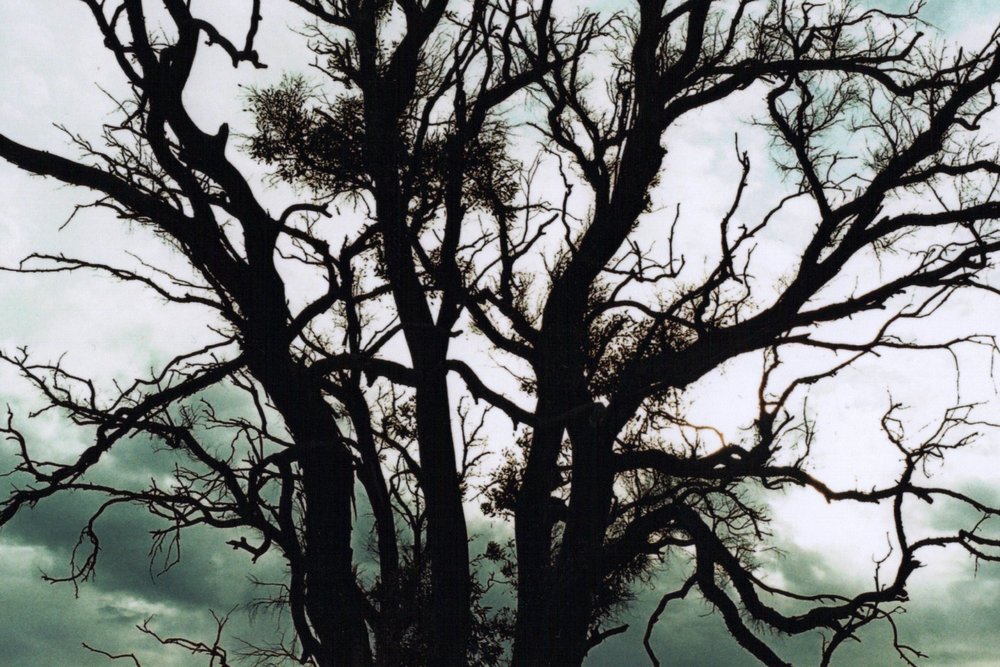
Moody tree near the old train-line, late in the afternoon
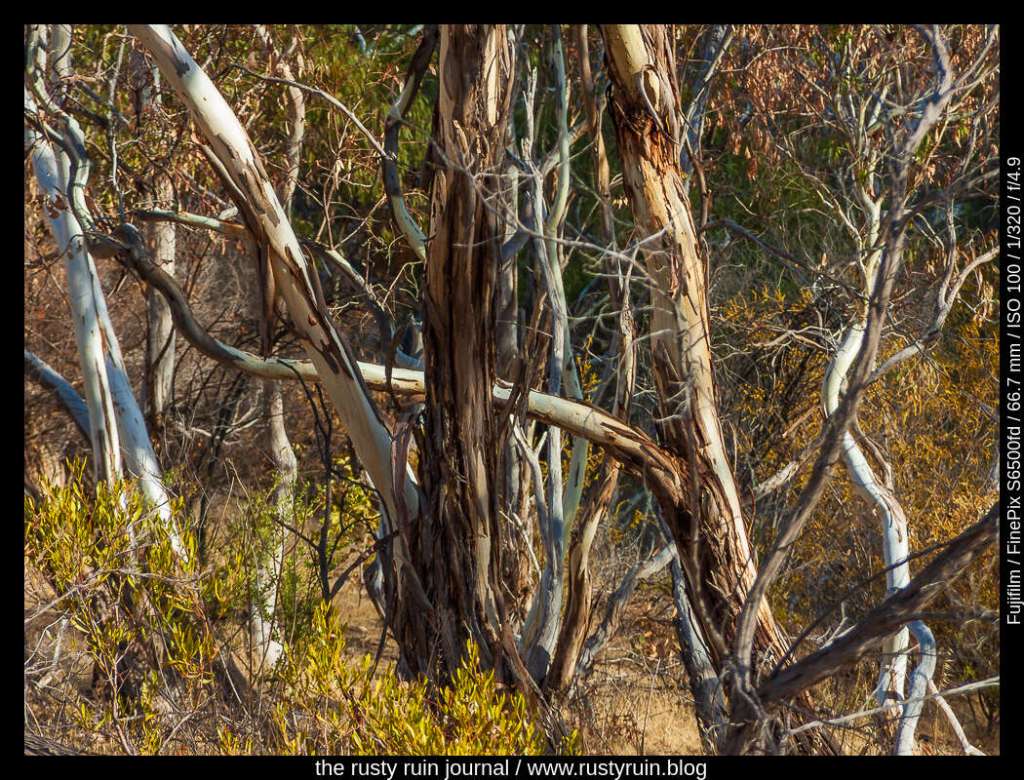
It was the perfect afternoon for us to ramble along a walking trail through century old goldfields nearby. I’d decided to pack the Nikon D40 and the Fujifilm S6500fd. I totally forgot about the Sony RX100 sitting in the zipper pocket of my camera shoulder-bag – the usual go-to in case an old camera flakes on me. I’ll say this about the Finepix S6500fd: the combination of the tiny Super CCD sensor – ancient in digital photography terms – and the long, sharp lens, produce some really interesting photographs at times.
Ghostly gums – Finepix S6500fd
Setting the camera to the Fuji-chrome setting and Fine JPG seemed to enhance the blues and purples in this photo. Maybe it was the combination of the cloud, sunlight, shade, subject, and white balance, but there’s a really strong look to the image. I haven’t added additional colour in editing.
Gum trees along the trail – Fujifilm Finepix S6500fd
For the above photo, I decided to set the camera to generate RAF files – CCD-RAW in the settings menu. I wasn’t even sure they’d open in Lightroom, but they did, and I’m pretty pleased. This provides more latitude and flexibility during editing. As you can see above, I was able to draw out pretty good detail in the shadows and sharpen the image in specific areas. It’s not easy to see without magnifying in Lightroom, but there’s some beautiful detail and tonality in the bark. Hard to believe from this piece of old gear.
Beneath the bark – Finepix S6500fd
Finally, one of my favourite features on old bridge cameras is the Macro and Super-Macro modes, at the touch of a button. It’s so handy for getting up close when there’s good available light for a decent shutter speed. I usually wander handheld, so there’s no tripod involved. Steady hands and good light are a must under these circumstances. It’s a JPG (wish I’d set to CCD-RAW), but the colour and range of tonality is still impressive. The best photos from this camera, like the S7000, seem to have a versimillitude about them. Note to self: set this camera to make RAF files from now on!
Looking out from The Point – Fujifilm Finepix S6500fd
This small bridge camera from Fujifilm only has a small – 7.44 x 5.58 mm – digital sensor, but it features Fuji’s SuperCCD sensor technology, which seems to have some special sauce about it. Can you believe the electronic viewfinder even has a nice live histogram so that you can alter exposure compensation quickly? It even looks like a mini-DSLR. Along with the clunkier Finepix S7000, I think the S6500fd is one of the best bridge cameras from the 2000s era between film and digital.
The moody golden spill – Olympus E1
These aren’t great light conditions for an old CCD-based camera like the Olympus E1 that loves more light, especially when pushing the ISO introduces the type of visible noise that 20+ year old digital cameras are known for. My steady hand and the vestiges of bright sunlight helped keep the shutter speed usable. I still love what this camera can do even more than 20 years after market debut! It can make very painterly images.
I’ve briefly mentioned elsewhere that I used film cameras growing up. They were nothing too special though. I think my last film camera was an APS (Advanced Photo System) camera from Fujifilm. I liked that this format offered features like extra frames, easy-loading, and panoramic view. In some ways, it was the easy-to-use precursor to digital. It didn’t last long in the camera world as photographers didn’t like the reduction in frame size or the noticeable grain due to the crop. The market take-up of digital was not too far behind either, so APS remains the last turn of the millennium gasp of companies trying to squeeze every final buck out of film.
Sometimes, photographers say they have a relationship with film. I suppose that you might have a fondness for it if photography had been a big part of your life growing up. For me, film cameras were just there for special occasions. I knew exactly one person who had any professional camera gear, and I never saw them use it. My parents were certainly never interested in cameras, other than to document birthdays and other events. Rarely, I might receive a 110 format camera, the aforementioned APS camera, or go out and buy one of the cheapo plastic disposables. The best 35mm film camera I ever owned was given to me by my late father – a Chinon with a tiny lens and auto-rewind. I used it for a while until the film motor broke down.
I didn’t nurture a passion for photography from a young age, partly due to not having the financial means or the inspiration around me. Some of it also has to do with the fact that I’ve never been very technically minded or confident in my ability to learn such things. I always saw high-end photography as the pursuit of those who could afford it and those who could understand the numbers behind it.
When I was gifted my first APS camera, I enjoyed the ease of the exercise. I probably made more photos with that camera than with any other previously. I’ve since lost those photos, but I do remember becoming very interested in framing scenes and doing so in a way that pleased me. I think this is when I really started to develop an interest in the wider world of photography, though my bank account wasn’t always up to the challenge.
Very OrangeSunset – Smena 8 with home-made redscale film
When digital cameras came along, I was pretty excited. Though my first was a Kodak with a measly 1 megapixel and terrible battery life, I loved the immediacy of the experience. There’s something to be said for waiting for film to develop and unwrapping it like a gift, but digital offered me the chance to learn how to make better photos through immediate feedback. That’s when things started to really make sense to me and my, up to that point, nebulous and undefined interest in photography solidified.
In a previous post, I rushed out with the Fuji Finepix 6500fd and was impressed by the camera’s ability to hold onto detail. Fast-forward to a cloudy Sunday and a last-minute invitation from family friends, and once more, the Finepix 6500fd is in my hands. It has the feel of a mini-DSLR and the manual zoom, unlike most other Finepix cameras from the 2000s era, really adds to this feeling.
Pink scrawls – Finepix 6500fd
At this point, I’m trusting the Automatic White Balance of the 6500 because it does an admirable job, even on a really cloudy day. At some point, there’ll be some sun, I hope! As you can see in the above image, out of cameras JPGs are nice and colourful. Of course, I have it set to JPG Fine, ISO 100, and the Fujichrome picture setting so that there’s more saturation of certain colours and extra contrast. I’ve yet to use the F-Standard setting.
Roadside groceries – Finepix 6500fd
Like most older digital cameras, it’s not great when it comes to preserving strong light and shadow areas. There’s a bit of a focus on preserving highlight and shadow detail in modern photos, but it really depends on the subject and the type of photo it is. Is there anything you really want to preserve in the highlights/shadows? Do strong highlight and shadow areas add punch and drama to your photo? These are really the questions that should be asked, and not just an assumption that these areas need detail all the time. In many cases, clipped highlights and blocked out shadows don’t matter and add visual interest.
Bees and butterflies – Finepix 6500fd
I did also take out my Nikon D40 but I ended up bagging it because it seemed to be overexposing. As it happens, I think it was my error entirely. I’ll take it out again and check to see if it’s a mechanical issue with the shutter speeds or just me being completely stupid.
The cactus takes over – Finepix 6500fd
Because I set the Finepix to Soft sharpening levels, all of the JPGs benefit from some light extra sharpening in Lightroom. Using both Texture and Clarity in small amounts also brings the best out of this camera. I’d go so far as to say that the lens on the Finepix 6500fd is superb for the time, and it wrings the most out of the sensor to the point that a higher resolution sensor would likely be a better fit for the lens.
Previously, I admitted to having developed a thing for the old Fujifilm Finepix bridge cameras from yesteryear. I didn’t have the money to buy them back when they were new and I’ve often heard good things about Fujifilm cameras in general. Given the recent fetish in the more feverish and magical corners of the internet with CCD cameras of a certain vintage, I think it’s a good time to explore their capabilities and features.
Blossoms – Finepix 6500fd
Where the S7000 is a bit clunky and shows its age, despite some amazing image making capacity for the time, the S6500 feels more modern and sleek. Start-up time is quicker, menus are cleaner and more responsive, and the nice histogram that overlays on the, slightly disappointing, EVF when the Exposure Compensation button is pressed is really useful for looking after highlights and shadows.
I set it to JPG Fine and the Chrome picture mode. This pushes contrast and boosts saturation, especially in greens. Unfortunately, the day was thick with cloud cover, but the Auto White Balance did an admirable job when photographing flower blossoms on the side of the road. Even in this grim light, there’s lots of detail.
Speaking of detail, can you believe that the above photo was made with a small sensor bridge camera from 2006? Even under heavy cloud, there’s amazing detail in the foliage and on the sign. I set Soft sharpening in-camera, preferring to sharpen up in Lightroom. At ISO 100, there is no discernible noise. Unlike the JPGs from the S7000, where pushing them even a little during editing shows plenty of digital noise and tonal fragility, the JPGs from the 6500 preserve a lot more noise-free detail in shadows. The photo above was pushed to +30 in shadow areas! Apart from that, there were small boosts to mid-tone Contrast and Clarity.
Machinery in the yard – Finepix S6500fd
More than megapixels and sensors
The quality of these photos is not just about the sensor. Though the sensor is the same one that’s in the much-loved Fuji F31fd camera, a great lens also makes a big difference. A quick trip out under heavy clouds and rain isn’t ideal for testing a camera, but just looking at the detail in the foliage from a 6.3 megapixel Super CCD sensor and lens combination from 2006 is something of a revelation.
Beauty on the side of a back-road
I think this camera is worthy of setting to record in native Raw file format at some stage, just to see how much detail can be pulled from shadows and highlights. What’s clear is that the Super CCD sensor in the S6500 handles higher dynamic range scenes much much better than the older and clunkier S7000. Two years of digital camera advancement makes a big difference, and I can only imagine how thrilled I would have been to have had this camera way back when!
There’s something delightful about rust – rough patches of red, brown, orange, and black signify the decay of something once whole. It’s a reminder that nothing lasts forever. It gives one pause to consider time, relentless and vast. Also, a good excuse to post some photos of rust and old stuff!
Something rusty – Sony RX100 Mark 1
There’s another thing too: lately I’ve become interested in those old Fujifilm bridge cameras I could never afford at the time of market release. Honestly, I barely had two cents to rub together, let alone the disposable income to purchase one of the many Finepix models from the 2000s era. It was a time when digital, so ubiquitous now, was still carving out a place in photographer’s hearts.
Back in 2004 or 2005 (too long ago), I remember going out with my late father with the intention to buy a good camera. He picked up a mostly plastic, silvery Finepix – a 3500 I think. It was 4 megapixels and looked quite neat. I picked up an Olympus Ultra Zoom – silvery and plastic: a 3 megapixel Olympus Camedia C-725. I still have it, minus the XD card.
My father got the better deal, honestly. Though it wasn’t the best digital camera at the time, the Fuji Finepix he had was fun and easy to use, and he used it a lot! On the other hand, I used my C-725 rarely, under the misapprehension at the time that Olympus must somehow be of more legendary status than Fujifilm. I failed to squeeze much joy out of it and found myself feeling regret. I foolishly set it to Manual mode, placing myself under pressure to make sense of it all, and my brain exploded! Once I find an XD card, I’ll fire it back up with new vigor and give it a second life – if it still works.
Where industry once was, rust reigns supreme – Sony RX100 Mark 1
I have the Finepix S7000 now, of course – a camera that recently surprised me with features, even if it’s slow by today’s lofty standards. But there are two more on the way: the Finepix S5600 and the Finepix S6500fd. The former intrigues me with a minimum ISO of just 64, and a reputation for low noise. The latter features the excellent sensor also present in the Finepix f31fd – a camera that has been targeted by the CCD colour crowd and is now absurdly expensive.
I’m enjoying the old bridge cameras. Back then, these cameras bridged the gap between people who were either still using film cameras and wanted an easy way into digital, and/or those who were using compact digital cameras and wanted to move to something closer to a DSLR/pro camera but didn’t want to lay out too much money.
I’m not a scientist. I’m not an engineer of any sort. I’m certainly not a designer of optical devices or digital sensors, just so you know. There has been debate in some corners of the web about old cameras with CCD sensors rendering better colour and their images looking more film-like. I think a pleasing photo is a subjective thing and people are free to decide what that looks like. I’m just curious about the nature of the debate and why people might think this way.
CCD sensors were the dominant type of digital sensors at the dawn of digital photography. Around 2010 or so, CMOS sensors started to appear in new camera models. At the time, I really didn’t think about it, as I couldn’t even afford any of the better CCD cameras anyway. And believe me, there are plenty of CCD cameras that make junk photos! Interestingly, the CCD colour is better pundits rarely discuss those junk cameras, perhaps because their output doesn’t suit the argument that CCD colour is better.
Of Nikons, Canons, Pentax, and Fujifilm
When people talk about those lovely CCD colours, they usually reference the same cameras: most of the early Nikon CCD cameras, the Fuji Super CCD cameras, early Canons and compacts of a certain model, the Olympus Evolt series, the Leica M9, and a handful of compacts with excellent output. Of course, those cameras were always considered excellent. Reviews at the time of their release praised them, so it’s no surprise that they’re still great cameras today.
I used a few CCD cameras at the time, and then moved to CMOS cameras because that’s what was being sold. I don’t remember anyone discussing the merits of CCD colour versus CMOS colour. I do know that the output of many cheap and cheerful CCD cameras at anything higher than 200 ISO is pretty awful – there’s lots of chroma and luminance noise, and the colours don’t look so great. If you read reviews of those old consumer cameras online, you’ll see there was a focus on accuracy of colour. This is because camera makers saturate certain colours to make the output more attractive for consumers.
Consider the quote above about an old CCD camera. Evidence that colour reproduction has always been on the mind of the photographer and that CCD cameras, for all their current hype, have issues with accurate colour reproduction. This is not to say that inaccurate colours are less attractive. Many cameras are sold based on how their on-board JPG conversion software renders colour, after all.
What influences the colour of a digital photo?
First of all, whether it’s a CCD sensor or a CMOS sensor, the sensor itself is actually colour-blind. The sensor only sees lightness/brightness and not colour. The Colour Filter Array on top of this slice of silicon filters wavelengths of light into Red, Green, and Blue. All of this data is transferred to AD converters and the signal amplified. The on-board software takes this data and, in the case of JPG output, it does some clever stuff to render a compressed file. To achieve the Canon look or the Olympus look, or whatever, the software also applies a tone curve, temperature and tint settings, and may saturate certain colours more heavily.
The Fuji-Chrome look in digital
Fuji is pretty well-known for offering users lots of film presets in their digital cameras. These settings emulate some of the qualities of certain films, including colour, grain, and tone curve. The photo above is from an old Fuji Finepix S7000. It’s a JPG straight out of the camera on the Chrome setting. Note that there’s a slight green bias in the white balance, as well as extra contrast. Definitely a pleasing photo.
On some makes of camera, the White Balance is known to bias warmer or cooler. Nikons tend to have a cooler look to photos, and this helps to produce better colour in some scenes where a warmer bias would create unnatural colours, such as in some types of skin tones. But these things largely matter only when JPG file output is needed.
Choice of lens also has some influence on how a photo looks. People talk about the Leica look, for example, noting that there’s some mystique about it. I don’t have the money to buy a Leica of any sort, so it’s hard for me to comment on this phenomenon. What I do know is that a poor lens can produce poor output, and a great lens can produce great output. Leica have always been known for the superiority of their optics, so it’s most likely that the signature Leica look has a lot to do with the contrast and sharpness imparted by the lens.
Hype and reality
So, why are some people talking about the inherent superiority of CCD sensors and how they render colour? Is CCD colour a question of hardware or software? Here are some common reasons and assumptions, including my thoughts on them, from people who believe that CCD sensors produce better or more film-like images:
The old CCD sensors have thicker Colour Filter Arrays that separate colour better and produce stronger images: As I said, I’m no engineer, so this is tough to question. If this is true, then all a camera maker would need to do is to put a thicker CFA on a new CMOS sensor, and it would approximate all of those great colour results from old cameras. I strongly suspect that the CFAs have very little, if anything, to do with it though, given that there are other strong influences on how a photo looks, such as white balance and camera software.
Camera manufacturers stopped using CCD because CMOS was cheaper, which led to less organic images: Companies do things to save money all the time, but would they really intentionally hobble the output of their cameras to the extent that many CCD enthusiasts believe?
Camera X with a CCD sensor makes photos that look so much better than camera Y with a CMOS sensor, so therefore the CCD sensor must be superior: Let us not forget that most CCD pundits never mention all the junk CCD cameras from that era (is anyone talking about those plasticky Nikon L series compacts that produce average photos?). They mostly talk about the CCD cameras that are still good, even today. They were praised then, and they are still making good photos now. I think that some people who were too young to remember the digital transition now cultivate the mistaken assumption that old camera technology is mostly inferior to today’s technology, and that those great cameras from yesteryear make photos look great because there’s some hidden and forgotten technology in them – the CCD sensor.
CCD cameras make images that are film-like: Let us be clear – only film looks like film. I grew up with film cameras and remember the cheap cameras (I couldn’t afford anything else), powerful in-built flashes, and cheap consumer film. I think the look that many young people talk about relates to the softer quality of many film photos due to low-grade lenses and the appearance of highlights from low-priced consumer film cameras. Those old CCD cameras have limited dynamic range, often creating blown highlights. The best CCD sensors, at low ISOs, do produce less digital noise due to the chip’s architecture, and some people say that this means it’s closer to film. But modern CMOS sensors have advanced greatly in these areas and have far more dynamic range, colour accuracy, and noise control. Just look at the crappiest CCD cameras at anything above base ISO and you’ll see some pretty ugly chroma and luminance noise. The best CCD cameras from that era can make some very nice low noise images, even up to 800 ISO, but none of this means it looks like film. Plenty of people know more about it than I do, but film grain is random and organic. Digital noise is square and uniform. Where an old and highly regarded CCD camera may be useful is at the lowest ISOs and almost no perceptible digital noise. That could make for some nice black and white conversions. The low noise might also make it a better fit for overlaying scanned images of film grain. I’ve never seen much point in overlaying film grain over digital photos that already have digital noise.
You’ll have unlimited film-like images if you buy this cheap CCD camera: There are lots of YouTube videos touting the benefits of these old digicams, even going so far as to label them Y2K cameras. This is a hook to lure people in to watching the videos so that the creators can game the algorithm and snag subscribers, with a little magical thinking and potential profiteering thrown in. Growing up, I saw thousands of photos from film cameras of all sorts. The so-called Y2K camera, the moniker itself a pointer to the generational interest in digicams, doesn’t make film-like images.
If you want to read a pretty in-depth, though only loosely scientific, article on CCD versus CMOS colours, take a look at this site. Spoiler alert: there isn’t a visible difference between them for most people, and any colour output differences seem to come down to company preferences with regard to on-board software processing. CMOS also offers so much more low-light performance that it’s little wonder CCD was replaced by it in the end.
There is something curious about the Olympus E-1 I’ve been using recently, in light of this speculation about sensors. The RAW files it produces are not as flat and dull as you’d expect. They require little editing when exposure settings are nailed. Is that the sensor? Maybe. More likely a tone curve applied, though it seems odd that this can be seen in the RAW files? You can read my thoughts about it here.
Nikon Z5, when paired with sharp lenses, can produce wonderful output
Does it matter?
People love the photos they love. And I’m not an engineer, so I don’t have all the answers. In the end, it doesn’t really matter. Humans are always looking for meaning somewhere and often latch onto narratives despite the data. And that’s OK. Creating and finding greater meaning in life is what we’ve always done.
What I do find interesting is how much prices have risen for the CCD cameras that get the most attention in these online forums and social media discussions. No doubt, some people in those corners have enough interest in profits and online followers that they’ll keep pushing the CCD vs CMOS colour narrative, even unconsciously. I think this is what bothers me the most: the fact that a lot of young people are being duped into paying a three figure sum for a point and shoot from the early 2000s just because some YouTubers told them that the CCD sensor it features produces filmic photos.
In the end, whatever the truth, it’s all part of the marketing and hype cycle. It’s a snake-oil trend that will eventually fade. A generation that grew up seeing family members use those early digital cameras are now looking back to find inspiration in a world that’s over-saturated by AI and overly processed images from smartphones. They feel nostalgic about those old cameras from their childhood and that’s perfectly OK and understandable.
Are digicams worth using now?
The short answer is: yes, of course old cameras are worth using now! Admittedly, I like some of those old cameras because I can afford some of the best ones and their history interests me. And where else would they end up? In the junkyard, thoughtlessly tossed and abandoned as old XD cards and Compact Flash cards molder and rot in their plastic slots? We don’t need the latest and greatest cameras to make interesting photos, that’s for sure.
I do have one thing to thank the Y2K digcam craze for: it has provided me with the impetus to explore some of the early digital cameras I always wanted and could never afford at the time. I can now appreciate some of the great technology in some of those cameras and see how we ended up where we are now. It has also taught me something else: image-making hasn’t advanced as much as the big companies want us to believe.
I came across an old Flickr group about a long obsolete and out of production Finepix camera. The discussion thread there is now abandoned and filled with hopeful posts from beginner photographers, posts from film camera veterans excited about the possibilities of digital photography, and people considering the merits and costs of upgrading to a DSLR.
Sony RX100
Some people questioned why the group was becoming less active, with people theorising that the marketing cycle of cameras and the forced obsolescence of models was resulting in formerly active members moving on to bigger and better cameras, the lure of more megapixels ever-present. Some others were steadfast in their dedication to a camera that permitted them to fall in love with photography as a hobby, sure that they’d never need any more than 5 or 6 megapixels. As you can imagine, there’s a little camera history in those threads, underpinned by melancholy.
Finepix Flickr groupEarly morning walk – Sony RX100
The joy of discovering photography is reflected in those discussions, as well as the spin-cycle of marketing, upgrades, and feature-creep. Isn’t there often a sense of doubt kindled in us by big manufacturers so that we’ll buy the latest gadget? This is part of the reason why I like old digicams. It’s not that I think there’s some long-forgotten, superior image making technology buried in CCD sensors, or that those cameras are more capable than cameras of today, but that old cameras still feed the joy of photography. In this sense, they are relevant.
Seen better days – Nikon Z5
The truth is that people were making interesting photos using simple box cameras a hundred years ago. People still make arresting photos using old cameras now. The act of photography is the recording of an image to a medium, whether that’s film emulsion or software output via digital sensor and SD card. Photography is about seeing the world afresh and inhabiting the moment.






























 The Rusty Ruin Journal