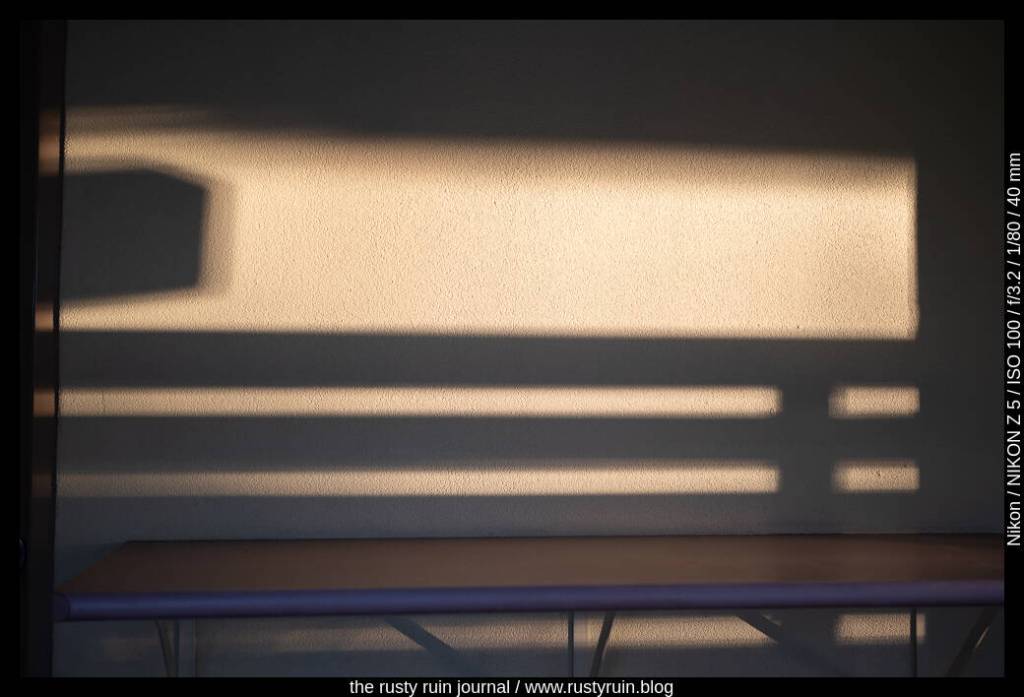
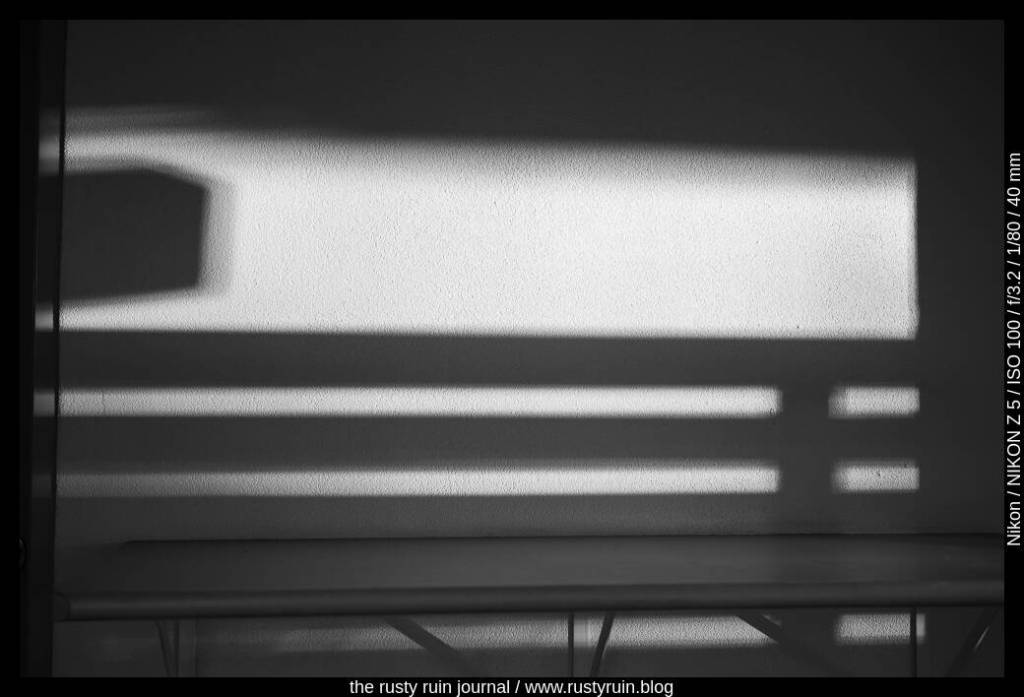
After my last post, it seems I’m in the mood for monochrome. The interplay of light and shadow – the patterns on the rough wall – the cold metal bench. This collection of quiet and ordinary things caught my eye, emotion, and imagination:
photos / thoughts / cameras / contemplation

After my last post, it seems I’m in the mood for monochrome. The interplay of light and shadow – the patterns on the rough wall – the cold metal bench. This collection of quiet and ordinary things caught my eye, emotion, and imagination:

Entering the cabin, patches of slow late sunlight catch my eye – lambent and leisurely.
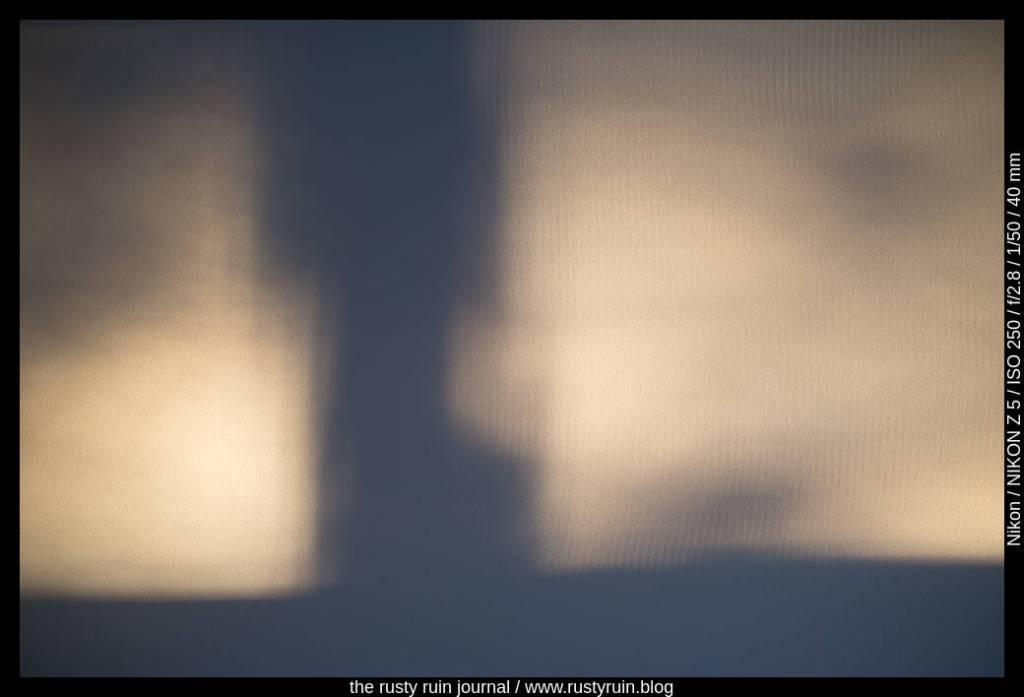
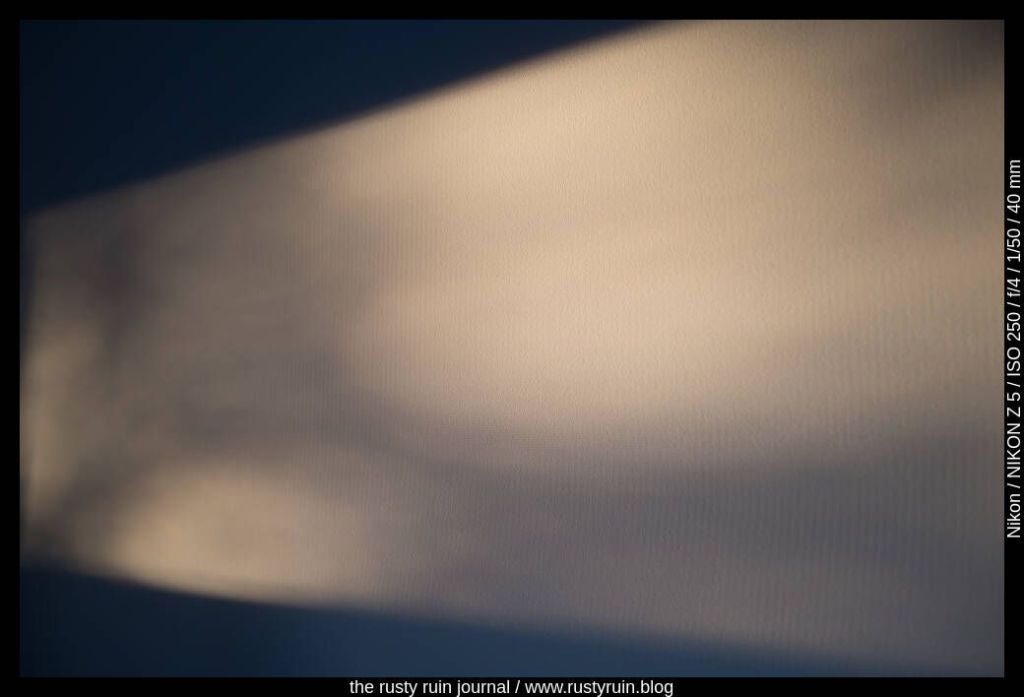
Gentle at the edges, brushing over the lightly textured wall.
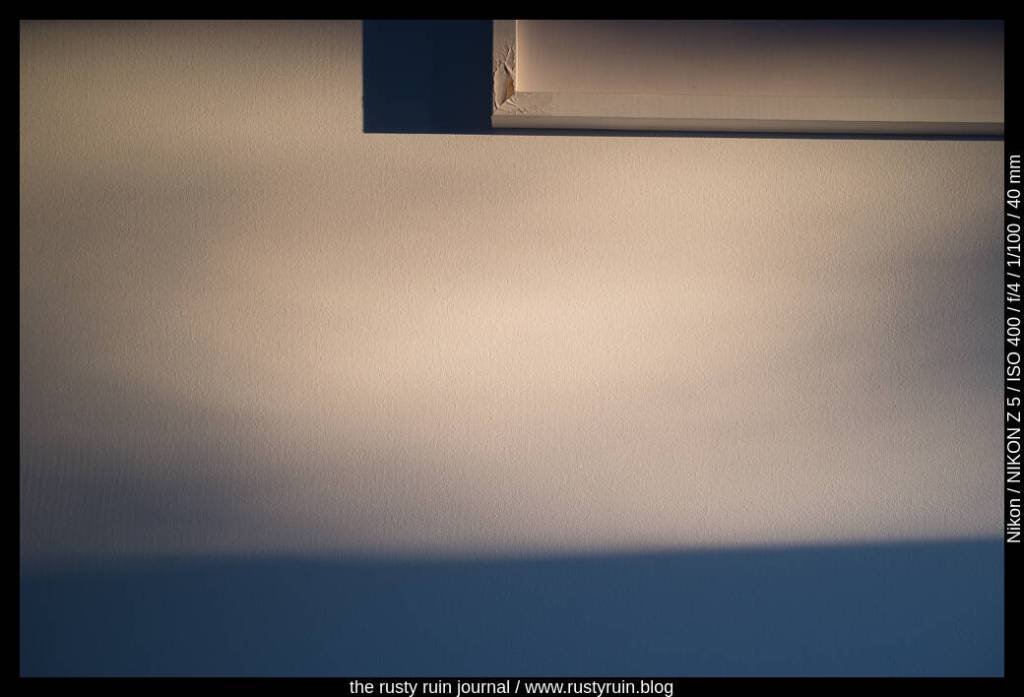
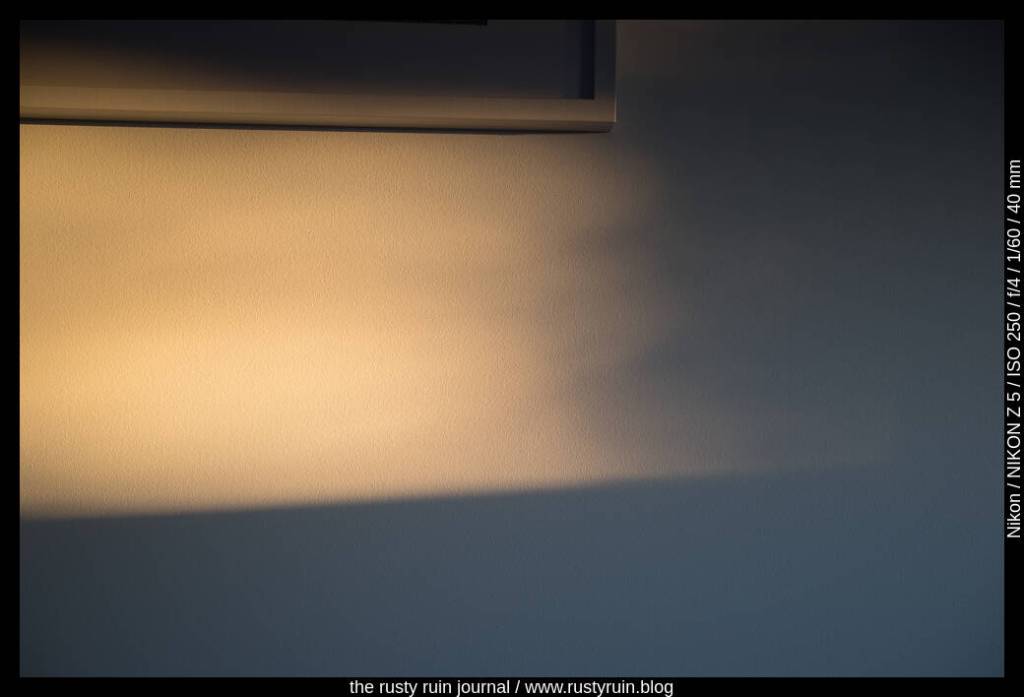
The hard angles of a cheap painting cast in soft shadow before the sun sets in deep yellow.

It seems that during prior lyrical waxings on the concepts underpinning mindful/contemplative photography and Miksang, I came to refer to it as Quiet Photography. This, without thinking for a moment that Quiet Photography might indeed be a thing out there in the world – a concept already girded by philosophies and academic essays. As it turns out, it’s a definite thing in some academic circles and is mentioned elsewhere.

For me, quiet photos don’t announce themselves. They don’t add their voice to the cascade of loud photos that speak of ego, marketing, and contrivance. They step away from noise and action. Quiet photos speak of the small things and the ordinary things. I think the best of these photos imbues the mundane subject with an imaginary life, as though revealing a mystery in a quiet place unnoticed by the noisy hubbub of humanity.

As in contemplative photography, the necessary mindset inhabits a moment fully but may be distracted easily. The play of autumn light over the surface of an old door, a wooden bench in shadow and light – ordinary things that convey the passing of time and a feeling of history, with the photographer as quiet witness.

I think contemplative photography has always appealed to me at some level. As photographers, we’re sometimes too focussed on making photos that announce our presence to others. That makes sense when looking at things through an economic or self-marketing lens. There’s a space for that, of course. But photography is about more than the next Like or Follow on the latest social media platform.

I’m not so interested in mass appeal, exposure, ego-stroking, or money. I’m certainly interested in people and ideas and connections, but the idea that I’d need to specialise and market and propel myself in front of others just feels wrong. It goes against my grain, I suppose. The foundation of my practice finds expression through wandering, seeing, imagining, and purpose in the moment. Seeing the world differently in a single moment is at the heart of photographic practice, for me.
It’s not always an easy thing to enter the mind-state of reacting instinctively to a scene. We so often judge what we see: is it a good photo? How can I make it better when editing it? How can I crop it? What camera settings should I use? When such thoughts take over, like a virus, they interrupt the flow of the moment and remove some of the joy. Is it truly important that we frame a scene so precisely that it attracts comments? Is it truly important that we even make the photo in the first place? Do we really need the camera to see the world?
On this last point: it’s true that we require no camera to experience the joy of the moment. And I think that as photographers, we’re prone to feeling as though we must capture everything and see the world through the lens. Still, the camera is integral to photography and there’s some consideration to be afforded technical settings. It’s the tension between the camera and inhabiting the world in the moment without distraction that can be the tricky tightrope for me to walk at times.


Do you ever find beauty in everyday things? Seemingly mundane stuff is part of the fabric of our daily lives, existing quietly in the background. I’ve been thinking about this a lot lately, especially on days when I feel as though I lack photographic inspiration. I can’t help but think that we’re sometimes looking for the big things as photographers, hoping they’ll catch the attention of online communities often engulfed by their own search for attention and validation. I’ve touched on that before too, of course.
Seeing everyday things in a fresh way that reveals their beauty isn’t a new idea. Contemplative photography and Miksang are approaches that emphasise an unpretentious photographic practice that’s mindful and completely present in the moment. The elevation of technical perfection is secondary to the experience of being in the world – of being aware of the moment completely and utterly. In this sense, it draws parellels to mindfulness and meditation, where inhabiting the moment non-judgementally is key.

There’s an interesting tension in this approach – maintaining a mind that’s open to details without becoming overly distracted by them.
When I inhabit the moment in photography, I pause momentarily to make a photo when a scene tugs at my attention gently enough that it doesn’t completely dislodge my middle-focus. Middle-focus occurs when attention hovers between soft and intense – when it’s non-judgemental and simply observational – when we focus on a thing without placing too much value on it or too much thought into it, and don’t allow it to draw us too close. In this state, we recognise something as being of value photographically, but our attention only skims across it – like a small boat floating lightly on clear water.
If this middle-focus state is dislodged and derailed, if the small boat sinks, the mindful journey will stop like a train pulling into the station to accept noisy passengers. This is the moment where mindfulness is thwarted and attention inhabits the distraction too fully, too intensely, and with an overburden of thought and judgement of value.

What defines this gentle pull at the edges of attention? What qualities in a scene are important? This is likely different for every photographer. For me, it’s important that such photos inhabit a space somewhere between details normally unnoticed and scenes that communicate meaning softly and quietly.

In my previous post, I wrote about driving through some of the towns along the Murray River. We’ve been here many times but I’ve often found myself uninspired in the photography department, though I’m not entirely sure why. Going for a day-trip with friends is always fun, but sometimes it doesn’t lend itself to me spending time fiddling with camera settings or framing scenes! This time was different though. I found myself with the trusty Olympus E-1 again and looking for the kinds of scenes that the old digital sensor can manage more easily.
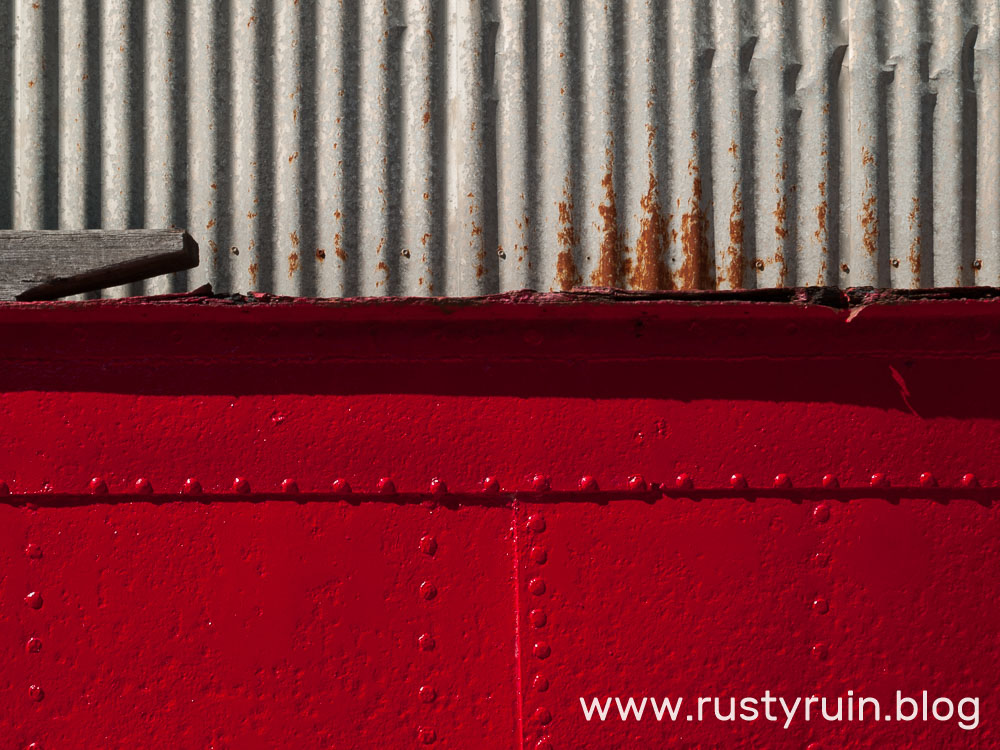
There’s no substitute for time when it comes to photography, at least for me. I’m not one who clicks a thousand photos in an hour. I prefer to be as deliberate as possible. Admittedly, using an old camera like the E-1 teaches me to slow down even more to carefully consider the scene before me. That’s a good thing, I think.

How often is it that we don’t get to slow down and really look at the world around us? How often are we pre-occupied with thoughts of the forever-gone past or the uncertain future? How often do we steal the present moment from ourselves? Once that moment is gone, it’s gone for good.
I like to think that photography has the capacity to teach us something about the hidden details of the world that are ordinarily missed. When I first started teaching myself how to use a DSLR, I turned to a practice called Contemplative Photography, or Miksang.
On such occasions, I found myself a little more in touch with both my mind and the world, with inner and outer touching at the very boundaries, one might say. At these times, there’s no judgement of a scene, just an image pressing gently on the mind, as though it leaps out of the water like a fish to be seen momentarily. There’s no setting up or messing with technology beyond what the eye sees and the press of the button. And arguably, the camera itself is not even needed to see those hidden details in the world.

 The Rusty Ruin Journal