The Fujifilm Finepix S200EXR ~ strange sensor alchemy from 2009

The Fuji Finepix S200EXR was released in 2009. It features:

  • A 12 megapixel SuperCCDEXR sensor,
  • A big optical zoom that starts at 30.5 mm and ends at 436mm (F2.8 to F5.3),
  • DSLR-like styling and external buttons,
  • A largish, by bridge camera standards, 8x6mm (1/1.6th inch) sensor,
  • And a 200 000 dot electronic viewfinder.

In many ways, it feels modern, though the speed of processing is definitely of the 2009 variety. Still, I can save in both JPG and CCD-RAW, unlike previous Fujifilm bridge cameras.

The old red lighthouse – Fuji Finepix S200 EXR

The octagonal pixels that Fujifilm packed into these old sensors might seem odd by today’s standards, but the tech produces photos said to contain extra highlight information. It’s not terribly easy to verify this, as I’m still trying to work out the weird digital alchemy that results in:

  • Strange cross-hatch image artifacts in some 12 megapixel images,
  • 12 megapixel TIFF files that can only be created from RAF files in an aging program called S7raw – built almost exclusively to read CCD-RAW files from these later Fuji cameras,
  • JPGs and RAF files that are 12 megapixels in any of the PASM modes and High Resolution EXR mode, or 6 megapixels in the Dynamic Range or Low Noise EXR modes.

It’s a lot to digest and also explains why some people describe this camera as a JPG machine ~ they clearly have better things to do with their time than mess with TIFF and RAF files. This makes it a complex camera on the inside. And as much as I like that the S200EXR offers classic Fujifilm JPG recipes – Provia, Astia, Velvia, and BW – the menu organisation also reflects the complexity of options available.

Ahoy Captain! – Finepix S200EXR

The seperate EXR option on the dial offers three special modes: 12 megapixel High Resolution photos that use all of the sensor pixels, 6 megapixel Dynamic Range photos that preserve more detail in shadows and highlights, and 6 megapixel images in the High ISO Low Noise mode. Weirdly, the regular PASM functions don’t offer any of the three EXR special modes and create regular 12 megapixel photos that use a different kind of dynamic range preservation technology.

Rails and pipes – Fuji Finepix S200 EXR – plenty of detail in the shadows, even in this 6 megapixel image

I’ve found that importing the RAF files into Lightroom is the most convenient option in all cases. The imported 6 megapixel images from RAF files recorded in two of the EXR modes seem to be the darker of two exposures – or at least the darkest part of whatever data lives in the mystical RAF files. It seems likely that Lightroom is throwing away some of the data from the smaller octagonal pixels that preserve extra highlight information. A RAF file recorded in any of the PASM modes results in a 12 megapixel image, and Lightroom imports them just fine – this is my preference going forward.

Balls balls balls – Fujifilm Finepix S200EXR

It seems that the EXR line of cameras represented the pinnacle of Fujifilm’s longstanding SuperCCD sensor technology. Not too long after these premium bridge cameras and their strange alchemical sensors, the company moved to CMOS and their X-Trans technology. Despite the complexities of the camera, I find the images very pleasant.

Behind the plywood wall

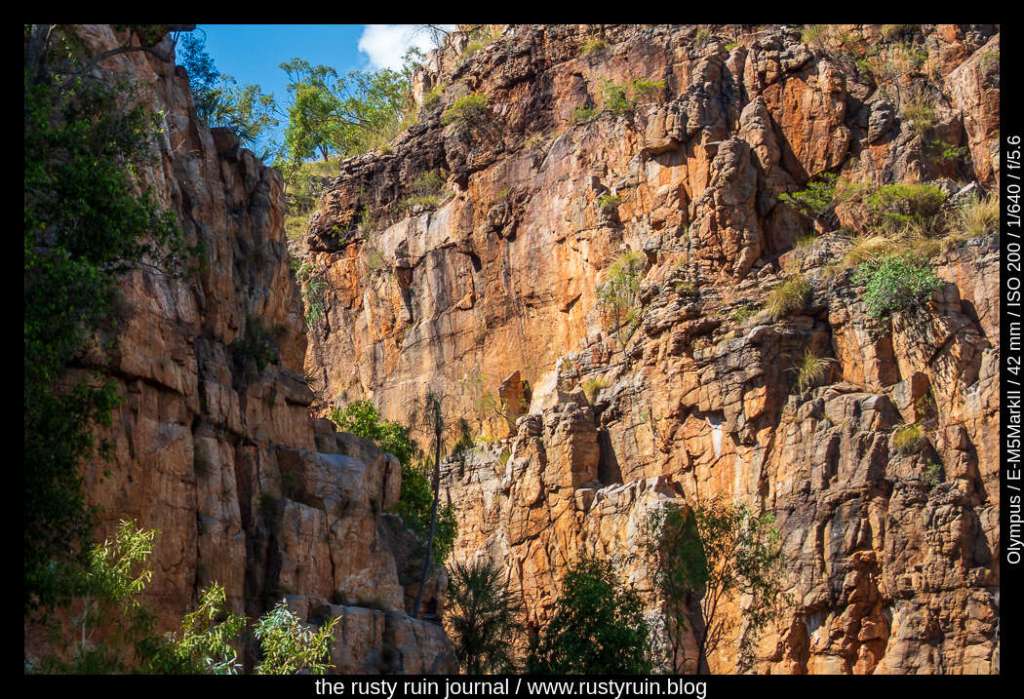
Nitmiluk National Park ~ awe-inspiring gorges, a kit lens, and harsh light

To the local Jawoyn people, the amazing gorges in Nitmiluk National Park (Katherine Gorge) hold special significance. We were fortunate enough to book a short cruise to see some of the many wondrous gorges in the area and view the ancient sandstone rock formations, calm waters, and freshwater crocodiles. This is an area teeming with life and Dreamtime stories.

Nitmiluk National Park, one of the gorges – Olympus OMD EM5 Mark 2 and 14-42 kit lens

Sunlight at the height of the Australian afternoon can be harsh. This is one reason I prefer viewfinders rather than the big LCD screens on so many cameras that get washed out in these conditions. 

The soft golden light of dawn or dusk brings out the best colours in the outback landscape, but trip timing doesn’t always permit, and you have to work with the tools you have and the light available when the opportunity arises. One quality this strong afternoon light does emphasise: all the textures on the ancient sandstone.

On the day, I packed lightly since I’d been lugging a not insignificant amount of camera gear around on other days (hello Lowepro Nova 200). The Olympus EM5 provides good image quality and lots of control in a small package. It’s just a small pity I’d also decided to take the 14-42 kit lens with me. That’s not to say that kit lenses are bad at all. Nikon makes some great kit lenses, such as the 18-55mm. And this Olympus Zuiko kit lens is no slouch in the image quality stakes – it does pretty well for a cheapish plastic lens. But at times when I want more sharpness to record all of the landscape’s details, it gets a bit fluffy and squishy at the edges of the frame. Still, you work with what you have and the conditions of the day.

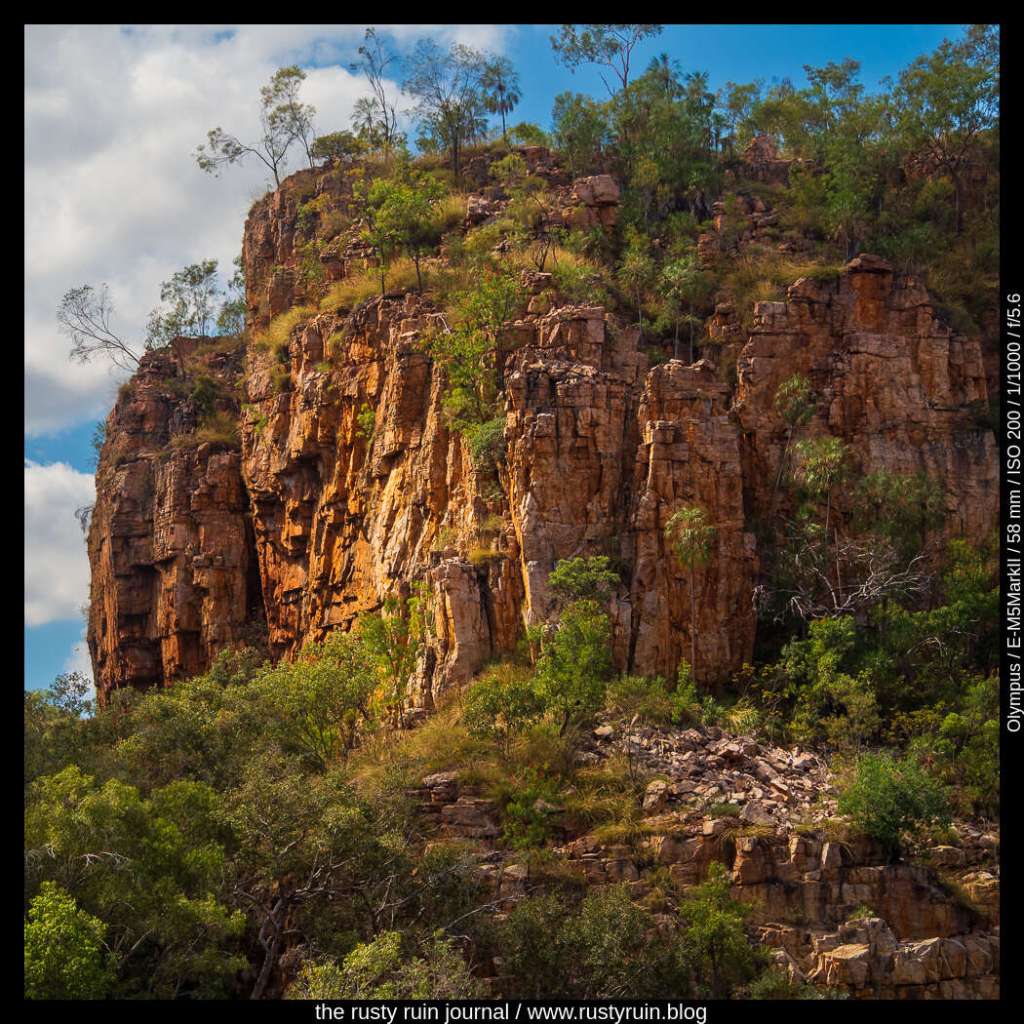
Nitmiluk National Park – Olympus OMD EM5 Mark 2

I’ll always say that eye-watering sharpness is generally overrated in photography, but there are times when sharpness is another tool you want in order to communicate certain qualities – the texture of the rocks in this case. Despite some of the shortcomings of my kit lens, careful subject selection, use of exposure compensation to retain as much detail as possible in high dynamic range scenes, and some boost to the red/orange/yellow colour channels during editing helps to make the photos shine. I also reduced highlights to reveal the details of the ancient sandstone.

A patch of sunlight illuminates ancient rock – Olympus OMD EM5 Mark 2 and Zuiko 40-150mm lens

As the clouds grew heavy, the light conditions became a little more forgiving. As you can see in the above photo, clearing clouds also provided an opportunity to record sunlight as it illuminated sections of rock. I used the so-called plastic fantastic 40-150mm Olympus Zuiko lens for this photo – small, light, and really quite sharp at most focal lengths. I guess the message is to know your camera gear and accept and make best use of your tools and the conditions. I’ll freely admit to not knowing all of my gear well enough at times!

Botanicals and the Biophilia Hypothesis – Sony RX100

In my current, seemingly endless and potentially dull, blogging about the little Sony RX100 Mark 1 camera, I’ve realised that I really enjoy using old cameras. Not exclusively old cameras, mind, but just older cameras when the mood strikes. The very idea that I’d upgrade as soon as the latest fancy-glitter-megapixel thing hits the shelves is tedious. The whole thing is exhausting, really. It’s also why I’m excited to receive an old Nikon D70 in the post.

The sunny edges we miss

There’s some science behind the nurturing properties of spending time in nature, with reports that subjective well-being is elevated, even for people with depression and anxiety. Many people report feeling recharged when they spend time in nature, be it walking through the local forest or walking along the beach. The Biophilia Hypothesis posits that humans are innately attracted to natural places and living areas filled with biodiversity. By seeking out this connection, we truly get back to who we are as living beings.

A world of green

Have you ever wondered why stress levels are so high in urban environments? The further away we are from nature and our natural selves, the greater our risk of developing a wide range of physical and mental health problems. Even something as simple as exposure to natural light each day can promote better sleep and improved subjective well-being. And the addition of green spaces to urban areas is linked with lower levels of stress.

Bamboo in the sun

We all need connection

What would it be like to see our planet from the deep cold of space? Some astronauts report their lives being significantly changed and their views transformed after seeing earth from this unique angle. The Overview Effect is a transformative state of mind that affects some astronauts. They report that after viewing our planet suspended in the depths of space, they develop not just a new appreciation for beauty, but a deep connection to all life.

Our small blue planet, from this point of view, is incredibly fragile and special – an oasis in a cold, black vacuum. There may indeed be billions of planetary star systems out there, but we’ll likely never reach them as even the closest is impossibly distant, and beyond the reach of the best rocket science, unless there’s a sudden shift in our understanding of time and space. So, rather than pollute the sea and soil beneath our feet, we should imagine our planet as a tiny blue speck, teeming with life, finite and fragile.