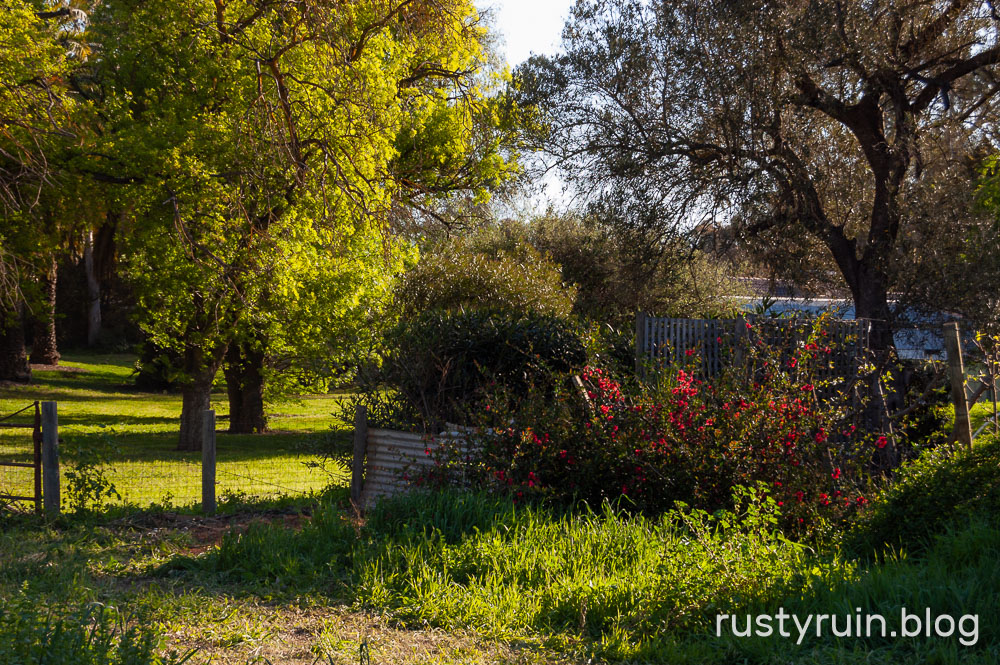
Revisiting a ruin at sunset and dealing with angry people

I was a little way up the dusty side-road with my Nikon Z5 and Nikon D40 when a big white 4-wheel drive roared past me and stopped next to our car, dust kicking up from the wheels. I knew it was a bad sign. I’d been here before. A few moments later, the car belted away down the dirt and turned onto the bitumen. Everything was quiet again and I gazed in the direction of the setting sun, hoping we’d be left alone long enough to make some more photos in the best light of the day.

Covered in old vines – Nikon Z5

I went back to work with the Z5, dialling back the exposure to preserve the highlights and waiting eagerly for the golden light to bathe the dusty corner we’d chosen for some evening photos. The quiet didn’t last very long…

Another big vehicle pulled up next to the ruined building we’d been training our lenses upon. I packed up my gear and started to walk back up the road to my buddy, suspecting he’d have to deal with a mouthful of abuse from the locals. I wasn’t wrong.

“What the FUCK do you think you’re doing???!”

I get it. There we are on a normally quiet road and we’re loitering outside his property. I made it there just in time for the tirade. My mate was very calm in the face of it, de-escalaing the situation and rightly pointing out we weren’t trespassing on his property and had no intention of entering or wrecking anything. Some minutes of back and forth and the property owner was still gruff but calm enough to take some mouthfuls of beer from the bottle he was swinging about.

Collapsing shed – Nikon D40 and Nikkor 35mm 1.8 lens

I contributed the odd word or two, reinforcing the argument that we were innocently making photos in great light and staying outside the fence-line.

“Yeah…I s’pose that’s OK if you’re into photography…”

Clearly his own mate was just there for moral support, as he’d said not a word the whole time. The golden light was fast fading and we were still locked in heated discussion about kids stealing copper from the old house and cutting the barbed wire fencing. The anger’s understandable, of course.

“Next time, ask me for permission! I’m just up the road, there.”

The problem with so many of these ruined places is that you just don’t know where the landowners are. Properties beyond urban areas can be big and it’s not always obvious who owns what. So, we stick to the public areas – the pathways and the roads, usually. Legally, you can make a photo of just about anything if you’re in a public space and you can see the subject from that public space. Permission isn’t required unless you’re planning to enter the property. I’ve never needed to say any of this to an angry onlooker or property owner, mostly because it doesn’t result in calm conversations.

A sea of cactus – Nikon D40

Finally, we made our peace and drove off. We’d missed the best light of the day. It would have been amazing too – pink clouds and soft golden highlights bathing all the dusty old corners and abandoned places.

Camera settings, mistakes, and cognitive load

When I decided to dive headfirst into photography as a hobby, I was anxious about the technical jargon and understanding the myriad camera settings. The good news is that it wasn’t all that bad. I read and watched and learned a lot through trial and error.

Owning up to failure is always important. Being able to move on from a mistake to the next moment is even more important for continued growth in any field. I’ll tell you something, honestly: I still make plenty of mistakes!

Falling down – Nikon D40 and Nikkor 35mm 1.8 DX lens

Here are some of the most common photographic errors I continue to make:

  • Not resetting important camera settings: All too often, I’ve forgotten to change ISO when entering different light situations, or I’ve missed resetting exposure compensation.
  • The camera mis-pack: I’ve packed not enough when I needed extra gear and packed too much gear when I should have packed less.
  • SD card woes: Yes, I’ve filled up an SD card and forgotten to pack a backup. The only solution is to go through the recorded files and be brutal about deletion decisions.
  • ISO stubborn: Have you ever been stubborn about pushing your ISO in poor light situations? Base ISO is optimal for less digital noise in a photo, but a blurry photo just isn’t worth the stubborn refusal to UP the ISO a bit more to force a faster shutter speed! It’s better to have a noisy photo over a blurry one. Digital noise can be dealt with far more easily now using software tools. I can’t even tell you how many times I’ve stubbornly refused to move from base ISO in fast-fading light, standing there with my arms tucked and not breathing just to cut as much movement as possible to achieve perfection at a too-slow shutter speed in hopes of a sharp image.
  • Reverse dialling: Older Nikon bodies dial positive and negative exposure compensation values in reverse to other cameras, so when my muscle memory becomes accustomed to the opposite dial movement of another camera, I find myself cursing the over or under-exposed photo on an old Nikon camera. At worst, I just forget the reverse dial motion completely until I’ve long moved on from the scene, at which point I sigh. Thankfully, the new Z-mount Nikons have changed both the exposure value dial direction and the reverse F-mount lens twist they had going for decades.
The old green gate of J. Martin & Co. – Nikon D40

I’ve been tough on myself in times past when it comes to making photographic mistakes. I think part of that was not feeling comfortable with the equipment and not believing I could learn enough to make good photos. In fairness, I still make plenty of stinky photos, but every poor photo teaches me something new, even if it’s a lesson I thought I’d already learned.

We can always improve our photography, but learning and living isn’t some easy linear path. It’s full of twists and turns and ups and downs. There are rocks of many different sizes littering the paths we walk. One of the hardest things to develop is self-compassion. We’re often kinder to strangers than we are to ourselves. But, why? We’re just as fragile and just as prone to mistakes as anyone else. All that truly matters is that we experience and inhabit the moment meaningfully, in whatever mode we choose: Auto, Program, Aperture Priority, Shutter Priority, or Manual.

Have I become a Nikon fan, unwittingly?

When I look in the cupboard, I see lots of cameras and lenses – some would say, rather too many! Plenty of my film cameras are still piled up in boxes, so they barely add to the shelved pile. Poring over my digital cameras and lenses specifically, I see a growing number of Nikon branded things. I wonder if I’ve become brand loyal? I’d certainly not describe myself as a person overly concerned with brands!

Coober Pedy – Nikon Z5

Identifying with brands

There are lots of people who adore certain brands. By identifying with a brand, we express something of who we are. We recognise some characteristics in the brand that strike a chord within us. We announce to the world: “This brand expresses who I am or who I want to be!”. Perhaps the brand expresses qualities we aspire to demonstrate in our own lives? Perhaps it reinforces a self-perception that we’d like others to notice? Brands are symbols that can be important to our identities, and the most successful brands resonante more strongly with larger numbers of people.

You could say that brand Nikon is doing something right after being so long in operation. The Nikon Corporation has been around since 1917 and has become a household name in that time. They know how to make great cameras, but that’s not to say that Canon or Sony don’t also make great cameras. They certainly do! And they have their own branding and marketing. Truthfully, I’ve often felt that Nikon have been pretty terrible at marketing their gear. It’s great engineering, but companies like Canon and Sony often seem to have had more attractive marketing campaigns over the years.

So, I guess I’m wondering why I open up my cupboard and see a growing bunch of Nikon cameras staring back at me – what does it say about me? Am I now a brand fan?

Through the pass – Nikon D70

How I got started

The truth is that I never thought I’d be much good with a big pro-looking camera. I was convinced that small and simple cameras would be my fate, seeming to fit better with my self-perception of not being very technically minded.

Despite this, I decided some years ago to push my limits, so I purchased a Nikon D5100 in hopes of finding a way to express myself more creatively. It was either the Nikon or the equivalent Canon, but the D5100 just seemed to have some better tech-stuff inside – a marginally bigger APSC sensor, a well-regarded sensor also featured in the D7000, and the fact that I could use so many F Mount lenses. For about the same price as the Canon, it seemed to be a slightly better camera.

Waiting after a tiring day – Nikon D5100 with Nikkor 55-200mm DX

I wasn’t at all disappointed with the D5100. On the day I received it, I set about educating myself on how to use a DSLR. I’ll be honest – it was a bit intimidating. It was a very different and more complex camera than I was used to. After reading a lot and watching a lot of how-to and exposure triangle videos, I went out and did some night photography. I can highly recommend this practice if you want to learn about the importance of light in photography. You very quickly learn that light is everything when you’re running around at night with a cheap tripod and a shutter remote that only works half of the time!

For the Nikonians and other interested parties

I don’t have the D5100 anymore, but I do have a growing bunch of Nikons that many Nikonians would be familiar with:

  • Nikon D40 – It’s an old and small DSLR from Nikon, featuring a 6.1 megapixel CCD sensor. I’ve written more about it here. Paired with Nikon’s older kit kens – the Nikkor 18-55mm – it’s a great lightweight camera.
  • Nikon D70 – My copy is a bit on the used side, but it still makes great photos with the CCD sensor. Some say it has a definite cool bias, but that can be perfect for many types of scenes.
  • Nikon D7100 – This was my workhorse Nikon DSLR for a long time. I upgraded to it at a good price after selling the D5100 and what a difference it felt like upon opening the box! Unlike the D5100, it has more external controls and solid ergonomics that don’t feel plastic. It feels like a professional camera when contrasted to the D5100 !
  • Nikon Z5 – After a long time, Nikon finally entered the mirrorless game. The Z5 is every bit a modern mirrorless camera for a good price, considering the 35mm digital sensor. After using my mirrorless Olympus OMD EM5 cameras for so long, this feels both familiar and a huge upgrade in capability. As much as I trust my D7100, the Z5 is my new workhorse.
  • Nikon D200 – Released in 2005, the D200 features a well-regarded Sony-made CCD digital sensor. I regard it as one of the best early DSLRs from Nikon, as the camera market was shifting from film to digital.

I know that my Nikons aren’t exactly heavy enough to bow the shelving. It just feels like they outnumber my other cameras by a long way! Maybe it’s because I use them a lot, so I feel like I’m a brand loyal Nikonian? I’ve used my share of small junk cameras over the years, so it’s nice to pick up a big-name camera that just works when I want it to. I’ve had a few cameras die on me now – I’m looking at you, Sigma DP1 and Sigma DP2M ! I still don’t think I’m a brand loyalist, but I do like my Nikons.

Flowers, trees, and Chihuly

In my previous post, I didn’t have a lot to say, other than to talk about the sculptures of Dale Chihuly. Turns out, I still don’t have a lot to say, so I’ll let the sculptures speak for themselves. Sometimes, we need the contemplative therapy that photography can provide.

Float Boat and Niijima Floats by Dale Chihuly, 2012 – 2019 – Nikon D40

How shiny are those polyvitro baubles? Even on a cloudy day those colours really pop. By now, I’ve resigned myself to the idea that old CCD cameras like the Nikon D40 just seem tuned to produce punchy and colourful photos, even when set to RAW.

Magenta Flowers – Nikon D40

As lovely as the sculptures are, the gardens are full of opportune moments for one with a camera. Luckily, the flowers were in bloom.

The Sun by Dale Chihuly, 2014 – Nikon D40

The Sun really exemplifies Chihuly’s installation – an explosion of powerful colours spreading dynamically in all directions.

The original sculpture, green in all directions – Nikon D40

Some street photos with the perfectly excellent Nikon D40

Having been very connected to my Olympus E-1 lately, I decided it was high time to take out another old digital camera in the Nikon D40. I don’t always get the chance to engage in street photography but when I do it can be a lot of fun. It does require a different approach though – being on the look-out for likely scenes and waiting for the right moment. The D40 isn’t exactly a classic street machine but it’s also small enough not to be much of a bother unless a big lens is attached, like the Tamron 17-50 2.8 I decided to go with!

Reaching for the stars – Nikon D40, ISO 200, F 2.8

I find that the D40 makes really nice photos, but the CCD sensor technology isn’t so great when you have to pull details out of heavy shadows during editing. The RAW files are flexible enough, but the heavy shadow areas can be a bit thin. These older sensors also aren’t so great at retaining highlights either, so you have to make the choice – expose for shadows or highlights when the lighting creates dynamic range that’s outside of the scope of the camera. This is similar to slide film.

Framed by yellow – Nikon D40

Even though there’s noise in shadow areas when you pull up the exposure during editing, the digital noise pattern isn’t objectionable. This is one area where CCD sensors had a clear advantage over their CMOS counterparts at the time – lower noise and a finer noise pattern. We seem to have come a long way since those early digital days, but cameras like the D40 still make perfectly excellent photos! How far have we really come, one might wonder?

Free hugs – Nikon D40

There’s also another nice advantage to using an old camera like this – 6 megapixels pairs really well even with a kit lens that doesn’t see a lot of love. The old 18-55mm Nikkor kit lens is much maligned but is nicely sharp on an old camera like this, since it out-resolves the 6 megapixel sensor. My Tamron looks even better and seems to pick up plenty of primary colours wide open. Still a perfectly excellent camera.

The Nikon D40 – a perfectly small classic

In the days between film and the mainstream take-up of digital, traditional companies like Nikon were doing what they could to persuade people to finally make the jump to Digital SLRs. We’re now a long way from the days of the Nikon D40 – featuring 6.1 megapixels and an APS-C sized sensor – but it can still surprise with excellent image making. And after going out with a number of Finepix cameras recently, the D40 feels fantastically Nikonian, which is to say that the ergonomics are comfortable and familiar.

Dodge and polished chrome – Nikon D40

Note the lovely reds of the car body and the blue of the chrome preserved in the above photo. Plenty of detail with this old sensor too. I was using the 18-55mm 3.5-5.6 Nikkor kit lens, version 1. Plastic feel for sure, but decent optics, especially for a 6.1 megapixel sensor, where any shortcomings of the glass aren’t a deal-breaker. It turns out that the shutter mechanism isn’t faulty at all, as I thought last week, just my inability to note that the Exposure Compensation goes in reverse on these Nikons! That’s some good news at least, and rather makes up for the Finepix 602z I recently purchased, with a bent CF pin and non-working EVF. At least it was cheap!

Garden of colour – Nikon D40

I was fortunate to have some great sunlight late in the day. These old CCD cameras definitely love the light, and I’m looking forward to also receiving my Olympus E1, even if it does have some usability issues. I’d heard a lot about the colour of the D40 and it doesn’t disappoint in this kind of light. I won’t say there’s something magical about CCD colour, like others do, but these photos do make you wonder whether image making has really advanced as much as we’re told?

As the leaves catch last light – Nikon D40

My Nikon D40 settings: JPG Fine, base ISO of 200, Exposure Compensation often set to -0.3 or -0.7, and Vivid picture mode. There’s barely any noise at 200 ISO and reputation has it that noise is not much of an issue up to 800 anyway. Old forums also suggest that the D40 has a tendency to overexpose, so I did often dial in a touch of negative Exposure Compensation just to preserve highlights.

The above photo was one that I made in Nikon’s native NEF Raw format. The Raw files from the D40 definitely have more latitude than the JPGs and it’s easier to tame highlights and shadows, but there’s certainly less editing potential in these files compared to the NEF files from modern Nikons. Nevertheless, the photo is pleasant, and working with NEF does provide the option to use a different White Balance setting and fine tune any sharpening.

The D40 was one of Nikon’s most popular early consumer cameras and I can understand why. I like that it’s so small and fits easily in a smallish camera bag. I’ll have to seek out the G version of the 50mm 1.8 lens for it, as the D version requires a screw drive motor, and the D40 lacks this feature. Really, the D40 proves that picture quality wasn’t a problem for digital cameras even in 2006.

Another cloudy day and another Finepix camera in hand

In a previous post, I rushed out with the Fuji Finepix 6500fd and was impressed by the camera’s ability to hold onto detail. Fast-forward to a cloudy Sunday and a last-minute invitation from family friends, and once more, the Finepix 6500fd is in my hands. It has the feel of a mini-DSLR and the manual zoom, unlike most other Finepix cameras from the 2000s era, really adds to this feeling.

Pink scrawls – Finepix 6500fd

At this point, I’m trusting the Automatic White Balance of the 6500 because it does an admirable job, even on a really cloudy day. At some point, there’ll be some sun, I hope! As you can see in the above image, out of cameras JPGs are nice and colourful. Of course, I have it set to JPG Fine, ISO 100, and the Fujichrome picture setting so that there’s more saturation of certain colours and extra contrast. I’ve yet to use the F-Standard setting.

Roadside groceries – Finepix 6500fd

Like most older digital cameras, it’s not great when it comes to preserving strong light and shadow areas. There’s a bit of a focus on preserving highlight and shadow detail in modern photos, but it really depends on the subject and the type of photo it is. Is there anything you really want to preserve in the highlights/shadows? Do strong highlight and shadow areas add punch and drama to your photo? These are really the questions that should be asked, and not just an assumption that these areas need detail all the time. In many cases, clipped highlights and blocked out shadows don’t matter and add visual interest.

Bees and butterflies – Finepix 6500fd

I did also take out my Nikon D40 but I ended up bagging it because it seemed to be overexposing. As it happens, I think it was my error entirely. I’ll take it out again and check to see if it’s a mechanical issue with the shutter speeds or just me being completely stupid.

The cactus takes over – Finepix 6500fd

Because I set the Finepix to Soft sharpening levels, all of the JPGs benefit from some light extra sharpening in Lightroom. Using both Texture and Clarity in small amounts also brings the best out of this camera. I’d go so far as to say that the lens on the Finepix 6500fd is superb for the time, and it wrings the most out of the sensor to the point that a higher resolution sensor would likely be a better fit for the lens.

First photos with the Nikon Z5

Moving to a 35mm digital camera requires some adjustment, especially if you’ve been using crop sensor cameras for a long time, as I have. I’ve mentioned these challenges recently, and the specific issue around choosing the right aperture for a depth of field that’s equivalent to what I’d get on a small sensor camera.

Not habitable – Nikon Z5, F8, ISO 100, 24mm

I purchased the Z5 with a well-regarded Z-mount lens: 24 – 70mm F4 S. The S designation that Nikon put on this lens means that it’s above average in performance – or Superior. Perhaps not one of the Pro quality lenses, but definitely exceeding kit lens quality. I also like the constant F4 aperture and the weather-sealing. Not that I’m often out in the rain, but it’s definitely useful when the clouds threaten.

Machines we once used – Nikon Z5

I’ve no issue at all with the sharpness, but the left corner seems to be mushier than the other corners, as though one of the elements is slightly out of position. It seems to happen mostly when at 24mm and possibly at other focal lengths. Not a deal-breaker (not that I could return it anyway), but certainly irritating at times. I keep this in mind when I pull it out and will opt for the 40mm F2 instead if I don’t need the extra width, as that lens is even sharper.

Moving to mirrorless was a wise move for Nikon. I’m not loyal to the brand, but I’ve had a D5100 previously, and still have a D70, a D40, a D3100, a D7100, and the Nikon Z5 in the house, so they must be doing something I like. The Z5 is definitely a fantastic camera to handle and use, as I’ve found with all Nikons. I just need to break some old habits.