A few nights ago, I was parked on a busy main road near the city, scoffing a greasy burger and fries and washing it all down with a lukewarm decaf. I needed to fill several hours while I waited for the Katy Perry concert to finish so I could ferry home a car full of tired and content family members. I’d packed my Nikon Z5 so I could take a walk in the cold and make some photos. Opportunities to wander unfamiliar neighbourhoods don’t present themselves too often, so it was a great opportunity to challenge my eye.
Rainbow rotunda – Nikon Z5 and Nikkor 40mm F2 lens at 5000 ISO
When I use my older Nikon DSLRs, I temporarily forget how technically capable the Nikon Z5 is. Nikon were slow to enter the mirrorless market after a false start with the petite CX system, but their Z cameras are high quality devices that are a joy to use. I’m often amazed at how clean the Nikon Z5’s photos can be. The Z lenses have a reputation for being very sharp, with the Nikkor 40mm F2 being a good example.
Behind the shops
Photos made at night are often challenging to edit because the quality of light is so different to photos made during daylight hours. Where we might raise shadows to reveal more detail during the editing process for a day-time photo, it usually makes more sense to obscure the details in dark areas of a night-time photo where the absence of light defines the image.
In the photo above, the inky shadows obscuring the ground and part of the fence define areas of the image that are illuminated. Brightening the shadows not only weakens the impact of the photo but also makes little sense when part of the goal is to communicate the quality and feel of the night hours – the difference between light and shadow, the quality of artificial light running across metal and brick, and the darkness of the hour. If the versimilitude of the photo is important, as it is in this case, it’s as important to communicate the quality of absent light as it is to communicate how and where light falls.
I was a little way up the dusty side-road with my Nikon Z5 and Nikon D40 when a big white 4-wheel drive roared past me and stopped next to our car, dust kicking up from the wheels. I knew it was a bad sign. I’d been here before. A few moments later, the car belted away down the dirt and turned onto the bitumen. Everything was quiet again and I gazed in the direction of the setting sun, hoping we’d be left alone long enough to make some more photos in the best light of the day.
Covered in old vines – Nikon Z5
I went back to work with the Z5, dialling back the exposure to preserve the highlights and waiting eagerly for the golden light to bathe the dusty corner we’d chosen for some evening photos. The quiet didn’t last very long…
Another big vehicle pulled up next to the ruined building we’d been training our lenses upon. I packed up my gear and started to walk back up the road to my buddy, suspecting he’d have to deal with a mouthful of abuse from the locals. I wasn’t wrong.
“What the FUCK do you think you’re doing???!”
I get it. There we are on a normally quiet road and we’re loitering outside his property. I made it there just in time for the tirade. My mate was very calm in the face of it, de-escalaing the situation and rightly pointing out we weren’t trespassing on his property and had no intention of entering or wrecking anything. Some minutes of back and forth and the property owner was still gruff but calm enough to take some mouthfuls of beer from the bottle he was swinging about.
Collapsing shed – Nikon D40 and Nikkor 35mm 1.8 lens
I contributed the odd word or two, reinforcing the argument that we were innocently making photos in great light and staying outside the fence-line.
“Yeah…I s’pose that’s OK if you’re into photography…”
Clearly his own mate was just there for moral support, as he’d said not a word the whole time. The golden light was fast fading and we were still locked in heated discussion about kids stealing copper from the old house and cutting the barbed wire fencing. The anger’s understandable, of course.
“Next time, ask me for permission! I’m just up the road, there.”
The problem with so many of these ruined places is that you just don’t know where the landowners are. Properties beyond urban areas can be big and it’s not always obvious who owns what. So, we stick to the public areas – the pathways and the roads, usually. Legally, you can make a photo of just about anything if you’re in a public space and you can see the subject from that public space. Permission isn’t required unless you’re planning to enter the property. I’ve never needed to say any of this to an angry onlooker or property owner, mostly because it doesn’t result in calm conversations.
A sea of cactus – Nikon D40
Finally, we made our peace and drove off. We’d missed the best light of the day. It would have been amazing too – pink clouds and soft golden highlights bathing all the dusty old corners and abandoned places.
We looked up at the huge rocky dome, in awe of the ancient geological processes that had created it. Over 500 million years ago, before dinosaurs wandered the lands around the ancient sea that would one day become a national park and tourist attraction,Uluru and Kata Tjuta started to form. At such times, you realize the scale of the world around you and feel very small indeed.
Looking back in time: Uluru – Nikon Z5 with Nikkor 40mm F2 lens and Circular Polariser
Doing the 10km base walk is the best way to appreciate the vastness of Uluru. We were already exhausted from our 8km hike through Kata Tjuta the day before – those rocky slopes and winding pathways can be unforgiving on cheap hiking shoes! I once climbed Uluru in about 45 minutes, back when it was commonly known as Ayers Rock. No-one is permitted to climb it now, but you can still see the old climber’s entrance and the worn path that millions of tourists braved over the years.
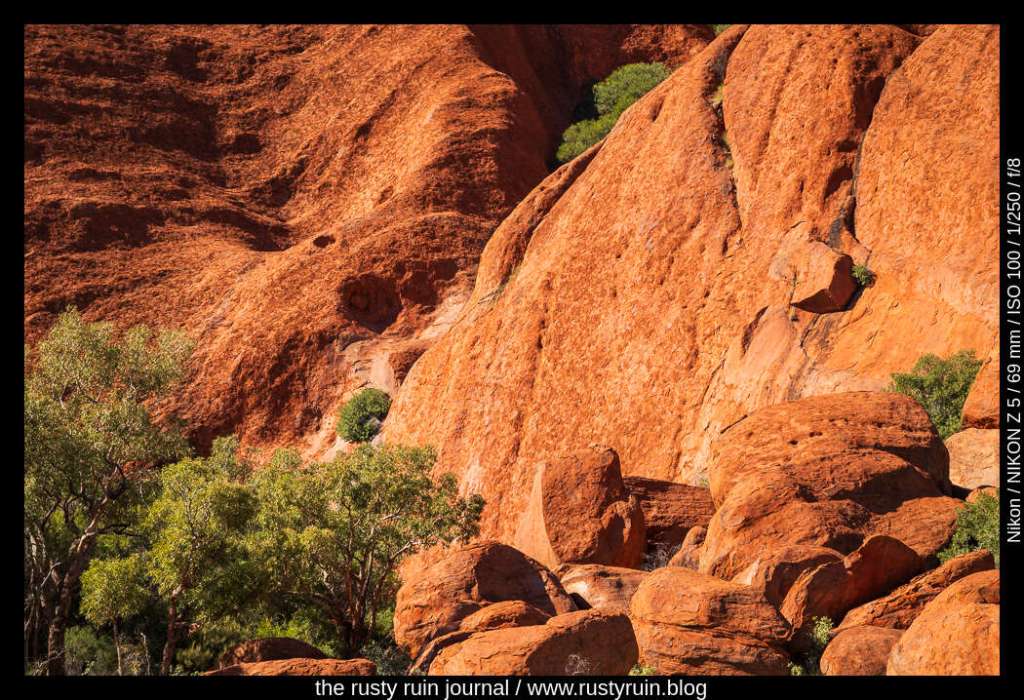
From a distance, Uluru looks like it has quite a uniform surface, but up close is where you get to see the details – weathered sections of grey stone, streaks of white, dark caves that seem to make recognisable patterns, and the iconic red rock that signals high iron content. Both Uluru and Kata Tjuta were formed over millions of years as the soft parts of the Petermann Ranges were eroded, leaving only the boulders and rocks.
Uluru up close – Nikon Z5
Uluru takes on different colours, depending on the time of day and season. It can be bright orange at sunset one moment and then pink with purple and blue shadows the next. I posted a sunset picture in another post, though it was a rushed pull-over to the side of the road and the local police weren’t too happy we’d parked in a no-park area as they beeped us on a drive-by! You take your chances when you have a camera in-hand. There are some designated photo spots in the area for tourists, but they can be quite busy, and I’m not always best pleased to make photos that everyone else does.
The red bones of ancient Australia – Nikon Z5
I was more prudent in my use of the circular polariser on this trip. Hiking around the base of Uluru, I was mindful of the location of the sun. The polarising effect is strongest when the sun is at a 90-degree angle to where you’re pointing the camera – so either on your left or your right. I dial it up so that the effect is strongest, and then dial it back a bit to add more natural stray light reflections back into the scene.
A polariser is fantastic for cutting out stray reflections on foliage and rocks and for deepening colours, but it can also make a scene look flat and darken clear Australian skies to the point of ultra-violet. It’s important not only to be mindful of where the sun is but also whether a polarised photo is what you want. Great for foliage and cutting out reflections on water, but not so useful when you want to preserve all the golden colours of a sunset. It’s also not useful in shady areas, so there was a whole section of the base-walk where I put it away.
Uluru detail: weathering and streaks – Nikon Z5
I’ve often thought of Uluru as the rocky heart of Australia, located not too far from Alice Springs. Amazingly, this monolith extends up to 6 km underground, so it’s much like a rocky iceberg. Absolutely worth visiting if you’re ever in a position to do so.
West MacDonnell Ranges aglow 1 – Nikon Z5 and Nikkor 40mm F2 lens
Upon driving back to Alice Springs after a long day on the road, the sun hit the ancient earth just right, and we pulled the car over to a patch of gravel. Like a long red serpent from The Dreamtime, stretching across the land, the rocky ridges were awash in the sun’s eventide glow. The photos here really don’t do it justice. How can one encapsulate over a thousand million years of geological history? It’s a land that feels as old as Time itself.
West MacDonnell Ranges aglow 2 – Nikon Z5 and Nikkor 40mm F2 lens
In a rush to exit the car, switch on the Nikon, and frame the scene before the light faded, I was amused by my scurrying about in the shadow of those ancient red rocky giants of earth. How many people had done the very same thing – catch the red glow of sunset across the hard-edged boulders, crags, and rocky outcrops? Many millions of sunsets across that land and there I was, one small thing in the vastness, fiddling with my camera, hoping to stop time.
When I look in the cupboard, I see lots of cameras and lenses – some would say, rather too many! Plenty of my film cameras are still piled up in boxes, so they barely add to the shelved pile. Poring over my digital cameras and lenses specifically, I see a growing number of Nikon branded things. I wonder if I’ve become brand loyal? I’d certainly not describe myself as a person overly concerned with brands!
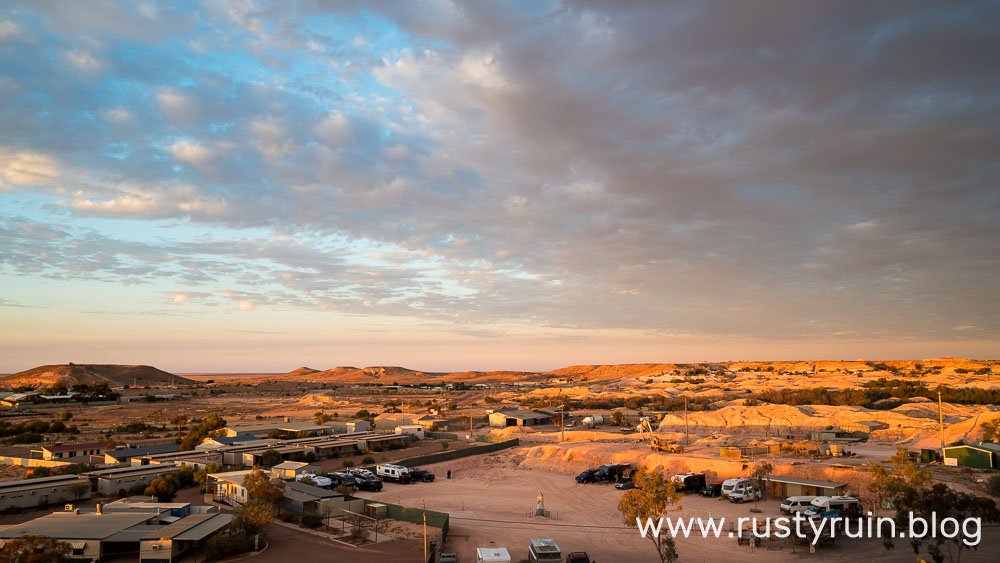
Coober Pedy – Nikon Z5
Identifying with brands
There are lots of people who adore certain brands. By identifying with a brand, we express something of who we are. We recognise some characteristics in the brand that strike a chord within us. We announce to the world: “This brand expresses who I am or who I want to be!”. Perhaps the brand expresses qualities we aspire to demonstrate in our own lives? Perhaps it reinforces a self-perception that we’d like others to notice? Brands are symbols that can be important to our identities, and the most successful brands resonante more strongly with larger numbers of people.
You could say that brand Nikon is doing something right after being so long in operation. The Nikon Corporation has been around since 1917 and has become a household name in that time. They know how to make great cameras, but that’s not to say that Canon or Sony don’t also make great cameras. They certainly do! And they have their own branding and marketing. Truthfully, I’ve often felt that Nikon have been pretty terrible at marketing their gear. It’s great engineering, but companies like Canon and Sony often seem to have had more attractive marketing campaigns over the years.
So, I guess I’m wondering why I open up my cupboard and see a growing bunch of Nikon cameras staring back at me – what does it say about me? Am I now a brand fan?
Through the pass – Nikon D70
How I got started
The truth is that I never thought I’d be much good with a big pro-looking camera. I was convinced that small and simple cameras would be my fate, seeming to fit better with my self-perception of not being very technically minded.
Despite this, I decided some years ago to push my limits, so I purchased a Nikon D5100 in hopes of finding a way to express myself more creatively. It was either the Nikon or the equivalent Canon, but the D5100 just seemed to have some better tech-stuff inside – a marginally bigger APSC sensor, a well-regarded sensor also featured in the D7000, and the fact that I could use so many F Mount lenses. For about the same price as the Canon, it seemed to be a slightly better camera.
Waiting after a tiring day – Nikon D5100 with Nikkor 55-200mm DX
I wasn’t at all disappointed with the D5100. On the day I received it, I set about educating myself on how to use a DSLR. I’ll be honest – it was a bit intimidating. It was a very different and more complex camera than I was used to. After reading a lot and watching a lot of how-to and exposure triangle videos, I went out and did some night photography. I can highly recommend this practice if you want to learn about the importance of light in photography. You very quickly learn that light is everything when you’re running around at night with a cheap tripod and a shutter remote that only works half of the time!
For the Nikonians and other interested parties
I don’t have the D5100 anymore, but I do have a growing bunch of Nikons that many Nikonians would be familiar with:
Nikon D40 – It’s an old and small DSLR from Nikon, featuring a 6.1 megapixel CCD sensor. I’ve written more about it here. Paired with Nikon’s older kit kens – the Nikkor 18-55mm – it’s a great lightweight camera.
Nikon D70 – My copy is a bit on the used side, but it still makes great photos with the CCD sensor. Some say it has a definite cool bias, but that can be perfect for many types of scenes.
Nikon D7100 – This was my workhorse Nikon DSLR for a long time. I upgraded to it at a good price after selling the D5100 and what a difference it felt like upon opening the box! Unlike the D5100, it has more external controls and solid ergonomics that don’t feel plastic. It feels like a professional camera when contrasted to the D5100 !
Nikon Z5 – After a long time, Nikon finally entered the mirrorless game. The Z5 is every bit a modern mirrorless camera for a good price, considering the 35mm digital sensor. After using my mirrorless Olympus OMD EM5 cameras for so long, this feels both familiar and a huge upgrade in capability. As much as I trust my D7100, the Z5 is my new workhorse.
Nikon D200 – Released in 2005, the D200 features a well-regarded Sony-made CCD digital sensor. I regard it as one of the best early DSLRs from Nikon, as the camera market was shifting from film to digital.
I know that my Nikons aren’t exactly heavy enough to bow the shelving. It just feels like they outnumber my other cameras by a long way! Maybe it’s because I use them a lot, so I feel like I’m a brand loyal Nikonian? I’ve used my share of small junk cameras over the years, so it’s nice to pick up a big-name camera that just works when I want it to. I’ve had a few cameras die on me now – I’m looking at you, Sigma DP1 and Sigma DP2M ! I still don’t think I’m a brand loyalist, but I do like my Nikons.
One warm night on the ourskirts of Darwin, we pulled the car to the side of a busy road. The marina had caught our eyes. I grabbed my camera bag in a hurry, threw open the car door, looked both ways, and made a dash to the other side. I could see the water more easily from there, but there was no wide walkway offering protection from the speeding cars, so I was stuck close to the concrete siding that formed the road’s crash barrier. The driver, beating even my swift movements, carried his drone and launched it with some excitement.
A calm night near Darwin – Nikon Z5
I’m not one for a tripod even though I have one. My photos tend to be opportunistic and made in short timeframes. It’s the sort of thing you do when you travel with other people who might not have the patience to wait for just the right kind of light. Given the situation, the Nikon’s 35mm digital sensor and sensitivity to low light proved fortuitous ~ I didn’t need to push ISO beyond 6400 and I could use slow but usable shutter speeds if I held the camera still enough and held my breath momentarily. Just as well that the Z5 also has inbuilt image stabilisation to help out in these situations!
There I was, busy making photos of the boats and the water reflections and the hazy orange-hued moon. My friend was busy controlling his drone remotely and flying it further out over the marina and the moored boats. Out of the dark, we heard someone shouting gruffly at us: “What the F*** are you doing? Are you F****** spying on us?”. I’ve encountered this kind of thing before and I’ve no doubt that the audible buzz of the little drone really grabbed the attention of the marina locals. As another stranger once said in relation to my mate’s little flying friend: “Every moron has a drone!”
A lank-haired young man on a scooter, chest puffed out and eyes wide, flanked by his eager buddy, rode up to the edge of the road about 20 metres distant. Luckily, I’d finished, and my friend had just landed his drone only moments before the gruff accusations. The young scooter-using macho-man attempted to impress his surfer-type colleague, who’d now perched himself lazily over the crash barrier to observe: “If you don’t put that F***** thing away, I’m gonna F****** shoot it down!”.
In these situations, I can get a little fired up, especially if I think I’m not doing anything wrong. We were on a public road near a publicly accessible marina. In this heavily surveiled world of security cameras and manufactured fear, people sometimes overreact. And a drone flying overhead may provide the paranoid with an excuse to resort to threats and violence, especially if they have something to hide. Of course, we all know that only morons have drones, so it’s no surprise that someone would take offence!
We started back to the car under the watchful eyes of the two young aggressors, offering them jaded jibes on the way: “What are you gonna shoot it down with? Go ahead and try it, mate!” These are the kinds of words that older men say to younger men sometimes, having undergone the trials of similar testosterone surges once upon a time. But nowadays, we pack our cameras and drones and wonder at the world…
How do you feel about sunsets? What do you think about when you’re watching the sun dip slowly below the horizon line? Are you an avowed opacarophile? I think most of us love a good sunset!
Fiery water – Nikon Z5
How do you go about framing a sunset? What decisions do you make when you compose? The so-called rule of thirds can be useful when framing landscapes like this. Typically, I’ll keep two thirds of the photo as sky, since this is usually where the most interest is – beautiful clouds and shifting colours. But as you can see in the above photo, I decided not to do that on this occasion.
My decision here revolved around the difficulty of balancing some of the brightest sections of sky with the reflections on the water. The dark shadowy landmass serves as a strong dividing line between sky and sea. I also found the texture and colour of the water more intetresting than the sky at that moment, so I chose to include more of it.
During editing, one sticking point was the brightest section of sky, right in the middle, casung me some visual distraction. The sun breaking through those clouds is strong enough to draw the attention away from the texture of the water. To address this, I opened it in Lighroom, selected a mask over that bright area, and lowered the highlights a little more. Doing this brought out some cloud detail and minimised it as a visual distraction.
As city revellers were ushering in the new year, we were driving with good friends through silent streets around the wharfs and docks. Earlier, we’d had dinner at a pub on the edge of the marina and witnessed a sunset full of delicate hues.
The Marina at Sunset – Nikon Z5
Once again, the opacarophile strikes! Low in the frame, the masts were like trees – but stripped back, orderly, severe, and made by human hands. Tiny streaks of boat fuel and chemicals on top of the water, iridescent in the fading light, reminded me of how these places are underpinned by our need to exploit the environment for reasons of vanity and leisure. I gazed at expensive apartments across the water, with expensive boats moored nearby, and thought about the very few who could afford that kind of life.
Some mundane reflections
I’m learning how to handle the Nikon Z5 better. I have no complaints about the hand-feel of the camera. The grip is typically nice in that Nikonian way – though not up to the high standard of the Olympus E1. The Z5 doesn’t have all the external button control of higher models in the Z lineup, but it’s the entry level camera, after all. That’s no bother to me.
I once wondered about the role my tiny Olympus OMD EM5 Mark 2 would play in the aftermath of my Z5 purchase. Admittedly, I don’t take the Olympus out as much as I used to, but on days when I want to carry less weight, it’s the better option. I’ve also become so used to using old manual focus lenses on the Olympus, just for the central sweet spot of the glass, that it seems a missed opportunity not to use it.
Reeds at Meningie, SA – Nikon Z5
I should explore the use of vintage glass on the Nikon Z5 this year. I invested in a good quality M42 adapter, so now I can use all of my old Soviet, German, and other glass. Pleasingly, the Z5 automatically detects a non-CPU lens and switches to Focus Peaking mode. No longer do I need to go into a menu and turn it on!
It’s a new year. We’ll see what happens. Some things will change and some things never will.
Two sunsets in my previous post, and now two photos of rusty stuff for this post! Can you detect a theme here?
This old rust-bucket – Tennant Creek, NT – Nikon Z5with Viltrox 20mm lens
Tennant Creek – Jurnkkurakurr to the Warumungu people who have lived in the area for many thousands of years – is located 1000 kilometres from Darwin. In other words, it’s a long way from any big city! The town features a history of gold mining and some of that equipment and the story of that time can be found in a local museum.
I daresay that many travellers pass through Tennant Creek as quickly as possible, mindful of the stories they’ve heard regarding the residents and crime. Whilst it’s true that a recent history of such social turmoil exists, it’s wise to remember that the land speaks of much older stories and times long before colonialism. As ever, visceral reactions to news stories and statistics obscures the lived experience of local people and ultimately, the real drivers behind social problems.
Another old rust-bucket – Tennant Creek NT – Nikon Z5
Making photos isolates a moment in time. Photos often lack context and tell a story that the photographer wants to tell. The idea that a viewer would have an emotional reaction to a photo drives the work of many photographers. Indeed, street photography is littered with such raw moments and reactions.
Such thoughts enter my mind as I carry the camera and stop at a street corner in Tennant Creek. Rather than lift the viewfinder to my eye, better to think on the people who have lived here for thousands of years and face the cultural whiplash of colonialism and bleak over-representation in the justice system – a system that usually protects the rich and powerful and punishes those who can least endure it.
The Urban Dictionary defines an Opacarophile as someone who loves sunsets. It would be fair to say that many people find beauty in sunsets. Certainly, at the end of a day out on the road, our thoughts turn to whether we’ll find a suitable spot to witness the sunset and make a good photo. There’s always some resigned grumbling when heavy clouds obscure the sun!
The importance of the setting sun
The setting sun signals the end of the day and the turning of the earth. One might ponder our long line of ancestors, staring at the shifting hues and watching the sun retreat below the horizon. Such an event reminds us of our smallness and our place in the world.
Evolutionary science suggests that when we experience the beauty of sunsets, we tap into our evolved aesthetic faculties – brain wiring that allow us to see the rightness or harmony of something in order to judge its value and health. A healthy mate is vital to produce healthy offspring and continue the species, so beauty in this context represents a healthy mate and potential long-term survivability. A beautiful sunset stimulates the same aesthetic faculties that allow us to determine the health of a potential mate and the rightness and harmony of things.
Perhaps that theory is a long-bow to draw for many! My favourite is the Biophilia Hypothesis, which I’ve mentioned in a previous post. The idea that humans are drawn to natural areas because we have a deep-rooted connection to them, having lived in such areas for most of our history, is a compelling one.
Two sunsets, two interpretations
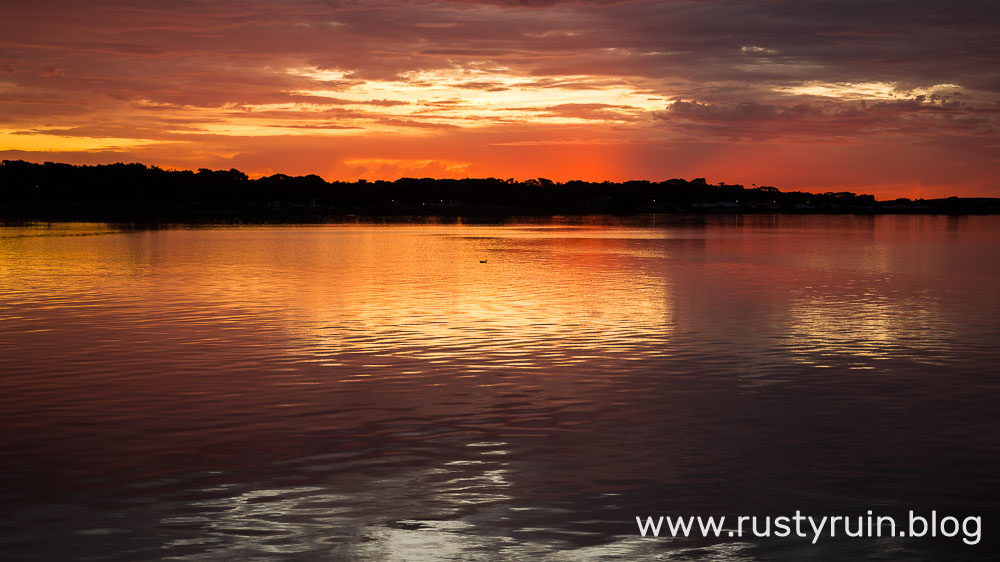
Sunset, Meningie SA – Nikon Z5
Having spent much of the day driving around the Cooring, Meningie provided us with the most wonderful of sunsets. A variety of colours, shifting from moment to moment, reflected in calm water. This single sunset made up for all of the sunsets we missed. Can you spot the lone duck in the above photo?
I’m glad I had my Nikon Z5 with me for this. I’d attached the excellent Nikkor 24-70mm F4 S lens after deciding that my usual lens, the Nikkor 40mm f2, needed a break. I know that many photographers prefer a tripod for such scenes, perhaps combined with Neutral Density filters, but our day-trips are about chance and hope, best represented by hand-holding the camera and moving to the next potential aesthetic wonder.
Sunset, Meningie SA – Nikon Z5
What a difference a moment makes to the colours of a sunset! I’m being a bit cheeky, as the colour in the photo above is actually a momentary interpretation of the automatic white balance in the Z5. Once I saw what white balance it had chosen, I decided to stick with it. The first photo is much more like the original sunset we saw. I simply exaggerated the blues and pinks by setting a Tungsten white balance during editing. It’s one thing I’ve noticed in my Z5: the automatic white balance is sometimes over-eager. Still, I find it’s best to grasp these chance moments and chance settings!












 The Rusty Ruin Journal