Nitmiluk National Park ~ awe-inspiring gorges, a kit lens, and harsh light

To the local Jawoyn people, the amazing gorges in Nitmiluk National Park (Katherine Gorge) hold special significance. We were fortunate enough to book a short cruise to see some of the many wondrous gorges in the area and view the ancient sandstone rock formations, calm waters, and freshwater crocodiles. This is an area teeming with life and Dreamtime stories.

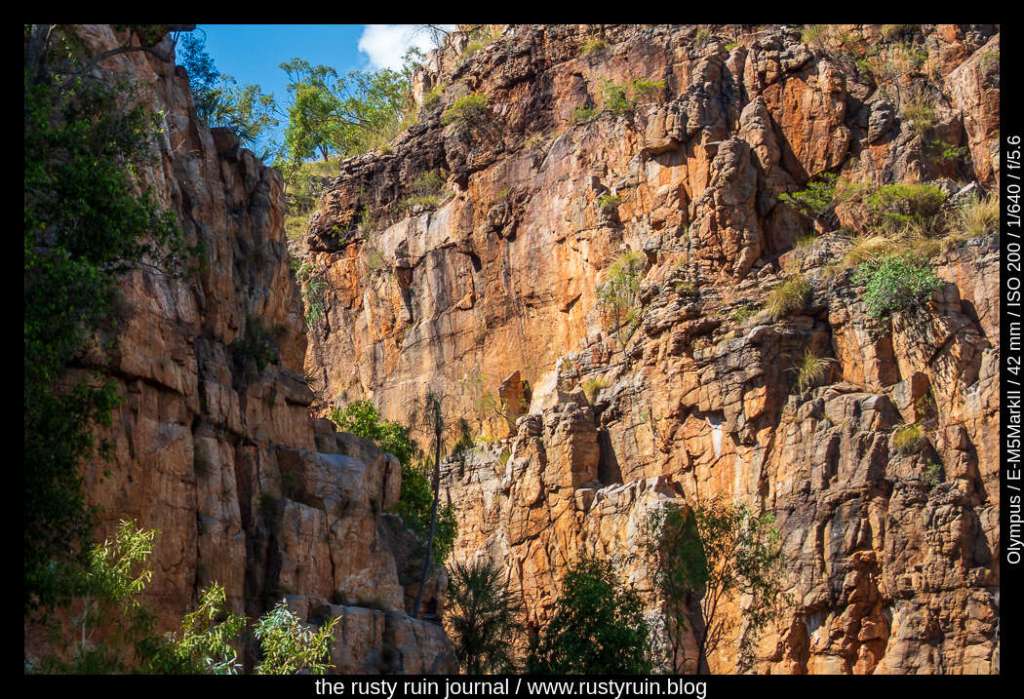
Nitmiluk National Park, one of the gorges – Olympus OMD EM5 Mark 2 and 14-42 kit lens

Sunlight at the height of the Australian afternoon can be harsh. This is one reason I prefer viewfinders rather than the big LCD screens on so many cameras that get washed out in these conditions. 

The soft golden light of dawn or dusk brings out the best colours in the outback landscape, but trip timing doesn’t always permit, and you have to work with the tools you have and the light available when the opportunity arises. One quality this strong afternoon light does emphasise: all the textures on the ancient sandstone.

On the day, I packed lightly since I’d been lugging a not insignificant amount of camera gear around on other days (hello Lowepro Nova 200). The Olympus EM5 provides good image quality and lots of control in a small package. It’s just a small pity I’d also decided to take the 14-42 kit lens with me. That’s not to say that kit lenses are bad at all. Nikon makes some great kit lenses, such as the 18-55mm. And this Olympus Zuiko kit lens is no slouch in the image quality stakes – it does pretty well for a cheapish plastic lens. But at times when I want more sharpness to record all of the landscape’s details, it gets a bit fluffy and squishy at the edges of the frame. Still, you work with what you have and the conditions of the day.
Nitmiluk National Park – Olympus OMD EM5 Mark 2

I’ll always say that eye-watering sharpness is generally overrated in photography, but there are times when sharpness is another tool you want in order to communicate certain qualities – the texture of the rocks in this case. Despite some of the shortcomings of my kit lens, careful subject selection, use of exposure compensation to retain as much detail as possible in high dynamic range scenes, and some boost to the red/orange/yellow colour channels during editing helps to make the photos shine. I also reduced highlights to reveal the details of the ancient sandstone.
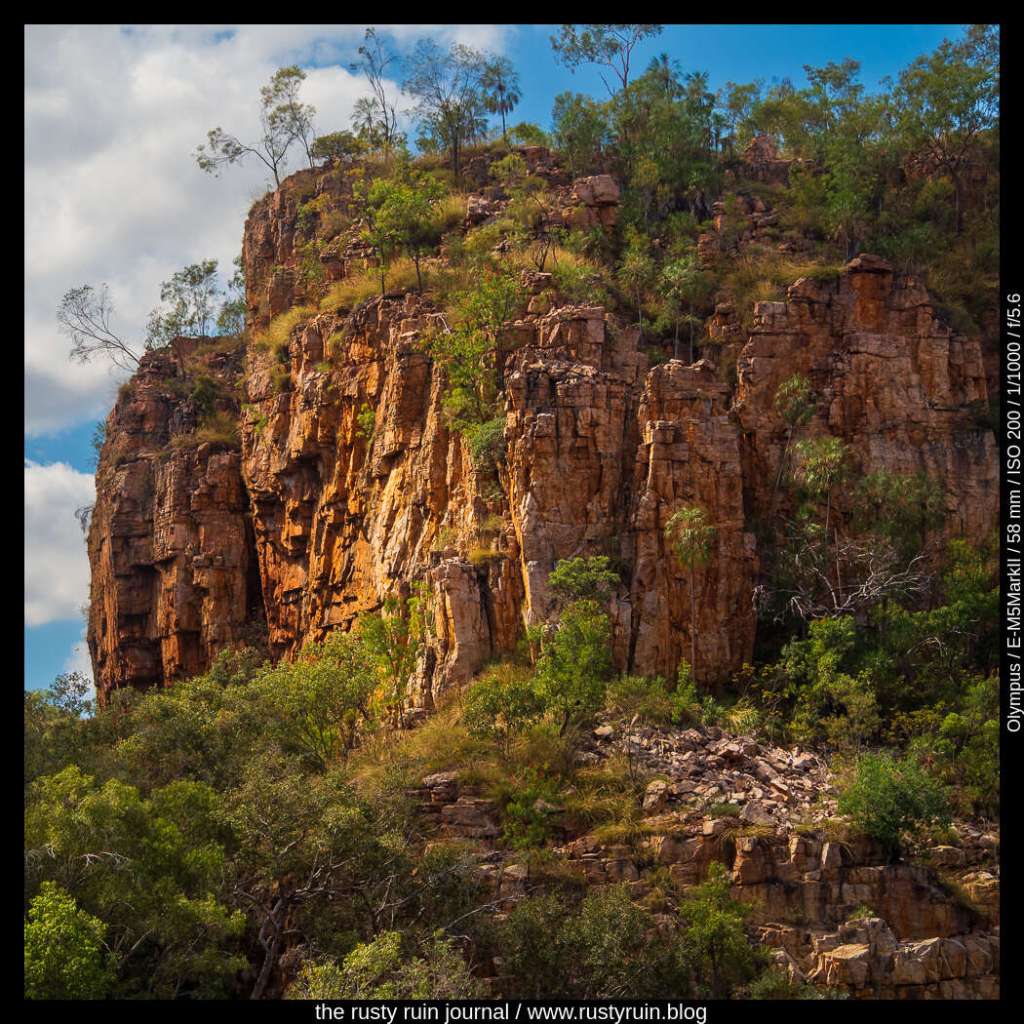
A patch of sunlight illuminates ancient rock – Olympus OMD EM5 Mark 2 and Zuiko 40-150mm lens

As the clouds grew heavy, the light conditions became a little more forgiving. As you can see in the above photo, clearing clouds also provided an opportunity to record sunlight as it illuminated sections of rock. I used the so-called plastic fantastic 40-150mm Olympus Zuiko lens for this photo – small, light, and really quite sharp at most focal lengths. I guess the message is to know your camera gear and accept and make best use of your tools and the conditions. I’ll freely admit to not knowing all of my gear well enough at times!

Uluru up close ~ a story of hiking, geology, erosion, and deep time

We looked up at the huge rocky dome, in awe of the ancient geological processes that had created it. Over 500 million years ago, before dinosaurs wandered the lands around the ancient sea that would one day become a national park and tourist attraction, Uluru and Kata Tjuta started to form. At such times, you realize the scale of the world around you and feel very small indeed.

Looking back in time: Uluru – Nikon Z5 with Nikkor 40mm F2 lens and Circular Polariser

Doing the 10km base walk is the best way to appreciate the vastness of Uluru. We were already exhausted from our 8km hike through Kata Tjuta the day before – those rocky slopes and winding pathways can be unforgiving on cheap hiking shoes! I once climbed Uluru in about 45 minutes, back when it was commonly known as Ayers Rock. No-one is permitted to climb it now, but you can still see the old climber’s entrance and the worn path that millions of tourists braved over the years.

From a distance, Uluru looks like it has quite a uniform surface, but up close is where you get to see the details – weathered sections of grey stone, streaks of white, dark caves that seem to make recognisable patterns, and the iconic red rock that signals high iron content. Both Uluru and Kata Tjuta were formed over millions of years as the soft parts of the Petermann Ranges were eroded, leaving only the boulders and rocks.

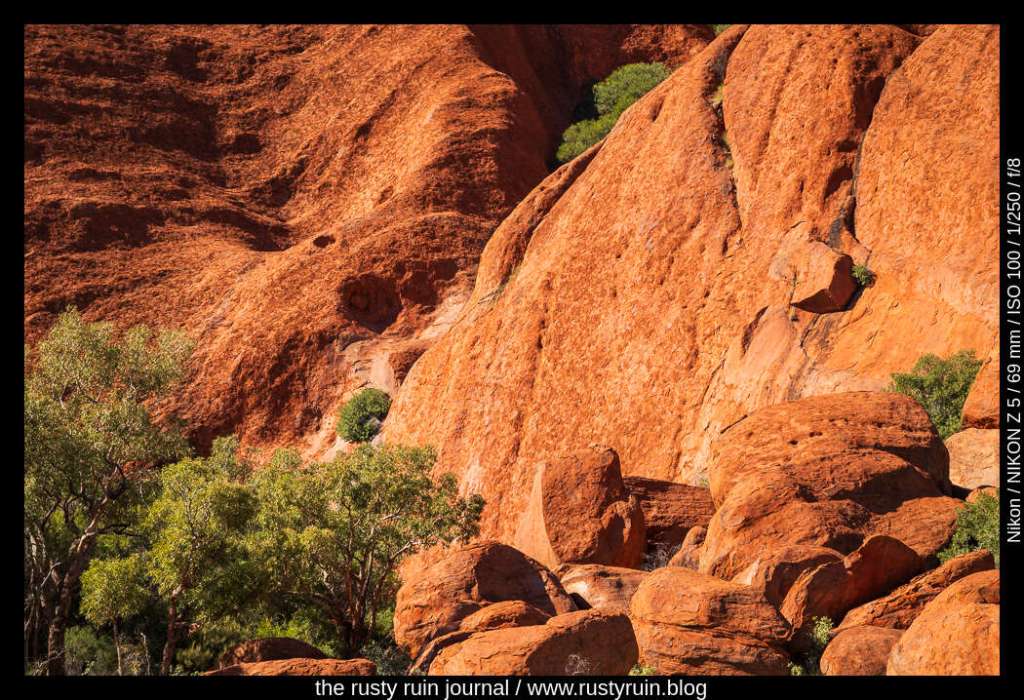
Uluru up close – Nikon Z5

Uluru takes on different colours, depending on the time of day and season. It can be bright orange at sunset one moment and then pink with purple and blue shadows the next. I posted a sunset picture in another post, though it was a rushed pull-over to the side of the road and the local police weren’t too happy we’d parked in a no-park area as they beeped us on a drive-by! You take your chances when you have a camera in-hand. There are some designated photo spots in the area for tourists, but they can be quite busy, and I’m not always best pleased to make photos that everyone else does.

The red bones of ancient Australia – Nikon Z5

I was more prudent in my use of the circular polariser on this trip. Hiking around the base of Uluru, I was mindful of the location of the sun. The polarising effect is strongest when the sun is at a 90-degree angle to where you’re pointing the camera – so either on your left or your right. I dial it up so that the effect is strongest, and then dial it back a bit to add more natural stray light reflections back into the scene.

A polariser is fantastic for cutting out stray reflections on foliage and rocks and for deepening colours, but it can also make a scene look flat and darken clear Australian skies to the point of ultra-violet. It’s important not only to be mindful of where the sun is but also whether a polarised photo is what you want. Great for foliage and cutting out reflections on water, but not so useful when you want to preserve all the golden colours of a sunset. It’s also not useful in shady areas, so there was a whole section of the base-walk where I put it away.

Uluru detail: weathering and streaks – Nikon Z5

I’ve often thought of Uluru as the rocky heart of Australia, located not too far from Alice Springs. Amazingly, this monolith extends up to 6 km underground, so it’s much like a rocky iceberg. Absolutely worth visiting if you’re ever in a position to do so.

Murder in Larrimah

When you drive through Alice Springs and head further north on the Stuart Highway, the landscape changes not long after leaving town. You see termite mounds on the side of the road, often dressed up in bras, hats, and high-visbility fluorescent vests – something of a cheeky tradition in the Northern Territory. Other things change too – the red rocks, boulder formations, and rough-hewn ranges that are such an iconic part of the Australian outback give way to flatter landscapes dotted with grasses and tall trees that grow in tropical zones. Also, dusty old towns spending their slow days sinking into the red soil.

Out the back of the Larrimah Hotel – Nikon Z5 and Nikkor 40mm F2 lens

If you require toilet facilities or a beer, you might stop at the tiny town of Larrimah. You might also make a photo of the giant fibreglass Pink Panther that stands out like a hot pink beacon off the highway. The garish statue seems to be the theme of the only pub in town – the Larrimah Hotel. It has been the local watering hole for years, and the cartoonish mascot seems to stand in stark contrast to the darkness that overshadowed the town in 2018.

That year, Paddy Moriarty and his dog went missing. The subsequent police investigation shed light on a possible local murder thread after an exhaustive search, but to this day, no one has been charged. The whereabouts of Paddy and his dog remain a mystery.

Best pies in town – Nikon Z5 with Viltrox 20mm lens

There seems to have been some argument about selling pies to tourists. If the photo of Paddy’s old place above is anything to go by, he seemed hellbent on making a name for himself as a pie seller in competition with another town-dweller. Who knows? It’s a strange story. One TV documentary on the murder in Larrimah identifies multiple possible motivations, none of which have ended in answers.

One of the interviewees in the documentary said something that struck me – small outback towns like Larrimah can be filled with jealousies and petty arguments, twisted into something bigger by the slowness of time in remote places. In those distant places, where social life for a dozen inhabitants revolves around a beer at the only pub in town, I’d guess that ideas about right and wrong also change shape in tune with the long days melting into one another.

A calm night rudely interrupted

One warm night on the ourskirts of Darwin, we pulled the car to the side of a busy road. The marina had caught our eyes. I grabbed my camera bag in a hurry, threw open the car door, looked both ways, and made a dash to the other side. I could see the water more easily from there, but there was no wide walkway offering protection from the speeding cars, so I was stuck close to the concrete siding that formed the road’s crash barrier. The driver, beating even my swift movements, carried his drone and launched it with some excitement.

A calm night near Darwin – Nikon Z5

I’m not one for a tripod even though I have one. My photos tend to be opportunistic and made in short timeframes. It’s the sort of thing you do when you travel with other people who might not have the patience to wait for just the right kind of light. Given the situation, the Nikon’s 35mm digital sensor and sensitivity to low light proved fortuitous ~ I didn’t need to push ISO beyond 6400 and I could use slow but usable shutter speeds if I held the camera still enough and held my breath momentarily. Just as well that the Z5 also has inbuilt image stabilisation to help out in these situations!

There I was, busy making photos of the boats and the water reflections and the hazy orange-hued moon. My friend was busy controlling his drone remotely and flying it further out over the marina and the moored boats. Out of the dark, we heard someone shouting gruffly at us: “What the F*** are you doing? Are you F****** spying on us?”. I’ve encountered this kind of thing before and I’ve no doubt that the audible buzz of the little drone really grabbed the attention of the marina locals. As another stranger once said in relation to my mate’s little flying friend: “Every moron has a drone!”

A lank-haired young man on a scooter, chest puffed out and eyes wide, flanked by his eager buddy, rode up to the edge of the road about 20 metres distant. Luckily, I’d finished, and my friend had just landed his drone only moments before the gruff accusations. The young scooter-using macho-man attempted to impress his surfer-type colleague, who’d now perched himself lazily over the crash barrier to observe: “If you don’t put that F***** thing away, I’m gonna F****** shoot it down!”.

In these situations, I can get a little fired up, especially if I think I’m not doing anything wrong. We were on a public road near a publicly accessible marina. In this heavily surveiled world of security cameras and manufactured fear, people sometimes overreact. And a drone flying overhead may provide the paranoid with an excuse to resort to threats and violence, especially if they have something to hide. Of course, we all know that only morons have drones, so it’s no surprise that someone would take offence!

We started back to the car under the watchful eyes of the two young aggressors, offering them jaded jibes on the way: “What are you gonna shoot it down with? Go ahead and try it, mate!” These are the kinds of words that older men say to younger men sometimes, having undergone the trials of similar testosterone surges once upon a time. But nowadays, we pack our cameras and drones and wonder at the world…

Two rust-buckets at Tennant Creek

Two sunsets in my previous post, and now two photos of rusty stuff for this post! Can you detect a theme here?

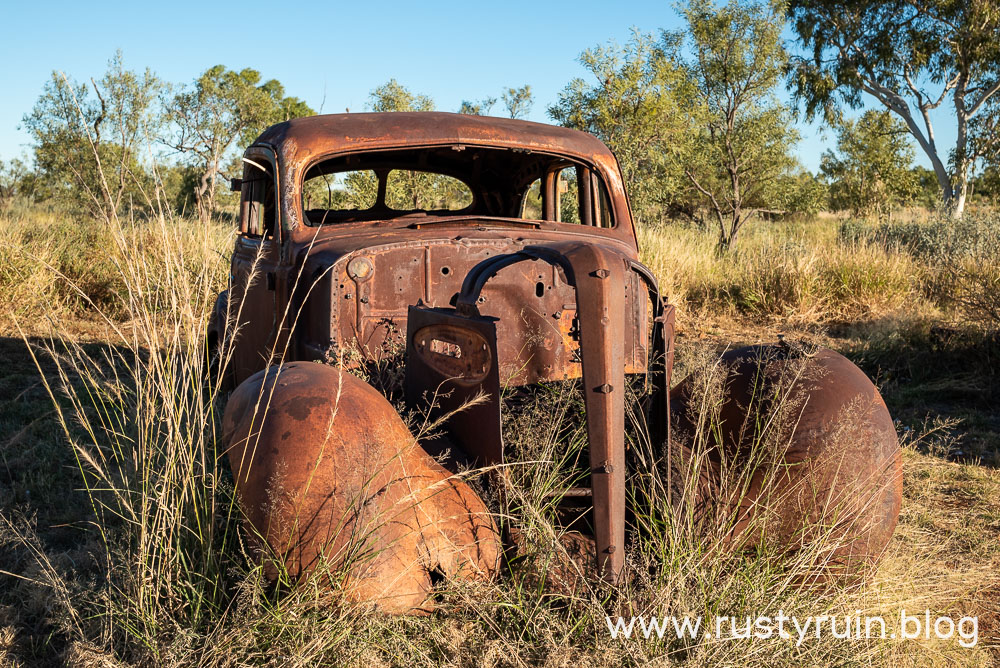
This old rust-bucket – Tennant Creek, NT – Nikon Z5 with Viltrox 20mm lens

Tennant CreekJurnkkurakurr to the Warumungu people who have lived in the area for many thousands of years – is located 1000 kilometres from Darwin. In other words, it’s a long way from any big city! The town features a history of gold mining and some of that equipment and the story of that time can be found in a local museum.

I daresay that many travellers pass through Tennant Creek as quickly as possible, mindful of the stories they’ve heard regarding the residents and crime. Whilst it’s true that a recent history of such social turmoil exists, it’s wise to remember that the land speaks of much older stories and times long before colonialism. As ever, visceral reactions to news stories and statistics obscures the lived experience of local people and ultimately, the real drivers behind social problems.

Another old rust-bucket – Tennant Creek NT – Nikon Z5

Making photos isolates a moment in time. Photos often lack context and tell a story that the photographer wants to tell. The idea that a viewer would have an emotional reaction to a photo drives the work of many photographers. Indeed, street photography is littered with such raw moments and reactions.

Such thoughts enter my mind as I carry the camera and stop at a street corner in Tennant Creek. Rather than lift the viewfinder to my eye, better to think on the people who have lived here for thousands of years and face the cultural whiplash of colonialism and bleak over-representation in the justice system – a system that usually protects the rich and powerful and punishes those who can least endure it.