Strange name, big Cold War glass ~ the Zenitar 16mm 2.8 Fisheye lens

If you believe the more scurrilous online rumours, the quality of a camera lens from the former Soviet Union was directly proportional to the Vodka consumption of weary factory workers. This is not the colourful fancy one might suppose, as any factory line embedded in an economic and socio-political culture where wages are neither incentive nor punishment is more likely to be driven by exhausted hands and eyes.

None of this suggests that any cheap trinket or fast fashionable piece made today in vast factory cities by exploited workers and then sent abroad to be marked up for huge profits is any better. Always, there are grifters and exploiters taking advantage of the vulnerable and the gullible. But anyway…I digress slightly. The source of my Soviet-produced lens beyond the factory floor is not a story for today.

The Zenitar 16mm 2.8 Fisheye lens is an impressive piece of Cold War glass. It’s a hefty thing in the hands, has a distinct and very short hood, a lens cap that can’t be used on any other lens, and looks great when the sunlight bounces off the large curved glass that sits right out front. On my trusty Olympus EM5 Mark 2, this 16mm Zenitar has a field of view equivalent to a 32mm focal length in 35mm format. So, if I was using it on my Z5, which has a 35mm sensor, the field of view is the native 16mm. Because my Olympus has a digital sensor that’s half the size of the one in my Z5, I double the 16mm to a field of view of 32mm instead.

Trudging through swampland at mid-afternoon – Olympus EM5 Mark 2 and Zenitar 16mm Fisheye

My copy of the lens is sharp enough at apertures F 5.6-8, and even at those settings the corners display a lack of sharpness that’s more fizzy than actually mushy – as though details are being pulled away from the centre and slightly distorted. The effect reminds me of using a plastic lens but I don’t find it unpleasant.

Capitalism harms us all – Olympus EM5 Mark 2 and Zenitar 16mm Fisheye

As with other wide angles, and certainly with all Fisheye lenses, there’s distortion. You can see how the normally straight cortners of the skip bins in the above photo look bowed. I don’t have an issue with it, as this is just a feature of the lens, but it’s not the sort of lens you want if you desire pleasant portraits, straight horizons, and distortion-free buildings (using the Nikkor 16mm 2.8 lens profile in Lightroom will straighten out most of the distortion if you really want that).

Lenses like this are great for getting in very close to a subject to take advantage of the optical distortions they produce. On the Olympus, however, the Fisheye effect is certainly much less because of the smaller sensor size, making it a really valuable wide-angle lens if you don’t mind manual focus, fizzy corners, and the chance that the quality of your copy may have suffered due to the effects of authoritarianism and the revolutionary whims of Vladimir Lenin.

Squeezing the most from old lenses ~ the Clubman 28mm 2.8

I’ve used many old manual lenses on my Olympus EM5. It’s a great way to explore old glass, even if the lenses weren’t made for modern mirrorless digital cameras. One of my favourite lenses is the Clubman 28mm 2.8 – a mass-market cheapo lens that was made by a Japanese optical manufactuer and then rebranded to be sold in camera shops and department stores at the height of 35mm film photography in the 70s, when colour film rose to prominence and new artistic styles found voice. It can also be found under the Ensinor name and likely some others. Many cheap lenses from that era were equally cheap in performance, but the Clubman is surprisingly good.

Like all of the lenses from back then, it’s an all-metal build and features an aperture ring and manual focus – quite hefty when compared to the plastic lenses we often find today. One of the best things about it is that it has a kind-of macro mode where you can focus down to about 30 cm at a 1:5 ratio. The other surprising thing about the lens is that it’s quite sharp after stopping the aperture down to f 5.6-f 8.

The lens also benefits greatly from the small sensor size of the Olympus because the softer edges and corners are mostly chopped out on the Micro Four Thirds format. This lens wouldn’t be so good on a larger format, like APS-C or 35mm, because those mushy edges and corners would form a bigger part of the visible frame. On the Olympus, I get the central part of the lens, where it’s sharpest.

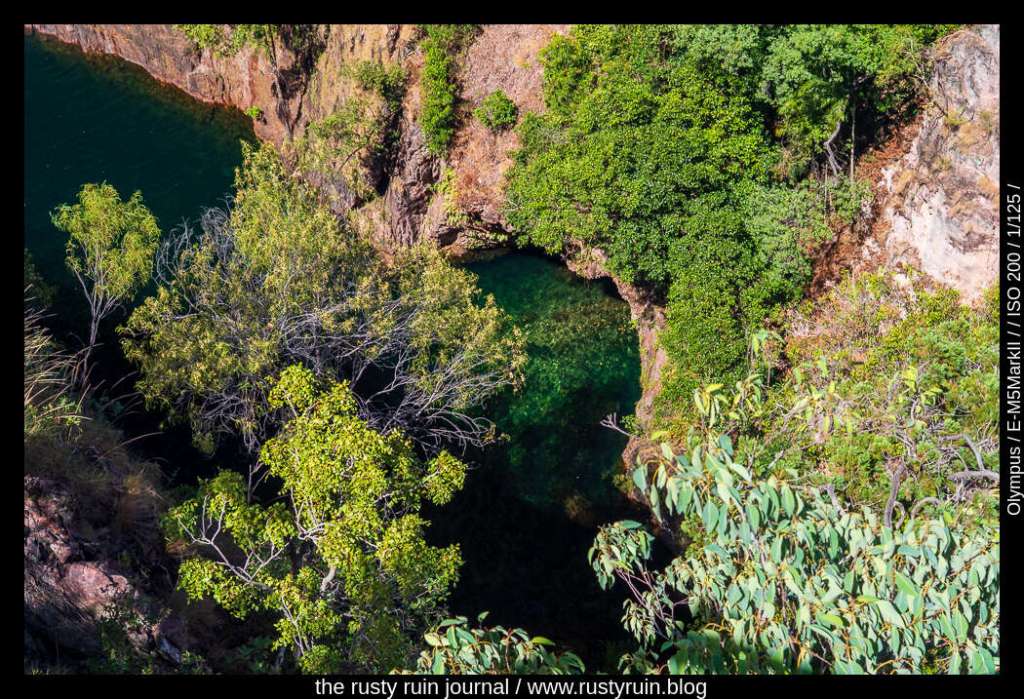
On a hike , Litchfield National Park – Olympus EM5 Mark 2 with Clubman 28mm lens and Circular Polariser

For the photo above, I stopped the lens down to F 5.6 – the sweet spot for this lens/camera combination. I also used a circular polariser to cut out stray light reflections on the rocks and the foliage. This also deepens the colours.

The effect of the polariser is obvious in the above photo when you look at the water. The reflections have been minimised, creating transparency and deeper colours. You can even see the cliff visible below the water’s edge and some of the rocks on the riverbed. This is when a circular polarising filter is most useful and helps to maximise the optical properties of older glass.

Here are some of my other most-used manual focus lenses:

  • Takumar 35mm 3.5
  • Takumar 28mm 3.5
  • Macro-Takumar 50mm F4
  • Fujinon 55mm 1.8
  • Petri CC Auto 55mm 1.8
  • Micro-Nikkor 55mm 3.5
  • Nikkor 50mm F2
  • Zenitar 16mm 2.8 Fisheye
  • Minolta Rokkor MC 50mm F2
  • Minolta Rokkor 55mm 1.7
  • Vivitar 28mm 2.5

Of wrecked trains and automobiles

I imagine the car wrecks that litter the Australian outback partly inspired films like Mad Max. I could spend an entire road-trip stopping and photographing these hulks. You’re always looking for something interesting on long lonely roads in the middle of nowhere and the cars remind you that people drive through the middle of the country often enough to lose their way, run out of fuel, and break down. More than one overseas tourist has become lost in the Aussie bush and perished in the heat!

Newly overturned – Olympus EM5 Mark 2
The old carriages make for good canvasses – Olympus EM5 Mark 2

Likewise for abandoned train carriages that have seen better days and could whisper the dreams of passengers long vanished. Rather than litter the outback, they often sit abandoned in old railyards in worn-out towns, languising next to tracks overgrown with weeds.

Welcome aboard! – Olympus OMD EM5 Mark 2

Some thoughts on Quiet Photography

It seems that during prior lyrical waxings on the concepts underpinning mindful/contemplative photography and Miksang, I came to refer to it as Quiet Photography. This, without thinking for a moment that Quiet Photography might indeed be a thing out there in the world – a concept already girded by philosophies and academic essays. As it turns out, it’s a definite thing in some academic circles and is mentioned elsewhere.

Old door and dappled light – Olympus EM5 Mark 2 and Sigma 30mm 2.8 lens

For me, quiet photos don’t announce themselves. They don’t add their voice to the cascade of loud photos that speak of ego, marketing, and contrivance. They step away from noise and action. Quiet photos speak of the small things and the ordinary things. I think the best of these photos imbues the mundane subject with an imaginary life, as though revealing a mystery in a quiet place unnoticed by the noisy hubbub of humanity.

Wood bench partly in shadow – Olympus EM5 Mark 2

As in contemplative photography, the necessary mindset inhabits a moment fully but may be distracted easily. The play of autumn light over the surface of an old door, a wooden bench in shadow and light – ordinary things that convey the passing of time and a feeling of history, with the photographer as quiet witness.

Wending my way through photo edits on a quiet day ~ curation, technical considerations, and personal growth

It’s a public holiday and I’m working my way through old photos in hopes of finding some stray winners I’d forgotten about. I’ve always been my own biggest critic, editor, and curator. I think it’s good to develop our own tastes as photographers over time. It’s important to connect to our own photos without judgement, reflect on the image and the subject choice, consider the chosen settings, and remember our original photographic vision for the scene versus the actual image.

The key is to do this without judgement. Not every photo is going to meet your developing creative tastes. Not every photo is going to work at a technical level – some will be blurry, some will be rushed, some subject choices will seem odd, and some photos will seem dull. All this is absolutely OK. It needs to happen for growth to happen.

Sundial on a cloudy day – Olympus EM5 Mark 2 and Zenitar 16mm 2.8 Fisheye lens

I love the way the sunlight hits the sundial to reveal the texture of the metal in the photo above. All of the rust spots, built-up debris, weathering, and patina is visually interesting. The old Zenitar Fisheye would be a specialist lens on a 35mm camera, but on the half-sized sensor of the Olympus it works out to an equivalent focal length of 32mm and functions as a nice wide lens with a sharp centre and mushy corners. In situations where I want to get close and get in as much of the scene as possible, it’s a great lens.

There’s a little blown out highlight right up the top, but blown highlights and blocked shadows are not necessarily bad things, and in the above photo it’s very small and not distracting. There are so many other elements that make up a photo! Consider these questions: is there any detail in the highlights/shadows that you want to preserve? Will preserving those details add to your photo? If you make a photograph and part of the image features a glowing light bulb, for example, should you decrease the exposure to bring down this highlight so that the filament inside the bulb can be seen? Will doing this compromise other elements in your photo? How integral are those highlights and shadows to your photographic vision? Instead of the sensor having to manage dynamic range that exceeds its capabilities, can you simply reframe the image instead to include less heavy highlights/shadows?

Cheapo Mad Max – Olympus E1

In the photo above, my decision to focus on the car door was made easy by the fact that the window at the top was allowing in a lot of light. The E1 has an old sensor that doesn’t manage high dynamic range so well, so it made sense for me to cut out most of the light from the window in my viewfinder composition so as to preserve the details in darker areas and on the car door. In effect, the old sensor didn’t need to work so hard to contain all of the dynamic range in the scene.

The red paint on the left, the curved red painted area to the bottom right, and the window at the top all serve to frame the weather-beaten door and its message. It may not be the most exciting photo in the world, but it works for me and it’s a good example of connecting a scene to a photographic vision through careful composition and technical knowledge. I’ll be the first to admit that I’m not always good at that and plenty of photos don’t meet my own tastes, but I keep learning.

Digging deeper into a cache of unedited photos ~ thoughts on subject and composition

In my previous post, I revealed a cache of old photos I’d discovered on a hard-drive backup. Apart from giving me an excuse to go into Lightroom and do something that isn’t related to my day job, it also provides me an opportunity to reflect on why I made those photos. What was my intent? What did I find interesting at the time? What scenes and subjects caught my eye and why?

Painting in the details – Olympus EM5 Mark 2 and unknown vintage lens

I really like the way the painter seems to blend in with her mural. She’s leaning forward at just the right angle so that her body almost becomes part of the skin tones and the angle of limbs on the wall. Her bright yellow hair also contrasts well against the blue paint. There’s colour, shape, contrast, and detail – all providing a visual feast for the viewer’s eyes.

Ripples and shadows – Olympus EM5 Mark 2

There’s something wonderful about the way water reflects and bends light. In the photo above, the setting sun provides gloomy and interesting light that plays across the surface of the water. The ripples themselves form an interesting pattern, leading the eye in a circular motion to the silhouette of the duck and the tree stump. I also love the way that the shadows of these subjects are distorted by the ripples and lead away and out of the photo to the edge of the frame.

I discovered a cache of unedited photo files ~ backups and bad sectors

Do you remember waiting for a roll of film to be developed? I used to enjoy going to the photo lab and collecting those envelopes filled with photos. I’d sit down on a bench somewhere and pore through them excitedly. Sometimes, they’d be from rolls of film I’d been sitting on for a few years, so looking through them was a joyous exercise in reliving those memories. If I had the extra money, I might even pay for 7×5 prints or even a grainy 8×10 enlargement. We don’t experience any of that with digital photography, of course, but there is a close cousin: finding unedited RAW files on drive backups.

View of the Lighthouse 1 – Olympus EM5 Mark 2 and unknown vintage lens

I’m not especially organised when it comes to my photo backups. I’ve even lost a bunch of photos from one particular holiday due to my lack of foresight. Admittedly, I’m also a bit burned out on the tech and the multiple passwords and the platforms and…well you get the idea. In short – my fault for not listening to the hard drive that was burping and farting to let me know it was living its final days. So, it’s always nice to discover a maverick folder full of photos files I’d forgotten about.

Rusty grille and green concrete – Olympus EM5 Mark 2

I use One Drive a lot for backups now. I usually save a DNG version to the cloud and save a web-ready version for this journal and for sharing (1000 px on the long side and 60% JPG quality, if you’re interested). You might also have noticed that my photos now have a neat black border with some EXIF information on the side and a URL for this place. It’s an unobtrustive way to watermark the photos, record some useful EXIF data, and make the photo pop a little more against the black border. It’s a slightly convoluted process to install and configure, but once set up, the Mogrify 2 plugin works well in Lightroom. I have a license somewhere, but it probaby went down with another bad hard drive incident.

View of the Lighthouse 2 – Olympus EM5 Mark 2

More photos from the Nikon D200

In my previous post, I sang the praises of the Nikon D200 – first released in 2005. Back then, I could barely afford a decent digital point ‘n’ shoot, let alone a premium DSLR like the D200 ! Even RAW photos from this Nikon feature similar contrast, punch, and compressed dynamic range to those from the Olympus E1yet another widely respected antiquarian among cameraphiles and CCD sensor enthusiasts. I’ll not expand fervently on that in this entry, as I’ve done previously! Just some more photos from the hefty and reassuringly solid Nikon D200:

A rusty old shed somewhere – Nikon D200 and Tamron 17-50mm F2.8 lens
The green shed – Nikon D200

Notice the old tin shed theme so far? I won’t deny that lonely sheds make for some nice pictures, especially when they’re decaying into the sun-beaten soil.

The yellow shed – Nikon D200

Seriously, I was going to post something other than a shed, I really was, but I couldn’t help myself! Back to another angle of the yellow shed you saw in my last post. Looking at these photos, I can’t help but wonder again about the image quality perfected in some of these old cameras. Makes you also wonder about the role of marketing and what we believe.

A sunny day with the Nikon D200

The Nikon D200 was released to market in 2005 – a long time ago in the world of digital cameras. Everything about it screams digital retro – the hulking black body, the 10.2 megapixel CCD digital sensor, 11 auto-focus points, and 5 frames per second shooting speed. Anyone who reads this journal regularly, knows that megapixels aren’t everything. Also, I’m a sucker for old and slow technology that does a good job and has a good feel.

Yellow shed – Nikon D200 and Tamron 17-50mm F2.8

I’ve kind of concluded by now that the best of the CCD sensor cameras produce punchy and colourful images. Even the RAW files look nice and punchy. I know that some people put it down to a thicker Color Filter Array above the photosites, and this may certainly be part of it, but I also think that the limited dynamic range of the sensor and the tonal response tuned by the engineers produces photos with extra contrast. Modern CMOS sensors have a much wider dynamic range and tend to produce flatter files for editing. You’ll find that shadows can be lifted more and highlights retain greater detail. In cameras like the D200 and the Olympus E1, the limited dynamic range of the CCD sensor results in less shadow and highlight detail, making for files that have compressed tonal range – more contrast.

The output from the Nikon D200 is reminiscent of the output from the Olympus E1 – a 5 megapixel beast I regard very highly. Of course, the lens makes a difference too, and the Tamron 17-50mm is a nice fast walk-around lens that balances well on this Nikon. It’s a bit on the soft side at 17mm in the corners, but at F8 and around the 35mm mark, it produces sharp images across the frame in my experience. It’s a great fit for the old D200.

Sand and sky and mangroves – Nikon D200

Just as with the Olympus E1, I’m not doing much editing at all with the RAW files from the Nikon D200 – minimal contrast boost if required, sharpening, and only a little vibrance for all of the photos on this page. In use, it’s a solid camera with all of the external control buttons you could ever want. This was a camera with pro features at the time, for sure. The magnesium-alloy skeleton and deep hand grip makes it feel secure and reliable, providing enough weight and heft for balancing longer lenses. Next to modern Nikon mirrorless cameras though, the D200 is an antiquated hulk! It makes the Nikon D70 seem like a cheap piece of plastic.

Shipping containers, a shed, and a caravan – Nikon D200

I received two original Nikon EN-EL3a batteries with the camera. I’d charged both of them before going out, but one of them drained to zero within minutes of fiddling with menu settings. I know the D200 had a reputation for poor battery life, but I think that particular battery may be done for! The other battery seems to have plenty of juice though. I’ve ordered some third-party replacements anyway, as Nikon don’t manufacture the official batteries anymore.

0000 – 9999 – Nikon D200

The Nikon D200 was the last Nikon camera body to feature a CCD digital sensor. The Nikon D300 featured a CMOS sensor, which enabled the use of higher ISO settings and low light photography with less noise. I’ve never used the D300, but I know it’s considered one of Nikon’s best early digitals. In my opinion though, the D200 remains a great camera and certainly scratches the retro digital itch – one of Nikon’s best cameras in the market transition between film and digital.

You can see more D200 photos in my follow-up post here.

Seeing in 2025 quietly

As city revellers were ushering in the new year, we were driving with good friends through silent streets around the wharfs and docks. Earlier, we’d had dinner at a pub on the edge of the marina and witnessed a sunset full of delicate hues.

The Marina at Sunset – Nikon Z5

Once again, the opacarophile strikes! Low in the frame, the masts were like trees – but stripped back, orderly, severe, and made by human hands. Tiny streaks of boat fuel and chemicals on top of the water, iridescent in the fading light, reminded me of how these places are underpinned by our need to exploit the environment for reasons of vanity and leisure. I gazed at expensive apartments across the water, with expensive boats moored nearby, and thought about the very few who could afford that kind of life.

Some mundane reflections

I’m learning how to handle the Nikon Z5 better. I have no complaints about the hand-feel of the camera. The grip is typically nice in that Nikonian way – though not up to the high standard of the Olympus E1. The Z5 doesn’t have all the external button control of higher models in the Z lineup, but it’s the entry level camera, after all. That’s no bother to me.

I once wondered about the role my tiny Olympus OMD EM5 Mark 2 would play in the aftermath of my Z5 purchase. Admittedly, I don’t take the Olympus out as much as I used to, but on days when I want to carry less weight, it’s the better option. I’ve also become so used to using old manual focus lenses on the Olympus, just for the central sweet spot of the glass, that it seems a missed opportunity not to use it.

Reeds at Meningie, SA – Nikon Z5

I should explore the use of vintage glass on the Nikon Z5 this year. I invested in a good quality M42 adapter, so now I can use all of my old Soviet, German, and other glass. Pleasingly, the Z5 automatically detects a non-CPU lens and switches to Focus Peaking mode. No longer do I need to go into a menu and turn it on!

It’s a new year. We’ll see what happens. Some things will change and some things never will.