In the last two weeks, we drove ten thousand kilometeres, taking in numerous towns both dusty and tropical. It has been a holiday very long in the planning and the waiting! Now we’re all back home, the old routine is dominant, and our first night in outback accommodation, surrounded by red dust and diesel fumes, seems a distant memory. The ennui associated with returning home from such a journey has certainly hit!
I did make many spur of the moment photos with the plastic Camp Snap. While most of them are mediocre, some are distinctly charming. As I spend time organising and editing the many photos made by my Nikon cameras in the coming months, here are some of the Camp Snap photos I like most:
Seen on an outback road in Queensland – Camp Snap
The warming and softening filters I tacked to the Camp Snap really add some mood to the scene and match well with the outback sun.
An old home in Augathella, QLD
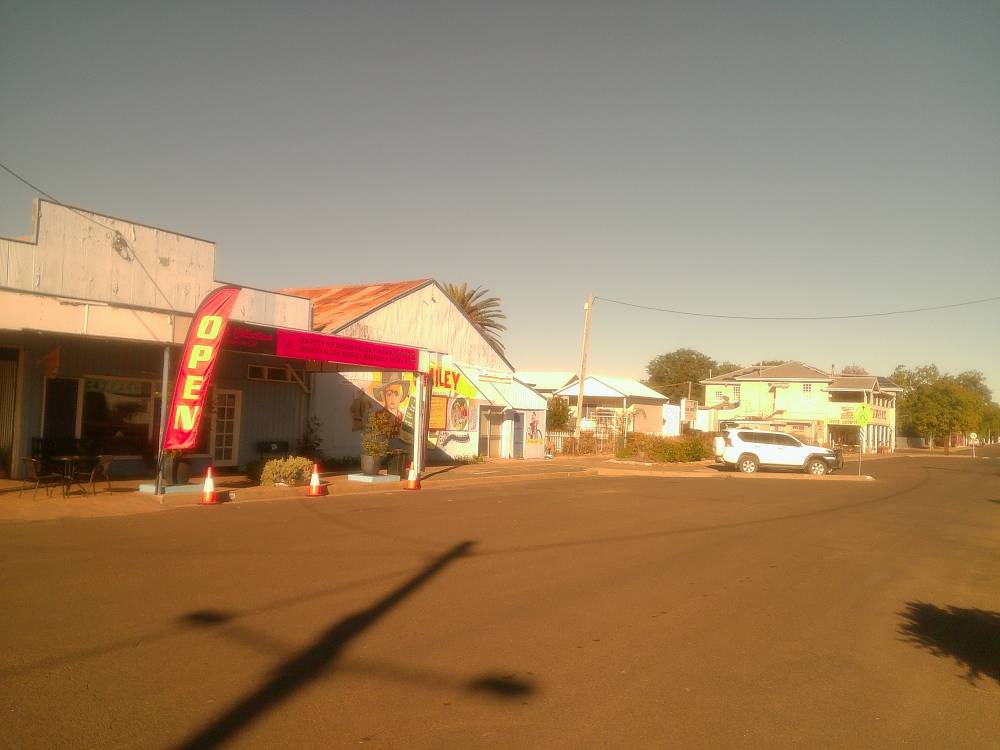
One of my favourite towns from the trip is Augathella. Located in outback Queensland, it had a population of 321 as of 2021. The local cafe operator was eager to say that the town has a crime rate of zero.
Main street in Augathella
I always sense a feeling of state pride in Queenslanders, as though they represent the best of Australia and every other state is a pale cultural imitation. Every town seems to feature a gimmick, narrative, or site of historical significance to attract the nomads and tourists.
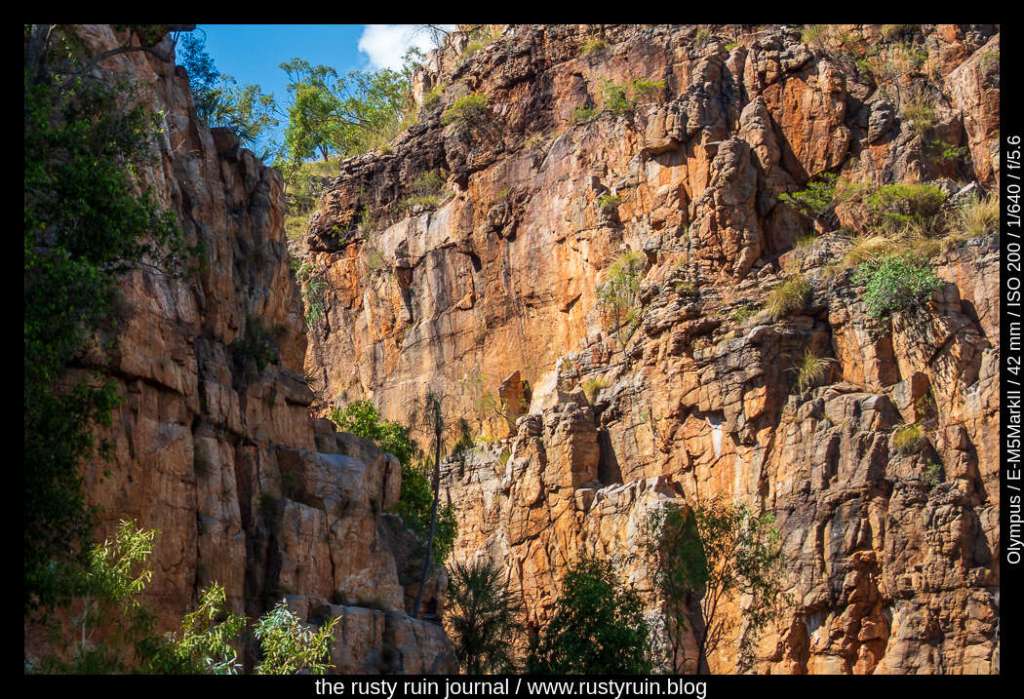
To the local Jawoyn people, the amazing gorges in Nitmiluk National Park(Katherine Gorge) hold special significance. We were fortunate enough to book a short cruise to see some of the many wondrous gorges in the area and view the ancient sandstone rock formations, calm waters, and freshwater crocodiles. This is an area teeming with life and Dreamtime stories.
Nitmiluk National Park, one of the gorges – Olympus OMD EM5 Mark 2 and 14-42 kit lens
Sunlight at the height of the Australian afternoon can be harsh. This is one reason I prefer viewfinders rather than the big LCD screens on so many cameras that get washed out in these conditions.
The soft golden light of dawn or dusk brings out the best colours in the outback landscape, but trip timing doesn’t always permit, and you have to work with the tools you have and the light available when the opportunity arises. One quality this strong afternoon light does emphasise: all the textures on the ancient sandstone.
On the day, I packed lightly since I’d been lugging a not insignificant amount of camera gear around on other days (hello Lowepro Nova 200). The Olympus EM5 provides good image quality and lots of control in a small package. It’s just a small pity I’d also decided to take the 14-42 kit lens with me. That’s not to say that kit lenses are bad at all. Nikon makes some great kit lenses, such as the 18-55mm. And this Olympus Zuiko kit lens is no slouch in the image quality stakes – it does pretty well for a cheapish plastic lens. But at times when I want more sharpness to record all of the landscape’s details, it gets a bit fluffy and squishy at the edges of the frame. Still, you work with what you have and the conditions of the day.
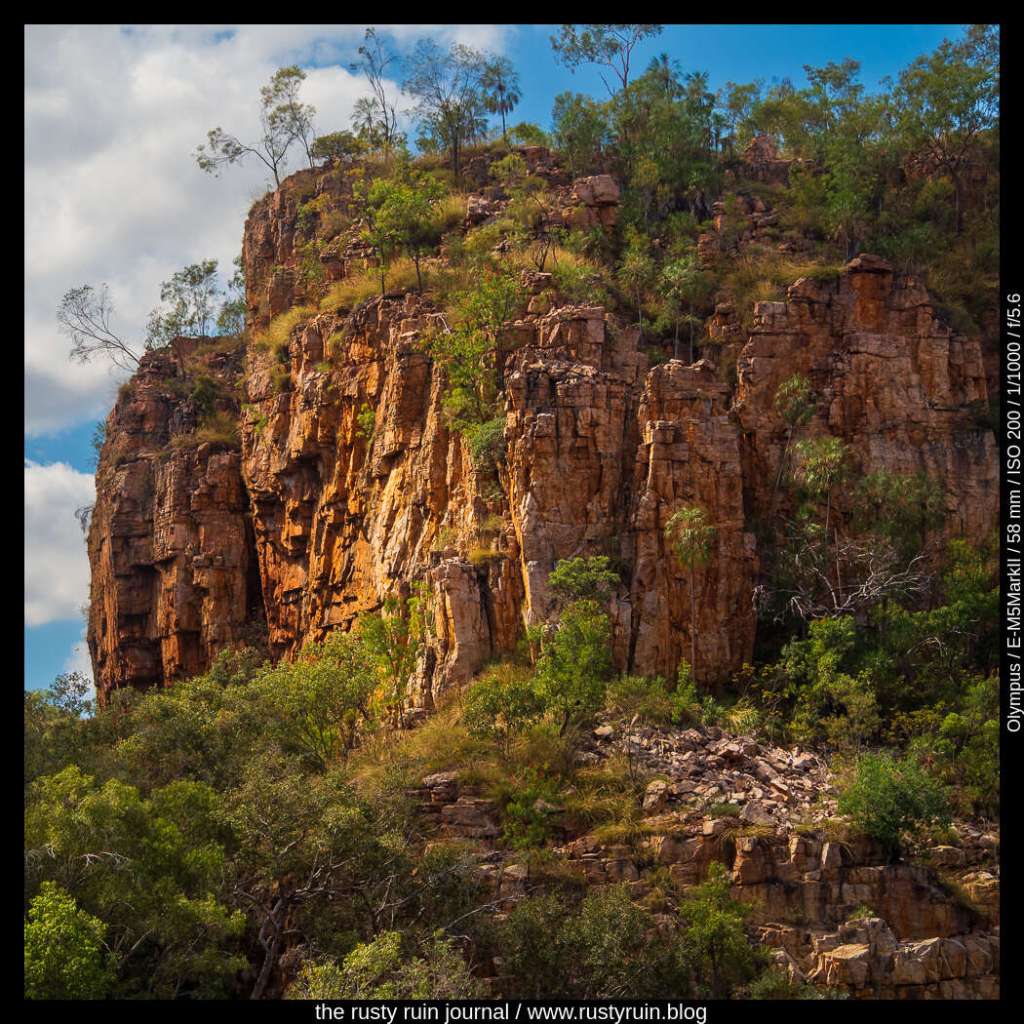
Nitmiluk National Park – Olympus OMD EM5 Mark 2
I’ll always say that eye-watering sharpness is generally overrated in photography, but there are times when sharpness is another tool you want in order to communicate certain qualities – the texture of the rocks in this case. Despite some of the shortcomings of my kit lens, careful subject selection, use of exposure compensation to retain as much detail as possible in high dynamic range scenes, and some boost to the red/orange/yellow colour channels during editing helps to make the photos shine. I also reduced highlights to reveal the details of the ancient sandstone.
A patch of sunlight illuminates ancient rock – Olympus OMD EM5 Mark 2 and Zuiko 40-150mm lens
As the clouds grew heavy, the light conditions became a little more forgiving. As you can see in the above photo, clearing clouds also provided an opportunity to record sunlight as it illuminated sections of rock. I used the so-called plastic fantastic 40-150mm Olympus Zuiko lens for this photo – small, light, and really quite sharp at most focal lengths. I guess the message is to know your camera gear and accept and make best use of your tools and the conditions. I’ll freely admit to not knowing all of my gear well enough at times!
Winter seems to have finally arrived and the looming long weekend here is threatening rain and wind. Not fantastic conditions for photo-walks, of course, but some interesting details can usually be found for the lens even on grim days. On this cold night, after a day of work, I’m scouring the file folder and not seeing aything that fires the imagination too much, so a loose photo assortment follows.
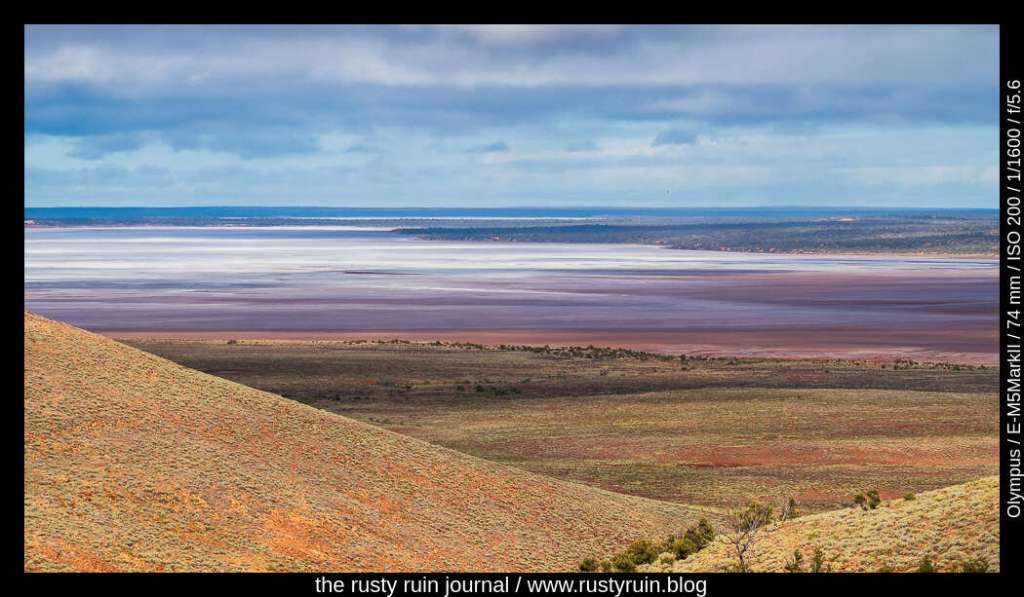
Lake Hart, SA Australia – Olympus OMD EM5 Mark 2
I like the coloured layers in this photo. Driving into the outback not far beyond Port Augusta, lies Lake Hart ~ a vast inland salt lake that’s easily accessible from the rest area and car park. The salt crystals crunch underfoot and the moisture below this top layer gets muddier the further you walk out.
Rusted and overturned car – Olympus OMD EM5 Mark 2
So often, we miss finding an interesting subject to photograph when the sun moves low and the light turns golden. On this occasion, after a day of driving through the Australian outback, we spotted this overturned and burned out car. The sunset rays hit the rusty body just right so that it glowed gold and red and orange. I must have made a dozen photos and this was the only one I was happy with. Always good to get close-up to subjects like this too.
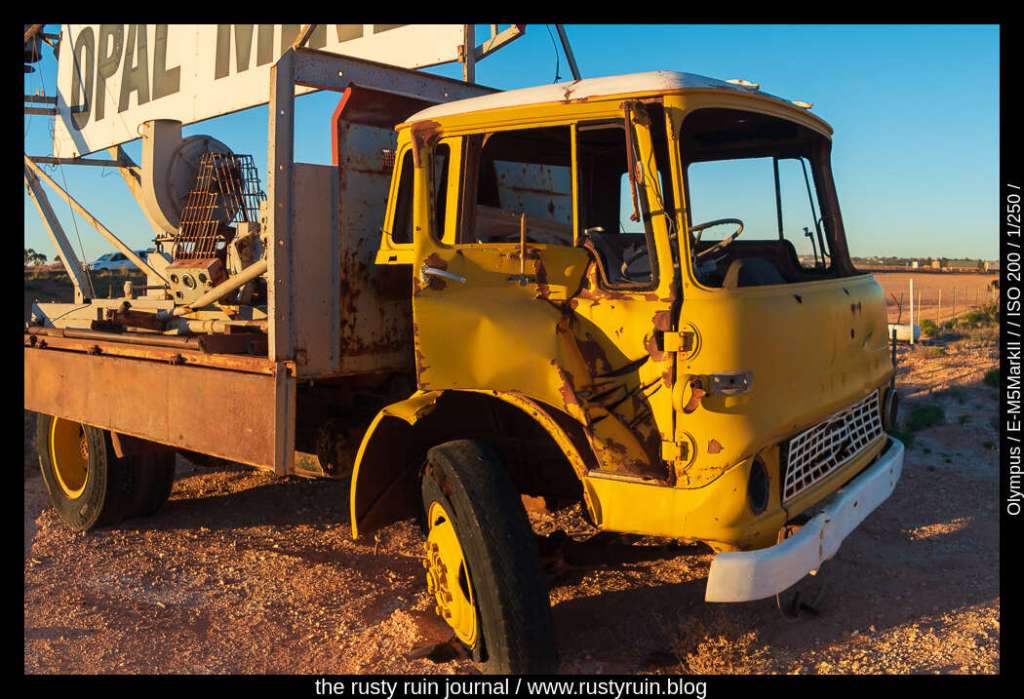
Opal mines hereabouts – Olympus OMD EM5 Mark 2 and Zenitar 16mm Fisheye lens
Have you noticed that I’ve posted very summery and warm photos on this wintry eve? This vehicle has seen better days, for sure. It’s used as a signpost around Coober Pedy now.
I imagine the car wrecks that litter the Australian outback partly inspired films like Mad Max. I could spend an entire road-trip stopping and photographing these hulks. You’re always looking for something interesting on long lonely roads in the middle of nowhere and the cars remind you that people drive through the middle of the country often enough to lose their way, run out of fuel, and break down. More than one overseas tourist has become lost in the Aussie bush and perished in the heat!
Newly overturned – Olympus EM5 Mark 2The old carriages make for good canvasses – Olympus EM5 Mark 2
Likewise for abandoned train carriages that have seen better days and could whisper the dreams of passengers long vanished. Rather than litter the outback, they often sit abandoned in old railyards in worn-out towns, languising next to tracks overgrown with weeds.
We looked up at the huge rocky dome, in awe of the ancient geological processes that had created it. Over 500 million years ago, before dinosaurs wandered the lands around the ancient sea that would one day become a national park and tourist attraction,Uluru and Kata Tjuta started to form. At such times, you realize the scale of the world around you and feel very small indeed.
Looking back in time: Uluru – Nikon Z5 with Nikkor 40mm F2 lens and Circular Polariser
Doing the 10km base walk is the best way to appreciate the vastness of Uluru. We were already exhausted from our 8km hike through Kata Tjuta the day before – those rocky slopes and winding pathways can be unforgiving on cheap hiking shoes! I once climbed Uluru in about 45 minutes, back when it was commonly known as Ayers Rock. No-one is permitted to climb it now, but you can still see the old climber’s entrance and the worn path that millions of tourists braved over the years.
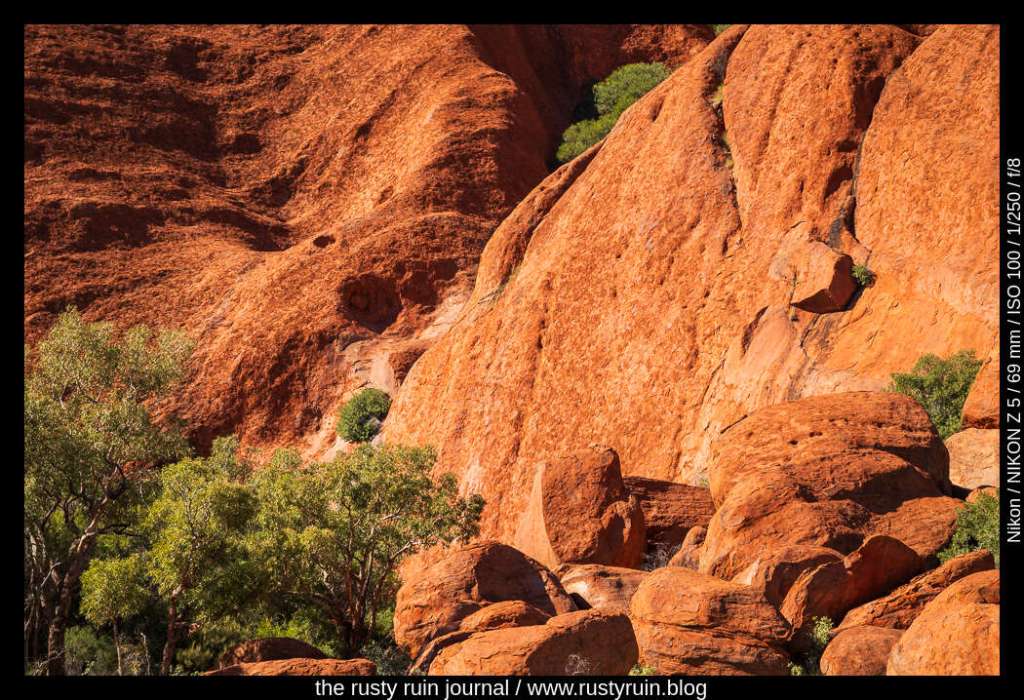
From a distance, Uluru looks like it has quite a uniform surface, but up close is where you get to see the details – weathered sections of grey stone, streaks of white, dark caves that seem to make recognisable patterns, and the iconic red rock that signals high iron content. Both Uluru and Kata Tjuta were formed over millions of years as the soft parts of the Petermann Ranges were eroded, leaving only the boulders and rocks.
Uluru up close – Nikon Z5
Uluru takes on different colours, depending on the time of day and season. It can be bright orange at sunset one moment and then pink with purple and blue shadows the next. I posted a sunset picture in another post, though it was a rushed pull-over to the side of the road and the local police weren’t too happy we’d parked in a no-park area as they beeped us on a drive-by! You take your chances when you have a camera in-hand. There are some designated photo spots in the area for tourists, but they can be quite busy, and I’m not always best pleased to make photos that everyone else does.
The red bones of ancient Australia – Nikon Z5
I was more prudent in my use of the circular polariser on this trip. Hiking around the base of Uluru, I was mindful of the location of the sun. The polarising effect is strongest when the sun is at a 90-degree angle to where you’re pointing the camera – so either on your left or your right. I dial it up so that the effect is strongest, and then dial it back a bit to add more natural stray light reflections back into the scene.
A polariser is fantastic for cutting out stray reflections on foliage and rocks and for deepening colours, but it can also make a scene look flat and darken clear Australian skies to the point of ultra-violet. It’s important not only to be mindful of where the sun is but also whether a polarised photo is what you want. Great for foliage and cutting out reflections on water, but not so useful when you want to preserve all the golden colours of a sunset. It’s also not useful in shady areas, so there was a whole section of the base-walk where I put it away.
Uluru detail: weathering and streaks – Nikon Z5
I’ve often thought of Uluru as the rocky heart of Australia, located not too far from Alice Springs. Amazingly, this monolith extends up to 6 km underground, so it’s much like a rocky iceberg. Absolutely worth visiting if you’re ever in a position to do so.
West MacDonnell Ranges aglow 1 – Nikon Z5 and Nikkor 40mm F2 lens
Upon driving back to Alice Springs after a long day on the road, the sun hit the ancient earth just right, and we pulled the car over to a patch of gravel. Like a long red serpent from The Dreamtime, stretching across the land, the rocky ridges were awash in the sun’s eventide glow. The photos here really don’t do it justice. How can one encapsulate over a thousand million years of geological history? It’s a land that feels as old as Time itself.
West MacDonnell Ranges aglow 2 – Nikon Z5 and Nikkor 40mm F2 lens
In a rush to exit the car, switch on the Nikon, and frame the scene before the light faded, I was amused by my scurrying about in the shadow of those ancient red rocky giants of earth. How many people had done the very same thing – catch the red glow of sunset across the hard-edged boulders, crags, and rocky outcrops? Many millions of sunsets across that land and there I was, one small thing in the vastness, fiddling with my camera, hoping to stop time.
In my previous post, I spoke about the eerie ruins of the accommodation complex at Wycliffe Well. To the best of my knowledge, the large bush-fire in this area still rages uncontrolled. Such is the creation and destruction cycle of life in outback Australia. One day you’re listening to tourists recount stories about Min Min Lights and the next you’ve sold your long-term outback business and it now lies in ruins at the feet of new owners, unlikely to be repaired. Life moves on quickly and time is uncaring.
Anyone for the Ladies Toilets? – Nikon Z5
At this point in the road-trip, I was still getting used to the Nikon Z5. It’s a lovely camera, without doubt, but I need to get into the habit of choosing smaller F-stops to create a deeper depth of field when close to my subject. For many of these photos I used the excellent Nikkor 40mm F2 lens. I’m a sucker for prime lenses and this one is certainly good bang for the buck, despite the all-polycarbonate mount. It’s one sharp lens for sure!
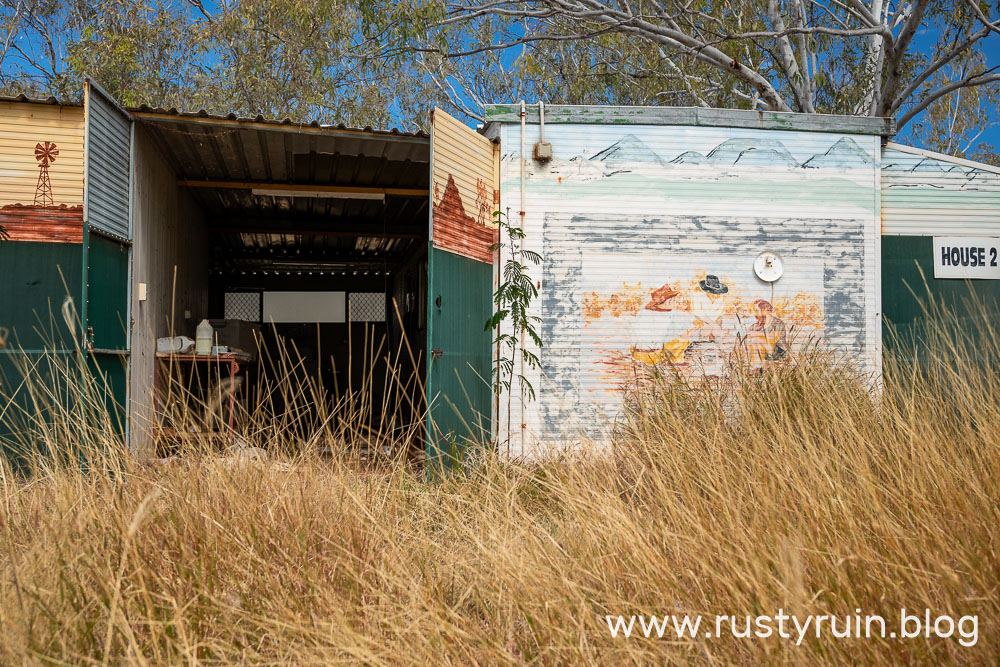
House 2 – Nikon Z5
I also used the 52mm B+W Circular Polarising Filter. This helps to cut stray reflections and saturate the colours so editing isn’t so burdensome. But using the CPL is not for every occasion. It’s great for cutting reflections, deepening the colour of foliage, and good if you want to photograph water, but it does tend to make photos look a bit flat and unnatural at times. I find that I always need to add contrast during the editing process just to cut that flatness.
Your caravan awaits – Nikon Z5
As you can see, the skies also really come alive when using the CPL. Sometimes it’s a bit too much, honestly. One year, I remember using it extensively around Alice Springs and the skies looked so dark they were almost purple. Now, I twist the brass ring of the CPL until it hits maximum effect and then dial it back a little to add some natural reflection to the scene. I think I used it quite judiciously on this outback journey.
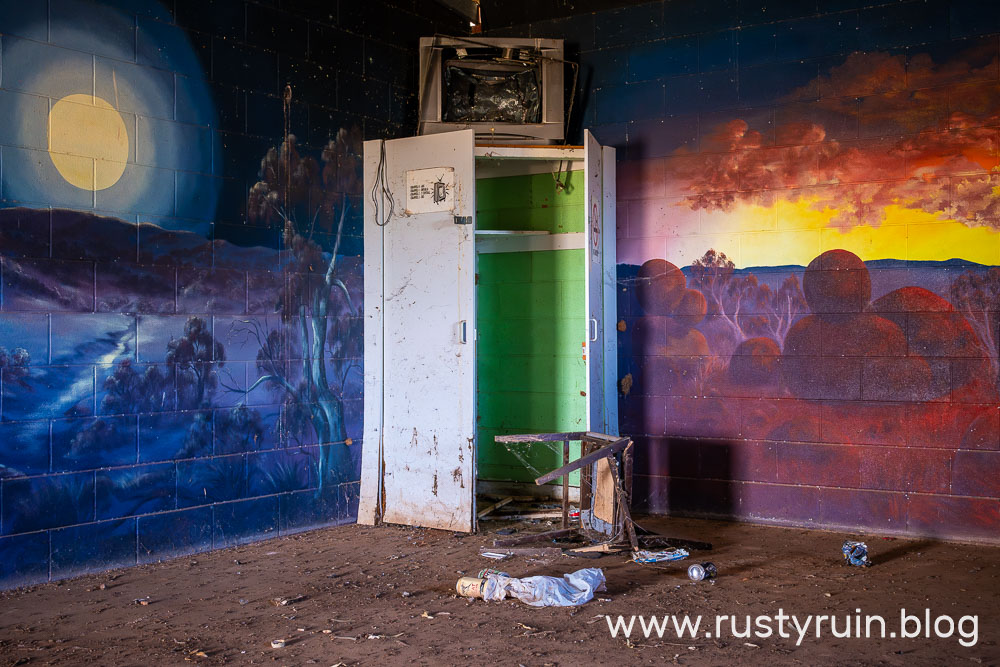
Welcome to the TV Room – Nikon Z5
The Z5 is very comfortable at ISO 6400 and I’m comfortable using it when required. I think I got away with ISO 3200 in the above photo and used Lightroom’s great AI-based noise reduction to smooth it all out. That’s a good use of AI technology, as far as I’m concerned. Really love that artwork too, though the TV has seen better days.
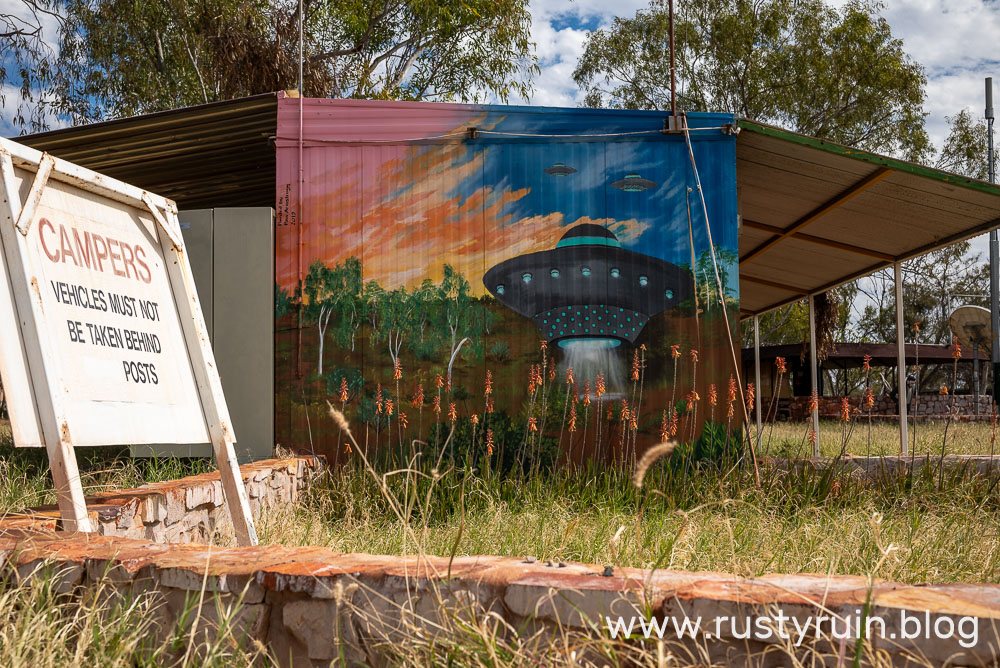
Sometimes, on those long and lonely roads through outback Australia, you come across things you don’t expect to see. Burned out cars flipped on the roadside are commonplace. So too are the broken bottles, campfire ashes, and plastic rubbish that litter desolate truck stops. What you don’t expect to see is an old campground and motel that lies in ruins, featuring an alien and UFO theme. This is Wycliffe Well – once known as Australia’s UFO sighting capital.
Attention Campers – Nikon Z5
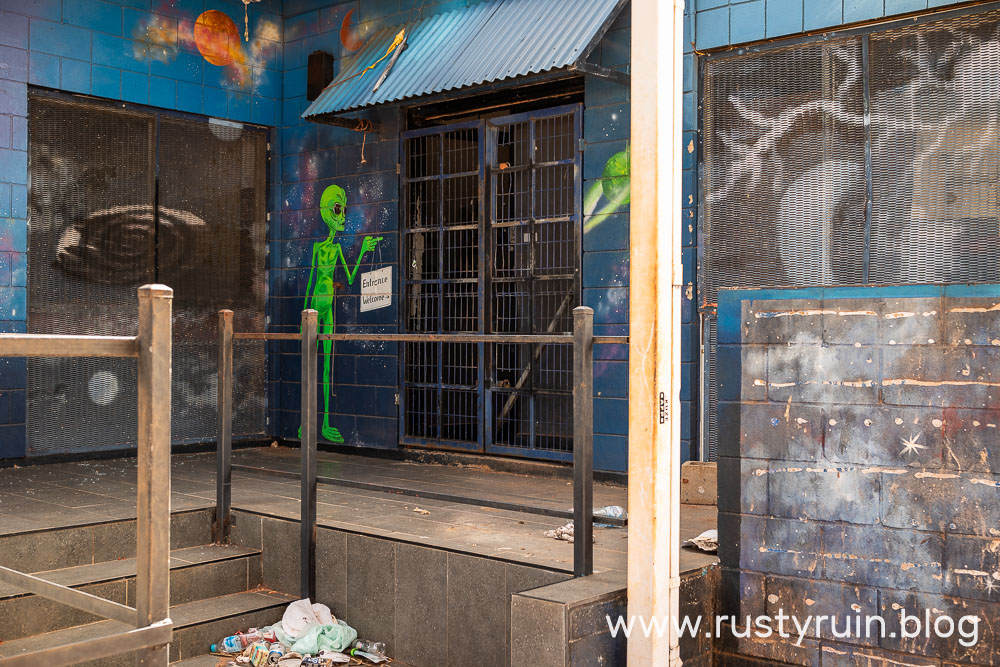
In this ruined complex of dormitories, recreation rooms, and offices, we found the remains of glory days, when the site was home to a thriving community looking for their first UFO sighting. The signs are everywhere, including alien murals and painted UFO landings, as well as enigmatic depictions of Karlu Karlu (otherwise known as Devil’s Marbles), providing the geological majesty that perhaps fired the imaginations of UFO spotters who saw lights in the sky around here decades ago.
Welcome – Nikon Z5
The story of the site is a familiar one from a business perspective. It was owned for a long time by one family and managed by an ambitious man who drew upon the UFO mystery to market the facilities effectively to tourists. There were glory days, as the bar and large on-site restaurant provided rollicking evenings of food and music to guests. Finally, they decided to sell up and less enthusiastic owners took the reins whilst promising to repair and maintain the place. It now lies in ruins after flood waters ravaged the site. And there’s little doubt that tourism dried up in the wake of the Covid pandemic.
House 1 – Nikon Z5
It’s an eerie place to explore on the way to somewhere else. Though vandals have long since taken plenty of souvenirs, the site remains a strange and melancholy tribute to outback Australia’s tourist economy and the challenges of surviving in remote locations. Sadly, it’s now at risk of further damage, as huge uncontrolled bush-fires are currently sweeping through the area.













 The Rusty Ruin Journal