Manual Mode or Die! ~ the race to prove oneself

If you hang around in online photography forums, especially where beginners flock, you’ll come across people who proclaim that the best and only way to really learn photography is to set the camera dial to Manual Mode and endure the suffering until it makes sense. I think this is one of the worst pieces of advice that anyone can give to a beginning photographer!

To be clear, I’m not suggesting that Manual mode is somehow inferior. Of course it’s not. Some people might even learn well by pushing through the disappointment of fumbling with sweaty command dials whilst missing photographic opportunities. It’s just one way of learning and everyone learns differently.

Through the busted window I see – Nikon D200

In fact, I heartily recommend Manual mode and night photography to any beginner who wants to learn all about the role of light in photography and how it can be controlled through shutter speed. What I object to is the stubborn declaration by some photographers that Manual mode is the Holy Grail and will enlighten even the most confused beginner. Let me tell you, setting that dial to M is more likely going to frustrate an eager beginner and turn them sour.

Learning about the exposure triangle – how Shutter Speed, Aperture, and ISO interact to control light – is essential to the journey. But it’s not a mad race to the finish line. Rather than stopping stubbornly at M and staying there, set the camera to Aperture or Shutter Priority mode and take the gentler path. There’s no shame in using any of these modes. Set it to Program mode, even, and concentrate on developing the eye and the imagination and living in the moment. There’s NO rule that states a photographer must use Manual mode all the time, every time. Cameras are tools that provide options and we use the best tool for the job to produce a result.

High Voltage – Finepix S200EXR

Photography is about more than gear. It’s about more than the money you spend. It’s about more than how sharp a lens is or how proficient you are at reading a light meter – and lets face it, insecure ego-driven types who are stuck in M are likely still glued to their camera’s inbuilt light meter anyway – even old film professionals use a light meter as a starting point.

The truth is that lots of mediocre photographs are made in all camera modes. There are people obsessed with sharpness and eradicating all digital noise, but seem to forget that an interesting composition is key. There are also people who are justifying the thousands spent on gear, hoping that the next pro camera body will make them a better photographer. Let me tell you something: if you make mediocre photos on a 16 megapixel camera, that 45 megapixel camera on the shop shelf isn’t going to suddenly make you better. Getting better is not just about becoming technically comfortable. It’s also about learning to see the world differently.

The Fujifilm Finepix S200EXR ~ strange sensor alchemy from 2009

The Fuji Finepix S200EXR was released in 2009. It features:

  • A 12 megapixel SuperCCDEXR sensor,
  • A big optical zoom that starts at 30.5 mm and ends at 436mm (F2.8 to F5.3),
  • DSLR-like styling and external buttons,
  • A largish, by bridge camera standards, 8x6mm (1/1.6th inch) sensor,
  • And a 200 000 dot electronic viewfinder.

In many ways, it feels modern, though the speed of processing is definitely of the 2009 variety. Still, I can save in both JPG and CCD-RAW, unlike previous Fujifilm bridge cameras.

The old red lighthouse – Fuji Finepix S200 EXR

The octagonal pixels that Fujifilm packed into these old sensors might seem odd by today’s standards, but the tech produces photos said to contain extra highlight information. It’s not terribly easy to verify this, as I’m still trying to work out the weird digital alchemy that results in:

  • Strange cross-hatch image artifacts in some 12 megapixel images,
  • 12 megapixel TIFF files that can only be created from RAF files in an aging program called S7raw – built almost exclusively to read CCD-RAW files from these later Fuji cameras,
  • JPGs and RAF files that are 12 megapixels in any of the PASM modes and High Resolution EXR mode, or 6 megapixels in the Dynamic Range or Low Noise EXR modes.

It’s a lot to digest and also explains why some people describe this camera as a JPG machine ~ they clearly have better things to do with their time than mess with TIFF and RAF files. This makes it a complex camera on the inside. And as much as I like that the S200EXR offers classic Fujifilm JPG recipes – Provia, Astia, Velvia, and BW – the menu organisation also reflects the complexity of options available.

Ahoy Captain! – Finepix S200EXR

The seperate EXR option on the dial offers three special modes: 12 megapixel High Resolution photos that use all of the sensor pixels, 6 megapixel Dynamic Range photos that preserve more detail in shadows and highlights, and 6 megapixel images in the High ISO Low Noise mode. Weirdly, the regular PASM functions don’t offer any of the three EXR special modes and create regular 12 megapixel photos that use a different kind of dynamic range preservation technology.

Rails and pipes – Fuji Finepix S200 EXR – plenty of detail in the shadows, even in this 6 megapixel image

I’ve found that importing the RAF files into Lightroom is the most convenient option in all cases. The imported 6 megapixel images from RAF files recorded in two of the EXR modes seem to be the darker of two exposures – or at least the darkest part of whatever data lives in the mystical RAF files. It seems likely that Lightroom is throwing away some of the data from the smaller octagonal pixels that preserve extra highlight information. A RAF file recorded in any of the PASM modes results in a 12 megapixel image, and Lightroom imports them just fine – this is my preference going forward.

Balls balls balls – Fujifilm Finepix S200EXR

It seems that the EXR line of cameras represented the pinnacle of Fujifilm’s longstanding SuperCCD sensor technology. Not too long after these premium bridge cameras and their strange alchemical sensors, the company moved to CMOS and their X-Trans technology. Despite the complexities of the camera, I find the images very pleasant.

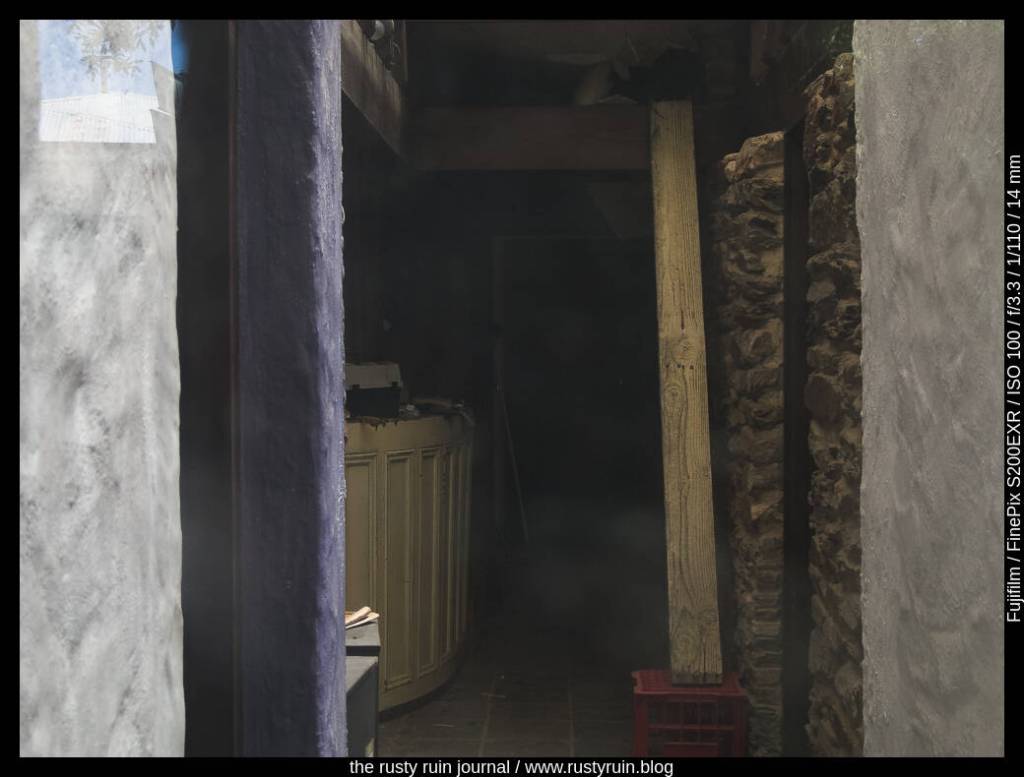
Behind the plywood wall

Fuzzying up the edges ~ more edits of Camp Snap photos

In my last post, I wrote about experimenting with the Focus module in Exposure X7 to add slight blur and bloom. This goes some way towards reviving the look of old soft lenses that lack modern anti-glare coatings. It’s potentially a great fit for the low resolution results from toy cameras like the Camp Snap and others because it reduces the ugly haloes around edges that have been aggressively sharpened.

Tree of Knowledge, Barcaldine QLD – Camp Snap

You can see in the photo of the Tree of Knowledge above that the Soften and Diffuse preset in the Focus module adds glow around the highlights, giving it an ethereal quality that contrasts well against the sharply angled boughs of the tree and the descending wooden timbers.

Old car in the shade – Camp Snap

Here again, the highlights take on a nice soft glow. Everything seems ever so slightly blurred and the sharpened edges are softened considerably.

I think the glow effect in some of these photos is more pronounced because I’d used the Camp Snap with two filters attached: a Photape Warming filter, and a cheap diffusion filter that adds glow and softens highlights. I’ve since removed the filters and will experiment further.

The red lantern – Camp Snap

You can see how the Camp Snap struggles to handle the strong red colour of the lantern. The result is a blown out mess where the details are lost.

A rocky coastline – Camp Snap

The Camp Snap is great for scenes like this, where there are more mid-tones than bright highlights – sky, sea, and cloud in distinct layers. It’s the kind of seascape that I might have snapped with my old Kodak 110 format film camera as a teenager.

Back to camp ~ softening oversharpened photos

One of my biggest issues with the Camp Snap is the aggressive noise reduction and oversharpening. The latter results in ugly haloes that are especially visible in backlit scenes. Adding film grain to the image in Exposure X7 combats this to some extent, and also effectively breaks up oversmoothed areas, but it’s not an ideal solution. But I think I might just have found a better way.

Old machinery in outback Queensland – Camp Snap plus softening and warming filters

The Focus section in Exposure X7 contains a useful preset called Soften – Diffuse Glow. This module mimics vintage lenses that are softish and bloom the highlights. I have now created a preset that adds blurring and blooming, slight vignetting, and fine film grain.

Even though the Camp Snap is a toy camera, it features good sharpness and resolution when compared to other toy cameras like the Kodak Charmera, the G6 Thumb Camera, and the Chuzhao. More importantly, Camp Snap photos don’t seem to feature obvious interpolation artifacts because I don’t think it’s resizing images beyond the native resolution of the sensor. Both the G6 and the Chuzhao feature these unattractive digital artifacts.

Transport museum window – Camp Snap

Tonight I went back and edited a bunch of Camp Snap photos. The Focus module seems to effectively soften the hard edges and sharpening haloes. I’ll be playing with this a lot more.

Minimart open 7 days – Camp Snap

Pocketable plastic fun and the Nikon D200 ~ a day on the coast with two cameras

The Nikon D200 and the Kodak Charmera – two very different cameras on the surface. The D200 is built like a magnesium-alloy tank and the Kodak Charmera is a tiny plastic toy. There’s no comparison when talking about image quality, of course, yet I continue to return to the fact that we can freeze time through the use of these devices, whatever their technical limitations.

The act of making a photo has become so culturally habitual – so intertwined with commerce and self-promotion – that the initial magic has long since been lost. We’re a long way from the very first photo made ~ “View from the window at Le Gras”.

California Surf – Kodak Charmera

It’s strange to think the toy Kodak’s 1.6 megapixels features vastly more resolution than the very first photo made using a camera obscura over an 8 hour exposure time. Marked in technological milestones, human lives seem small. Our lives seem smaller still when we pick up to examine even the dullest stone that lies at the foot of a worn hill that was once a mountain.

Fern in high-key – Kodak Charmera

In colour, the photo above is washed out and the highlights burned beyond editing. In black and white, the photo becomes a small study in shape, direction, pattern, and shadow, with a high-key aesthetic. It was a single moment seized as we ordered food.

Exploring the wreckage – Kodak Charmera

We chanced upon a burned out ruin. I walked around fallen red brick and charred wall cladding, immersing myself in light and shadow.

Ghosts in broken rooms – Kodak Charmera
Angry scrawls – Kodak Charmera
Nails and holes in the wall – Kodak Charmera

I couldn’t forget the Nikon D200 in my camera bag. It pulled on my left shoulder as it reminded me that it’s services were available – every bit the prosumer DSLR of 2005 and seemingly so distant from that first photograph in the early 19th century.

One might wonder if there exists a linear technological line between cave art on rough walls and the recording of the world to modern digital storage media? It’s hard to imagine a world without the technology to record ourselves and the world, yet we’ve always sought a type of crude immortality through the things we leave behind – whether recorded on cave walls 60 thousand years ago or posted online. We try to leave a mark before we leave.

Blue walls and red brick – Nikon D200

Rarely do I have the opportunity to get so close to a ruin like this. Walking over the rubble, the soles of my sneakers adjusting to the sharp edges and angles of detritus, I reflected on the passage of time.

Ghosts in slivers of light – Nikon D200

The Chuzhao Toy Camera ~ Inspiration at your fingertips or more plastic junk?

When wading into the plastic-strewn waters of toy cameras and weirdly branded scameras, you’d be foolish to expect image quality. I certainly don’t! What I’m looking for in cheap cameras like this is fun factor. The Kodak Charmera works not because it makes high quality images, but because it’s small, pocketable, easy to use, and fun. At the very least, the Charmera makes consistently dodgy photos, so I know what to expect.

The Chuzhao is a tiny plastic TLR-inspired digital toy camera. It has no menu system, a nice colour screen shaded by a flimsy plastic hood, and a bunch of awkwardly placed buttons that seem to operate according to cryptic laws – hold down one button to access the photo album then twist the tiny silver crank on the side of the camera to select a photo, then press another button to delete. Like I said, it’s cryptic. It’s a good thing the basic operation of the camera is easy enough.

Sunset, wood, and wire – Chuzhao camera

My first impression is that the Chuzhao TLR-inspired camera can make surprisingly detailed photos in good light. In low light, it’s an impressionist painter’s worst nightmare – more oversmoothing than exists in half a dozen Kodak Charmeras combined. They’re not even worth salvaging in the best photo editing programs. I don’t believe all the AI in the world could save the worst of these photos without significant insertion of generated content. But as you can see in both the photos above and below, the detail possible can be surprisingly good for such a toy.

Furniture on the side of the road – Chuzhao camera

I need to make an admission: all of these photos have been ever so slightly edited. As with my Charmera pictures, I’ve added film grain to break up the oversmoothing, reduced the Clarity to make it look less sharp, and added some extra warmth.

Growing in the window light – Chuzhao

The Chuzhao camera is a strange device. It’s not as unobtrusive as the Kodak Charmera because it’s not really small enough to fit into a pocket comfortably without it feeling like you’ve stuck too many Mars Bars in there. And because it features the classic TLR top-down view, it takes time to compose pictures and isn’t going to be your friend when you want to use it in other positions and angles. I can quickly grab a photo with the Charmera, but the Chuzhao demands more attention, making it not quite as fun or as convenient.

Zaneti in monochrome – Chuzhao

I do think there’s something positive to be said for using the Chuzhao in good light in the included black and white filter mode (mine is actually sepia tinted, so I just desaturated it during editing). And the inclusion of auto-focus (yes, auto-focus in a toy camera) means that it’s capable of close-focussing and blurring backgrounds. That in itself is pretty cool. Being fixed focus only, the Charmera can’t do that. Neither can the Camp Snap.

The Chuzhao is worth a look if you buy it cheaply. It’s available on a wide range of sites and I wouldn’t be surprised if quite a number of those listed are just copies of copies with different innards – so you take your chances with something like this.

It’s all about the vibe ~ why use old digital cameras?

If you’d told me 15 years ago that my 1 megapixel Kodak would become a vintage digicam fetish item for Gen Z, I might have been amused. At the time, I was looking for tech-upgrades I could afford. It was all about more megapixels, as that seemed to be the measure of a digital camera in the 2000s – a time when companies other than Nikon, Sony, and Canon thought they had a chance to revive their fortunes after the film era.

I might not be Gen Z, but it’s nice to use these old cameras again. Exploring macro modes, slow start-up times accompanied by bell chimes, and outdated storage media reminds me of how exciting the digital camera market was back then. Even a company like Casio – largely known for calculators and watches – was dipping their toes into a market that was fresh and ripe for innovation.

Soft shadows on wood – Olympus C-770

For those of us who lived through it, this particular past doesn’t hold the mythical gold that Gen Z thinks it does, but it’s also perfectly natural to yearn for brighter yesterdays, especially when today is so obsessed with both the perfection of the image and the kind of moral purity testing that accompanies a technology layer that weaves relentlessly through our lives, recording our thoughts and feelings so that we’re not allowed to ever forget or forgive.

Despite the nostalgia, there are other benefits to reviving old digital cameras:

  • Save the environment by not chucking out a perfectly usable old camera. Companies tapping viciously into the dopamine hits that reliably ensure we hit the technology upgrade treadmill and spend spend spend don’t help our planet.
  • Use limits to learn – it might only have a maximum ISO of 400, no image stabilisation, and a sensor that goes blind as soon as a sliver of a highlight hits the photosites, but those old camera limits will teach you patience. They’ll teach you to consider dynamic range. They’ll teach you to slow down and compose each frame properly because the camera doesn’t have the same easy conveniences our modern cameras do.


  • An old digital camera will also teach you that photography is about more than expensive camera gear. I’ve said it before – people have been making wonderful photos for more than a century. Great photos are not restricted to the 21st century and camera gear that makes your bank account weep. If you’re not making good photos with a cheap camera, you’re not going to make good photos with a $6000 camera.
Demolition of the old church – Nikon D200

The Olympus Camedia C-770 Ultra Zoom ~ 4 million pixels of unhurried contemplation

Just as I once developed a taste for the Fufifilm Finepix series of bridge cameras, it seems that I’ve developed a similar taste for old Olympus bridge cameras. I blame it on the recent resurrection of my Olympus C-725!

Behind the varnished door – Olympus C-770

On paper, the Olympus Camedia C-770 doesn’t seem like much: 4 megapixels, shutter lag that would annoy today’s impatient camera users, a 1.8 inch TFT screen, a longer start-up time than you’d hope for (good for those with a contemplative photography bent), and the need to use an XD card as a means of storage – let me tell you, those XD cards aren’t especially cheap.

Despite the negatives, there are surprising positives: an excellent lens with a sluggish 10x zoom; a decently fast 2.8 aperture at the wide end; a double (yes, double) flash for nuclear tests with unsuspecting portrait subjects; a respectable Electronic Viewfinder (yes, these old digital cameras carried the DNA of modern mirrorless cameras); a very readable EVF information overlay that includes a live Histogram; level settings for Sharpness, Contrast, and Saturation; the capability to record TIFF files if you can deal with the slow write times to the XD card (only 8 bit, unfortunately); and an enlarge feature that seems to engage an upsizing algorithm and makes those 4 megapixel files into 8 megapixel-sized files.

Have a seat – Olympus C-770 Ultra Zoom

I set the camera to record Super High Quality JPG files, dialled back the Sharpness and Contrast by -1, and increased the Saturation +1. Out of the camera, the images are pleasing. At 64 ISO, the digital noise pattern is so fine that it’s negligible. Of course, you wouldn’t want to push such an old camera beyond ISO 400 anyway, unless more digital noise is your goal. Nor would you want to entertain a low shutter speed when zooming enthusiastically, as there’s no vibration reduction or image stabilisation.

Red door corner – Olympus C-770

LIke the Olympus E-1, the Olympus bridge cameras are great little image makers when used within optimal limits ~ high dynamic range scenes will punish these old sensors and you’ll be forced to crush blacks or blow highlights. To compensate for these limits, I choose my scenes carefully – evaluating the dynamic range before putting the camera to my eye. Often, I’ll recompose, making decisions on how many shadows/highlights to include and how this will affect my vision for the final photo.

Worn and weathered gear behind the old shop window – Olympus Camedia C-770 UZ

Lo-fi junk toy paradise ~ The G6 Thumb Camera

A few days ago, I received the G6 Thumb Camera ~ a knock-off version of the Kodak Charmera available from cheapo plastic junk merchants like AliExpress. A copy was always going to happen when it became clear that the Kodak would sell-out quickly.

As I tore the box open to reveal the toxic green G6 keychain toy camera, my contribution to environmental pollution gnawed at me. It’s a feeling that grows with each passing year. We might have cherished our expensive mechanical film cameras for many years in decades gone by, valuing their form and function in a much slower and less product-addicted world, but now it seems as though we can’t get enough of the next thing and the next thing and the next

Under the table – G6 Thumb camera, edited in Exposure X7

I edited all of the photos in Exposure X7 using settings that disguise the mushy and detail-bereft shadows, the blown highlights, the oversharpened edges, and the oversmoothing – though the G6, despite clipping the red channel as soon as even a hint of red appears in a scene, doesn’t seem to sharpen or smoothe things quite as much as the Kodak Charmera. Consequently, the images are bad in a different way, weird banding artefacts included.

Yellow wall and webs – G6 Thumb Camera

The G6 can do a few extra things – I can set the EV, the image quality, and even the White Balance. I have mine set to -1 EV, 2 megapixels, and Daylight WB. Even though the image quality settings extend to a whopping 12 megapixels, I’m not even going to bother as I imagine things would only get worse if an almost useless image resizing algorithm were to be engaged.

Blue trolley on a hot day – G6 Thumb Camera

The focal length is too wide to be really comfortable, and the 16:9 aspect ratio is not ideal. However, this does encourage different thinking around framing and composition – not a bad thing at all. Oh, and if I long-press the up-button on the back, the LED flash turns on and the G6 becomes a torch…

Discovering quiet corners ~ the transient and the imperfect

Feeling sentimental, I recently took the newly revived Olympus C-725 to a local marina on New Year’s Eve. It was a lovely night with friends and family. I also packed the Kodak Charmera of course, having been my 30 gram pocket companion since Christmas. Since the ageing 16 megabyte XD card in the Olympus only holds a maximum of 21 photos at the High Quality setting – a storage concern sure to vex many modern digital camera users – I reached for the Charmera once I received the dreaded Olympus Card is Full message in bright orange text.

Stacked for the evening – Kodak Charmera

Encouraging a playful mindset, the Charmera encourages photos that are both ordinary and atypical. Divorced from the need to create a worthy image with a worthy camera, there are no gorgeous sunsets or beautiful portraits. There are instead worn chairs stacked against a blue wall and orange chairs stacked atop a weathered table. Beauty in the ordinary – liberated from the gear – Kodak wabi-sabi – the appreciation of the imperfect and the impermanent.

Orange chairs chained to a wooden table

The glow of angled orange plastic at sunset, set against the wood and brick, with a hint of blue wall – an ordinary scene recorded by a distinctly ordinary toy camera.

The size of the camera doesn’t matter. The quality of the digital sensor is just another tool to be used wisely. What matters is the encouragment of the eye and the imagination in the moment.

One corner of a Chevrolet