In my previous post, I touched on the idea that not every photo needs to be epic and impactful. Not every moment needs to be recorded. We must always remember that seeing and feeling are at the heart of photographic practice. In cultivating the eye and heeding the pull of emotion, we enable synchronicity with the environment, and in this momentary state the camera records our imaginative trajectory through the world.
Yet, sometimes the photos are small and quiet. They’re not loud or imposing at all. These are the quiet corners and the scenes forgotten in a rush. They’re just as important and they’re the details we often miss.
Empty bottles in the sun at a second-hand shop in the country – Sony RX100
In a world where we often clamour for attention, hoping for some notoriety or virality, for some interaction on social media, for the epic amplification of our voice, being loud seems to have become the default mode for many. The intense desire to be heard above the digital cacophany may signify the ongoing trend to further isolation, loneliness, and insularity but the small and quiet photo, bereft of loud intentions and sweeping announcements, is a momentary escape. This is where we connect the eye, the heart, and the imaginationto the world.
The sun was out, there was a nice breeze, and we had an entire afternoon free. A drive to Blanchetown should have provided fruitful inspiration for photographs. But it didn’t, mostly. The weather was kind, the company good, the battery charged, and the Nikon Z5 ready for anything. So, what happened? It was me…
You know those days as a photographer when things just don’t come together? There’s a disconnect between what you see and how you feel. You compose and press the shutter but the result fails to inspire you. At times like this, I do a few things:
Remove the pressure from myself by leaning into other moments. Not everything needs to be camera-worthy and not every moment needs to be recorded. Enjoy the day and put down the camera;
Take out a different camera for fun and just focus on other scenes – details, textures, shadows. There’s good stuff in the small stuff.
Peeling and rusting – Sony RX100
Finding the details again
Sometimes, it’s easy to fall into the trap of wanting every photo to make a big impact. But those magical sunsets full of great colours don’t come around too often. Those moments when the photographic mind and heart are synchronised with the wider world aren’t always available to us. At these times, it’s important to take a step back and access other areas of the photographic process: enjoying the moment, seeing the details.
Peeling and rusting 2 – RX100
Accepting fate and below average photos
Sometimes, even when we dig into another bag of tricks, the photos don’t turn out great. Over time, we develop a sense of taste and curate our photographic output, so what might please someone else won’t please us. Part of the creative journey is developing taste and deciding which photos meet our taste standards to become the ones that really make an impact.
The remaining, less than stellar, photos are still important because they’re part of the journey to get to the photos that meet a well-developed artistic taste. Some days are about honing the eye and sensibility. Not every photo is going to be a winner and that’s OK. In fact, it needs to happen, otherwise things get boring and you don’t sharpen your eye, your imagination, your taste, and your art.
As city revellers were ushering in the new year, we were driving with good friends through silent streets around the wharfs and docks. Earlier, we’d had dinner at a pub on the edge of the marina and witnessed a sunset full of delicate hues.
The Marina at Sunset – Nikon Z5
Once again, the opacarophile strikes! Low in the frame, the masts were like trees – but stripped back, orderly, severe, and made by human hands. Tiny streaks of boat fuel and chemicals on top of the water, iridescent in the fading light, reminded me of how these places are underpinned by our need to exploit the environment for reasons of vanity and leisure. I gazed at expensive apartments across the water, with expensive boats moored nearby, and thought about the very few who could afford that kind of life.
Some mundane reflections
I’m learning how to handle the Nikon Z5 better. I have no complaints about the hand-feel of the camera. The grip is typically nice in that Nikonian way – though not up to the high standard of the Olympus E1. The Z5 doesn’t have all the external button control of higher models in the Z lineup, but it’s the entry level camera, after all. That’s no bother to me.
I once wondered about the role my tiny Olympus OMD EM5 Mark 2 would play in the aftermath of my Z5 purchase. Admittedly, I don’t take the Olympus out as much as I used to, but on days when I want to carry less weight, it’s the better option. I’ve also become so used to using old manual focus lenses on the Olympus, just for the central sweet spot of the glass, that it seems a missed opportunity not to use it.
Reeds at Meningie, SA – Nikon Z5
I should explore the use of vintage glass on the Nikon Z5 this year. I invested in a good quality M42 adapter, so now I can use all of my old Soviet, German, and other glass. Pleasingly, the Z5 automatically detects a non-CPU lens and switches to Focus Peaking mode. No longer do I need to go into a menu and turn it on!
It’s a new year. We’ll see what happens. Some things will change and some things never will.
Two sunsets in my previous post, and now two photos of rusty stuff for this post! Can you detect a theme here?
This old rust-bucket – Tennant Creek, NT – Nikon Z5with Viltrox 20mm lens
Tennant Creek – Jurnkkurakurr to the Warumungu people who have lived in the area for many thousands of years – is located 1000 kilometres from Darwin. In other words, it’s a long way from any big city! The town features a history of gold mining and some of that equipment and the story of that time can be found in a local museum.
I daresay that many travellers pass through Tennant Creek as quickly as possible, mindful of the stories they’ve heard regarding the residents and crime. Whilst it’s true that a recent history of such social turmoil exists, it’s wise to remember that the land speaks of much older stories and times long before colonialism. As ever, visceral reactions to news stories and statistics obscures the lived experience of local people and ultimately, the real drivers behind social problems.
Another old rust-bucket – Tennant Creek NT – Nikon Z5
Making photos isolates a moment in time. Photos often lack context and tell a story that the photographer wants to tell. The idea that a viewer would have an emotional reaction to a photo drives the work of many photographers. Indeed, street photography is littered with such raw moments and reactions.
Such thoughts enter my mind as I carry the camera and stop at a street corner in Tennant Creek. Rather than lift the viewfinder to my eye, better to think on the people who have lived here for thousands of years and face the cultural whiplash of colonialism and bleak over-representation in the justice system – a system that usually protects the rich and powerful and punishes those who can least endure it.
The Urban Dictionary defines an Opacarophile as someone who loves sunsets. It would be fair to say that many people find beauty in sunsets. Certainly, at the end of a day out on the road, our thoughts turn to whether we’ll find a suitable spot to witness the sunset and make a good photo. There’s always some resigned grumbling when heavy clouds obscure the sun!
The importance of the setting sun
The setting sun signals the end of the day and the turning of the earth. One might ponder our long line of ancestors, staring at the shifting hues and watching the sun retreat below the horizon. Such an event reminds us of our smallness and our place in the world.
Evolutionary science suggests that when we experience the beauty of sunsets, we tap into our evolved aesthetic faculties – brain wiring that allow us to see the rightness or harmony of something in order to judge its value and health. A healthy mate is vital to produce healthy offspring and continue the species, so beauty in this context represents a healthy mate and potential long-term survivability. A beautiful sunset stimulates the same aesthetic faculties that allow us to determine the health of a potential mate and the rightness and harmony of things.
Perhaps that theory is a long-bow to draw for many! My favourite is the Biophilia Hypothesis, which I’ve mentioned in a previous post. The idea that humans are drawn to natural areas because we have a deep-rooted connection to them, having lived in such areas for most of our history, is a compelling one.
Two sunsets, two interpretations
Sunset, Meningie SA – Nikon Z5
Having spent much of the day driving around the Cooring, Meningie provided us with the most wonderful of sunsets. A variety of colours, shifting from moment to moment, reflected in calm water. This single sunset made up for all of the sunsets we missed. Can you spot the lone duck in the above photo?
I’m glad I had my Nikon Z5 with me for this. I’d attached the excellent Nikkor 24-70mm F4 S lens after deciding that my usual lens, the Nikkor 40mm f2, needed a break. I know that many photographers prefer a tripod for such scenes, perhaps combined with Neutral Density filters, but our day-trips are about chance and hope, best represented by hand-holding the camera and moving to the next potential aesthetic wonder.
Sunset, Meningie SA – Nikon Z5
What a difference a moment makes to the colours of a sunset! I’m being a bit cheeky, as the colour in the photo above is actually a momentary interpretation of the automatic white balance in the Z5. Once I saw what white balance it had chosen, I decided to stick with it. The first photo is much more like the original sunset we saw. I simply exaggerated the blues and pinks by setting a Tungsten white balance during editing. It’s one thing I’ve noticed in my Z5: the automatic white balance is sometimes over-eager. Still, I find it’s best to grasp these chance moments and chance settings!
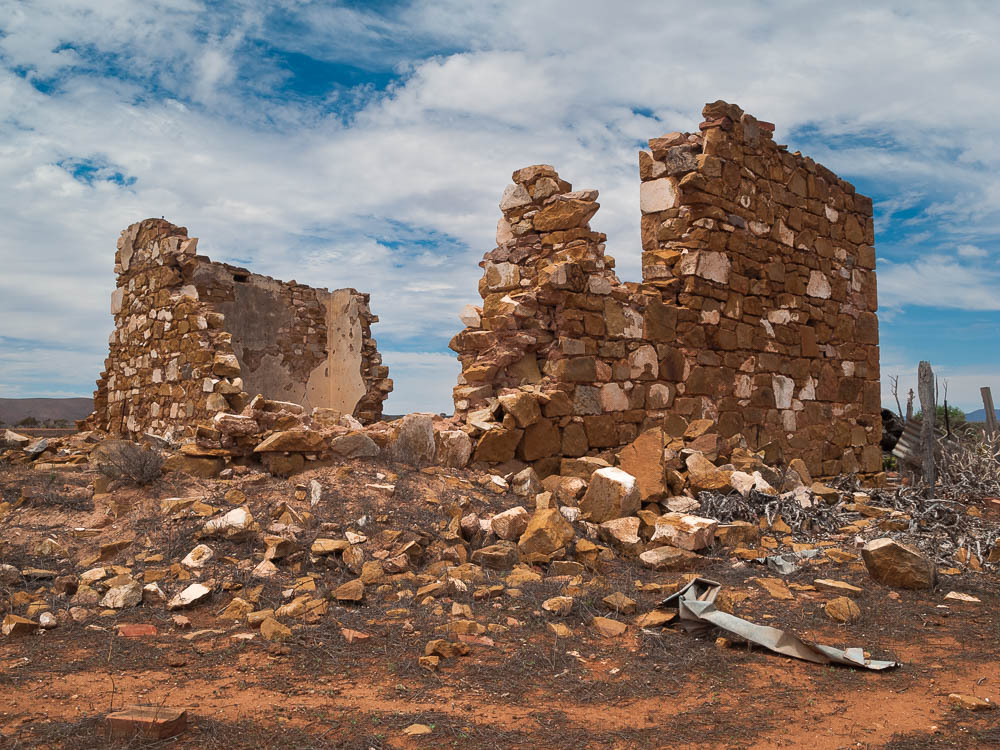
When driving along the dusty Southern Flinders road into Hammond, it’s clear that it was once an important town along the formerly vital narrow-gauge rail line that fed so many settlements in the area. Whilst not completely abandoned, another decade or two may see Hammond left to the relentless heat and wind.
On the outskirts of Hammond SA – Olympus E1
I was drawn, of course, to the dilapidated ruins up the road, marking the dusty way to more ghost towns beyond. Yet another reminder that nothing is everlasting.
The E1 proved a great companion here, even on a bright sunny day. As long as I looked after the exposure compensation carefully, so as not to blow out highlights too heavily, I was rewarded with at least half a dozen photos the equal of my Nikon Z5 in all but overall size and resolution. Still, as discussed before, megapixel counts are often overrated.
A once grand entrance, Hammond SA – Olympus E1
If I have the stamina, I also pack my Z5 alongside the E1, but the bag then does tend to drag at the shoulder a little. Fortunately, such long drives into the mid-north necessitate lengthy car rides, thus allowing my shoulder to rest between destinations. As ever, my concern is for a solid shoulder-slung camera bag that allows me to pack enough gear for a comfortable day – hopefully as inexpensively as possible whilst still retaining usability and build quality. My current bag cost all of $60 AUD and allows me to pack both the Nikon Z5 and the Olympus E1, though other features are lacking, including a strap that isn’t adjustable.
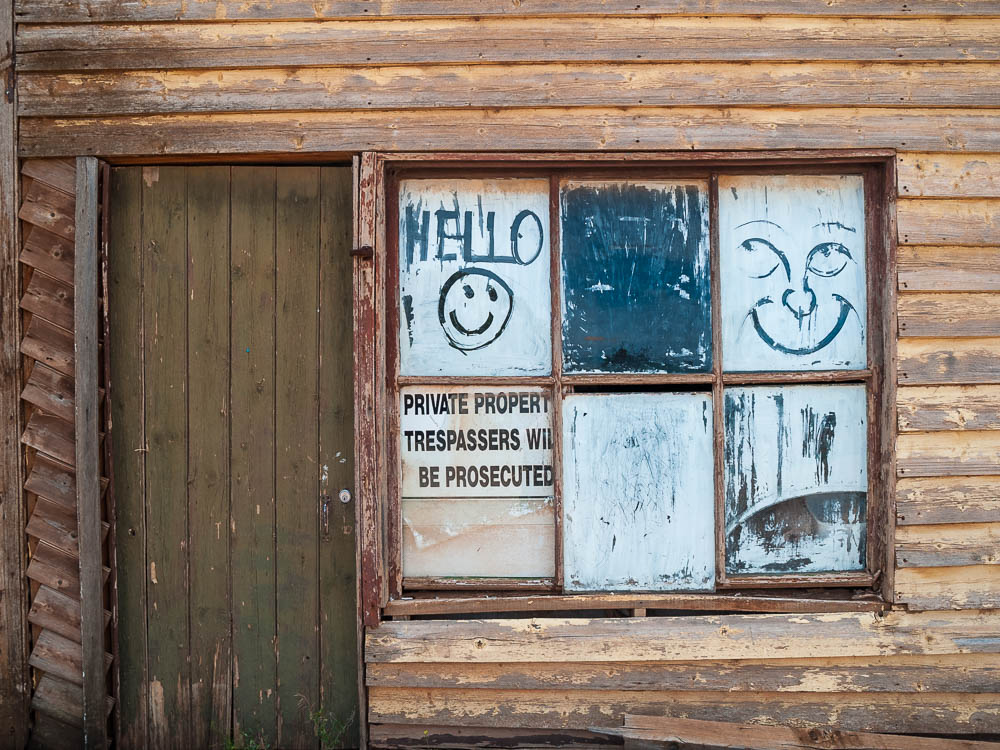
Hello Trespassers! – Hammond SA – Olympus E1
The E1 still surprises me. For a camera from 2003, with limited dynamic range, it can certainly handle enough tonal range to produce some of the most attractive photos in my folders. Sure, a good subject helps a lot, but the E1 seems a good match for scenes I would have thought it would struggle with. Perhaps I’ve gelled with it to the point that I’m looking for scenes with more mid-tones and less gap between light and shadows, as this is where it shines best.
Old mysteries behind closed doors, Hammond SA – Olympus E1
Well worth the drive, if you can stand the dust and the gnawing sense of a town that has all but been forgotten. I love it, of course – the sense of melancholy is always a stern reminder of time’s vengeful movement. One interesting feature of our time there: a resident playing modern pop music loudly from inside the old town bank, drifting on the same winds scouring the bones of the empty buildings.
It has been one heck of an exhausting fortnight and time has been limited and my motivation low. Apart from work and a possible change on that front, there have been some unexpected things to deal with that are proving tough to endure. So, instead of my usual ramblings, I’m just going to post photos of Dale Chihuly’s amazing sculptures – currently installed in our Botanic Gardens.
Sapphire Star, 2010 by Dale Chihuly – Nikon D40
It looks like glass but the sculptures are composed of a specially formulated polymer called Polyvitro. The material is robust enough to be outdoors in the weather and reflects the light beautifully. We thought it was glass at first!
Cattails and Copper Birch Reeds by Dale Chihuly, 2024 – Nikon D40Lime and Lava Red Tower by Dale Chihuly, 2021 – Nikon D40Blue Crystal Tower by Dale Chihuly, 2024 – Nikon D40
In my previous post, I went out with the Nikon D40 and made some street photos. Even though it’s an enjoyable experience, street photography can also be tiring if not in the right frame of mind. I find that placing too much pressure on myself to make good photos can take a lot away from the experience. And out in the street where you need to be alert to interesting scenes that may last mere moments, missing one can lead to frustration.
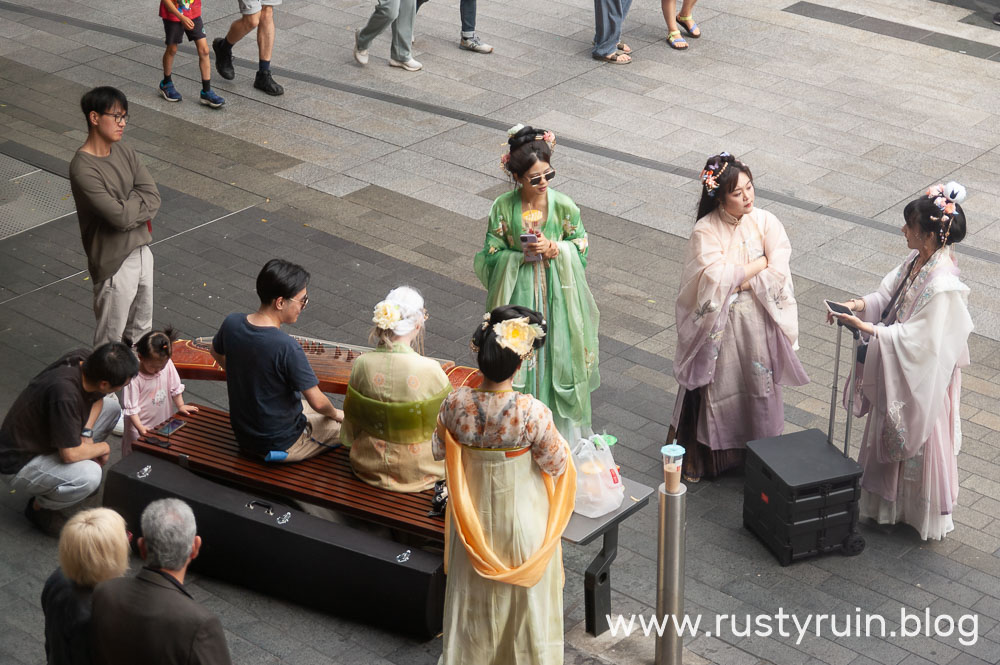
Gathering before busking – Nikon D40
As much as that experience can lead to moments of regret at having not been quick enough on the shutter button, going down that path simply leads to more frustration and lack of joy. There are so many moments on the street that it’s always possible to find another. In simple terms: don’t get stuck in a moment missed because you’ll have just missed another moment.
Fresh milk and soft toys – Nikon D40 with Tamron 17-50 2.8
What do we do as photographers?
A photographer collaborates with the world to make a photo of a moment that never repeats. As much as there’s pressure to record all of the moments that pass so quickly, the photographer also brings the attention of others to a framed moment in time. In doing so, the photographer creates an awareness in others of the larger world we inhabit. And how often do we inhabit it without much care for the present moment?
In this context, street photography is like being in a whirlpool of moments. That’s both exciting and potentially exhausting if the pangs of regret haunt us too easily when the camera and the moment don’t quite line up. In those cases, better to accept the passing moment and move into a new moment with open eyes and mind. And have we really missed a moment if we haven’t recorded it?
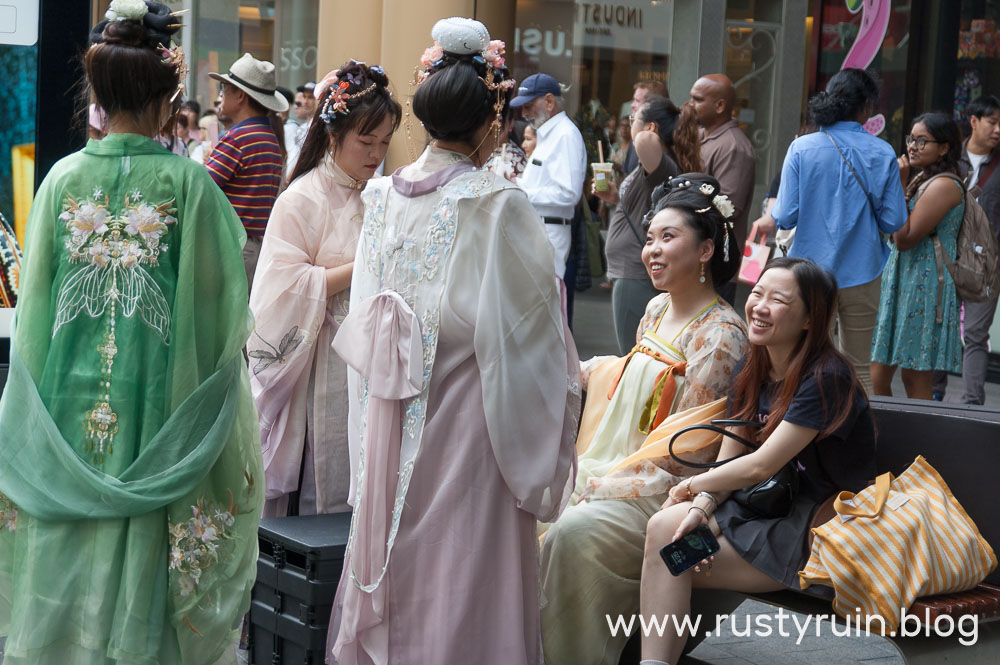
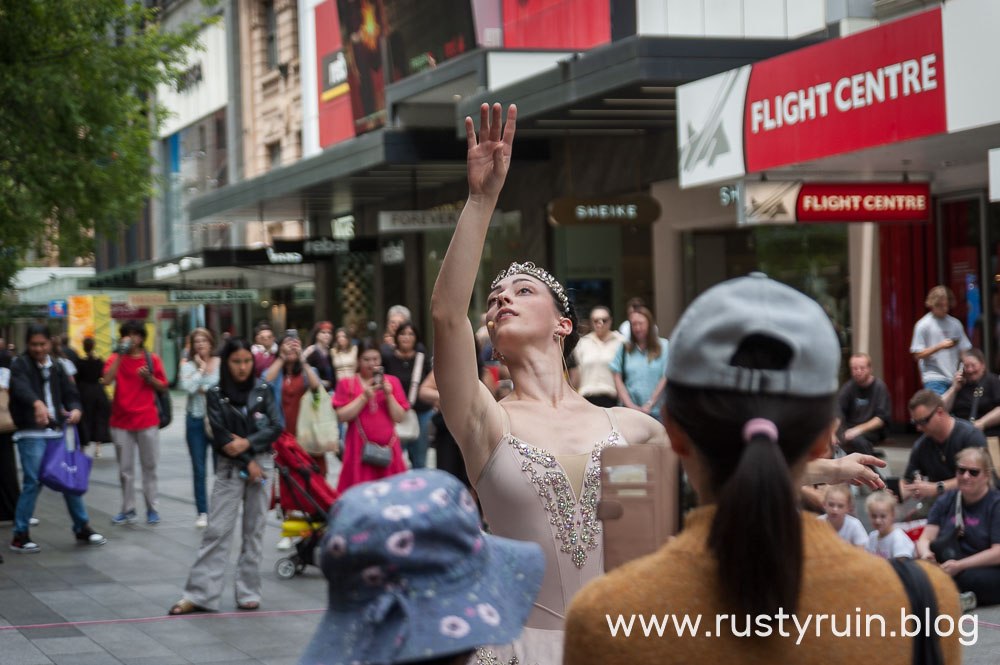
Celebration and relief after a street performance – Nikon D40
Having been very connected to my Olympus E-1 lately, I decided it was high time to take out another old digital camera in the Nikon D40. I don’t always get the chance to engage in street photography but when I do it can be a lot of fun. It does require a different approach though – being on the look-out for likely scenes and waiting for the right moment. The D40 isn’t exactly a classic street machine but it’s also small enough not to be much of a bother unless a big lens is attached, like the Tamron 17-50 2.8 I decided to go with!
Reaching for the stars – Nikon D40, ISO 200, F 2.8
I find that the D40 makes really nice photos, but the CCD sensor technology isn’t so great when you have to pull details out of heavy shadows during editing. The RAW files are flexible enough, but the heavy shadow areas can be a bit thin. These older sensors also aren’t so great at retaining highlights either, so you have to make the choice – expose for shadows or highlights when the lighting creates dynamic range that’s outside of the scope of the camera. This is similar to slide film.
Framed by yellow – Nikon D40
Even though there’s noise in shadow areas when you pull up the exposure during editing, the digital noise pattern isn’t objectionable. This is one area where CCD sensors had a clear advantage over their CMOS counterparts at the time – lower noise and a finer noise pattern. We seem to have come a long way since those early digital days, but cameras like the D40 still make perfectly excellent photos! How far have we really come, one might wonder?
Free hugs – Nikon D40
There’s also another nice advantage to using an old camera like this – 6 megapixels pairs really well even with a kit lens that doesn’t see a lot of love. The old 18-55mm Nikkor kit lens is much maligned but is nicely sharp on an old camera like this, since it out-resolves the 6 megapixel sensor. My Tamron looks even better and seems to pick up plenty of primary colours wide open. Still a perfectly excellent camera.
In my previous post, I wrote about driving through some of the towns along the Murray River. We’ve been here many times but I’ve often found myself uninspired in the photography department, though I’m not entirely sure why. Going for a day-trip with friends is always fun, but sometimes it doesn’t lend itself to me spending time fiddling with camera settings or framing scenes! This time was different though. I found myself with the trusty Olympus E-1 again and looking for the kinds of scenes that the old digital sensor can manage more easily.
Red paint and corrugated iron – Olympus E-1
There’s no substitute for time when it comes to photography, at least for me. I’m not one who clicks a thousand photos in an hour. I prefer to be as deliberate as possible. Admittedly, using an old camera like the E-1 teaches me to slow down even more to carefully consider the scene before me. That’s a good thing, I think.
Red paint and old wood – Olympus E-1
How often is it that we don’t get to slow down and really look at the world around us? How often are we pre-occupied with thoughts of the forever-gone past or the uncertain future? How often do we steal the present moment from ourselves? Once that moment is gone, it’s gone for good.
I like to think that photography has the capacity to teach us something about the hidden details of the world that are ordinarily missed. When I first started teaching myself how to use a DSLR, I turned to a practice called Contemplative Photography, or Miksang.
On such occasions, I found myself a little more in touch with both my mind and the world, with inner and outer touching at the very boundaries, one might say. At these times, there’s no judgement of a scene, just an image pressing gently on the mind, as though it leaps out of the water like a fish to be seen momentarily. There’s no setting up or messing with technology beyond what the eye sees and the press of the button. And arguably, the camera itself is not even needed to see those hidden details in the world.
All the red envelops you in this moment – Olympus E-1



























 The Rusty Ruin Journal