The excitement of a road-trip and escaping into the world

In the weeks leading up to our annual road-trip holidays, there’s a slow build of excitement that obliterates any pretence of work productivity during the final few days, for me at least. Questions around camera gear take root in my mind many months before setting off – what and how many cameras to bring? What lenses? Will I really need a tripod? How many bags and what kind?

In some sense, it feels as though this holiday in particular is partly about escaping the world’s current problems by escaping into and losing myself in the world. Photography can be therapeutic self-help in this way – reframing the world to suit our own narratives. As photographers, we look at things differently, composing and considering scenes and subjects before us. It’s a distraction from the pressing issues. We’re out there in the world, breathing in all that it offers, yet we’re one shutter-click away from reframing it to suit a story we want to tell so we can help ourselves.

The Panda’s exhausted – Nikon D7100 and 55-200mm Nikkor lens

Packing camera gear

Having recently purchased a Tenba Skyline V2 Shoulder Bag, I’ve been trying out different combinations of camera stuff for daytrips. I won’t have access to all the gear whilst we’re on the road, but a well-stocked easy-to-carry shoulder bag that sits with me in the passenger seat is going to be handy for quick stops along the way. Right now, I’m trying out this combination:

  • Nikon Z5 camera with the Nikkor 40mm F2 attached: This is going to be my workhorse camera. The 40mm Nikkor is about as sharp a lens as I need. I know there are sharper lenses, but this Nikkor is inexpensive, small, light, fast, and sharp. Ok, it’s an all plastic build, but it uses Nikon’s tough polycarbonate material, which seems to be quite durable. It may not be a classic but the results are excellent.
  • Viltrox 28mm 4.5 AF Pancake: It’s a third-party full-frame lens for Nikon’s Z system, nicknamed Chip, and it’s inexpensive. It’s also a strange lens – a true pancake lens (80g in weight), with a fixed aperture of 4.5, a 28mm focal length, a metal mount, part plastic and part metal body, 2 Aspherical and 2 Extra Dispersion lens elements, a USB-C port for firmware upgrades, and a mask that creates 8-pointed starbursts. I’m intrigued by this lens as it’s so odd. Auto-focus in a lens this small and this cheap is unusual. I think it will be much sought after in years to come, but what concerns me is that once the AF motor burns out, there’s no manual focus to fall back on.
  • Olympus OMD EM5 Mark 2 camera: Having gone back to using the Olympus lately, I’ve rediscovered the joys of a lightweight system with high quality. I use a metal grip to add a bit of heft and for better ergonomics. I’m testing out the Yongnuo 25mm 1.7 lens right now, so it’s attached to the camera. I could also pack the Sigma 30mm 2.8 DN Art lens, which is sharp and reminds me of a teeny-tiny Dalek when the hood is also attached.
  • Olympus Zuiko 4-5.6 40-150mm lens: This lightweight and rather small lens gives me an equivalent focal length of 80-300mm on the Micro Four Thirds system. If I want to be as lightweight as possible and give myself flexibility on the road, this lens is essential. Image quality is a bit on the soft side at 150mm, but that’s to be expected in a non-pro Zuiko lens.
  • Sony RX100: I generally take this with my in a day-bag whenever we go out. It’s so light and small and silent that I can use it indoors when I don’t want to bother with a larger camera and lens combination. This one fits easily in the front pocket of my Tenba bag.
  • Other stuff: Spare battery for the Z5, a micro-fibre lens cloth, a small wallet for 3 x 52mm filters (B+W Circular Polariser, B+W 10 Stop ND filter, and K&F Black Mist Diffusion filter), and an SD card holder for spares. I like the K&F Concept Diffusion filter at 1/4 strength.
  • Undecided: I’d really like to squeeze the Nikkor 24-70mm F4S lens in the bag but it’s pretty big and heavy. Finding a home for it in this bag with everything else is going to be difficult, but I think it may be a better option than carrying the Nikkor 40mm and the Viltrox 28mm. It will mean that the Zuiko 40-150mm lens has to live on the Olympus camera. Alternatively, I ditch the Olympus completely and carry the 70-300mm Nikkor ED lens attached to the FTZ adapter so I can use it on the Z5 – but this is a heavy and tall lens.
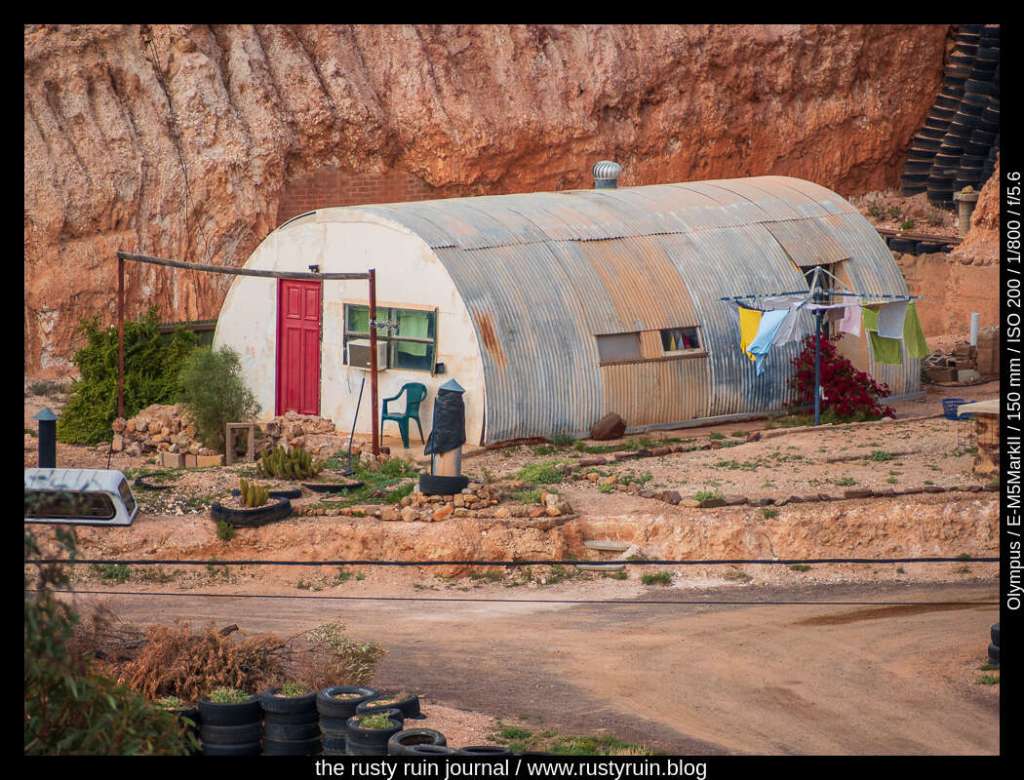
Behind the red door – Olympus OMD EM5 Mark 2 and Zuiko 40-150mm R lens – as you can see, even at 150mm, there’s acceptable sharpness available after some editing (contrast, clarity, and additional sharpening)

Notes from the warm side ~ another crappy photo

I recently acquired a Photape 85A warming filter (amber) – a colour correction filter normally used on film cameras to correct a mismatch between the colour cast of the scene and the colour temperature of the loaded film. It’s of not much use on modern digital cameras, especially if Automatic White Balance is used, since the camera’s software corrects for the colour cast. If using a custom or preset White Balance, the filter should have an impact, but it’s easier to do this in editing.

In my continuing quest to degrade the photos from the Camp Snap camera, I put the 85A in front of the softening filter, and discovered that the Automatic White Balance of the Camp Snap is not overly sophisticated. It may also be that this cheap toy camera uses a custom White Balance setting. Whatever the case, the old Photape filter does warm things up to a nice amber colour.

Gold Train – Camp Snap Camera with Photape 85A Warming Filter

Dreamy photos from the Yongnuo 25mm 1.7 lens

As much as I enjoy my Olympus EM5 Mark 2, I rarely invest in the system. Since the imaging arm of Olympus was sold off and rebranded under the OM Digital Solutions name, I admit that Micro Four Thirds has lost some lustre. It is, of course, a fantastic lightweight system and it would be nice to see Panasonic continue the format under their Lumix brand, though I fear that many camera manufacturers see 35mm sensors as the biggest cash-cow at this point.

It was with some surprise that I discovered the Yongnuo 25mm 1.7 lens for Micro Four Thirds. It’s a Chinese-made product and features a quiet auto-focus motor, which is unusual in such a cheap lens. The body is all-plastic, but it feels and looks good. It’s also the fastest Micro Four Thirds lens I own.
Dreamy vibes from a cheap lens

I made the photo with the lens wide open at F 1.7. The sun flared across the frame, resulting in a soft and dreamy look. It’s pretty sharp in the centre at an aperture setting of 1.7, with the edges and corners looking soft. There’s also plenty of chromatic aberration, especially in high contrast areas, but I think all of this adds to the mood of the photo.

Siloes at sunset – Yongnuo 25mm 1.7 lens

Just before the sun dipped below the horizon, I set the Yongnuo lens to F 2.2, just to sharpen things up a little, and made this photo. I really like the rendering of this lens so far and I think I’ll be packing it for our upcoming roadtrip.

Nitmiluk National Park ~ awe-inspiring gorges, a kit lens, and harsh light

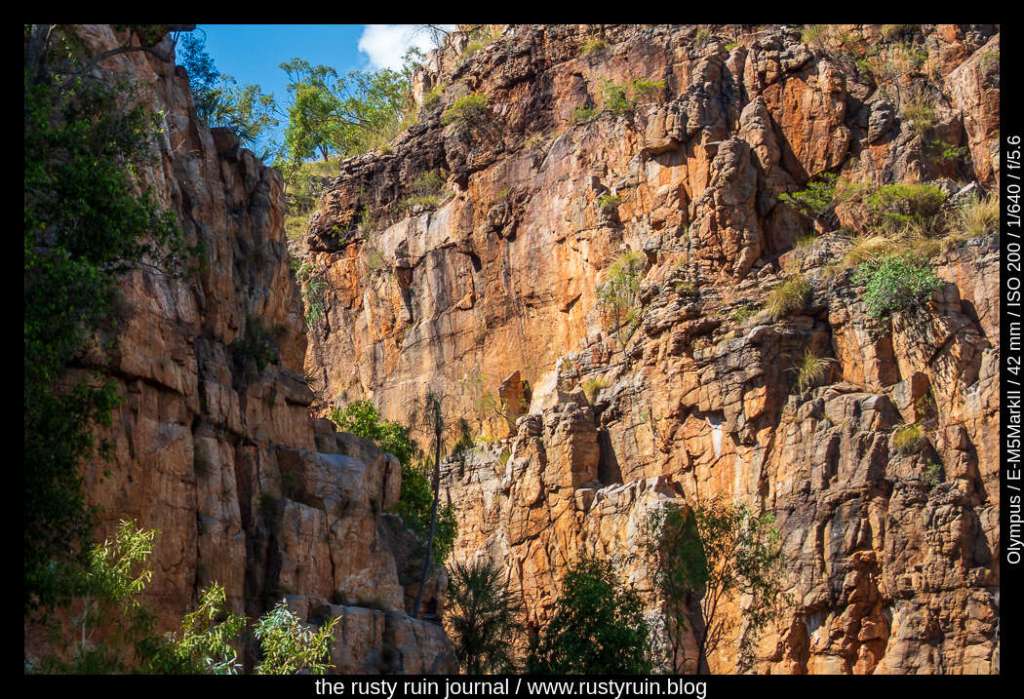
To the local Jawoyn people, the amazing gorges in Nitmiluk National Park (Katherine Gorge) hold special significance. We were fortunate enough to book a short cruise to see some of the many wondrous gorges in the area and view the ancient sandstone rock formations, calm waters, and freshwater crocodiles. This is an area teeming with life and Dreamtime stories.

Nitmiluk National Park, one of the gorges – Olympus OMD EM5 Mark 2 and 14-42 kit lens

Sunlight at the height of the Australian afternoon can be harsh. This is one reason I prefer viewfinders rather than the big LCD screens on so many cameras that get washed out in these conditions. 

The soft golden light of dawn or dusk brings out the best colours in the outback landscape, but trip timing doesn’t always permit, and you have to work with the tools you have and the light available when the opportunity arises. One quality this strong afternoon light does emphasise: all the textures on the ancient sandstone.

On the day, I packed lightly since I’d been lugging a not insignificant amount of camera gear around on other days (hello Lowepro Nova 200). The Olympus EM5 provides good image quality and lots of control in a small package. It’s just a small pity I’d also decided to take the 14-42 kit lens with me. That’s not to say that kit lenses are bad at all. Nikon makes some great kit lenses, such as the 18-55mm. And this Olympus Zuiko kit lens is no slouch in the image quality stakes – it does pretty well for a cheapish plastic lens. But at times when I want more sharpness to record all of the landscape’s details, it gets a bit fluffy and squishy at the edges of the frame. Still, you work with what you have and the conditions of the day.

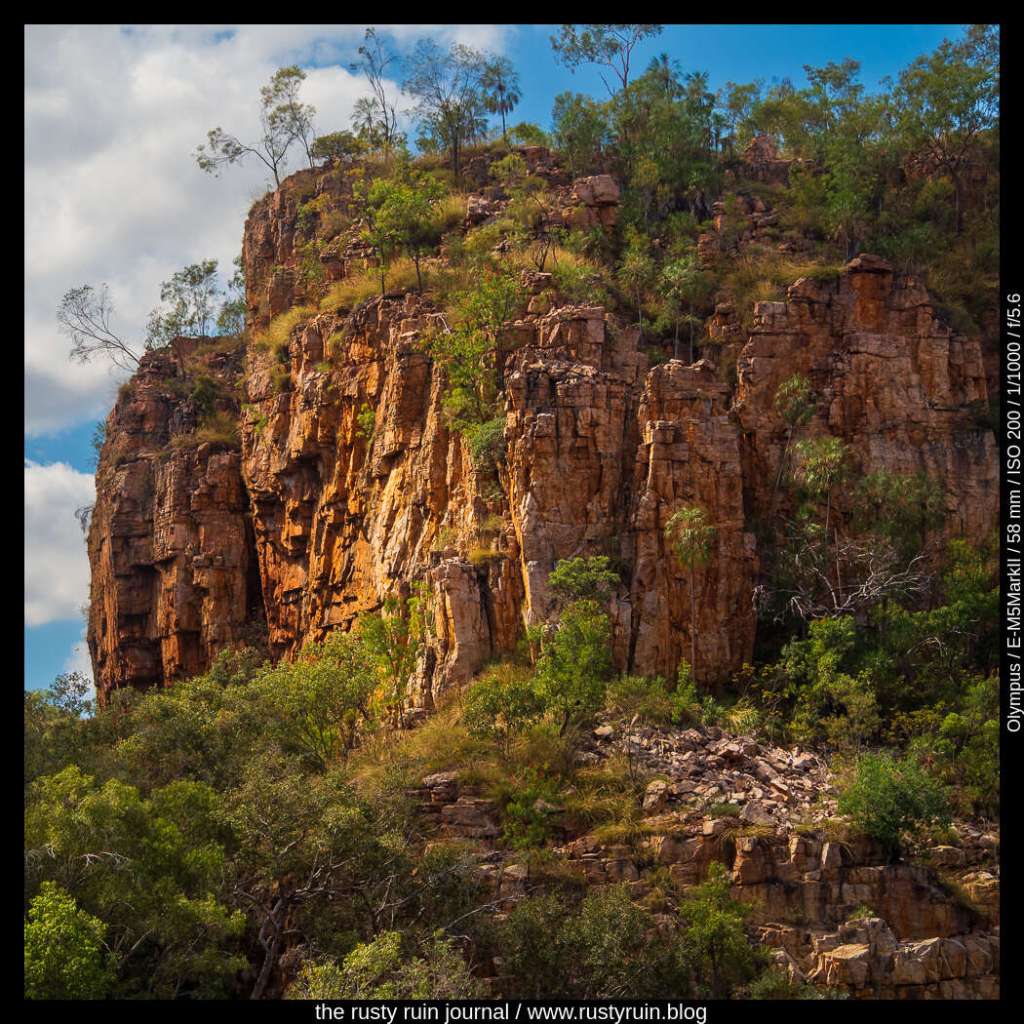
Nitmiluk National Park – Olympus OMD EM5 Mark 2

I’ll always say that eye-watering sharpness is generally overrated in photography, but there are times when sharpness is another tool you want in order to communicate certain qualities – the texture of the rocks in this case. Despite some of the shortcomings of my kit lens, careful subject selection, use of exposure compensation to retain as much detail as possible in high dynamic range scenes, and some boost to the red/orange/yellow colour channels during editing helps to make the photos shine. I also reduced highlights to reveal the details of the ancient sandstone.

A patch of sunlight illuminates ancient rock – Olympus OMD EM5 Mark 2 and Zuiko 40-150mm lens

As the clouds grew heavy, the light conditions became a little more forgiving. As you can see in the above photo, clearing clouds also provided an opportunity to record sunlight as it illuminated sections of rock. I used the so-called plastic fantastic 40-150mm Olympus Zuiko lens for this photo – small, light, and really quite sharp at most focal lengths. I guess the message is to know your camera gear and accept and make best use of your tools and the conditions. I’ll freely admit to not knowing all of my gear well enough at times!

The first flush of winter and some photos

Winter seems to have finally arrived and the looming long weekend here is threatening rain and wind. Not fantastic conditions for photo-walks, of course, but some interesting details can usually be found for the lens even on grim days. On this cold night, after a day of work, I’m scouring the file folder and not seeing aything that fires the imagination too much, so a loose photo assortment follows.

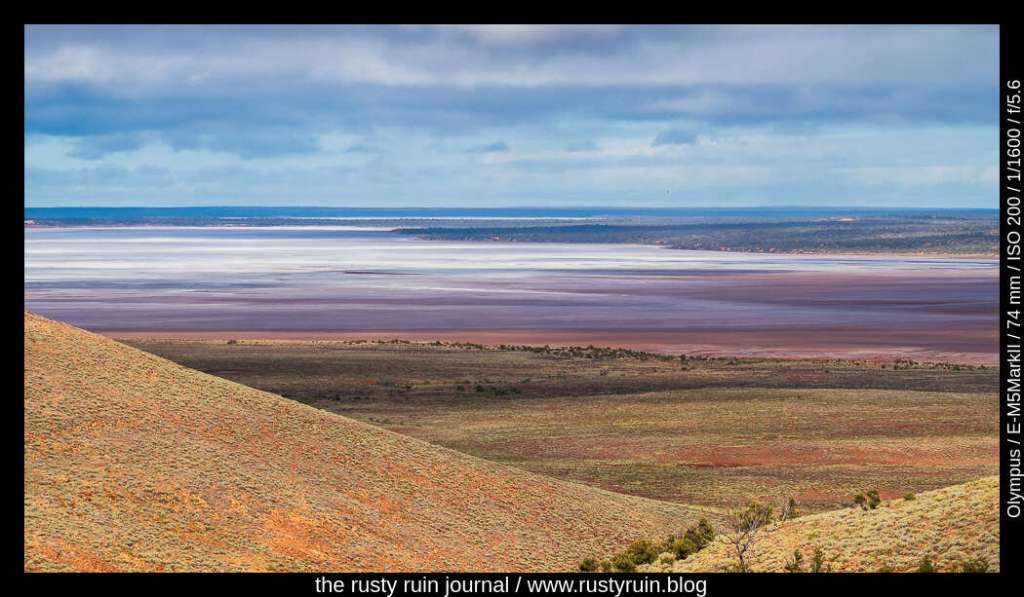
Lake Hart, SA Australia – Olympus OMD EM5 Mark 2

I like the coloured layers in this photo. Driving into the outback not far beyond Port Augusta, lies Lake Hart ~ a vast inland salt lake that’s easily accessible from the rest area and car park. The salt crystals crunch underfoot and the moisture below this top layer gets muddier the further you walk out.

Rusted and overturned car – Olympus OMD EM5 Mark 2

So often, we miss finding an interesting subject to photograph when the sun moves low and the light turns golden. On this occasion, after a day of driving through the Australian outback, we spotted this overturned and burned out car. The sunset rays hit the rusty body just right so that it glowed gold and red and orange. I must have made a dozen photos and this was the only one I was happy with. Always good to get close-up to subjects like this too.

Opal mines hereabouts – Olympus OMD EM5 Mark 2 and Zenitar 16mm Fisheye lens

Have you noticed that I’ve posted very summery and warm photos on this wintry eve? This vehicle has seen better days, for sure. It’s used as a signpost around Coober Pedy now.

Progress notes ~ I’m just over here making crappy photos

In my ongoing efforts to further crappify photos from the Camp Snap camera in the quest for feel and vibe, I’m definitely finding a grungy digital look with soft edges. I might not be able to tame the woeful oversharpening and noise reduction of the firmware, but I can absolutely stick some terrible pieces of glass and plastic in front of that tiny lens. Here’s where I really lean into the bad – the soooo bad, it might even be good. Maybe…

Arriving at the station – Camp Snap V105 with double softening filter in low light

Low light, two filters, and a tiny sensor, made through a car windshield – that’s a recipe for an image so grainy you could almost eat it with a spoon. I think it delivers some special digital vibe in a very lo-fi way.

Speeding through digital existence – Camp Snap with all the bad digital stuff

I’m really encouraging all the grain and the blown out highlights in the photo above. Those two stacked diffusion filters and low light conditions have slowed the shutter down so that the train is blurred. Add some spicy high ISO to the mix and this is the sort of image that most photogs would thumb their noses at. I like it. My favourite of the lo-fi digital train series.

Just passing through – Camp Snap camera

Progress notes on adding “vibe” to the Camp Snap camera

I ended up reviewing the Camp Snap camera in my last post ~ a toy camera made for kids on camp who aren’t allowed to take phones. For this purpose, it’s pretty cool, even if it’s overpriced here in Australia. But it also seems that a growing number of youngsters and lomo-hipsters have seen the value in it as an easy-to-use toy camera that makes vibey photos. In reality, the photos are awfully oversharpened and smoothed, but I see the appeal.

In my side-quest to improve the photos by degrading them further, I’ve toyed with some cheap filters. Here are two photos ~ the first without the softening filter and the second with it:

No filter
With cheapo diffusion filter (the cheaper the filter the better, for this purpose)

Already, the results are looking better! The filter spreads highlights around and results in a soft focus effect. Yes, the oversharpening is still there (unless the firmware can be hacked, this remains) but I think the image has more vibe and the sharpening is less obvious. I’m going to continue playing.

Back to basics with a trendy toy camera ~ Camp Snap or Crap Snap?

I recently purchased something I don’t usually look at – a toy camera that’s been doing the rounds on social media and seems to be popular with Gen Z and others who are looking for some kind of vintage-film-vibe from a digital camera. The Camp Snap is founded on some solid principles: an easy to use camera that kids can use on Summer Camps. In that context, the Camp Snap is actually kind of cool. So, is it any good? Is it worth picking up?

I can thank a gift card for bringing down the price to a level where I was actually interested. Otherwise, this is definitely an overpriced hunk of light plastic for what is essentially a cheap webcam in a shell. And if that sounds like bad news, then it’s likely only bad news if you’re looking for a quality camera that makes quality pictures. But if you’re in the mood for something that could be fun, and you also have a flexible attitude to image-making, then the Camp Snap might be of interest.

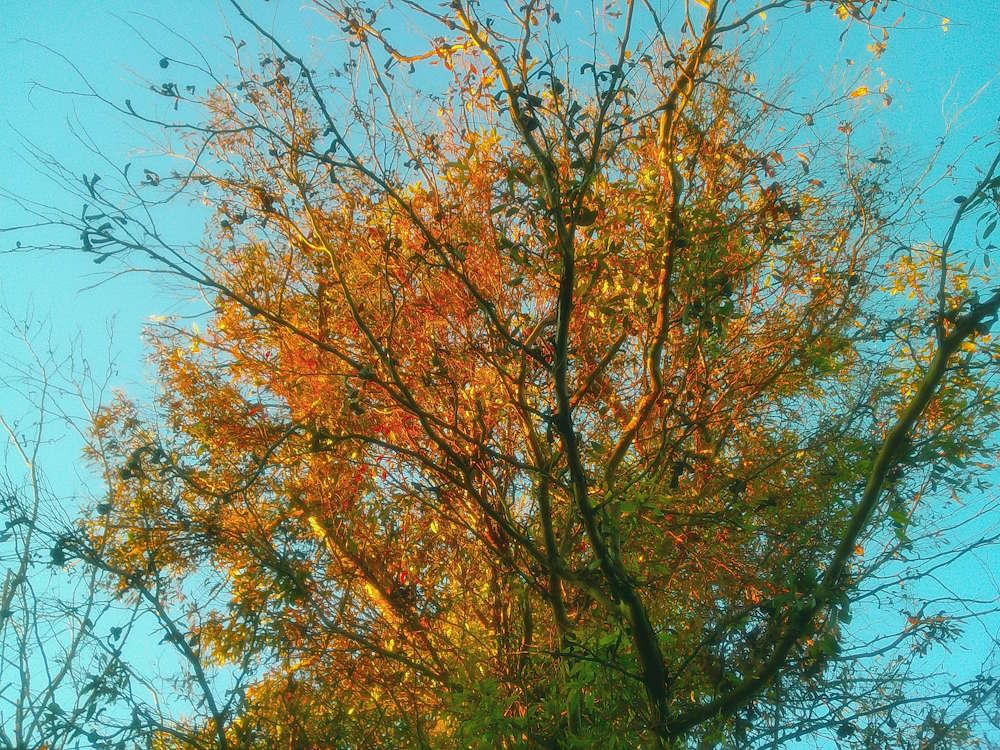
Tree at sunset – Camp Snap with my custom filter

Camp Snap camera features

It’s a simple plastic camera for kids with a shutter button that lights up in green, a USB C port for image transfers and charging, a LED flash that’s quite weak, a tiny CMOS sensor that produces 8 megapixel JPGs, and no screen for image reviews apart from a single readout that tells you how many photos you’ve made. Oh, it also comes pre-installed with a 4GB Micro SD card/TF Card. You can change the card if you unscrew a small panel. About the most annoying thing I’ve so far found is that the rubber covering over the USB port is recessed and hard to get my too-short fingernails underneath to lift up.

One thing I like is that it’s possible to use an online tool to create your own filters, spit out a *.flt file, and then drag it across to the root directory of the SD card. When you switch it on, the operating system reads the custom filter and applies the values – contrast, saturation, brightness, hue, RGB gamma – to every photo. In the photo of the tree above, I used a custom filter where I’d altered the RGB gamma values and emphasised mostly greens. It’s a quick experimental filter, so I’ll see how it goes.

Just quickly, if you like this post and want to read more of my words on photography, old cameras, and such, just fill in your email below. I’m grateful for every connection in this digital abyss!

Two trees – Camp Snap V105 with my custom filter

The bad news

If you’re looking for quality images, don’t buy a Camp Snap camera. It’s as simple as that. Hard to believe that anyone would think a cheap toy camera would make quality photos, of course. The photos have plenty of digital noise, are waaaaay oversharpened, and are aggressively denoised. This terrible combination results in photos that look like impressionist paintings when you zoom in. And even if you don’t zoom to look at the aggressive smoothing, you can see distinct sharpening haloes in high contrast scenes. I suspect all of this is to combat the teeny-tiny-noisy CMOS webcam sensor. In modern digital camera terms, it’s a piece of crap.

Vintage vibe?

I guess if you’re into that oversharpened and oversmoothed digital photo look from a 2007 mobile phone, then you’ll consider the Camp Snap a vintage photo-maker. I’ve read claims of it looking film-like and vintage, but this is not film. It really doesn’t look like film. Online claims of the photos looking vintage beyond the results of an old phone camera are a stretch. It’s a maker of jaggy digital images. If you want the film-look, buy a cheap consumer film camera from the 90s. Just be aware that it’s gonna cost you a bunch in film and development costs.

The good news

I bet you’re thinking this is a truly awful camera and I have some premium regrets, right? Actually, no. Apart from the fact that a gift card saved my bank account from what I think is an overpriced and slightly overhyped product, I didn’t buy it thinking it was going to make me quality photos (I have enough Nikon cameras for the whole neighbourhood, frankly). And that’s kinda the point of the camera.

The Camp Snap is easy to use. Really easy. A full battery charge is supposed to last for around 500 photos. That means you can slip it in your pocket day after day and make so many spur of the moment photos that you’ll forget about them until you come to download them – a bit like making film photos and then discovering undeveloped rolls in your drawer much later.

Speaking of spur of the moment, that’s probably the best thing about the Camp Snap. A cheap camera with no screen for reviewing images, a single plastic shutter button, and focus-free operation is a recipe for making photos without the mind being overburdened. It actually promotes a mindful-in-the-moment approach to making photos. You’ll likely make photos of things you wouldn’t even normally bother with, just to see how they turn out.

That scene of a rubbish bin at sunset? You’re probably not wasting time grabbing your Nikon DSLR to record that moment. But you’ll probably slip the Camp Snap from your pocket, make a quick photo, and then move on. There’s a certain liberation in that. And as long as you don’t expect good quality, some of those photos might even have some digital charm.

Corrupted green – Camp Snap and a corrupted filter

The other cool thing is that you can make your own photo filters and drop them into the root directory. Want to push the greens? You can do that. Want more contrast and saturation? You can do that too. It’s nothing more complex than the sort of thing you can do in any half-decent image editor or phone application, but it does contribute to the fun factor.

That bad looking photo above was made using a filter that, I believe, became corrupted when I used Lightroom to apply tweaks to a PNG file provided by Camper Snapper (a custom third party Camp Snap filter maker) and then truncated to an 8 bit file instead of 24 bits on the file save. It reminds me of a grainy photocopy. What this little mistake tells me is that the Camp Snap provides room for experimentation, and I think that’s fun.

Light on the wall – Camp Snap camera V105 and my custom filter

Room to have fun

The Camp Snap camera might make bad photos, mostly, but I don’t think the makers lean into the bad quite enough. Rather than excessive smoothing and sharpening, I’d rather see more noise and softer images. I’d rather see less quality! This is not quite the digital version of the Diana camera!

You definitely don’t want to zoom in on these photos and pixel-peep, but at small print or web-viewing sizes, you’ll hardly notice the noise patterns or the excessive smoothing. That said, I doubt this is aimed at anyone who’s considering printing these photos out. As a way to focus purely on the moment, put it in a pocket, and return to the bad old days of terrible phone photos surrounded by friends and family and moments, I think the Camp Snap offers some value.

What I will be doing is degrading the photos further. In my short testing with an old Kodak Hawkeye lens in front of the Camp Snap’s tiny lens, the results are soft and colourful and very very blurry. I’ll be striving to make the photos dreamier in future.

There’s a place for a product like this, even if I disagree with the pricing. I can definitely see a lot of young people taking this out to use with friends to record some crazy moments. This is the real appeal of Camp Snap – a simple camera that harks back to the screenless disposable film camera, minus the development costs, and encourages experimentation and fun in the moment.

One common criticism I hear is: “Why would you want such bad and unsharp photos when you have sharp lenses and modern cameras?”

This question assumes that one should only care about sharp and technically perfect photos, as though cameras from yesteryear couldn’t make good photos. There are times when I want sharp photos with lots of latitude for editing and other times when I’m primarily interested in vibe and feel. Toy cameras like this fall into the feel and the vibe category. Even technically poor images can communicate something worthy to a viewer. In the end, it’s the images that matter and not the gear.

Kodak Hawkeye life – Camp Snap camera, freelensing with a Kodak Hawkeye lens

Water, steel, and the perfect shoulder camera bag

Before going out for the day, I usually begin my camera bag pack the evening before: battery charging, lens choices, camera body choices, camera bag choices. Sometimes, it gets a bit tiresome. And at the centre of it all, my search for the perfect camera bag ~ not so big that it becomes a heavy burden to carry, but not so small that I can’t pack at least two cameras inside comfortably. This cognitive load has led to me seeking the perfect shoulder camera bag. Oh, and after the bag was finally packed, we went for a lengthy drive to the Eyre Peninsula.

Whyalla Jetty at sunset – Nikon Z5 and Nikkor 24-70mm F4 S lens

Qualities of a great shoulder camera bag

Here’s what I look for in a shoulder-carry camera bag:

  • Spacious internal dimensions: A lot of people are happy to have a smallish bag that slides comfortably around the hips and carries a single camera, with maybe a small lens or two. I don’t want to sound greedy, but I often like to carry more than one camera, and those cameras are not always small and svelte. I have some bags that are comfortable and seem as though they should carry plenty, but there’s too much vertical space wasted for my needs. I also have to think about how I orient my cameras inside a bag. Lots of bags encourage a lens-facing-down approach, which I really dislike. Not only is it harder to grab a camera quickly from the bag in this position, but I don’t especially like having the camera upside down like this for long periods.
  • Reverse opening lid: When I open the top flap of a camera bag to get my gear, it should open away from my body so that I can easily reach inside without fumbling over the lip of the lid. The zippers should also be smooth enough that it opens quickly.
  • Side pockets: Lowepro are great at including expandable side pockets on many of their bags that are elasticated. I can slip lens covers in there, but if they’re expandable, I can also carry a water bottle on a hike. If they’re not expandable, I want the side pockets big enough to carry meaningful stuff.
  • Outside front pocket: An easy to reach outside front pocket that’s spacious enough for spare batteries or my Sony RX100.
  • Outside back pocket: It’s not essential to have a slim pocket on the reverse side of the bag, but any additional space for documents, SD Cards and small flat things is welcome. A lot of bags also feature a slide-through section for wheeling it around with luggage, but I’d rather have the pocket.
  • Weatherproof: This is not really a big deal for me as I don’t usually get out during downpours, but it’s definitely a nice to have feature on any bag. Not essential, but bonus points, I guess.
  • Easy to reach lenses: There’s one thing that lots of camera bag makers have a tendency to do – say that their bag can hold 3 or 4 or 5 lenses or whatever, and then you see that the lenses are being stacked atop one another, with padding in between them to maximise space. How is that functional in the field? If I pack 4 prime lenses in my shoulder bag, 2 stacked either side of my camera body, how can I quickly access the bottom lens without fiddling and rummaging and ripping out the velcro padding as I miss a photo opportunity? Maybe I’m not maximising all of the space in a bag by not doing this, but storing lenses like a pancake stack isn’t my idea of fast and functional.
Whyalla Steelworks – Nikon Z5 and Nikkor 70-300mm VR ED lens with FTZ adapter

Trying something new

Last year, I bought myself a Lowepro AW Nova 200 shoulder bag. It carries a lot of gear and even has a raincover in a hidden pocket. The problem is that it’s just too big to carry around for a day. It’s more of a portable gear storage solution that can be carried short distances before you have to sit down and recover. And this illustrates the central conundrum: the more gear you carry, the bigger the bag and the heavier the burden. There’s just no way around this.

I recently purchased a new bag from a brand I’d not yet tried: the Tenba Skyline V2 12 Shoulder bag. It’s not going to be big enough to carry everything plus the kitchen sink, but it’s well-made and feels comfortable when carried in cross-shoulder fashion. I didn’t have it on this day-trip, sadly – opting instead for the cheap, thin, boxy, and oddly spacious Vanguard Vesta Aspire 25. The Vanguard carries a lot internally, but has tight side pockets and netting under the top flap that’s not zippered, so stuff you slide in there has a tendency to fall out when you flip it open with any vigor – goodbye spare batteries!

HMAS Whyalla – Nikon Z5

I think the Tenba is a handsome looking bag from a company that has a long history in camera bag design. It may not hold quite as much as the Vanguard, but it’s more durable, has a molded and curved top lid, and has functional pockets that have smooth zippers. I think I have to make better decisions about what and how much gear I carry!

Strange name, big Cold War glass ~ the Zenitar 16mm 2.8 Fisheye lens

If you believe the more scurrilous online rumours, the quality of a camera lens from the former Soviet Union was directly proportional to the Vodka consumption of weary factory workers. This is not the colourful fancy one might suppose, as any factory line embedded in an economic and socio-political culture where wages are neither incentive nor punishment is more likely to be driven by exhausted hands and eyes.

None of this suggests that any cheap trinket or fast fashionable piece made today in vast factory cities by exploited workers and then sent abroad to be marked up for huge profits is any better. Always, there are grifters and exploiters taking advantage of the vulnerable and the gullible. But anyway…I digress slightly. The source of my Soviet-produced lens beyond the factory floor is not a story for today.

The Zenitar 16mm 2.8 Fisheye lens is an impressive piece of Cold War glass. It’s a hefty thing in the hands, has a distinct and very short hood, a lens cap that can’t be used on any other lens, and looks great when the sunlight bounces off the large curved glass that sits right out front. On my trusty Olympus EM5 Mark 2, this 16mm Zenitar has a field of view equivalent to a 32mm focal length in 35mm format. So, if I was using it on my Z5, which has a 35mm sensor, the field of view is the native 16mm. Because my Olympus has a digital sensor that’s half the size of the one in my Z5, I double the 16mm to a field of view of 32mm instead.

Trudging through swampland at mid-afternoon – Olympus EM5 Mark 2 and Zenitar 16mm Fisheye

My copy of the lens is sharp enough at apertures F 5.6-8, and even at those settings the corners display a lack of sharpness that’s more fizzy than actually mushy – as though details are being pulled away from the centre and slightly distorted. The effect reminds me of using a plastic lens but I don’t find it unpleasant.

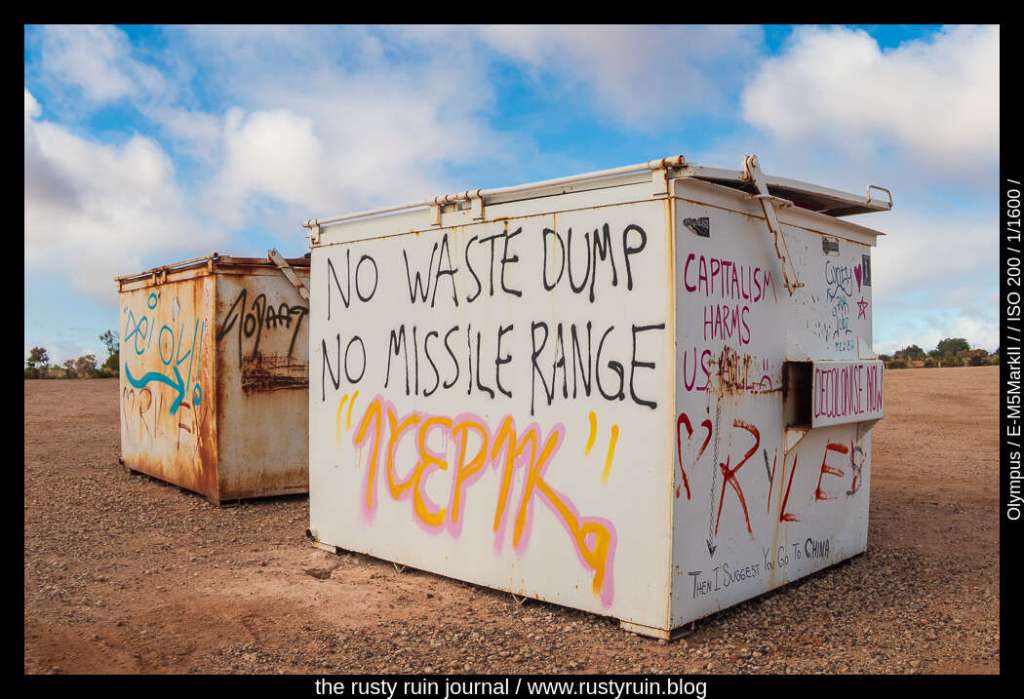
Capitalism harms us all – Olympus EM5 Mark 2 and Zenitar 16mm Fisheye

As with other wide angles, and certainly with all Fisheye lenses, there’s distortion. You can see how the normally straight cortners of the skip bins in the above photo look bowed. I don’t have an issue with it, as this is just a feature of the lens, but it’s not the sort of lens you want if you desire pleasant portraits, straight horizons, and distortion-free buildings (using the Nikkor 16mm 2.8 lens profile in Lightroom will straighten out most of the distortion if you really want that).

Lenses like this are great for getting in very close to a subject to take advantage of the optical distortions they produce. On the Olympus, however, the Fisheye effect is certainly much less because of the smaller sensor size, making it a really valuable wide-angle lens if you don’t mind manual focus, fizzy corners, and the chance that the quality of your copy may have suffered due to the effects of authoritarianism and the revolutionary whims of Vladimir Lenin.