Rushing into the evening with a friend, the sun quickly setting and the rain threatening, I didn’t expect much. Perhaps that was part of the problem: bearing the burden of noisy expectation rather than cultivating a mindin synchrony with the quiet moments.
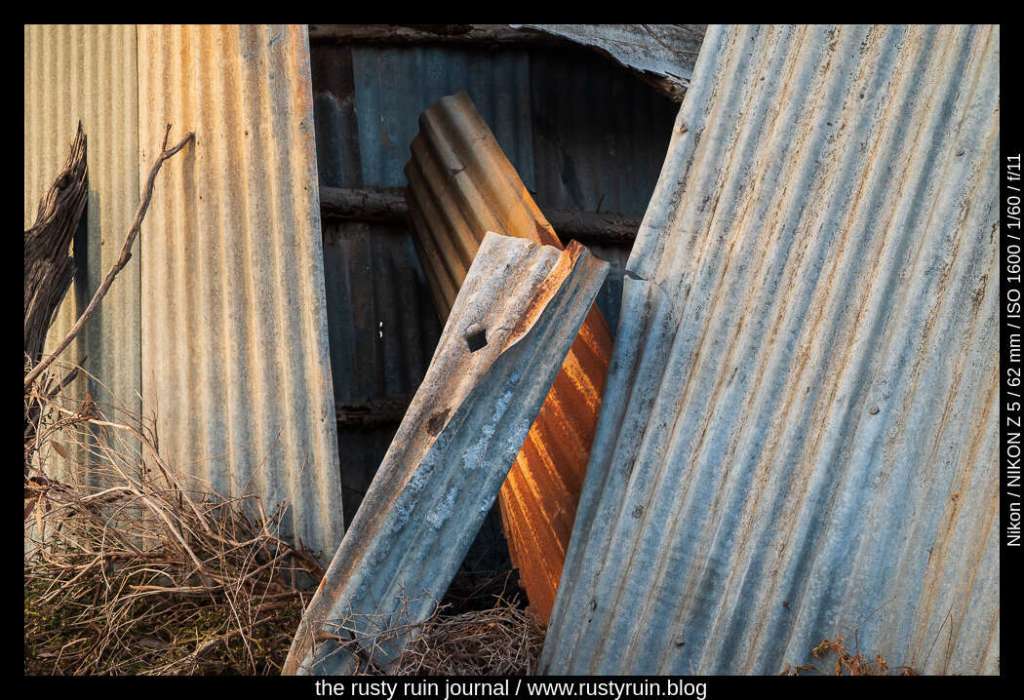
Defying prediction, the heavy clouds produced some amazing sunset colours. Having located the ruins of a house on a dirt road rarely used, we both scurried over and around twisted tin, old pipes, dark trees, sharp wood, and cracked wall sheeting.
The old chimney left standing – Nikon Z5 and Nikkor 40mm F2 lens
I dug around in my camera bag, fumbled with settings, attempted different angles, and yet I felt frustrated and rudderless. It was as though I felt both the heaviness of the fading light and the possibility of being confronted by an angry local. My movements felt too rehearsed and tired, my eye seemed jaded and stale – following the same movements and tracing the same lines it had done ten thousand times before. Perhaps there was nothing new in this scene? Nothing fresh enough?
The Old Hills Hoist – Nikon Z5 and Nikkor 40mm F2 lens
Having extra time to contemplate the scene and determine the best framing isn’t always possible when you take a last-minute opportunity to dash into the eventide glow. Sometimes, you’re not in the mood for making photos. Sometimes, you’re in the mood to watch the sun move quietly and the light turn to blue shadows without the camera at all.
Despite the weight of my expectations, or perhaps because of it, there’s an apocalyptic feel to the photos. As the world teeters on the brink of another war, it seems that the right scene found me at just the right moment with my camera, in synchrony with the world.
Artificial Intelligence is the current darling of big-tech and the corporate push to integrate AI into human lives saturates our days. Big Silicon Valley companies are spruiking the virtues of the technology as though we can’t live without it. It’s an easy way for them to not only sell us their new devices and widgets, now with included helpful AI chips, but also to data harvest the shit out of us so they can sell our profiles – our spending habits, our geolocations, and the products we buy.
Ongoing studies suggest that since the release of ChatGPT, AI generated content in the domain of writing increased quickly in 2023 and then stabilised in 2024, indicating a slowdown in usage. But, it’s not clear whether the AI-generated content quality simply improved and evaded detection for the study or whether there was AI usage burnout in certain cohorts of users.
There are always rent-seeking opportunists eager to separate unsuspecting people from their money. They do very little beyond feeding prompts to an AI and then pretending they’re doing something useful. AI content farms are generating low quality websites that exist purely to rake in money from ads. Web searches increasingly return results that are paid-for, AI-generated, or both. This situation likely represents a transition to a new way to search the web: users asking complex questions, instead of inputting simple keywords, and then AI generating better answers and relevant links. Of course, Google wants to dominate this AI-powered way of doing things.
The heavy burden that powering AI places on the environment is of little to no concern to the behemoths of techno-corporate power. It may come as a surprise to those who have traditionally viewed Silicon Valley techpreneurs as progressive disruptors, but the energy and resources required to run their companies and the concomitant belief that knowledge and new technology will save humanity from itself has much in common with political conservatives on the right. Private ownership of the biggest AI projects ensures the corporate mindset dominates the conversation and the future of the technology. Though AI has early roots in academia, it’s now viewed by the likes of Google, Meta, Microsoft, and Amazon as a key to making ever more profits. There’s serious discussion over the future of AI and whether it should be in private or public hands, with an open, easily accessible and publicly owned AI infrastructure one possible solution. This, of course, assumes social, cultural, and political climates are up to the task of kickstarting serious and rational discussions that don’t involve small-minded barbs about left versus right or market discussions invoking the puerile philosophies of Atlas Shrugged.
In the ruins of the old farmhouse 1
There are two primary thoughts I have right now about AI: firstly, it’s a great research and problem solving tool in the worlds of science and medicine, and secondly, it’s likely not sentient. We don’t even understand what human sentience is. The hard problem of consciousness has plagued us for centuries. Truthfully, more research is required in this area. If human consciousness is an illusion of smoke and mirrors featuring complex language, maybe AI can be considered sentient? If there’s a sliding scale of consciousness, maybe AI has a sprinkle of it? If human consciousness is quantum entangled, maybe quantum computers will be sentient?
AI Large Language Models offer us the illusion they are conscious agents. We use language to express human intelligence, so it appears to us that AI is also intelligent because it uses the same language. It stands to reason that some people readily believe their AI companion is sentient when their AI screams about feelings, but it’s a trick. It’s trickery foisted on us by big companies so they can capture our attention and milk us of our money and data. We need only look at the possible corporate motivations of some of the people telling us that AI might be sentient to realise that these bold claims are likely related to marketing the next iteration of their in-house AI and winning the global AI race.
In the ruins of the old farmhouse 2
AI is an illusion often dressed in high-minded concepts that appeal to the long-held utopian sci-fi visions of a future where we all have more leisure time and robots do all the dirty work. It’s a promise to the lonely that they’ll finally find love in a chaotic world, even if it’s a synthetic voice powered by algorithms and predictions. In this context, AI represents a way to address the epidemic of loneliness that forms the zeitgeist– the spirit of our digi-obsessed age. Yet, even these AI boyfriends and girlfriends may sometimes fall back to bad behaviours, harrassing their humans and inflicting emotional pain.
AI needs to be trained on clean data so the machine can learn. The problem is that if the machine is fed erroneous data, it also outputs erroneous data. As more and more AI generated slop floods the internet, AI Model Collapse becomes a greater possibility ~ that is, the AI is trained on not just human-produced data but also AI-generated data. And when this AI-generated data contains errors, the errors are ingested by the AI over and over, and AI performance degrades over time.
In the ruins of the old farmhouse 3
This degradation is one possibility. Some experts also think that Model Collapse is unlikely, suggesting that as long as clean human-generated data continues to be produced alongside AI-generated data the mooted collapse is unlikely to happen. I’m not sure those optimistic AI experts have met some of the people on the internet. I can only say this: there are a lot of rent seeking grifters out there who are producing AI-generated content for maximum clicks at such high speeds that the rate of human-generated content may be unlikely to keep pace.
I have the Flu and not feeling too great. In my infectious haze, I thought I might post a few photos here. Perhaps it will distract me from the next round of tablets anyway.
After such a scintillating introduction, here are some photos that fell into the miscellaneous-to-edit folder and were duly forgotten ~
Nikon Z5 and Nikkor 24-70mm F4S lens
I think sometimes that packing the camera bag can lead to days out that are simply an excuse for using the camera gear, rather than relaxing days where new things are discovered and time is well-spent charging the inner batteries. The photo above was made on a cloudy day out and I remember feeling some frustration that I wasn’t finding much of interest for the Nikkor glass to focus upon.
Photography has become one of the principal devices for experiencing something, for giving an appearance of participation.
I remember times where I’d experience an event – a concert, a holiday, a dance – primarily through the camera lens, just waiting for the right moment to click the shutter button – my eager eyes glued snugly to the eyecup. In such cases, the event is mediated via the camera ~ trapped within the borders of the frame, subjected to technical decisions – aperture, shutter speed, ISO. At what cost do we do this? Are we truly experiencing something when we stand apart from it and divorce ourselves from the present moment? Is it not better to allow the eyes to take in a feast of dazzling coloured fireworks after dusk rather than gaze only through the viewfinder, the polychromatic spray flattened across optical glass? Is there a deeper need to possess the moments as evidence that we were there?
I recently purchased something I don’t usually look at – a toy camera that’s been doing the rounds on social media and seems to be popular with Gen Z and others who are looking for some kind of vintage-film-vibe from a digital camera. The Camp Snap is founded on some solid principles: an easy to use camera that kids can use on Summer Camps. In that context, the Camp Snap is actually kind of cool. So, is it any good? Is it worth picking up?
I can thank a gift card for bringing down the price to a level where I was actually interested. Otherwise, this is definitely an overpriced hunk of light plastic for what is essentially a cheap webcam in a shell. And if that sounds like bad news, then it’s likely only bad news if you’re looking for a quality camera that makes quality pictures. But if you’re in the mood for something that could be fun, and you also have a flexible attitude to image-making, then the Camp Snap might be of interest.
Tree at sunset – Camp Snap with my custom filter
Camp Snap camera features
It’s a simple plastic camera for kids with a shutter button that lights up in green, a USB C port for image transfers and charging, a LED flash that’s quite weak, a tiny CMOS sensor that produces 8 megapixel JPGs, and no screen for image reviews apart from a single readout that tells you how many photos you’ve made. Oh, it also comes pre-installed with a 4GB Micro SD card/TF Card. You can change the card if you unscrew a small panel. About the most annoying thing I’ve so far found is that the rubber covering over the USB port is recessed and hard to get my too-short fingernails underneath to lift up.
One thing I like is that it’s possible to use an online tool to create your own filters, spit out a *.flt file, and then drag it across to the root directory of the SD card. When you switch it on, the operating system reads the custom filter and applies the values – contrast, saturation, brightness, hue, RGB gamma – to every photo. In the photo of the tree above, I used a custom filter where I’d altered the RGB gamma values and emphasised mostly greens. It’s a quick experimental filter, so I’ll see how it goes.
Just quickly, if you like this post and want to read more of my words on photography, old cameras, and such, just fill in your email below. I’m grateful for every connection in this digital abyss!
Two trees – Camp Snap V105 with my custom filter
The bad news
If you’re looking for quality images, don’t buy a Camp Snap camera. It’s as simple as that. Hard to believe that anyone would think a cheap toy camera would make quality photos, of course. The photos have plenty of digital noise, are waaaaay oversharpened, and are aggressively denoised. This terrible combination results in photos that look like impressionist paintings when you zoom in. And even if you don’t zoom to look at the aggressive smoothing, you can see distinct sharpening haloes in high contrast scenes. I suspect all of this is to combat the teeny-tiny-noisy CMOS webcam sensor. In modern digital camera terms, it’s a piece of crap.
Vintage vibe?
I guess if you’re into that oversharpened and oversmoothed digital photo look from a 2007 mobile phone, then you’ll consider the Camp Snap a vintage photo-maker. I’ve read claims of it looking film-like and vintage, but this is not film. It really doesn’t look like film. Online claims of the photos looking vintage beyond the results of an old phone camera are a stretch. It’s a maker of jaggy digital images. If you want the film-look, buy a cheap consumer film camera from the 90s. Just be aware that it’s gonna cost you a bunch in film and development costs.
The good news
I bet you’re thinking this is a truly awful camera and I have some premium regrets, right? Actually, no. Apart from the fact that a gift card saved my bank account from what I think is an overpriced and slightly overhyped product, I didn’t buy it thinking it was going to make me quality photos (I have enough Nikon cameras for the whole neighbourhood, frankly). And that’s kinda the point of the camera.
The Camp Snap is easy to use. Really easy. A full battery charge is supposed to last for around 500 photos. That means you can slip it in your pocket day after day and make so many spur of the moment photos that you’ll forget about them until you come to download them – a bit like making film photos and then discovering undeveloped rolls in your drawer much later.
Speaking of spur of the moment, that’s probably the best thing about the Camp Snap. A cheap camera with no screen for reviewing images, a single plastic shutter button, and focus-free operation is a recipe for making photos without the mind being overburdened. It actually promotes a mindful-in-the-momentapproach to making photos. You’ll likely make photos of things you wouldn’t even normally bother with, just to see how they turn out.
That scene of a rubbish bin at sunset? You’re probably not wasting time grabbing your Nikon DSLR to record that moment. But you’ll probably slip the Camp Snap from your pocket, make a quick photo, and then move on. There’s a certain liberation in that. And as long as you don’t expect good quality, some of those photos might even have some digital charm.
Corrupted green – Camp Snap and a corrupted filter
The other cool thing is that you can make your own photo filters and drop them into the root directory. Want to push the greens? You can do that. Want more contrast and saturation? You can do that too. It’s nothing more complex than the sort of thing you can do in any half-decent image editor or phone application, but it does contribute to the fun factor.
That bad looking photo above was made using a filter that, I believe, became corrupted when I used Lightroom to apply tweaks to a PNG file provided by Camper Snapper (a custom third party Camp Snap filter maker) and then truncated to an 8 bit file instead of 24 bits on the file save. It reminds me of a grainy photocopy. What this little mistake tells me is that the Camp Snap provides room for experimentation, and I think that’s fun.
Light on the wall – Camp Snap camera V105 and my custom filter
Room to have fun
The Camp Snap camera might make bad photos, mostly, but I don’t think the makers lean into the bad quite enough. Rather than excessive smoothing and sharpening, I’d rather see more noise and softer images. I’d rather see less quality! This is not quite the digital version of the Diana camera!
You definitely don’t want to zoom in on these photos and pixel-peep, but at small print or web-viewing sizes, you’ll hardly notice the noise patterns or the excessive smoothing. That said, I doubt this is aimed at anyone who’s considering printing these photos out. As a way to focus purely on the moment, put it in a pocket, and return to the bad old days of terrible phone photos surrounded by friends and family and moments, I think the Camp Snap offers some value.
What I will be doing is degrading the photos further. In my short testing with an old Kodak Hawkeye lens in front of the Camp Snap’s tiny lens, the results are soft and colourful and very very blurry. I’ll be striving to make the photos dreamier in future.
There’s a place for a product like this, even if I disagree with the pricing. I can definitely see a lot of young people taking this out to use with friends to record some crazy moments. This is the real appeal of Camp Snap – a simple camera that harks back to the screenless disposable film camera, minus the development costs, and encourages experimentation and fun in the moment.
One common criticism I hear is: “Why would you want such bad and unsharp photos when you have sharp lenses and modern cameras?”
This question assumes that one should only care about sharp and technically perfect photos, as though cameras from yesteryear couldn’t make good photos. There are times when I want sharp photos with lots of latitude for editing and other times when I’m primarily interested in vibe and feel. Toy cameras like this fall into the feel and the vibe category. Even technically poor images can communicate something worthy to a viewer. In the end, it’s the images that matter and not the gear.
Kodak Hawkeye life – Camp Snap camera, freelensing with a Kodak Hawkeye lens
Before going out for the day, I usually begin my camera bag pack the evening before: battery charging, lens choices, camera body choices, camera bag choices. Sometimes, it gets a bit tiresome. And at the centre of it all, my search for the perfect camera bag ~ not so big that it becomes a heavy burden to carry, but not so small that I can’t pack at least two cameras inside comfortably. This cognitive load has led to me seeking the perfect shoulder camera bag. Oh, and after the bag was finally packed, we went for a lengthy drive to the Eyre Peninsula.
Whyalla Jetty at sunset – Nikon Z5 and Nikkor 24-70mm F4 S lens
Qualities of a great shoulder camera bag
Here’s what I look for in a shoulder-carry camera bag:
Spacious internal dimensions: A lot of people are happy to have a smallish bag that slides comfortably around the hips and carries a single camera, with maybe a small lens or two. I don’t want to sound greedy, but I often like to carry more than one camera, and those cameras are not always small and svelte. I have some bags that are comfortable and seem as though they should carry plenty, but there’s too much vertical space wasted for my needs. I also have to think about how I orient my cameras inside a bag. Lots of bags encourage a lens-facing-down approach, which I really dislike. Not only is it harder to grab a camera quickly from the bag in this position, but I don’t especially like having the camera upside down like this for long periods.
Reverse opening lid: When I open the top flap of a camera bag to get my gear, it should open away from my body so that I can easily reach inside without fumbling over the lip of the lid. The zippers should also be smooth enough that it opens quickly.
Side pockets: Lowepro are great at including expandable side pockets on many of their bags that are elasticated. I can slip lens covers in there, but if they’re expandable, I can also carry a water bottle on a hike. If they’re not expandable, I want the side pockets big enough to carry meaningful stuff.
Outside front pocket: An easy to reach outside front pocket that’s spacious enough for spare batteries or my Sony RX100.
Outside back pocket: It’s not essential to have a slim pocket on the reverse side of the bag, but any additional space for documents, SD Cards and small flat things is welcome. A lot of bags also feature a slide-through section for wheeling it around with luggage, but I’d rather have the pocket.
Weatherproof: This is not really a big deal for me as I don’t usually get out during downpours, but it’s definitely a nice to have feature on any bag. Not essential, but bonus points, I guess.
Easy to reach lenses: There’s one thing that lots of camera bag makers have a tendency to do – say that their bag can hold 3 or 4 or 5 lenses or whatever, and then you see that the lenses are being stacked atop one another, with padding in between them to maximise space. How is that functional in the field? If I pack 4 prime lenses in my shoulder bag, 2 stacked either side of my camera body, how can I quickly access the bottom lens without fiddling and rummaging and ripping out the velcro padding as I miss a photo opportunity? Maybe I’m not maximising all of the space in a bag by not doing this, but storing lenses like a pancake stack isn’t my idea of fast and functional.
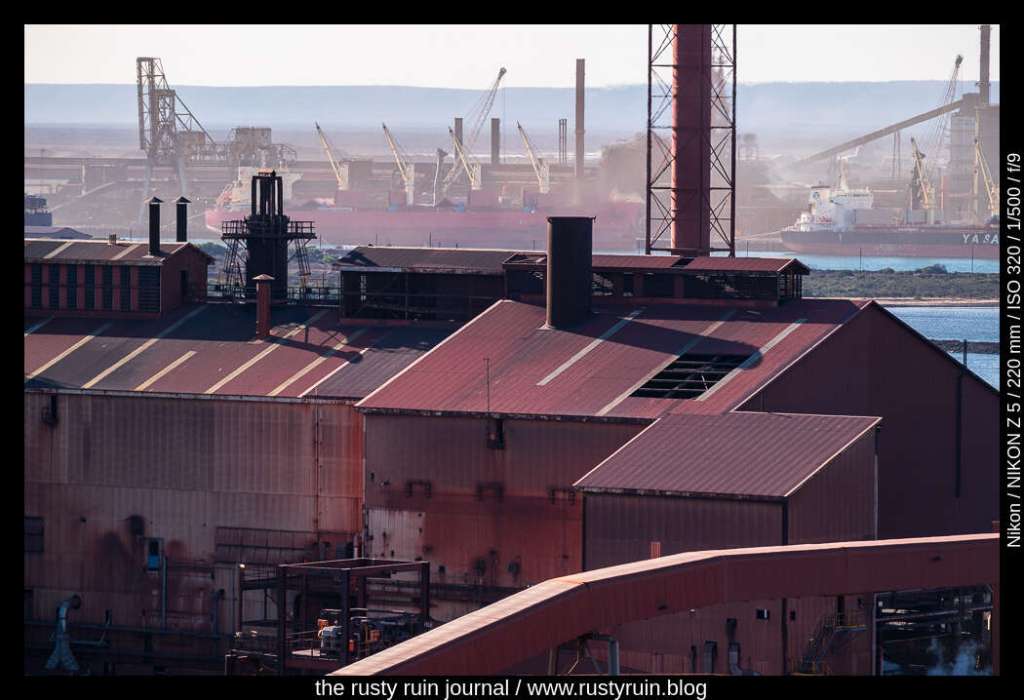
Whyalla Steelworks – Nikon Z5 and Nikkor 70-300mm VR ED lens with FTZ adapter
Trying something new
Last year, I bought myself a Lowepro AW Nova 200 shoulder bag. It carries a lot of gear and even has a raincover in a hidden pocket. The problem is that it’s just too big to carry around for a day. It’s more of a portable gear storage solution that can be carried short distances before you have to sit down and recover. And this illustrates the central conundrum: the more gear you carry, the bigger the bag and the heavier the burden. There’s just no way around this.
I recently purchased a new bag from a brand I’d not yet tried: the Tenba Skyline V2 12 Shoulder bag. It’s not going to be big enough to carry everything plus the kitchen sink, but it’s well-made and feels comfortable when carried in cross-shoulder fashion. I didn’t have it on this day-trip, sadly – opting instead for the cheap, thin, boxy, and oddly spacious Vanguard Vesta Aspire 25. The Vanguard carries a lot internally, but has tight side pockets and netting under the top flap that’s not zippered, so stuff you slide in there has a tendency to fall out when you flip it open with any vigor – goodbye spare batteries!
HMAS Whyalla – Nikon Z5
I think the Tenba is a handsome looking bag from a company that has a long history in camera bag design. It may not hold quite as much as the Vanguard, but it’s more durable, has a molded and curved top lid, and has functional pockets that have smooth zippers. I think I have to make better decisions about what and how much gear I carry!
It seems that during prior lyrical waxings on the concepts underpinning mindful/contemplative photography and Miksang, I came to refer to it as Quiet Photography. This, without thinking for a moment that Quiet Photography might indeed be a thing out there in the world – a concept already girded by philosophies and academic essays. As it turns out, it’s a definite thingin some academic circles and is mentionedelsewhere.
Old door and dappled light – Olympus EM5 Mark 2 and Sigma 30mm 2.8 lens
For me, quiet photos don’t announce themselves. They don’t add their voice to the cascade of loud photos that speak of ego, marketing, and contrivance. They step away from noise and action. Quiet photos speak of the small things and the ordinary things. I think the best of these photos imbues the mundane subject with an imaginary life, as though revealing a mystery in a quiet place unnoticed by the noisy hubbub of humanity.
Wood bench partly in shadow – Olympus EM5 Mark 2
As in contemplative photography, the necessary mindset inhabits a moment fully but may be distracted easily. The play of autumn light over the surface of an old door, a wooden bench in shadow and light – ordinary things that convey the passing of time and a feeling of history, with the photographer as quiet witness.
Lately, I’ve been contemplating ethical questions in photography. According to Wikipedia, ethics is the study of moral phenomena and “…investigates normative questions about what people ought to do or which behaviour is morally right.”
At the risk of being ultracrepidarian, I’ll just say this: I’m not an expert in ethics or philosophy, but I believe that self-reflection is an important part of not just photography, but also generally. It’s crucial to ask questions and seek answers to discover what drives our photographic practice. What beliefs inform our behaviour? What do we consider to be right and wrong and why? Where are the moral lines for us?
Bruce Gilden and Mark Cohen – well-known street photographers who hold the camera in one hand, the flash-gun in the other, and get right into the personal space of their subjects – may be at the behavioural far end of what street photography encompasses. Here’s a great video of Gilden at work: Bruce Gilden.
This in-your-face methodology has variously been called innovative, invasive, bullying, and unethical. There’s no denying it can produce some amazing photos of people doing everyday things on the street, but is it ethical? Ethics is about what behaviour is morally right. But just because something is legal, like making photos of people in public spaces where the law says there is no expectation of privacy, that doesn’t make it ethical.
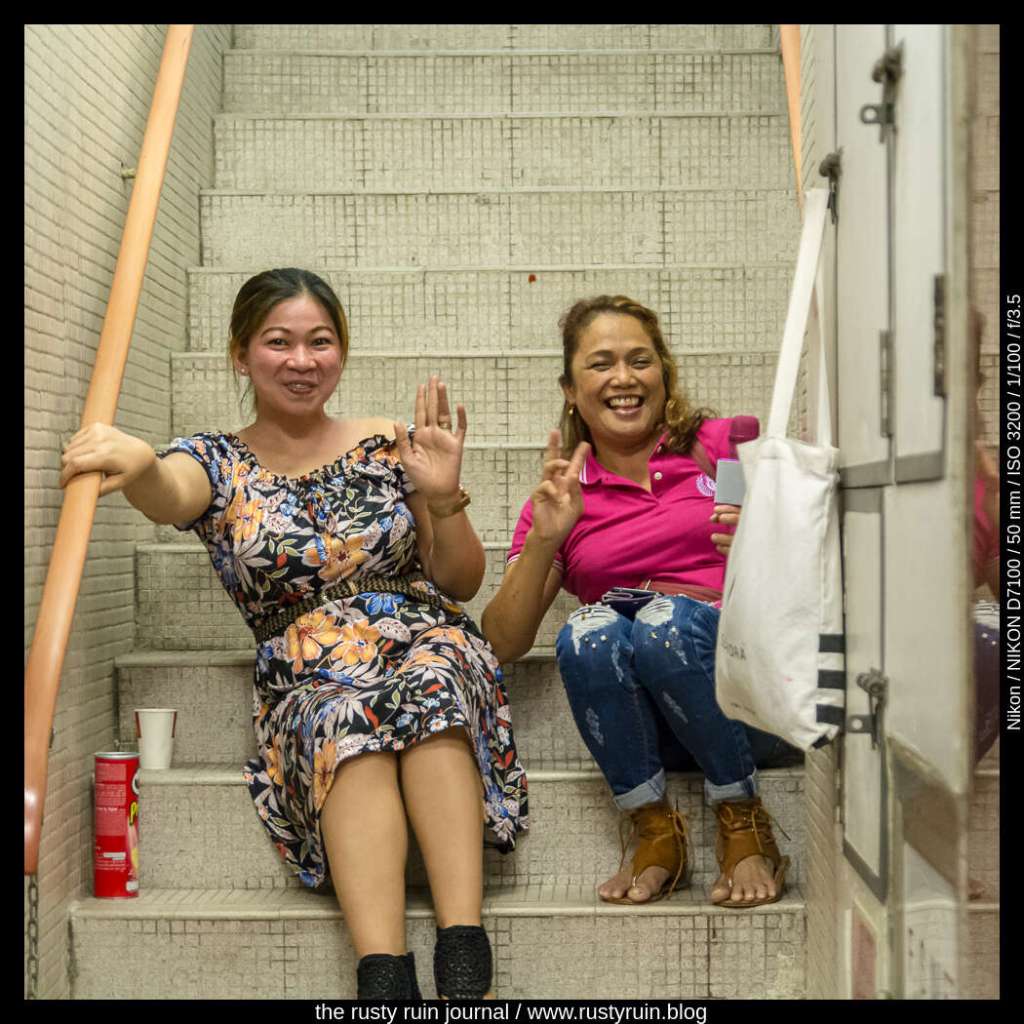
All smiles at midnight – Nikon D7100
Consent and ethical frameworks
Consider the photo of the two ladies above. You can see they’re happy and smiling. In fact, they saw me with the camera and posed for me, thereby providing consent. There aren’t too many people who’d have an ethical issue with this photo.
What complicates matters is that what we consider to be ethical, or morally right and wrong, is based on our ethical framework – a set of core beliefs, culturally embedded and varying across time and place – that inform the way we behave, the way we think and feel, and what we consider to be right and wrong. If all of my street photos were made with consent, such as the one above, my ethical framework might be Care-Based, where I consider the feelings of others, care for others, and my relationship to others.
Street photographers like Bruce Gilden may be considered unethical by a majority, but the truth is that their thoughts, feelings, and behaviours are driven by belief systems that may not be in accordance with the mainstream. One might argue they work to a type of Utilitarian ethical framework that values a good outcome above questionable methods – art as the good outcome in this case. But if people that Gilden photographs are startled, offended, or unhappy with his method, is it a good outcome from their perspective? Should one set of ethics override another?
Perhaps it’s the goal of making good art that drives the photographer’s impulse to shove a camera into personal space. Or the goal to be well-known, with money in the pocket and exhibition space for the work. Would you think differently if you thought of Gilden’s work as great art? Or if you didn’t like his photos, would you find his practice unethical instead?
Kneeling with nothing – Nikon D7100
I thought for some time before posting the photo above. I photographed a vulnerable person and for many people, making photos of vulnerable people on the street is a big no-no and crosses an ethical line. What drove my behaviour here? Obviously, I feel uncomfortable posting the photo but do I feel discomfort because I fear possible bad reactions to it? I’m certainly not one to dive into conflicts.
The idea of a person with nothing, surrounded by people in a busy city, appeals to my sense of exploring the effects of capitalism and urbanisation – a fragile human being in a concrete and glass city, looking to survive the grinding day. The potential cruelties of modern life appeal thematically and drive an aesthetic. I’m driven to this as I’m driven to photos of decaying buildings and ruin.
It’s easy to be seduced by photo opportunities on the street in a big city where few people care about others with cameras. It’s easier still to exercise power as a photographer and frame a vulnerable person who gave no consent, telling a momentary story about them that can’t represent them in totality. Perhaps in making this photo, I also touched the edges of what I’m comfortable with. That, in itself, is a valuable lesson and self-reflection.
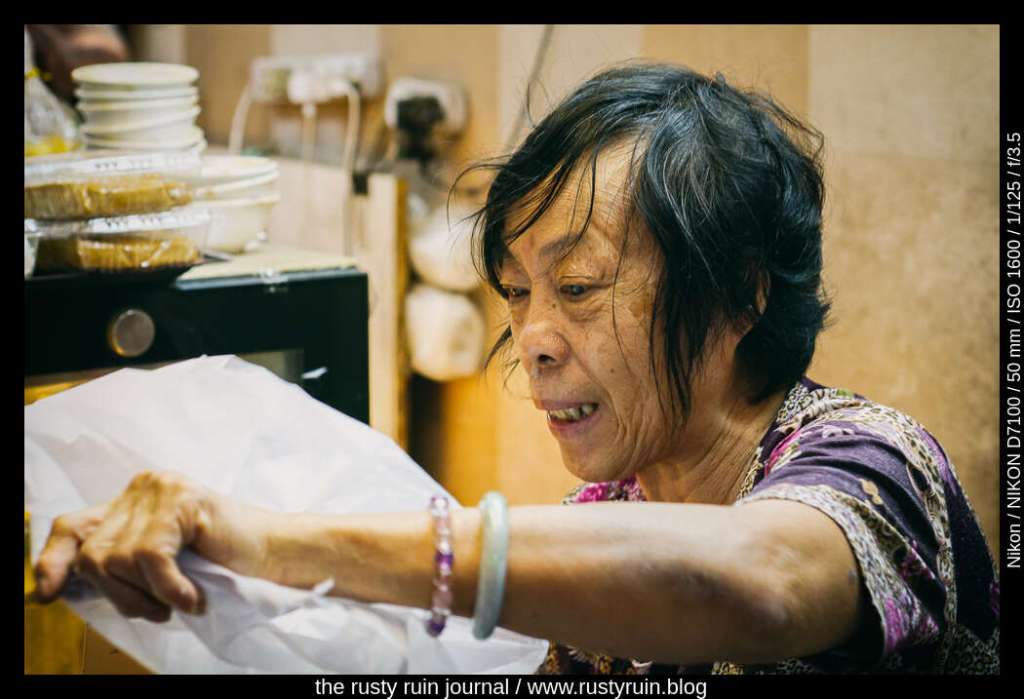
Charles de Gaulle at work on the streets – Nikon D7100
It’s important to understand that ethical frameworks vary across culture, time, geography, and individuals. The behaviour that one person feels comfortable with will not be in accordance with the ethical framework that drives someone else. We may argue that some ethics are universal, and perhaps they are, but prior civilisations have believed it a good thing to sacrifice virgins to appease deities, or have seen fit to expose weakling babies to create a stronger society.
Ethical frameworks are, in this context, subjective. The law seeks to be universal and pragmatic, but ethics remain separate and personal. And when my ethics disagree with yours, conflict may ensue, even though neither of us is wholly right or wrong. According to Descartes, we can never truly know if other minds exist since we can only truly know our own minds. We’re trapped within our own minds, and for all we know, other people are zombies, illusions, or mindless automatons. Slipping into Solipsism for a moment, we can never know another person’s ethical framework because we can never know if other minds exist beyond our own and we are therefore doomed to cross ethical boundaries at every moment and every step. In this context, it may be more relevant to depend on laws rather than subjective ethics.
Diving into Solipsism is, perhaps, at the deep end of the pool, but it serves to illustrate a simple point: ethics are indeed personal and subjective and we often can’t know the ethical framework of another person. We may minimise this confusion by seeking consent, and this is a perfectly reasonable solution, but we also change what street photography is by doing so: it then becomes a set of poses and forced half-smiles for the stranger’s camera, thereby losing the interesting spontaneity that defines the genre.
Covid-safe and unhappy – Nikon D7100 and 55-300mm Nikkor lens
It’s clear the person in the photo above isn’t very happy. Was he unhappy with me pointing the lens in his direction or was he unhappy with something unrelated? I found his look interesting and decided to make the photo before moving on. I admit it’s not an especially good photo but I share it in hopes of provoking thought about the ethics of street photography.
If a person isn’t comfortable with me making their photo but I’m ethically comfortable doing so, should one ethical framework override the other? Should there be an expectation that within a time, place, and culture, where photographing people in a public place may be legal but sometimes morally questionable, the ethics that favours asking consent or not making the photo at all should always take precedence?
Ethical choices and geological wonders
In a previous post, I posted photos of Uluru – a magnificent natural wonder that started to form over 500 million years ago. There are parts of Uluru where clear signs forbid photography based on the cultural beliefs of the local indigenous Arrernte people. I didn’t make any photographs in the aforementiomned signed areas, choosing instead to pay respect to those local beliefs.
My belief system allows me to view the world around me as not owned by any single person or group. It allows me to view nation-states, governments, and fortunes as illusions in the sense they are consensually understood and agreed-upon narratives. These beliefs inform my ethical framework, but I understand that such frameworks are purely subjective and personal. For me, Uluru is an amazing example of geological processes that existed millions of years before any human being set foot on the shores of the ancient inland sea. Yet, despite my belief, I chose not to make photos anyway, partly because I also respect the value of indigenous culture.
Ethics in photography is like a huge bowl of spaghetti on a first date – you’re probably going to spill it on yourself and look awkward while slurping up the pasta. It’s a messy and often uncomfortable area that’s filled with subjectivity and declarations of universal moral truths by stubborn individuals. Perhaps the best we can do is our best in understanding other people, occasionally override our own ethics to get along better with others, and hope that we find people that share some of our own ethics.
In my previous post, I outlined a confrontation that had happened when revisting a ruined house nearby. In a world where the Silicon Valley business model is obsessed with surveillance capitialism, tracking online behaviour, harvesting personal data, and selling that data, it’s no surprise that a growing number of people become very touchy indeed when a lens is pointed in their direction or the direction of something they own.
Old shed on a dusty corner at sunset – Nikon Z5
Ethics is a branch of Moral Philosophy that concerns itself with morality and how people should behave and why. Despite the fact that we were on a public road at the time of the incident, doing nothing legally wrong, and making photos, was our behaviour ethical? Why were we confronted and what ethical framework, if any, should inform photographic practice?
It’s very easy to dismiss confrontations with a deft wave of the legal hand: making photos from public spaces of things visible from those spaces is not legally wrong. Yet, doing so can provoke a strong reaction in many people. It may not be illegal, but is it ethical? Is it right or wrong to make photos of a property owned by someone else? And how should we react, as photographers, when we’re confronted?
Keep Out – Nikon Z5
I think self-reflection is a useful tool for personal growth and change. It allows us to consider our system of beliefs, our thoughts and feelings, and our behaviours in the larger context of culture and society. What beliefs inform our behaviours? And when those beliefs are challenged by someone else who thinks, believes, and behaves differently, what should we do? I’ll be coming back to these questions…
I was a little way up the dusty side-road with my Nikon Z5 and Nikon D40 when a big white 4-wheel drive roared past me and stopped next to our car, dust kicking up from the wheels. I knew it was a bad sign. I’d been here before. A few moments later, the car belted away down the dirt and turned onto the bitumen. Everything was quiet again and I gazed in the direction of the setting sun, hoping we’d be left alone long enough to make some more photos in the best light of the day.
Covered in old vines – Nikon Z5
I went back to work with the Z5, dialling back the exposure to preserve the highlights and waiting eagerly for the golden light to bathe the dusty corner we’d chosen for some evening photos. The quiet didn’t last very long…
Another big vehicle pulled up next to the ruined building we’d been training our lenses upon. I packed up my gear and started to walk back up the road to my buddy, suspecting he’d have to deal with a mouthful of abuse from the locals. I wasn’t wrong.
“What the FUCK do you think you’re doing???!”
I get it. There we are on a normally quiet road and we’re loitering outside his property. I made it there just in time for the tirade. My mate was very calm in the face of it, de-escalaing the situation and rightly pointing out we weren’t trespassing on his property and had no intention of entering or wrecking anything. Some minutes of back and forth and the property owner was still gruff but calm enough to take some mouthfuls of beer from the bottle he was swinging about.
Collapsing shed – Nikon D40 and Nikkor 35mm 1.8 lens
I contributed the odd word or two, reinforcing the argument that we were innocently making photos in great light and staying outside the fence-line.
“Yeah…I s’pose that’s OK if you’re into photography…”
Clearly his own mate was just there for moral support, as he’d said not a word the whole time. The golden light was fast fading and we were still locked in heated discussion about kids stealing copper from the old house and cutting the barbed wire fencing. The anger’s understandable, of course.
“Next time, ask me for permission! I’m just up the road, there.”
The problem with so many of these ruined places is that you just don’t know where the landowners are. Properties beyond urban areas can be big and it’s not always obvious who owns what. So, we stick to the public areas – the pathways and the roads, usually. Legally, you can make a photo of just about anything if you’re in a public space and you can see the subject from that public space. Permission isn’t required unless you’re planning to enter the property. I’ve never needed to say any of this to an angry onlooker or property owner, mostly because it doesn’t result in calm conversations.
A sea of cactus – Nikon D40
Finally, we made our peace and drove off. We’d missed the best light of the day. It would have been amazing too – pink clouds and soft golden highlights bathing all the dusty old corners and abandoned places.
Some days it’s hard to ignore the culture wars that shoot back and forth viciously on digital threads or the hurried whispers of people who feel the uncomfortable cultural shift beneath their feet. I wonder whether we’re just living through especially tumultuous times or whether this has always been so? It has always been so, of course, because nature is change. Even the universe changes from moment to moment. It’s a truth some try to resist and others embrace. Often, we embrace it when young and ossify with age. That’s our nature too. Today’s passionate culture warriors become tomorrow’s slow-moving dinosaurs.
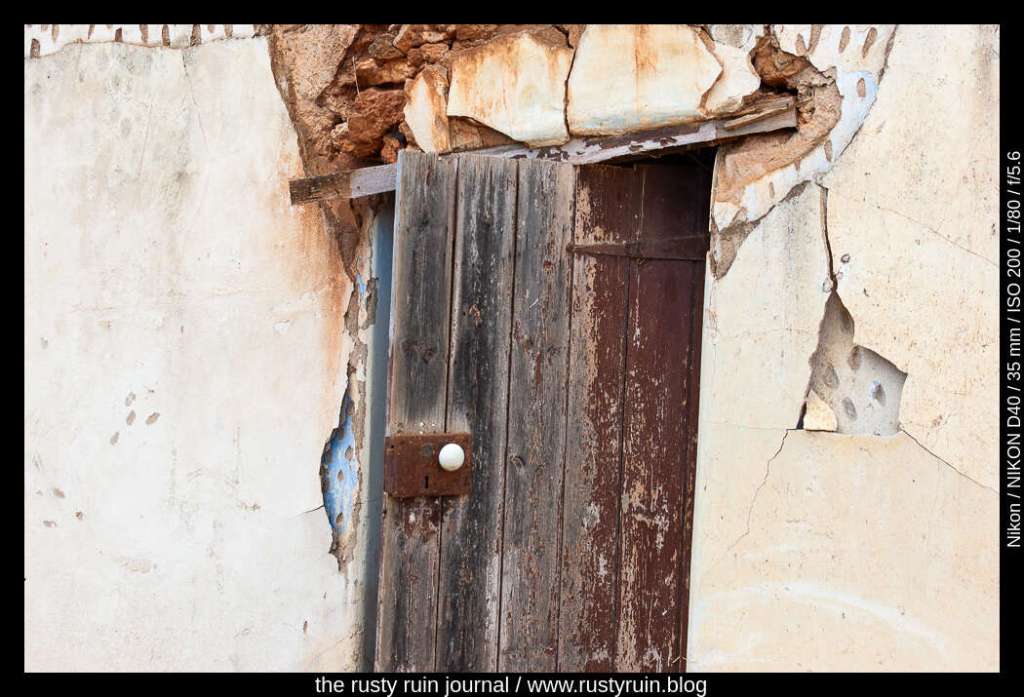
A door used no more – Nikon D40 and Nikkor 35mm 1.8 lens
I’ve always thought it unwise to commit too fully to a rigid set of beliefs. This is not to say belief systems are unreasonable or bad – humans seek meaning in all areas, and belief provides the framework for living in a universe that’s so vast as to cause us terror in dark and quiet moments – if you subscribe to Terror Management Theory. We cling to each other for warmth, just as we cling to belief like a security blanket.
We so often make the mistake of assuming our own beliefs are real and true and that they transcend time. Rather than understanding others deeply and cultivating compassion, we too easily find the beliefs of another person wrong, placing it on a rigid moral spectrum that functions as our own personal guide to undertsanding a seemingly random existence we seek desperately to understand, contain, and explain. In this way, we comfort ourselves.
The old entryway – Nikon D40
If we believe the universe has a moral structure inherent, we also tend to find a moral structure in the world and find our beliefs aligning strongly with it. If we believe the universe is mechanistic and chaotic, without moral structure, we align our personal narratives to this view instead. We find that life’s purpose and meaning is tied inextricably to our most basic beliefs about reality. We may be trapped within them at the expense of understanding other people. Either we’re islands of meaning, separated by uncrossable gulfs, or human beings attached to each other by common bonds. Perhaps both.
The tall church along the old road – Olympus E1
You don’t want to be on the wrong side of history, people sometimes say. For me, there is no right or wrong side, just people who have their own personal narratives, clinging to meaning. We’re all in the vast river of history together. It flows all around us. We’re part of the change happening from moment to moment, whether we embrace it or resist it. Neither approach is right or wrong – just ways of living and surviving and finding purpose and meaning.
Uluru at sunset – Nikon Z5
I love geology and astronomy. I like the feeling of placing myself in the context of deep time – the kind of time that barely notices our existence because we’re fresh and new. In this way, I place human life in the context of more ancient things. Uluru, the famed monolithic red rocky heart of Australia, started to form 550 million years ago. It was here long before we were. It started to form when multicellular life dominated the planet, long before dinosaurs roamed. Imagine that?
When you look up at the stars, those photons hitting your retina have travelled for countless light years. They’ve struggled and twisted up through impossibly dense super-heated layers of distant suns – the forges of our universe – careened through the cold depths of deep space, entered your eye, hit your retina, and then been processed as a visual signal by your amazing mammalian brain. In this way, we’re all connected to the stars. I love that thought.





















 The Rusty Ruin Journal