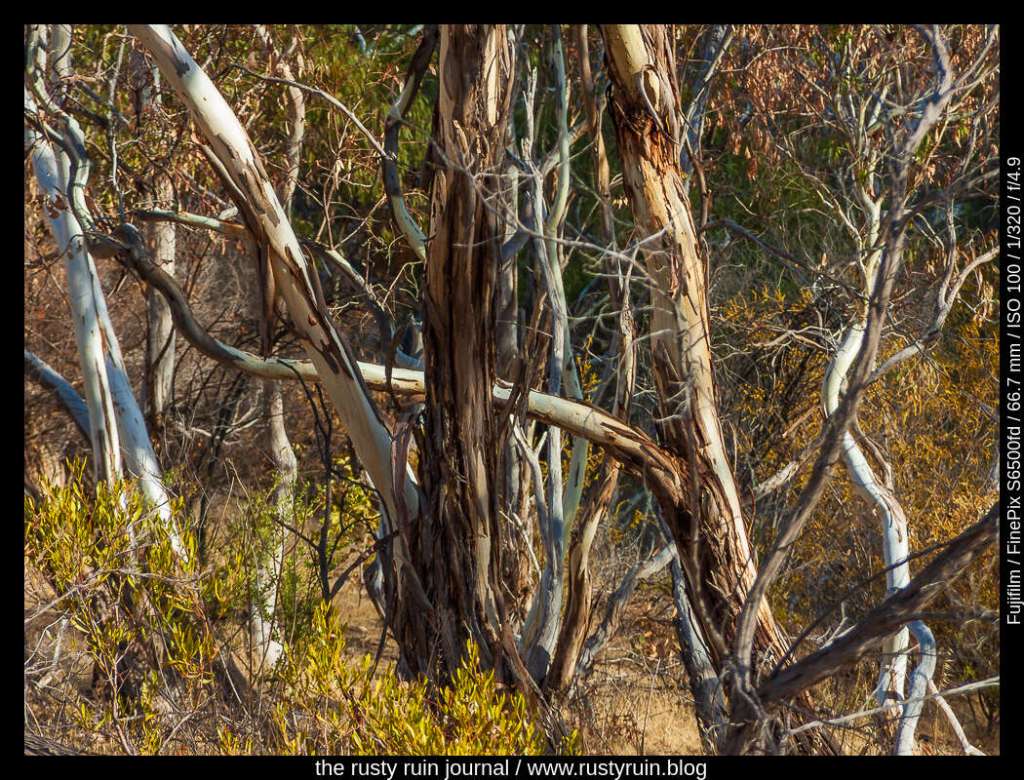
It was the perfect afternoon for us to ramble along a walking trail through century old goldfields nearby. I’d decided to pack the Nikon D40 and the Fujifilm S6500fd. I totally forgot about the Sony RX100 sitting in the zipper pocket of my camera shoulder-bag – the usual go-to in case an old camera flakes on me. I’ll say this about the Finepix S6500fd: the combination of the tiny Super CCD sensor – ancient in digital photography terms – and the long, sharp lens, produce some really interesting photographs at times.
Ghostly gums – Finepix S6500fd
Setting the camera to the Fuji-chrome setting and Fine JPG seemed to enhance the blues and purples in this photo. Maybe it was the combination of the cloud, sunlight, shade, subject, and white balance, but there’s a really strong look to the image. I haven’t added additional colour in editing.
Gum trees along the trail – Fujifilm Finepix S6500fd
For the above photo, I decided to set the camera to generate RAF files – CCD-RAW in the settings menu. I wasn’t even sure they’d open in Lightroom, but they did, and I’m pretty pleased. This provides more latitude and flexibility during editing. As you can see above, I was able to draw out pretty good detail in the shadows and sharpen the image in specific areas. It’s not easy to see without magnifying in Lightroom, but there’s some beautiful detail and tonality in the bark. Hard to believe from this piece of old gear.
Beneath the bark – Finepix S6500fd
Finally, one of my favourite features on old bridge cameras is the Macro and Super-Macro modes, at the touch of a button. It’s so handy for getting up close when there’s good available light for a decent shutter speed. I usually wander handheld, so there’s no tripod involved. Steady hands and good light are a must under these circumstances. It’s a JPG (wish I’d set to CCD-RAW), but the colour and range of tonality is still impressive. The best photos from this camera, like the S7000, seem to have a versimillitude about them. Note to self: set this camera to make RAF files from now on!
There’s something delightful about rust – rough patches of red, brown, orange, and black signify the decay of something once whole. It’s a reminder that nothing lasts forever. It gives one pause to consider time, relentless and vast. Also, a good excuse to post some photos of rust and old stuff!
Something rusty – Sony RX100 Mark 1
There’s another thing too: lately I’ve become interested in those old Fujifilm bridge cameras I could never afford at the time of market release. Honestly, I barely had two cents to rub together, let alone the disposable income to purchase one of the many Finepix models from the 2000s era. It was a time when digital, so ubiquitous now, was still carving out a place in photographer’s hearts.
Back in 2004 or 2005 (too long ago), I remember going out with my late father with the intention to buy a good camera. He picked up a mostly plastic, silvery Finepix – a 3500 I think. It was 4 megapixels and looked quite neat. I picked up an Olympus Ultra Zoom – silvery and plastic: a 3 megapixel Olympus Camedia C-725. I still have it, minus the XD card.
My father got the better deal, honestly. Though it wasn’t the best digital camera at the time, the Fuji Finepix he had was fun and easy to use, and he used it a lot! On the other hand, I used my C-725 rarely, under the misapprehension at the time that Olympus must somehow be of more legendary status than Fujifilm. I failed to squeeze much joy out of it and found myself feeling regret. I foolishly set it to Manual mode, placing myself under pressure to make sense of it all, and my brain exploded! Once I find an XD card, I’ll fire it back up with new vigor and give it a second life – if it still works.
Where industry once was, rust reigns supreme – Sony RX100 Mark 1
I have the Finepix S7000 now, of course – a camera that recently surprised me with features, even if it’s slow by today’s lofty standards. But there are two more on the way: the Finepix S5600 and the Finepix S6500fd. The former intrigues me with a minimum ISO of just 64, and a reputation for low noise. The latter features the excellent sensor also present in the Finepix f31fd – a camera that has been targeted by the CCD colour crowd and is now absurdly expensive.
I’m enjoying the old bridge cameras. Back then, these cameras bridged the gap between people who were either still using film cameras and wanted an easy way into digital, and/or those who were using compact digital cameras and wanted to move to something closer to a DSLR/pro camera but didn’t want to lay out too much money.
When the clouds are heavy and the weather inclement, I like to look for interesting patterns and textures in the environment. It’s also a good way to test out the macro abilities of the Fujifilm Finepix S7000. On these old fixed lens digicams, there was usually a dedicated Macro mode button. The S7000 has two modes – Macro and Super-Macro, making it possible to get as close as one centimetre away from the subject.
The details are crunchy enough in the close-up photo above, even before any Lightroom tweaking. I’m not going overboard with the editing, as these are only 8 bit JPGs and don’t contain a lot of information to work with. Small boosts to contrast and clarity, with a minimal increase in vibrance is enough to make it shine. Other settings are my usual on this camera: 12 MP Fine* JPG.
Since we were at the seaside, it made sense to photograph the lovely colours and patterns of the shallows. And in good light, the Finepix is a fine camera even 20 years after it debuted. Just a slight decrease to highlights and a slight boost to contrast and the photo comes alive I think.
Lastly, the photo above intrigues me. The seabed is distorted by the water and there’s something red lying on the sand below. One might almost think there are strange creatures inhabiting the salty depths, throwing out exploratory tentacles.
Next outing, I’ll probably take another camera. Perhaps the Sony RX100 – a camera I’ve had in my possession for a decade and have barely explored. Certainly a nice camera that was once King in the world of compacts – when compact cameras were still a going market concern.
OK, I pushed it today. I really did. And it didn’t really work. I should have known better, but I like to risk it sometimes. What am I risking? A blurry photo in conditions that should attract higher ISO/wider apertures.
The S7000 came with us for a hike today. The weather wasn’t great for old cameras with visible noise at what would be considered only moderate ISO ranges these days. The S7000 operates at a base ISO of 200, which is already a touch noisy. Add in a few rain drizzles and heavily overcast skies, and the problems become apparent.
I managed a few decent macro shots at lower than ideal shutter speeds, one of which is pictured above. What I noticed was that even on the F-chrome picture setting, the JPG output was decidedly dull. It lacked any punch or saturation, even in the greens. I’ll put that down to the overcast day and the even lighting conditions. At the very least, the clouds enabled some nice detail in macro photos.
Admittedly, I did add some Clarity, Vibrance, and Texture in Lightroom for these photos, but nothing overboard. I’m fortunate that the teeny 1/1.7 inch sensor is fairly forgiving of movement, as my shutter speeds just weren’t fast enough for most of the hike. This is because I really didn’t want to push to ISO 400 for fear of noise. Still, I should have widened the aperture more often. Perhaps I’m just too used to any form of stabilisation in my cameras.
Overall, a bit of a down day with the Finepix S7000. Today was as disappointing as last time was surprising. I’m pleased enough with the three photos that worked though. Looking at them now, they’re quite pleasant. My favourite is the arrangement of tree branches. I should certainly know better, of course, and I didn’t adapt. I was stubborn about my approach.
I suppose today just wasn’t the day for it. Next time I may take out the Sony RX100 and flip that to Vivid picture mode. No doubt, Sony’s sensor would handle a day like today with sufficient aplomb. I did also have my Olympus OMD EM5II with me, but it was the Finepix that I wanted to use, given the success I had the first time.
What did I learn today?
Older cameras like this love a lot more light,
Always watch shutter speed,
Even when I think I can hold steady, watch the shutter speed!
Be more flexible in my photographic approach,
Don’t be too hard on myself because there’s nothing wrong with learning and experimenting.
When I became serious about developing skills in photography, I was drawn to the practice of contemplative photography with small and simple cameras in Auto mode. The idea that I can re-frame the world and see it with fresh eyes is attractive because it anchors the mind in the moment. There’s no struggle with too many buttons or camera settings in Auto, and there’s no complex exposure puzzle to solve because the camera does the heavy lifting.
When I purchased my first DSLR – a Nikon D5100 – I was thrust into the world of camera gear. My formerly simple photo walks turned into knotted thoughts about dynamic range, sharpness, and aperture settings. I sought out videos and online forums so I could learn. I purchased even more gear, knowing all the while that people were making great photos with primitive boxes over a century ago.
There’s a joy in this sort of learning curve, and it’s important, but there’s also a cognitive load that removes some of the pleasure of inhabiting the moment – at least for me. Others, I suppose, may find sustainable joy in complexity.
So, how can I re-enter the moment with camera in hand? This is where old digital cameras are useful. Enter the Fuji Finepix S7000 – a prosumer camera announced in 2003 that features full auto and manual modes, a fixed zoom lens with a maximum aperture of 2.8, great ergonomics, a nice EVF, and Fujifilm’s take on the digital CCD sensor: a 6.3 megapixel Super CCD generation IV sensor.
Super CCD – the secret sauce?
Before CMOS digital sensors went mainstream, CCD sensors could be found in most older digital cameras. Most camera reviews at the time focussed on whether colours out of the camera were natural or over-saturated, providing clues as to how camera makers programmed their on-board software to make JPG photos more vibrant and attractive to buyers. There’s a current trend where some people believe that CCD sensors contain “techno-magical” properties and produce film-like results, but as someone who grew up with film cameras – only film looks like film. I suspect that those who believe this are young enough to think they missed out on a digital technology that offers long-lost superiority over current camera output. Frankly, there were plenty of trashy, low quality CCD sensor cameras back then too.
The Fujifilm Finepix S7000 features a Super CCD sensor with a honeycomb patterned Colour Filter Array (CFA) overlaid. Some people think CCD sensors create better colours than CMOS sensors, but people who know a lot more than me are pretty certain they don’t. Anyway, there are other reasons to use old cameras like the S7000.
Using the S7000
I purchased the S7000 for a fraction of its original retail price. Here in Australia, it would have been a top-shelf digital camera at the time of release – the likes of which I’d not have been able to afford. Back then, I’d only just moved on from my first digital camera: a boxy Kodak DSC with 1 megapixel, an awfully tiny LCD screen, no manual controls, and the worst battery life I’ve ever encountered in any modern electrical device.
Oh, what a camera I’d missed! The S7000 is pleasingly ergonomic. The grip is comfortable and the myriad buttons are within easy reach. What surprises me is the EVF – a pretty immersive experience, even by today’s standards, despite comparatively low resolution. Honestly, I had no idea that a 20 year old digital camera could be this advanced! This is mirrorless before we had modern mirrorless.
OK, the camera has some annoying quirks: the slow start-up time, washed out LCD and EVF, the tinny start-up sound I’d forgotten about on these old devices, the photo playback button located on the power switch, 2 separate menu buttons, a maximum shutter speed of 1/1000th of a second unless in full manual mode (where it’s a whopping 1/10000th), and the screen that nags you to update the date/time. You can turn off the tinny sounds, including the focus beep and the fake shutter sound, but when you change the 4xAA batteries, the camera forgets all user settings and you have to go in and do it all again. So, I just leave the annoying camera sounds on now.
SOOC – Straight out of the camera
I usually set all my cameras to RAW and edit the photos later, but in the interests of removing cognitive load, enjoying the moment, and exploring the manufacturer baked-in colour profiles of the S7000, I set it to the Fujichrome colour setting at 12 megapixel, Fine JPG. It’s the best way, I think, to experience what most people used at the time and just enjoy a day out.
All of the photos on this page are the S7000’s JPG output. In F-chrome mode the output is high contrast, high colour saturation, and a green bias in the white balance. I think they look pretty nice. In fact, I think the output is remarkable from a 2003 digital camera.
Older CCD sensors aren’t great when it comes to strong highlights in high dynamic range scenes, so I made most of these photos between -0.3 and -1.0 exposure compensation, just to protect the highlights. As you can see on the hulls of the boats above, the detail is preserved well. I do wish the giant black solar panel wasn’t blocking the boat at the back, but that’s life.
Blues and greens are especially nice using the Fujichrome setting, and the contrast is punchy. I barely touched these images in Lightroom – some cropping when required, some image straightening, and the barest highlight recovery and black point. Not that JPGs provide much latitude for recovering shadows or highlights, but I’m happy with that because it means I don’t need to mess around much in editing after enjoying the day out.
For such an old camera, the resolution and detail is excellent, though pixel peeping reveals the sort of softness that most modern photographers would be seriously troubled by. There’s also visible chromatic aberration around strong contrast areas. Still, there’s a pleasantness and immediacy to the images I can’t deny. They’re sharp enough without making the eyes water.
The S7000, through clever software and the honeycomb structure of the CFA, interpolates 6 megapixels to a 12 megapixel output, though you can choose 1, 3, or 6 megapixels if required. It can also output CCD RAW files at 12 megapixels only. I set it to 12 MP Fine JPG setting, as this seemed to be the preferred setting of many users at the time.
A surprising performer
The Fujifilm Finepix S7000 ticks a lot of boxes for me: it’s easy to use, has advanced settings if I want, has fantastic Macro and Super Macro modes (I’d forgotten about the dedicated macro button featuring the cute flower symbol on these old cameras), and satisfies the itch to stop thinking about settings too much and instead focus on the world and the image. The 12 megapixel output is certainly usable, even today, and would easily yield a good 8×10 inch print. It would have been an amazing camera at the time of release and I’m sure it would have blown my mind in 2003. It also proves that today’s complex mirrorless cameras had perfectly capable precedents.




 The Rusty Ruin Journal