
In my haste to post examples from the all-plastic Sima lens, I forgot to post one of the nicest examples of how the single plastic lens bends the light. Adam, over at Driftwood Imagery, has also been inspired to mess around with his own recently acquired copy of this lens.

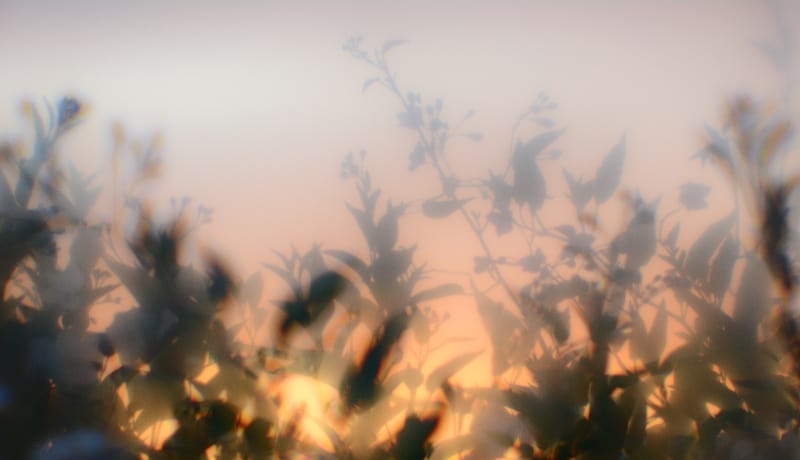
I’m not sure if I was paid in cash or gratitude (probably in gratitude, knowing my eagerness to experiment with old glass at the time), but it was nice to use the Sima lens at sunset. In the photo above, you can see how the plastic element creates blue, green, and purple chromatically aberrant auras around strong light sources. Everything blooms wonderfully. And while I’m in the mood to post portraits – a rare genre for me – here’s another from the same session. I swear to you that even though the pose and angle looks the same, I did actually take time to switch lenses!

Note the bokeh bubbles in the photo above ~ a good example that’s sure to inspire interest from people who love characterful out of focus areas. The Meyer-Optik Trioplan range of lenses is known to produce such pleasant hard-edged background bubbles. A recent obsession with such bubbly bokeh has pushed second-hand prices up dramatically, though I’ve not checked recent figures.
I was lucky to snag the Pentacon AV 80mm 2.8 Diaplan some years ago ~ a projector lens made by Pentacon (Meyer-Optik was part of the company merger that formed Pentacon). It has the same optical triplet formula as the famous early Trioplans. The only downside: being a projector lens, you need to mount it and focus it, somehow. I used some PVC tubing and glued it to a cheap mount adapter to form a simple push-pull focus mechanism.
Bokeh is just another tool in the kit-bag of the photographer. Sometimes you want everything in-focus and sharp, and sometimes you want great seperation between the subject and a super smooth background formed by a 16-bladed vintage lens iris. There are people who find Trioplan bubbles distracting and others who appreciate those gentle geometries. If we have the right tools to suit our photographic vision, and we understand their qualities and how to use them, we are a long way down the road to making the photos we imagine. Rather than favour a single tool, better to continue adding tools to our bag and treat them as equals on our journey.
And the model in question? Well, after I made some initial safety photos with what many people would call a normal modern lens and then experimenting with the Diaplan and the Sima, she ended up choosing the safe photo! I guess the bubbles don’t always appeal to the eye.



 The Rusty Ruin Journal