The excitement of a road-trip and escaping into the world

In the weeks leading up to our annual road-trip holidays, there’s a slow build of excitement that obliterates any pretence of work productivity during the final few days, for me at least. Questions around camera gear take root in my mind many months before setting off – what and how many cameras to bring? What lenses? Will I really need a tripod? How many bags and what kind?

In some sense, it feels as though this holiday in particular is partly about escaping the world’s current problems by escaping into and losing myself in the world. Photography can be therapeutic self-help in this way – reframing the world to suit our own narratives. As photographers, we look at things differently, composing and considering scenes and subjects before us. It’s a distraction from the pressing issues. We’re out there in the world, breathing in all that it offers, yet we’re one shutter-click away from reframing it to suit a story we want to tell so we can help ourselves.

The Panda’s exhausted – Nikon D7100 and 55-200mm Nikkor lens

Packing camera gear

Having recently purchased a Tenba Skyline V2 Shoulder Bag, I’ve been trying out different combinations of camera stuff for daytrips. I won’t have access to all the gear whilst we’re on the road, but a well-stocked easy-to-carry shoulder bag that sits with me in the passenger seat is going to be handy for quick stops along the way. Right now, I’m trying out this combination:

  • Nikon Z5 camera with the Nikkor 40mm F2 attached: This is going to be my workhorse camera. The 40mm Nikkor is about as sharp a lens as I need. I know there are sharper lenses, but this Nikkor is inexpensive, small, light, fast, and sharp. Ok, it’s an all plastic build, but it uses Nikon’s tough polycarbonate material, which seems to be quite durable. It may not be a classic but the results are excellent.
  • Viltrox 28mm 4.5 AF Pancake: It’s a third-party full-frame lens for Nikon’s Z system, nicknamed Chip, and it’s inexpensive. It’s also a strange lens – a true pancake lens (80g in weight), with a fixed aperture of 4.5, a 28mm focal length, a metal mount, part plastic and part metal body, 2 Aspherical and 2 Extra Dispersion lens elements, a USB-C port for firmware upgrades, and a mask that creates 8-pointed starbursts. I’m intrigued by this lens as it’s so odd. Auto-focus in a lens this small and this cheap is unusual. I think it will be much sought after in years to come, but what concerns me is that once the AF motor burns out, there’s no manual focus to fall back on.
  • Olympus OMD EM5 Mark 2 camera: Having gone back to using the Olympus lately, I’ve rediscovered the joys of a lightweight system with high quality. I use a metal grip to add a bit of heft and for better ergonomics. I’m testing out the Yongnuo 25mm 1.7 lens right now, so it’s attached to the camera. I could also pack the Sigma 30mm 2.8 DN Art lens, which is sharp and reminds me of a teeny-tiny Dalek when the hood is also attached.
  • Olympus Zuiko 4-5.6 40-150mm lens: This lightweight and rather small lens gives me an equivalent focal length of 80-300mm on the Micro Four Thirds system. If I want to be as lightweight as possible and give myself flexibility on the road, this lens is essential. Image quality is a bit on the soft side at 150mm, but that’s to be expected in a non-pro Zuiko lens.
  • Sony RX100: I generally take this with my in a day-bag whenever we go out. It’s so light and small and silent that I can use it indoors when I don’t want to bother with a larger camera and lens combination. This one fits easily in the front pocket of my Tenba bag.
  • Other stuff: Spare battery for the Z5, a micro-fibre lens cloth, a small wallet for 3 x 52mm filters (B+W Circular Polariser, B+W 10 Stop ND filter, and K&F Black Mist Diffusion filter), and an SD card holder for spares. I like the K&F Concept Diffusion filter at 1/4 strength.
  • Undecided: I’d really like to squeeze the Nikkor 24-70mm F4S lens in the bag but it’s pretty big and heavy. Finding a home for it in this bag with everything else is going to be difficult, but I think it may be a better option than carrying the Nikkor 40mm and the Viltrox 28mm. It will mean that the Zuiko 40-150mm lens has to live on the Olympus camera. Alternatively, I ditch the Olympus completely and carry the 70-300mm Nikkor ED lens attached to the FTZ adapter so I can use it on the Z5 – but this is a heavy and tall lens.
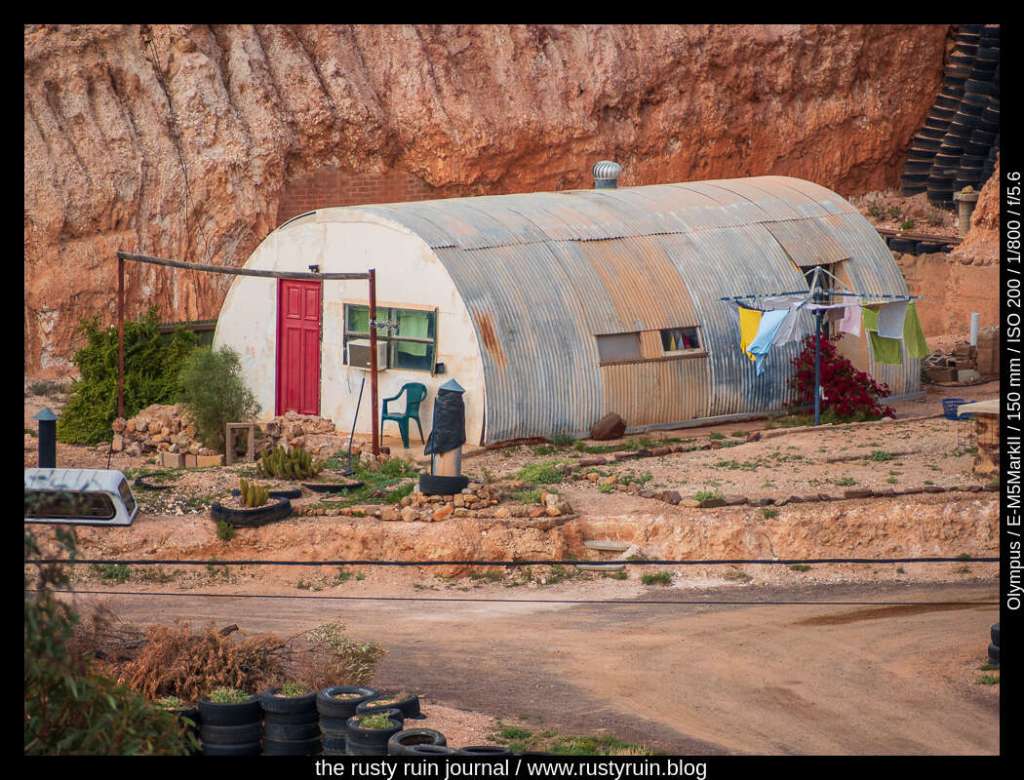
Behind the red door – Olympus OMD EM5 Mark 2 and Zuiko 40-150mm R lens – as you can see, even at 150mm, there’s acceptable sharpness available after some editing (contrast, clarity, and additional sharpening)

Walking the old goldfields with the Fujifilm Finepix S6500fd ~ ghostly gums and Fuji-Chrome

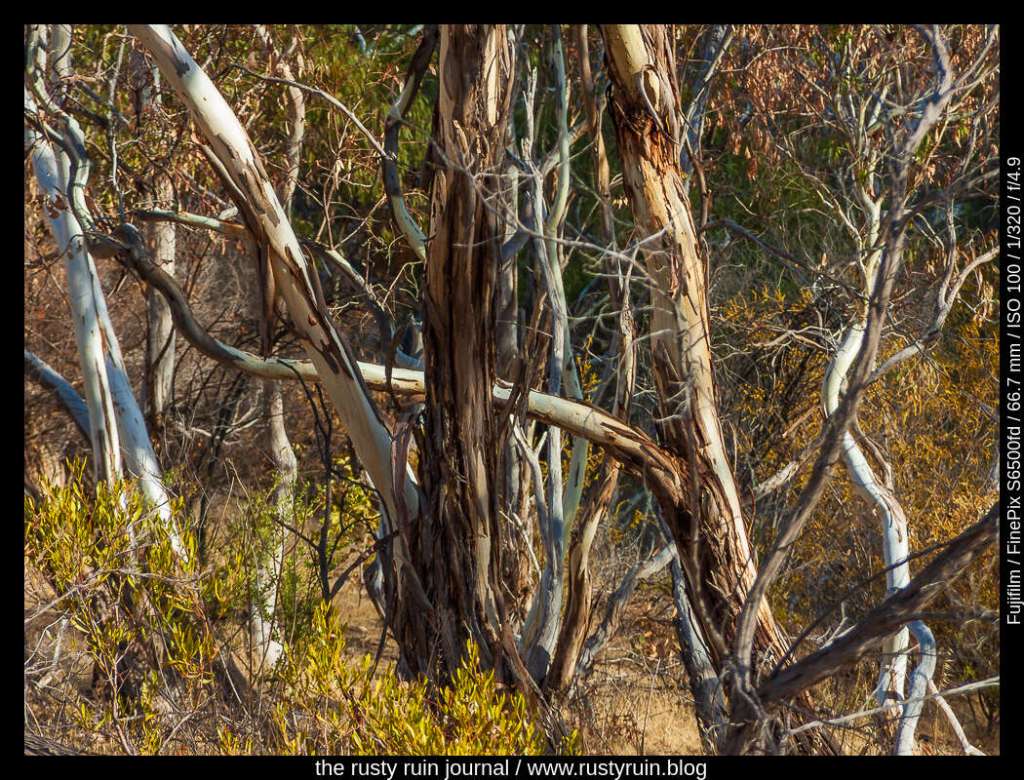
It was the perfect afternoon for us to ramble along a walking trail through century old goldfields nearby. I’d decided to pack the Nikon D40 and the Fujifilm S6500fd. I totally forgot about the Sony RX100 sitting in the zipper pocket of my camera shoulder-bag – the usual go-to in case an old camera flakes on me. I’ll say this about the Finepix S6500fd: the combination of the tiny Super CCD sensor – ancient in digital photography terms – and the long, sharp lens, produce some really interesting photographs at times.

Ghostly gums – Finepix S6500fd

Setting the camera to the Fuji-chrome setting and Fine JPG seemed to enhance the blues and purples in this photo. Maybe it was the combination of the cloud, sunlight, shade, subject, and white balance, but there’s a really strong look to the image. I haven’t added additional colour in editing.

Gum trees along the trail – Fujifilm Finepix S6500fd

For the above photo, I decided to set the camera to generate RAF files – CCD-RAW in the settings menu. I wasn’t even sure they’d open in Lightroom, but they did, and I’m pretty pleased. This provides more latitude and flexibility during editing. As you can see above, I was able to draw out pretty good detail in the shadows and sharpen the image in specific areas. It’s not easy to see without magnifying in Lightroom, but there’s some beautiful detail and tonality in the bark. Hard to believe from this piece of old gear.

Beneath the bark – Finepix S6500fd

Finally, one of my favourite features on old bridge cameras is the Macro and Super-Macro modes, at the touch of a button. It’s so handy for getting up close when there’s good available light for a decent shutter speed. I usually wander handheld, so there’s no tripod involved. Steady hands and good light are a must under these circumstances. It’s a JPG (wish I’d set to CCD-RAW), but the colour and range of tonality is still impressive. The best photos from this camera, like the S7000, seem to have a versimillitude about them. Note to self: set this camera to make RAF files from now on!

A contemplative wander at sunrise with the camera

I think contemplative photography has always appealed to me at some level. As photographers, we’re sometimes too focussed on making photos that announce our presence to others. That makes sense when looking at things through an economic or self-marketing lens. There’s a space for that, of course. But photography is about more than the next Like or Follow on the latest social media platform.

Illuminated – Sony RX100

I’m not so interested in mass appeal, exposure, ego-stroking, or money. I’m certainly interested in people and ideas and connections, but the idea that I’d need to specialise and market and propel myself in front of others just feels wrong. It goes against my grain, I suppose. The foundation of my practice finds expression through wandering, seeing, imagining, and purpose in the moment. Seeing the world differently in a single moment is at the heart of photographic practice, for me.

Sunrise and silhouettes – Sony RX100

It’s not always an easy thing to enter the mind-state of reacting instinctively to a scene. We so often judge what we see: is it a good photo? How can I make it better when editing it? How can I crop it? What camera settings should I use? When such thoughts take over, like a virus, they interrupt the flow of the moment and remove some of the joy. Is it truly important that we frame a scene so precisely that it attracts comments? Is it truly important that we even make the photo in the first place? Do we really need the camera to see the world?

On this last point: it’s true that we require no camera to experience the joy of the moment. And I think that as photographers, we’re prone to feeling as though we must capture everything and see the world through the lens. Still, the camera is integral to photography and there’s some consideration to be afforded technical settings. It’s the tension between the camera and inhabiting the world in the moment without distraction that can be the tricky tightrope for me to walk at times.

Sunlight and shadows – Sony RX100

The small beauty of everyday things

Do you ever find beauty in everyday things? Seemingly mundane stuff is part of the fabric of our daily lives, existing quietly in the background. I’ve been thinking about this a lot lately, especially on days when I feel as though I lack photographic inspiration. I can’t help but think that we’re sometimes looking for the big things as photographers, hoping they’ll catch the attention of online communities often engulfed by their own search for attention and validation. I’ve touched on that before too, of course.

Gaze – Sony RX100

Seeing everyday things in a fresh way that reveals their beauty isn’t a new idea. Contemplative photography and Miksang are approaches that emphasise an unpretentious photographic practice that’s mindful and completely present in the moment. The elevation of technical perfection is secondary to the experience of being in the world – of being aware of the moment completely and utterly. In this sense, it draws parellels to mindfulness and meditation, where inhabiting the moment non-judgementally is key.

Draped colours in strong sunlight – Olympus OMD EM5 Mark 2

There’s an interesting tension in this approach – maintaining a mind that’s open to details without becoming overly distracted by them.

When I inhabit the moment in photography, I pause momentarily to make a photo when a scene tugs at my attention gently enough that it doesn’t completely dislodge my middle-focus. Middle-focus occurs when attention hovers between soft and intense – when it’s non-judgemental and simply observational – when we focus on a thing without placing too much value on it or too much thought into it, and don’t allow it to draw us too close. In this state, we recognise something as being of value photographically, but our attention only skims across it – like a small boat floating lightly on clear water.

If this middle-focus state is dislodged and derailed, if the small boat sinks, the mindful journey will stop like a train pulling into the station to accept noisy passengers. This is the moment where mindfulness is thwarted and attention inhabits the distraction too fully, too intensely, and with an overburden of thought and judgement of value.

Morning delivery – Sony RX100

What defines this gentle pull at the edges of attention? What qualities in a scene are important? This is likely different for every photographer. For me, it’s important that such photos inhabit a space somewhere between details normally unnoticed and scenes that communicate meaning softly and quietly.

In the space between inspiration

Lately, I’ve been exploring the idea of quiet photography: noticing the quiet corners and seeking the details. When the big moments of inspiration don’t strike, it’s important not to feel the pressure of having to make photos. But if there is the tiniest inkling of wanting to pick up the camera at such times, why not commit to the small photos of everyday moments? Isn’t it in the everyday that we find a fresh view of the world?

Fire Panel – Sony RX100

Oh, where would I be without my little Sony RX100? Small, black, and set to silent mode, I re-discovered the joys of using it last year after keeping it in a drawer for too long. When the big Nikon seems too hefty for the moment, I’m always happy to find some fresh detail with the little Sony camera. Somehow, it feels less serious and more fun than my Nikons when inspiration lacks. Of course, it can make great pictures, but then again, so can a 100 year old film box!

Splashes of yellow – Sony RX100

Quiet corners and photos of distinct insignificance

In my previous post, I touched on the idea that not every photo needs to be epic and impactful. Not every moment needs to be recorded. We must always remember that seeing and feeling are at the heart of photographic practice. In cultivating the eye and heeding the pull of emotion, we enable synchronicity with the environment, and in this momentary state the camera records our imaginative trajectory through the world.

Yet, sometimes the photos are small and quiet. They’re not loud or imposing at all. These are the quiet corners and the scenes forgotten in a rush. They’re just as important and they’re the details we often miss.

Empty bottles in the sun at a second-hand shop in the country – Sony RX100

In a world where we often clamour for attention, hoping for some notoriety or virality, for some interaction on social media, for the epic amplification of our voice, being loud seems to have become the default mode for many. The intense desire to be heard above the digital cacophany may signify the ongoing trend to further isolation, loneliness, and insularity but the small and quiet photo, bereft of loud intentions and sweeping announcements, is a momentary escape. This is where we connect the eye, the heart, and the imagination to the world.

Out with the old – Sony RX100

What do you do when your photos don’t inspire?

The sun was out, there was a nice breeze, and we had an entire afternoon free. A drive to Blanchetown should have provided fruitful inspiration for photographs. But it didn’t, mostly. The weather was kind, the company good, the battery charged, and the Nikon Z5 ready for anything. So, what happened? It was me…

You know those days as a photographer when things just don’t come together? There’s a disconnect between what you see and how you feel. You compose and press the shutter but the result fails to inspire you. At times like this, I do a few things:

  • Remove the pressure from myself by leaning into other moments. Not everything needs to be camera-worthy and not every moment needs to be recorded. Enjoy the day and put down the camera;
  • Take out a different camera for fun and just focus on other scenes – details, textures, shadows. There’s good stuff in the small stuff.
Peeling and rusting – Sony RX100

Finding the details again

Sometimes, it’s easy to fall into the trap of wanting every photo to make a big impact. But those magical sunsets full of great colours don’t come around too often. Those moments when the photographic mind and heart are synchronised with the wider world aren’t always available to us. At these times, it’s important to take a step back and access other areas of the photographic process: enjoying the moment, seeing the details.

Peeling and rusting 2 – RX100

Accepting fate and below average photos

Sometimes, even when we dig into another bag of tricks, the photos don’t turn out great. Over time, we develop a sense of taste and curate our photographic output, so what might please someone else won’t please us. Part of the creative journey is developing taste and deciding which photos meet our taste standards to become the ones that really make an impact.

The remaining, less than stellar, photos are still important because they’re part of the journey to get to the photos that meet a well-developed artistic taste. Some days are about honing the eye and sensibility. Not every photo is going to be a winner and that’s OK. In fact, it needs to happen, otherwise things get boring and you don’t sharpen your eye, your imagination, your taste, and your art.

Waterbirds on twisted branches – RX100

Green machines, rusty bolts, and dynamic range

The clouds are slowly dissipating after months of grey days and this weekend provided an opportunity to drive around some of the vibrant towns of the Murray River. I packed my bag with the Olympus E-1, Nikon Z5, and the Sony RX100. I continue to be impressed with the output from the old E-1, but dynamic range is limited, and careful consideration of a scene is required before clicking the shutter button, I’ve discovered.

Shadows on emerald metal – Olympus E-1

Window of opportunity

Every digital sensor (and film, of course) has a limited window within which it can manage the dynamic range of a scene. If the dynamic range (brightest and darkest areas) of a scene exceed the window, then an exposure decision must be made: crush blacks or burn highlights? Modern sensors have a bigger window, so provide more latitude. The E-1, not so much.

Scenes with plenty of mid-tones and minimal strong highlights / deep shadows are good for this camera. Evenly lit scenes are great too. With excessive tonal ranges, I usually crush blacks because it’s less distracting for the eye, but it depends on how numerous the extreme tonal ranges are and the composition I’ve decided on.

Unused, catching dust and webs – Olympus E-1

The onboard tonal response of the Olympus is contrasty. Again, great for evenly lit scenes that could use a contrast bump, but not so great for extreme tonal ranges where pushing them further just causes distracting visual elements. The more I use this camera, the better I get at evaluating scenes in front of me before even picking the camera up. And if I can frame a scene and limit the extreme tonal ranges, I’ll do that. I also commonly dial in some negative Exposure Compensation to protect highlights but only when I want to preserve better gradation of tone over areas where distracting highlights could be a problem. Evenly lit scenes don’t need it unless that’s the look I’m going for.

Beneath the old machine – Olympus E-1

Calibrated for the old film pros?

It’s clear to me that the RAW files from the Olympus E-1 are different to the RAW files we get from modern cameras, but I don’t think this is a CMOS or CCD issue. The native tonal response of the E-1 produces files that are already contrasty and punchy. The images on this page are essentially the RAW output with barely any editing at all.

I know that some people will say I should use OM Workspace to get the colour goodness from this camera, but that software remains awful to use. And the few RAW files from the E-1 I’ve loaded into OM Workspace produce much the same initial result as the Adobe Standard profile in Lightroom, though my testing isn’t extensive enough to warrant strong views.

So, back to my speculation on the punchy files from the E-1. In 2003, when the camera was released, digital photography wasn’t mainstream. It’s entirely possible that early cameras like this were internally calibrated to produce images that were as close to certain film types as possible in terms of punchiness and also required less editing in software. Remember,  there wasn’t a lot of RAW editing software around at the time.

None of that means these old cameras make filmic photos, but it may explain why there seem to be differences in output compared to our modern cameras. I think this is less about the inherent properties of a CCD sensor and more about what kinds of photos the film companies wanted us to see from their cameras via internal calibrations. Now that photo editing programs are numerous and commonplace, modern cameras are calibrated to output flat RAW files that can easily be edited. Just speculation, of course.

Around the emerald machine – Olympus E-1

A remembrance of old cameras and simple joys

I came across an old Flickr group about a long obsolete and out of production Finepix camera. The discussion thread there is now abandoned and filled with hopeful posts from beginner photographers, posts from film camera veterans excited about the possibilities of digital photography, and people considering the merits and costs of upgrading to a DSLR.

Sony RX100

Some people questioned why the group was becoming less active, with people theorising that the marketing cycle of cameras and the forced obsolescence of models was resulting in formerly active members moving on to bigger and better cameras, the lure of more megapixels ever-present. Some others were steadfast in their dedication to a camera that permitted them to fall in love with photography as a hobby, sure that they’d never need any more than 5 or 6 megapixels. As you can imagine, there’s a little camera history in those threads, underpinned by melancholy.

Finepix Flickr group
Early morning walk – Sony RX100

The joy of discovering photography is reflected in those discussions, as well as the spin-cycle of marketing, upgrades, and feature-creep. Isn’t there often a sense of doubt kindled in us by big manufacturers so that we’ll buy the latest gadget? This is part of the reason why I like old digicams. It’s not that I think there’s some long-forgotten, superior image making technology buried in CCD sensors, or that those cameras are more capable than cameras of today, but that old cameras still feed the joy of photography. In this sense, they are relevant.

Seen better days – Nikon Z5

The truth is that people were making interesting photos using simple box cameras a hundred years ago. People still make arresting photos using old cameras now. The act of photography is the recording of an image to a medium, whether that’s film emulsion or software output via digital sensor and SD card. Photography is about seeing the world afresh and inhabiting the moment.

Standing alone – Sigma DP2M

Ruins, marketing, and megapixels

In the quest to sell cameras, companies convince us that the latest features are things we need to have. Have you ever heard that more megapixels are better, for example? You may think that the latest 42 megapixel beast is better in every way than your trusty old 12 megapixel compact, but this isn’t telling the whole story.

Ruins of the old school in Wirrabara Forest – Sony RX100

My old Nikon D70 only features a 6.1 megapixel sensor, but that’s more than enough for web viewing. It’s overkill for viewing on a phone screen. It can be printed at 4×6 inches, 7×5, and even 8×10 (possibly a little more too) if cropping hasn’t happened and you don’t use a magnifying glass to examine details.

This is where more megapixels has advantages: recording finer detail and the ability to crop the photo without losing too much of that detail when viewing at larger sizes. Six megapixels can stretch over a forest scene and pick up plenty of detail for small sized prints, but 24 megapixels can be halved in cropping and still print quite large without significant loss of detail across the image.

Sony RX100 output
Nikon D70 output

Consider the two photos above. The first is from my Sony RX100 – a 20.2 megapixel compact camera from 2012; edited from Raw. And the second photo is a straight JPG from my Nikon D70 – a 6.1 megapixel DSLR from 2004.

Ignoring the different white balance settings and the aggressive sharpening on the D70 photo, both images look quite detailed don’t they? But the RX100 file contains a lot more tonality and detail, and this can be seen when zooming during the editing process.

When output to compressed JPG – where finer details are lost and pixels discarded – and resized to the same dimensions, the two photos aren’t noticeably different. At small print and viewing sizes, 6.1 versus 20.2 megapixels is not significantly different to the eye. Print large, and all of a sudden, the detail of the 20.2 megapixel image will become apparent, as the D70’s admirable but comparatively humble resolution struggles to stretch to these sizes and details look blurry.

Rusting out in the green field – Sony RX100

Buckets of photons

Even though it’s best to be careful when framing photos with a low megapixel camera like the Nikon D70, it allows one to slow down and consider the scene. There is another variable at play here too – largish digital sensors with a low megapixel count have bigger pixels, and will usually produce less digital noise. Packing 20 or 40 million pixels onto the same sized sensor will produce more digital noise.

I remember my first digital camera – a grey plastic Kodak with an awfully tiny LCD screen, 1 megapixel, and batteries that barely lasted 12 shots. I did enjoy it though, as the colour profile over-saturated the colours and the JPGs looked nice to my eyes. It made some decent looking 6×4 inch prints, but anything larger and you’d easily see the pixelation on any lines that weren’t straight.

Every pixel on a sensor captures photons. The best analogy I’ve heard is to think of each pixel as a bucket, and each photon as a drop of water. You can put more buckets onto a large sensor but the more you cram on there, the smaller the buckets have to be. You can’t fill those small buckets with too much water without spilling it over to neighbouring buckets. And if you put 40 million buckets on a small sensor, those are going to be tiny buckets that can’t hold much water at all!

This is partly why smartphones with small sensors and 100 megapixels aren’t so good at making finely detailed photos. The light spills from tiny buckets and causes loss of detail, blown highlights, and noisy interference with neighbouring buckets. A larger camera sensor with less megapixels and bigger pixels can produce less noisy images with good detail. It’s also part of the reason why my Nikon D70, with an APS-C sized sensor and only 6.1 megapixels, produces practically noise free images up to ISO 400. That, and the fact that those CCD sensors seemed to produce a finer grained digital noise pattern that lends itself well to black and white conversion.

If only old walls could talk – Sony RX100

Glass, perceived sharpness, print size, and viewing distance

The quality of a lens also impacts the perceived detail in images. A sharp lens at the optimal F-stop, with good camera technique, can make even an old sensor with single digit megapixel counts shine. Likewise, poor optics can cause even 24 megapixel images to look mushy.

What constitutes a sharp photo? Lots of fine detail is important. But what about contrast? How about focus and blur? Big megapixel count cameras will punish average lenses and bad technique at the pixel level, as they’ll look less sharp than expected.

Here’s another thing to consider: viewing distance. The further away you are from a printed image, the less fine detail you’ll see. For example, I could print a photo from my D70 at 8×10 inches, 300 dpi, and while it would appear less sharp close-up, it could hang on my wall and look sharp enough at a normal viewing distance. I could even print at twice that size and as long as the viewer wasn’t close, the photo would look OK and certainly be recognisable. Up close, the edges would look blurry and other digital artifacts would show up. But it’s also wise to remember that there’s more to a good photo than whether you can see edge blurriness or not. An arresting image will always trump some loss of detail.

For optimally sharp prints at 8×10 inches and 300dpi, 7.2 megapixels is the minimum requirement. But remember, these are numbers for optimal sharpness, and 6.1 megapixels will still look OK when printed a bit larger because our normal viewing distance isn’t pixel peeping up close. The same applies to other megapixel counts: optimal sharpness versus actual viewing habits.

Lovely rust on blue – Sony RX100

So, what does it all mean?

If you’re looking to buy a camera, ask yourself this: what am I going to use it for? If you’re only going to share photos on the web, any digital camera since 2003 will serve you well. If you want to print the occasional photo, but you’re not looking to go much bigger than 8×10 inches, then look at cameras of at least 8 megapixels. Want the sharpest photos possible, with the most detail recorded, and you also have access to the best printers available that can actually print all that detail at poster sizes? Then you’ll be looking at cameras with at least 24 megapixels. You’ll probably need even more if you really want images with as much fine detail as possible. And that’s not to mention the cost of top quality glass!