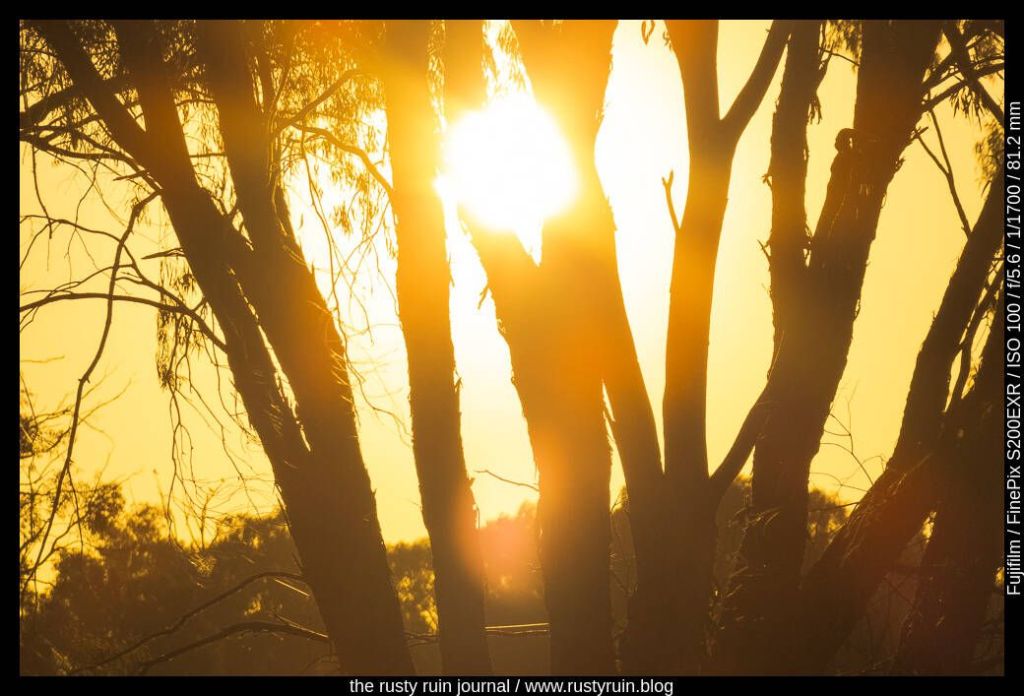
Driving around to find a good vantage point for the sunset, I spotted a group of trees arranged attractively. It was a quick photo, as we’d collectively decided to challenge the remaining minutes of sunlight by driving elsewhere for a different view.
Golden sun through trees
Thinking before pressing the shutter button and visualising the final photo: the shape and position of trees for my composition – the detail in the tree trunks and branches was not important – communicating feeling through light, colour, and shadow.
I underexposed to throw the foreground of trees into strong shadow. The detail and texture of bark didn’t matter so much as the shape and silhouette of each tree.
During editing, I decreased the Shadows and Darks further, increased White Point, and increased Saturation slightly to amplify the golden glow.
How often do we think that no photograph can ever record the majesty of a sunset? Rather than record an accurate scene, the best we can do is render an approximation that allows us to, perhaps, amplify certain attractive qualities during the editing process.
During this endeavour, liberal use of the tone curve – Highlights, Lights, Darks, and Shadows – may provide the tonal characteristics that produce a pleasant enough photo that one might imagine themselves, just for a moment, watching the sun in real-time as it illuminates the sky.
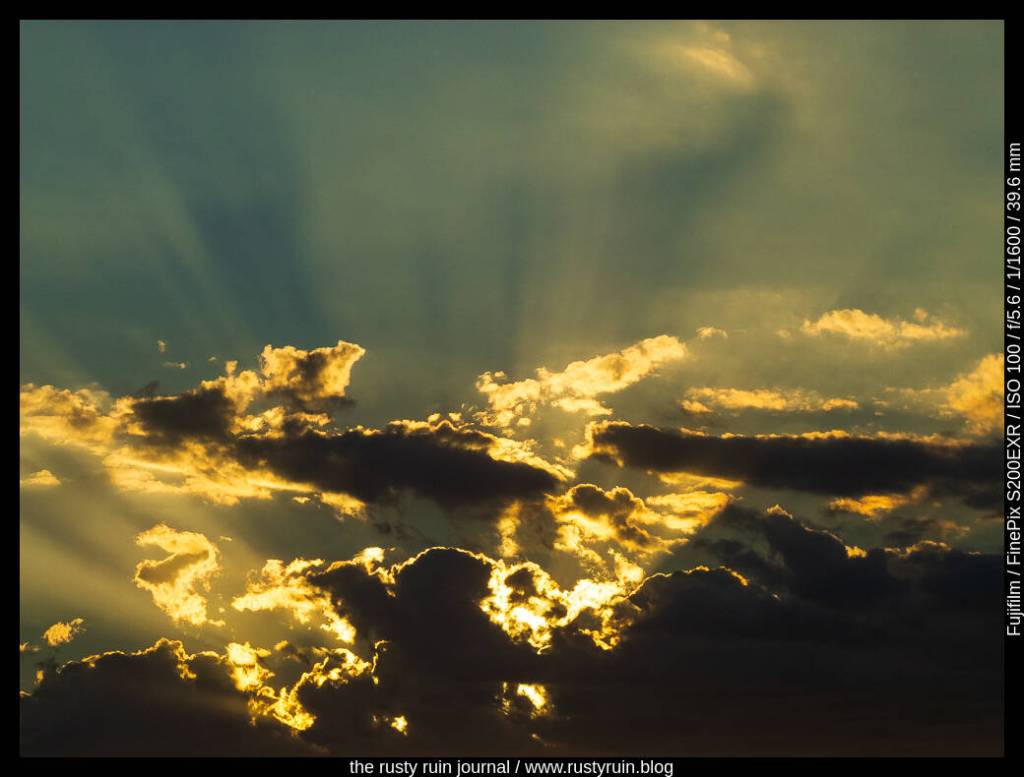
Sunset #1 – Finepix S200 EXR
As charcoal clouds largely obscured the sun, underexposing this photo at the moment of recording deepened the colours, revealed the delicate sun rays, and rendered a sky full of contrast and dynamic light. Though possible to adjust exposure settings during editing, having a final vision for the image in my mind – moody and dark – necessitated a faster shutter speed and, therefore, slight underexposure.
Visualising the final look of a photo and adjusting exposure accordingly is like scribbling in a notebook of ideas that informs the editing process many months later – oh, the clouds are moody and dark, I’ll go with that look! In this way, ideas for editing begin before pressing the shutter button.
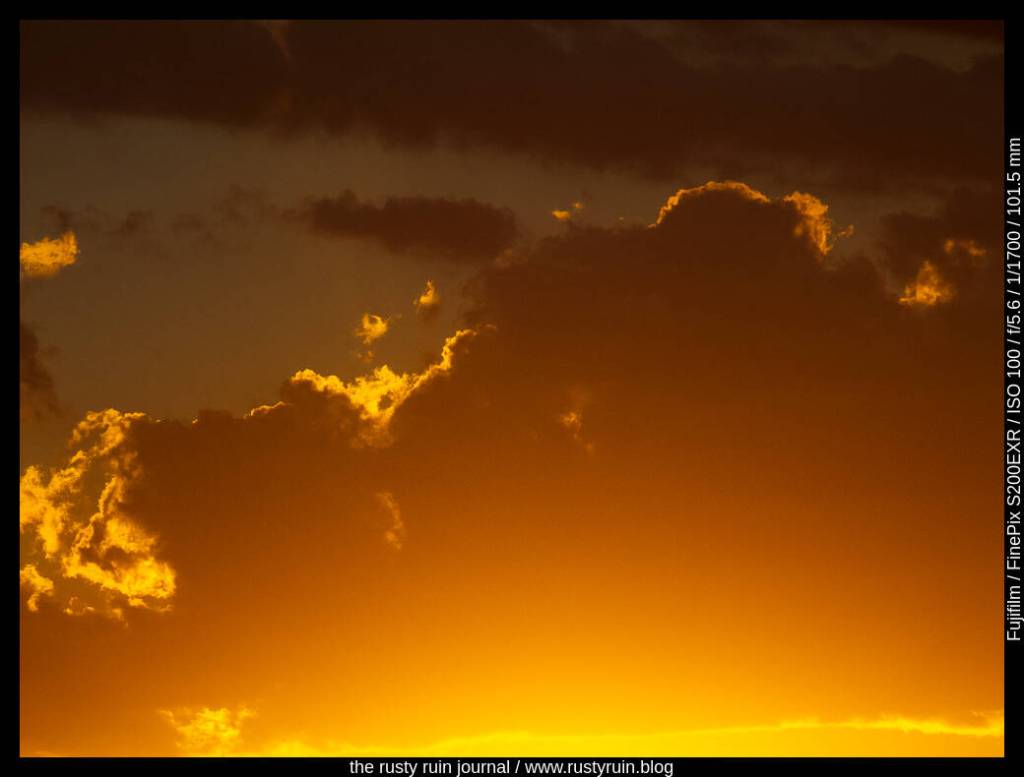
Sunset #2
Retaining the moody clouds through a careful decrease in Darks and Shadows, and increasing White Point and Light to amplify the sun’s aura produces an approximation of the golden illumination I witnessed at the time.
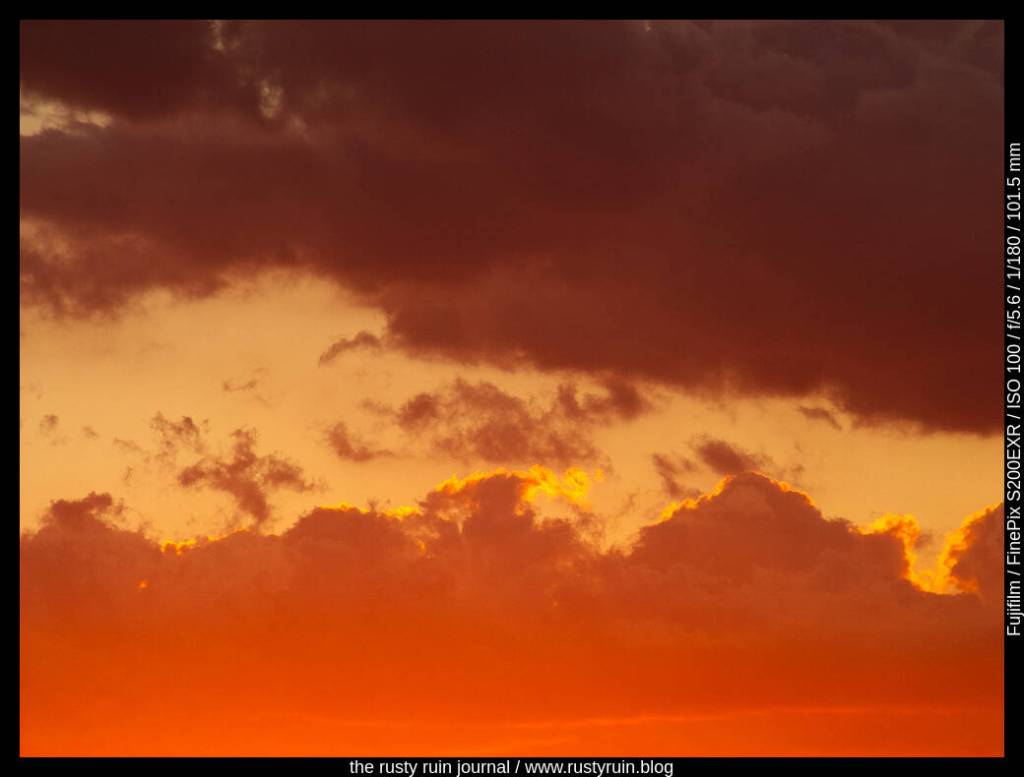
Sunset #3
Here, I wanted to focus on the orange yellow, and pinkish hues that defined this section of sky. Less contrast produces a more harmonious rendering – my feeling at the time of recording.
Sunset #4
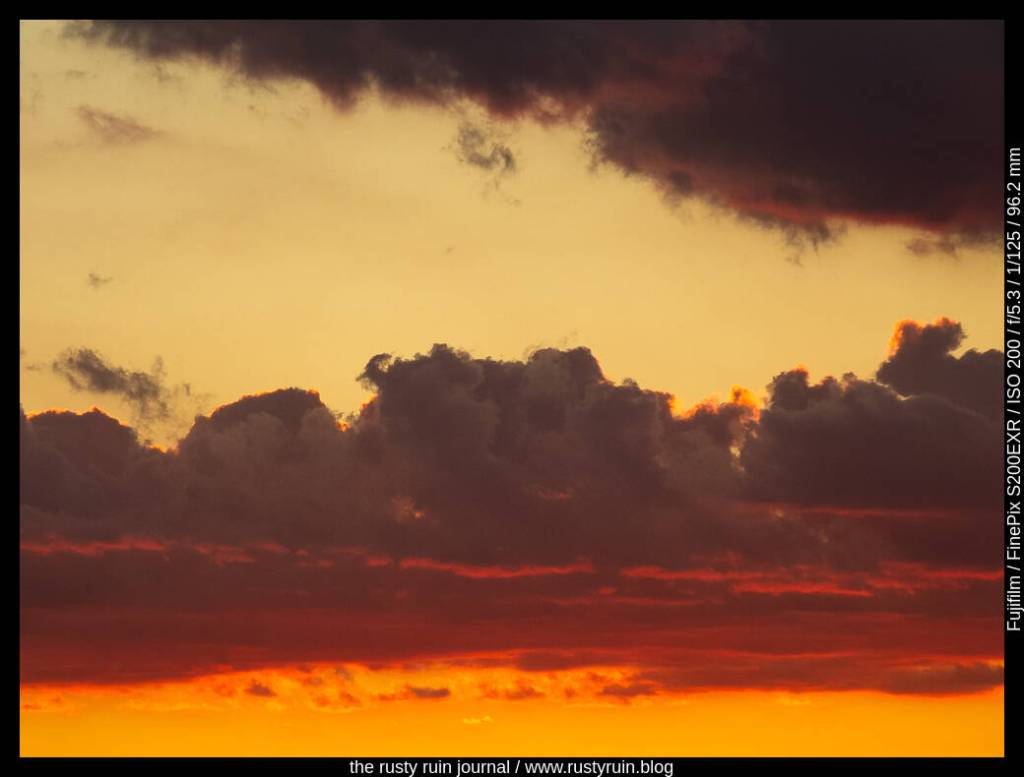
As the sun moved below the horizon, the clouds absorbed night’s early shadow and languid bands of amber, magenta, and vermillion brushed the edges.
There’s nothing better than slow moving light that turns everything gold and warm, especially in small coastal towns where the rough sea meets rocky beaches. The regular opacarophile might love every sunset, but I fear that not every sunset is so easily framed as to be visually interesting. Maybe I’ve just seen too many sunsets? Maybe too much time spent looking through the viewfinder pondering settings turns the mind to a need to make every photo a winner? I suspect the latter is closer to the truth and is another story worth exploring.
Sunset glow below – Fujifilm Finepix S200 EXR
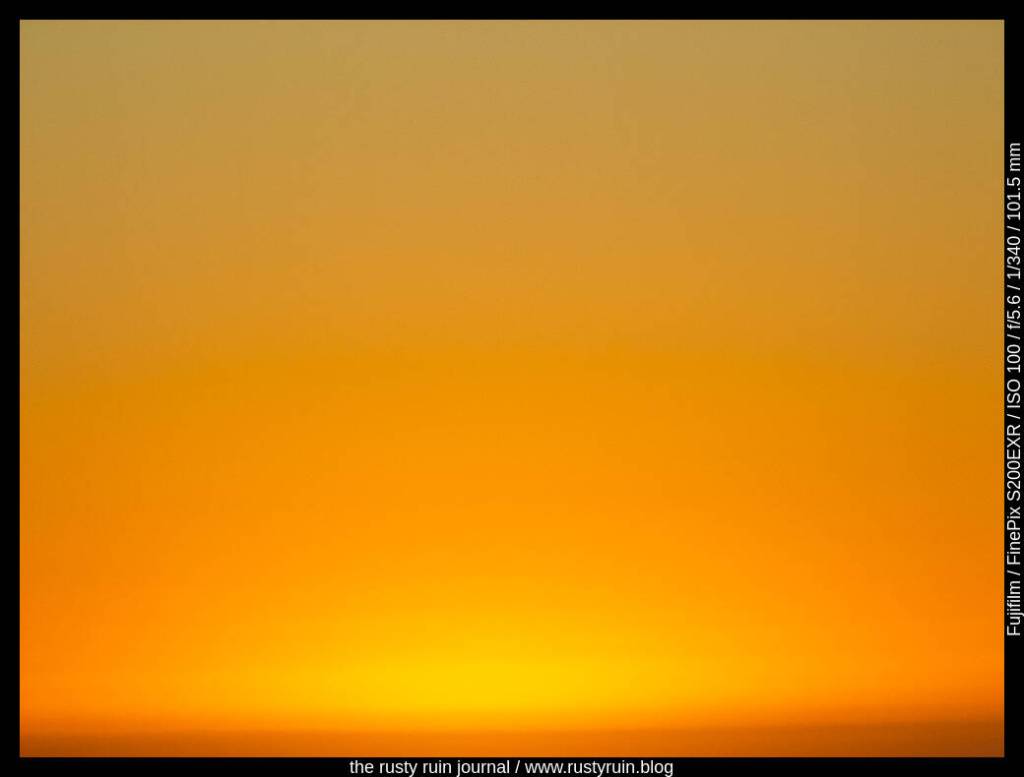
Another sunset and another horizon. How to make this one something different? How to avoid the same bright sun and carefully placed horizon line composition?
I filled the frame with the orange glow of the sun just as that bright sphere dipped out of sight. The Finepix S200 EXR is an old camera and is quite soft at the long end, but who needs sharpness for the photo above? It’s all about the colour field and the deep orange glow. Underexposing by two-thirds of a stop deepened the colours. Everything is smeared to a sunset abstraction to fill the frame.
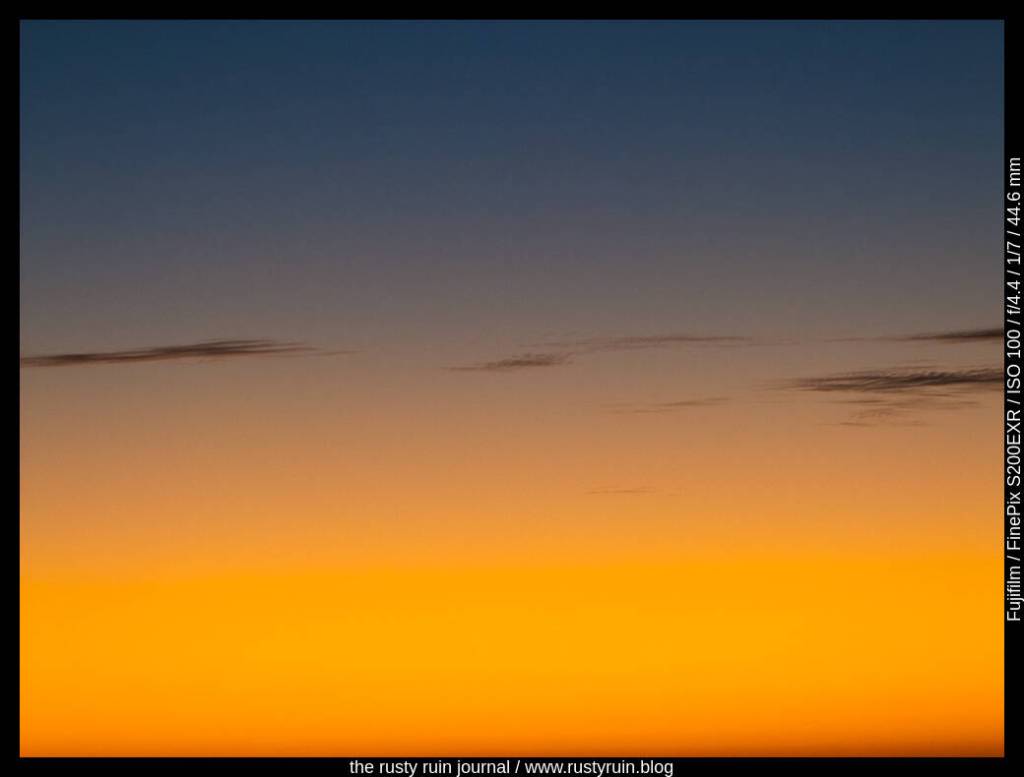
Minutes later, I caught a line of rough dark clouds marking the transition from golden hour to blue hour:
Suspended between orange and blue – Finepix S200EXR
I was a little way up the dusty side-road with my Nikon Z5 and Nikon D40 when a big white 4-wheel drive roared past me and stopped next to our car, dust kicking up from the wheels. I knew it was a bad sign. I’d been here before. A few moments later, the car belted away down the dirt and turned onto the bitumen. Everything was quiet again and I gazed in the direction of the setting sun, hoping we’d be left alone long enough to make some more photos in the best light of the day.
Covered in old vines – Nikon Z5
I went back to work with the Z5, dialling back the exposure to preserve the highlights and waiting eagerly for the golden light to bathe the dusty corner we’d chosen for some evening photos. The quiet didn’t last very long…
Another big vehicle pulled up next to the ruined building we’d been training our lenses upon. I packed up my gear and started to walk back up the road to my buddy, suspecting he’d have to deal with a mouthful of abuse from the locals. I wasn’t wrong.
“What the FUCK do you think you’re doing???!”
I get it. There we are on a normally quiet road and we’re loitering outside his property. I made it there just in time for the tirade. My mate was very calm in the face of it, de-escalaing the situation and rightly pointing out we weren’t trespassing on his property and had no intention of entering or wrecking anything. Some minutes of back and forth and the property owner was still gruff but calm enough to take some mouthfuls of beer from the bottle he was swinging about.
Collapsing shed – Nikon D40 and Nikkor 35mm 1.8 lens
I contributed the odd word or two, reinforcing the argument that we were innocently making photos in great light and staying outside the fence-line.
“Yeah…I s’pose that’s OK if you’re into photography…”
Clearly his own mate was just there for moral support, as he’d said not a word the whole time. The golden light was fast fading and we were still locked in heated discussion about kids stealing copper from the old house and cutting the barbed wire fencing. The anger’s understandable, of course.
“Next time, ask me for permission! I’m just up the road, there.”
The problem with so many of these ruined places is that you just don’t know where the landowners are. Properties beyond urban areas can be big and it’s not always obvious who owns what. So, we stick to the public areas – the pathways and the roads, usually. Legally, you can make a photo of just about anything if you’re in a public space and you can see the subject from that public space. Permission isn’t required unless you’re planning to enter the property. I’ve never needed to say any of this to an angry onlooker or property owner, mostly because it doesn’t result in calm conversations.
A sea of cactus – Nikon D40
Finally, we made our peace and drove off. We’d missed the best light of the day. It would have been amazing too – pink clouds and soft golden highlights bathing all the dusty old corners and abandoned places.
Looking out from The Point – Fujifilm Finepix S6500fd
This small bridge camera from Fujifilm only has a small – 7.44 x 5.58 mm – digital sensor, but it features Fuji’s SuperCCD sensor technology, which seems to have some special sauce about it. Can you believe the electronic viewfinder even has a nice live histogram so that you can alter exposure compensation quickly? It even looks like a mini-DSLR. Along with the clunkier Finepix S7000, I think the S6500fd is one of the best bridge cameras from the 2000s era between film and digital.
The moody golden spill – Olympus E1
These aren’t great light conditions for an old CCD-based camera like the Olympus E1 that loves more light, especially when pushing the ISO introduces the type of visible noise that 20+ year old digital cameras are known for. My steady hand and the vestiges of bright sunlight helped keep the shutter speed usable. I still love what this camera can do even more than 20 years after market debut! It can make very painterly images.
How do you feel about sunsets? What do you think about when you’re watching the sun dip slowly below the horizon line? Are you an avowed opacarophile? I think most of us love a good sunset!
Fiery water – Nikon Z5
How do you go about framing a sunset? What decisions do you make when you compose? The so-called rule of thirds can be useful when framing landscapes like this. Typically, I’ll keep two thirds of the photo as sky, since this is usually where the most interest is – beautiful clouds and shifting colours. But as you can see in the above photo, I decided not to do that on this occasion.
My decision here revolved around the difficulty of balancing some of the brightest sections of sky with the reflections on the water. The dark shadowy landmass serves as a strong dividing line between sky and sea. I also found the texture and colour of the water more intetresting than the sky at that moment, so I chose to include more of it.
During editing, one sticking point was the brightest section of sky, right in the middle, casung me some visual distraction. The sun breaking through those clouds is strong enough to draw the attention away from the texture of the water. To address this, I opened it in Lighroom, selected a mask over that bright area, and lowered the highlights a little more. Doing this brought out some cloud detail and minimised it as a visual distraction.
As city revellers were ushering in the new year, we were driving with good friends through silent streets around the wharfs and docks. Earlier, we’d had dinner at a pub on the edge of the marina and witnessed a sunset full of delicate hues.
The Marina at Sunset – Nikon Z5
Once again, the opacarophile strikes! Low in the frame, the masts were like trees – but stripped back, orderly, severe, and made by human hands. Tiny streaks of boat fuel and chemicals on top of the water, iridescent in the fading light, reminded me of how these places are underpinned by our need to exploit the environment for reasons of vanity and leisure. I gazed at expensive apartments across the water, with expensive boats moored nearby, and thought about the very few who could afford that kind of life.
Some mundane reflections
I’m learning how to handle the Nikon Z5 better. I have no complaints about the hand-feel of the camera. The grip is typically nice in that Nikonian way – though not up to the high standard of the Olympus E1. The Z5 doesn’t have all the external button control of higher models in the Z lineup, but it’s the entry level camera, after all. That’s no bother to me.
I once wondered about the role my tiny Olympus OMD EM5 Mark 2 would play in the aftermath of my Z5 purchase. Admittedly, I don’t take the Olympus out as much as I used to, but on days when I want to carry less weight, it’s the better option. I’ve also become so used to using old manual focus lenses on the Olympus, just for the central sweet spot of the glass, that it seems a missed opportunity not to use it.
Reeds at Meningie, SA – Nikon Z5
I should explore the use of vintage glass on the Nikon Z5 this year. I invested in a good quality M42 adapter, so now I can use all of my old Soviet, German, and other glass. Pleasingly, the Z5 automatically detects a non-CPU lens and switches to Focus Peaking mode. No longer do I need to go into a menu and turn it on!
It’s a new year. We’ll see what happens. Some things will change and some things never will.
The Urban Dictionary defines an Opacarophile as someone who loves sunsets. It would be fair to say that many people find beauty in sunsets. Certainly, at the end of a day out on the road, our thoughts turn to whether we’ll find a suitable spot to witness the sunset and make a good photo. There’s always some resigned grumbling when heavy clouds obscure the sun!
The importance of the setting sun
The setting sun signals the end of the day and the turning of the earth. One might ponder our long line of ancestors, staring at the shifting hues and watching the sun retreat below the horizon. Such an event reminds us of our smallness and our place in the world.
Evolutionary science suggests that when we experience the beauty of sunsets, we tap into our evolved aesthetic faculties – brain wiring that allow us to see the rightness or harmony of something in order to judge its value and health. A healthy mate is vital to produce healthy offspring and continue the species, so beauty in this context represents a healthy mate and potential long-term survivability. A beautiful sunset stimulates the same aesthetic faculties that allow us to determine the health of a potential mate and the rightness and harmony of things.
Perhaps that theory is a long-bow to draw for many! My favourite is the Biophilia Hypothesis, which I’ve mentioned in a previous post. The idea that humans are drawn to natural areas because we have a deep-rooted connection to them, having lived in such areas for most of our history, is a compelling one.
Two sunsets, two interpretations
Sunset, Meningie SA – Nikon Z5
Having spent much of the day driving around the Cooring, Meningie provided us with the most wonderful of sunsets. A variety of colours, shifting from moment to moment, reflected in calm water. This single sunset made up for all of the sunsets we missed. Can you spot the lone duck in the above photo?
I’m glad I had my Nikon Z5 with me for this. I’d attached the excellent Nikkor 24-70mm F4 S lens after deciding that my usual lens, the Nikkor 40mm f2, needed a break. I know that many photographers prefer a tripod for such scenes, perhaps combined with Neutral Density filters, but our day-trips are about chance and hope, best represented by hand-holding the camera and moving to the next potential aesthetic wonder.
Sunset, Meningie SA – Nikon Z5
What a difference a moment makes to the colours of a sunset! I’m being a bit cheeky, as the colour in the photo above is actually a momentary interpretation of the automatic white balance in the Z5. Once I saw what white balance it had chosen, I decided to stick with it. The first photo is much more like the original sunset we saw. I simply exaggerated the blues and pinks by setting a Tungsten white balance during editing. It’s one thing I’ve noticed in my Z5: the automatic white balance is sometimes over-eager. Still, I find it’s best to grasp these chance moments and chance settings!
For all of the great cameras and sharp glass on the shelves, it’s liberating to play around with low-tech options sometimes. Maybe there’s a scene in front of you with great lighting but a subject that has been overdone? Maybe you’re gear-fatigued and just want to try something else? Do you know what I do when I’m a bit exhausted with tech and sharp lenses? I put something cheap in front of the camera lens to see what happens…
Dreams of green cool – Nikon Z5 with cheap plastic
The time of day was right and the leaves were catching golden light but I was weary of the same tired approach. Sharpness is a state of mind! Great photos have been made with the most primitive film boxes. So, instead of doing the usual, I pulled out a flexible piece of clear plastic and stuck it in front of the sharp Z glass. As you can see, it pulls the light in different directions when moved about. After some Split Toning, Vibrance, and a decrease in Clarity, the photo has a nice dreamy look.
Dreams of a glassy sun – Nikon Z5 with Diffusion Filter and cheap plastic
Diffusion filters are a good idea when you want some highlight blooming and a softer tone to a photo. Though the TiffenBlack Mist Pro filter tends to be the top of the price and quality pile, my feeling is that dreaminess can be found in even cheaper materials. I purchased the K&F Concept Black Diffusion filter and it does just fine.
The sun photos were both made with the Black Diffusion filter in place. There’s some nice blooming around the sun, but that’s pretty much obscured by the use of the cheap plastic I used for the photo of the trees. Details are hidden, contrast is lowered, and only bright shapes remain.
A distant sun barely warms – Nikon Z5 with Black Diffusion Filter and cheap plastic











 The Rusty Ruin Journal