Why pack more than one camera? Thoughts on vanity, bag space, and lens mounts

How many cameras do you pack when you go on a road-trip/holiday/vacation/adventure? If you’re not a photographer, you might pack one camera. Or maybe you just pocket your smartphone and use that for all photos?

In my previous post, I was thinking aloud about what camera gear to pack for our impending road trip. In the comment section, another blogger, Disperser Tracks, asked me why I’d pack as much as I’m planning to if the goal is to pack light? It’s a great question and one that has often crossed my mind.

Bags everywhere – Nikon D5100 and Tamron 17-50

If my ultimate goal is to pack lightly, why not just pack the smallest and lightest camera I have and be done with it? Why bother packing anything else? Why cram gear into bags that are bursting at the seams?

  • Is it about ego and vanity? Am I trying to look impressive in the field? I don’t think so. I rarely meet other photographers on my travels. I’ve used all kinds of cameras, crappy lenses, and pieces of plastic when standing near photographers with expensive lenses and cameras. I’m interested in what they’re using and what they’re doing, but I don’t think about how I look next to them. Feeling insecure was an issue when I first started with a DSLR, but not now. I’m comfortable with my photographic approach. I make vast efforts to be aware of my inner world, my motivations, my reason for doing something, my intent, and my beliefs.
  • What about being prepared? Photo opportunities on the road are often last-minute stops. There isn’t much time to swap lenses and fiddle about. Having two camera bodies with different lenses mounted allows me to choose the best option quickly. Do I need a fast prime lens? Got that on my Nikon Z5. Do I need a telephoto? Got that mounted on the Nikon D3400 today.
  • It’s about the game of mounts. I actually don’t have a telephoto lens for my Nikon Z5 in the native Z mount but I do have one in F mount for my older Nikons. It makes sense to use the right lens for the right body. Likewise, I have a wide 20mm Z mount lens for my Nikon Z5 but not one for my older F mount Nikon cameras.
  • Yes, I’m a bit of a novelty seeker. I love cameras and I love photography. I enjoy all of my cameras and like to have options when on the road. Sometimes a Nikon Z5 will serve the moment and other times a Nikon D40X will bring me joy. If something makes a photo, I’m interested. I’ll also pack the Campsnap for some lo-fi fun.
  • Unfortunately, cameras have failed on me. Last year, I had my amazing Sigma Foveon camera fail me in the field as the shutter mechanism malfunctioned. Several years ago, my Olympus EM5 Mark 1 failed me on a day-trip. Call it bad luck, I guess. I pack other cameras just in case something breaks. Call it paranoia!

Surrounded by stuff – Nikon D7100 and Nikkor 50mm 1.8 lens

The excitement of a road-trip and escaping into the world

In the weeks leading up to our annual road-trip holidays, there’s a slow build of excitement that obliterates any pretence of work productivity during the final few days, for me at least. Questions around camera gear take root in my mind many months before setting off – what and how many cameras to bring? What lenses? Will I really need a tripod? How many bags and what kind?

In some sense, it feels as though this holiday in particular is partly about escaping the world’s current problems by escaping into and losing myself in the world. Photography can be therapeutic self-help in this way – reframing the world to suit our own narratives. As photographers, we look at things differently, composing and considering scenes and subjects before us. It’s a distraction from the pressing issues. We’re out there in the world, breathing in all that it offers, yet we’re one shutter-click away from reframing it to suit a story we want to tell so we can help ourselves.

The Panda’s exhausted – Nikon D7100 and 55-200mm Nikkor lens

Packing camera gear

Having recently purchased a Tenba Skyline V2 Shoulder Bag, I’ve been trying out different combinations of camera stuff for daytrips. I won’t have access to all the gear whilst we’re on the road, but a well-stocked easy-to-carry shoulder bag that sits with me in the passenger seat is going to be handy for quick stops along the way. Right now, I’m trying out this combination:

  • Nikon Z5 camera with the Nikkor 40mm F2 attached: This is going to be my workhorse camera. The 40mm Nikkor is about as sharp a lens as I need. I know there are sharper lenses, but this Nikkor is inexpensive, small, light, fast, and sharp. Ok, it’s an all plastic build, but it uses Nikon’s tough polycarbonate material, which seems to be quite durable. It may not be a classic but the results are excellent.
  • Viltrox 28mm 4.5 AF Pancake: It’s a third-party full-frame lens for Nikon’s Z system, nicknamed Chip, and it’s inexpensive. It’s also a strange lens – a true pancake lens (80g in weight), with a fixed aperture of 4.5, a 28mm focal length, a metal mount, part plastic and part metal body, 2 Aspherical and 2 Extra Dispersion lens elements, a USB-C port for firmware upgrades, and a mask that creates 8-pointed starbursts. I’m intrigued by this lens as it’s so odd. Auto-focus in a lens this small and this cheap is unusual. I think it will be much sought after in years to come, but what concerns me is that once the AF motor burns out, there’s no manual focus to fall back on.
  • Olympus OMD EM5 Mark 2 camera: Having gone back to using the Olympus lately, I’ve rediscovered the joys of a lightweight system with high quality. I use a metal grip to add a bit of heft and for better ergonomics. I’m testing out the Yongnuo 25mm 1.7 lens right now, so it’s attached to the camera. I could also pack the Sigma 30mm 2.8 DN Art lens, which is sharp and reminds me of a teeny-tiny Dalek when the hood is also attached.
  • Olympus Zuiko 4-5.6 40-150mm lens: This lightweight and rather small lens gives me an equivalent focal length of 80-300mm on the Micro Four Thirds system. If I want to be as lightweight as possible and give myself flexibility on the road, this lens is essential. Image quality is a bit on the soft side at 150mm, but that’s to be expected in a non-pro Zuiko lens.
  • Sony RX100: I generally take this with my in a day-bag whenever we go out. It’s so light and small and silent that I can use it indoors when I don’t want to bother with a larger camera and lens combination. This one fits easily in the front pocket of my Tenba bag.
  • Other stuff: Spare battery for the Z5, a micro-fibre lens cloth, a small wallet for 3 x 52mm filters (B+W Circular Polariser, B+W 10 Stop ND filter, and K&F Black Mist Diffusion filter), and an SD card holder for spares. I like the K&F Concept Diffusion filter at 1/4 strength.
  • Undecided: I’d really like to squeeze the Nikkor 24-70mm F4S lens in the bag but it’s pretty big and heavy. Finding a home for it in this bag with everything else is going to be difficult, but I think it may be a better option than carrying the Nikkor 40mm and the Viltrox 28mm. It will mean that the Zuiko 40-150mm lens has to live on the Olympus camera. Alternatively, I ditch the Olympus completely and carry the 70-300mm Nikkor ED lens attached to the FTZ adapter so I can use it on the Z5 – but this is a heavy and tall lens.
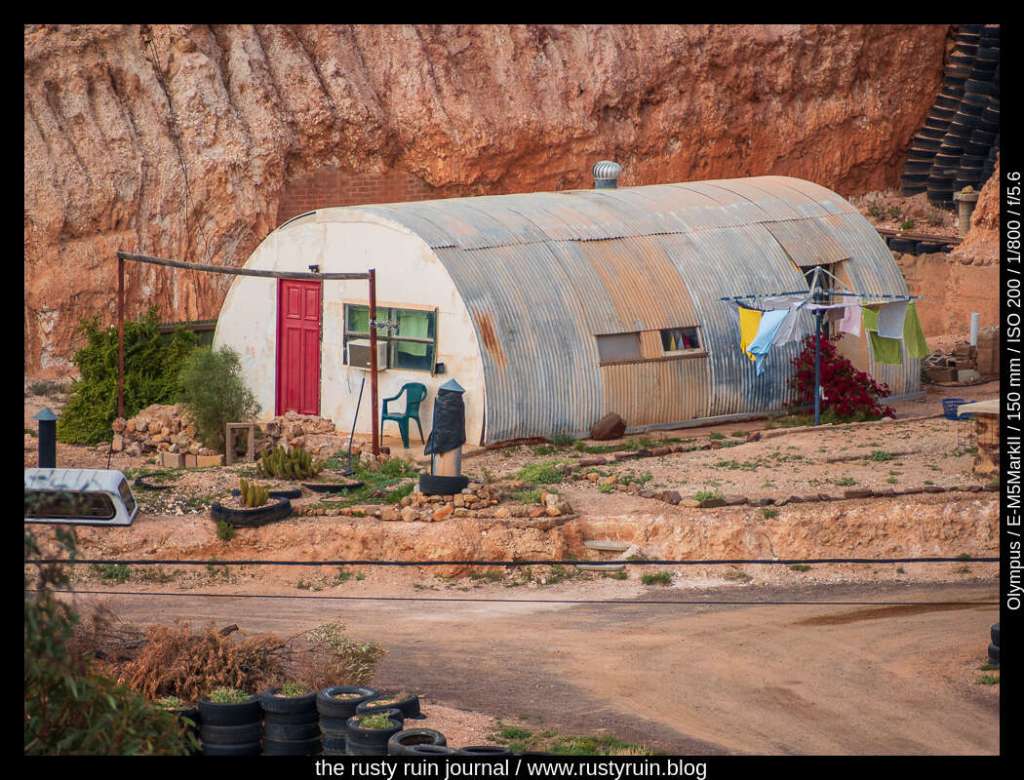
Behind the red door – Olympus OMD EM5 Mark 2 and Zuiko 40-150mm R lens – as you can see, even at 150mm, there’s acceptable sharpness available after some editing (contrast, clarity, and additional sharpening)

Nitmiluk National Park ~ awe-inspiring gorges, a kit lens, and harsh light

To the local Jawoyn people, the amazing gorges in Nitmiluk National Park (Katherine Gorge) hold special significance. We were fortunate enough to book a short cruise to see some of the many wondrous gorges in the area and view the ancient sandstone rock formations, calm waters, and freshwater crocodiles. This is an area teeming with life and Dreamtime stories.

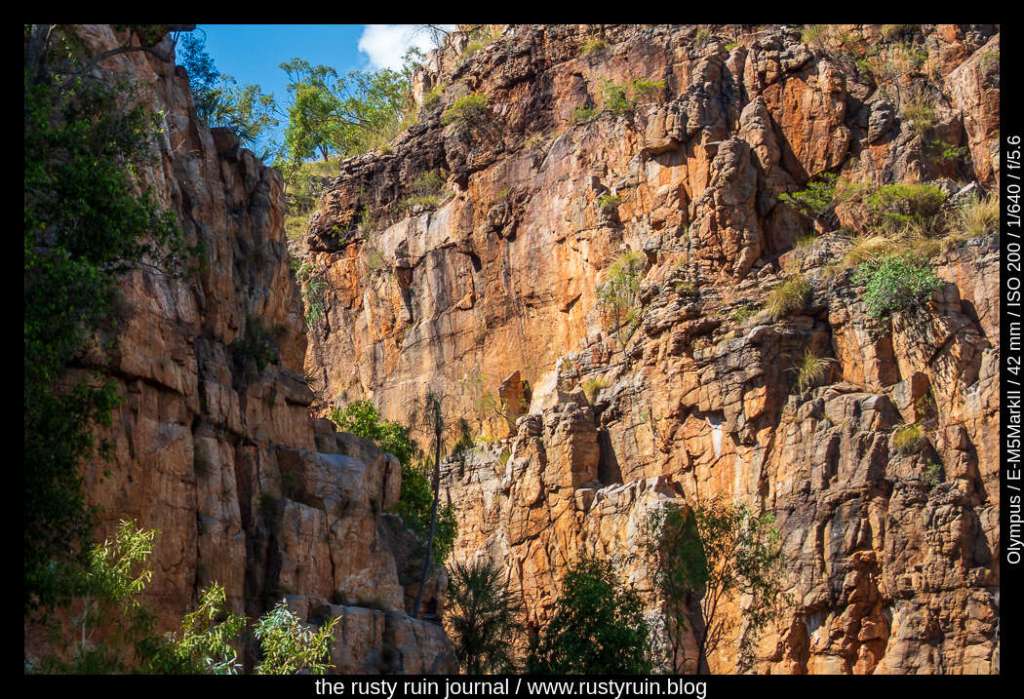
Nitmiluk National Park, one of the gorges – Olympus OMD EM5 Mark 2 and 14-42 kit lens

Sunlight at the height of the Australian afternoon can be harsh. This is one reason I prefer viewfinders rather than the big LCD screens on so many cameras that get washed out in these conditions. 

The soft golden light of dawn or dusk brings out the best colours in the outback landscape, but trip timing doesn’t always permit, and you have to work with the tools you have and the light available when the opportunity arises. One quality this strong afternoon light does emphasise: all the textures on the ancient sandstone.

On the day, I packed lightly since I’d been lugging a not insignificant amount of camera gear around on other days (hello Lowepro Nova 200). The Olympus EM5 provides good image quality and lots of control in a small package. It’s just a small pity I’d also decided to take the 14-42 kit lens with me. That’s not to say that kit lenses are bad at all. Nikon makes some great kit lenses, such as the 18-55mm. And this Olympus Zuiko kit lens is no slouch in the image quality stakes – it does pretty well for a cheapish plastic lens. But at times when I want more sharpness to record all of the landscape’s details, it gets a bit fluffy and squishy at the edges of the frame. Still, you work with what you have and the conditions of the day.

Nitmiluk National Park – Olympus OMD EM5 Mark 2

I’ll always say that eye-watering sharpness is generally overrated in photography, but there are times when sharpness is another tool you want in order to communicate certain qualities – the texture of the rocks in this case. Despite some of the shortcomings of my kit lens, careful subject selection, use of exposure compensation to retain as much detail as possible in high dynamic range scenes, and some boost to the red/orange/yellow colour channels during editing helps to make the photos shine. I also reduced highlights to reveal the details of the ancient sandstone.

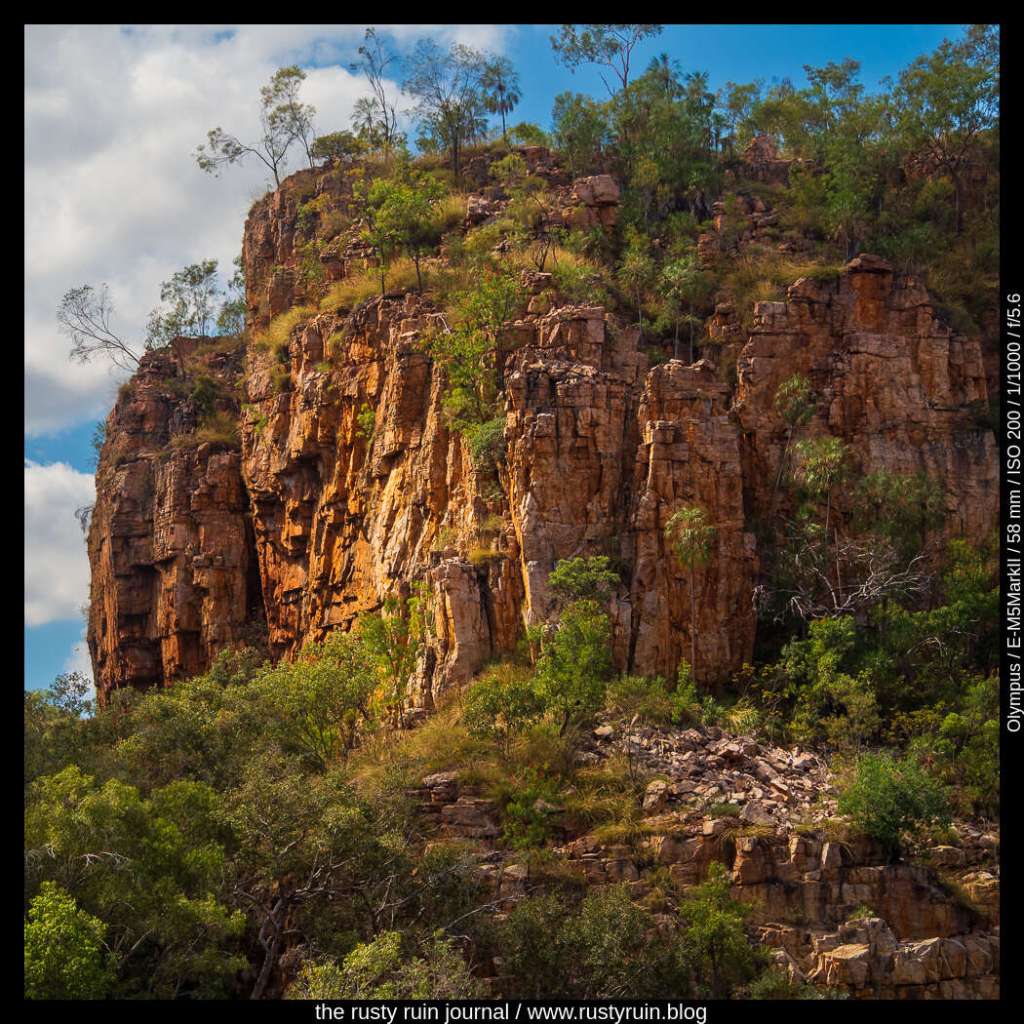
A patch of sunlight illuminates ancient rock – Olympus OMD EM5 Mark 2 and Zuiko 40-150mm lens

As the clouds grew heavy, the light conditions became a little more forgiving. As you can see in the above photo, clearing clouds also provided an opportunity to record sunlight as it illuminated sections of rock. I used the so-called plastic fantastic 40-150mm Olympus Zuiko lens for this photo – small, light, and really quite sharp at most focal lengths. I guess the message is to know your camera gear and accept and make best use of your tools and the conditions. I’ll freely admit to not knowing all of my gear well enough at times!

Uluru up close ~ a story of hiking, geology, erosion, and deep time

We looked up at the huge rocky dome, in awe of the ancient geological processes that had created it. Over 500 million years ago, before dinosaurs wandered the lands around the ancient sea that would one day become a national park and tourist attraction, Uluru and Kata Tjuta started to form. At such times, you realize the scale of the world around you and feel very small indeed.

Looking back in time: Uluru – Nikon Z5 with Nikkor 40mm F2 lens and Circular Polariser

Doing the 10km base walk is the best way to appreciate the vastness of Uluru. We were already exhausted from our 8km hike through Kata Tjuta the day before – those rocky slopes and winding pathways can be unforgiving on cheap hiking shoes! I once climbed Uluru in about 45 minutes, back when it was commonly known as Ayers Rock. No-one is permitted to climb it now, but you can still see the old climber’s entrance and the worn path that millions of tourists braved over the years.

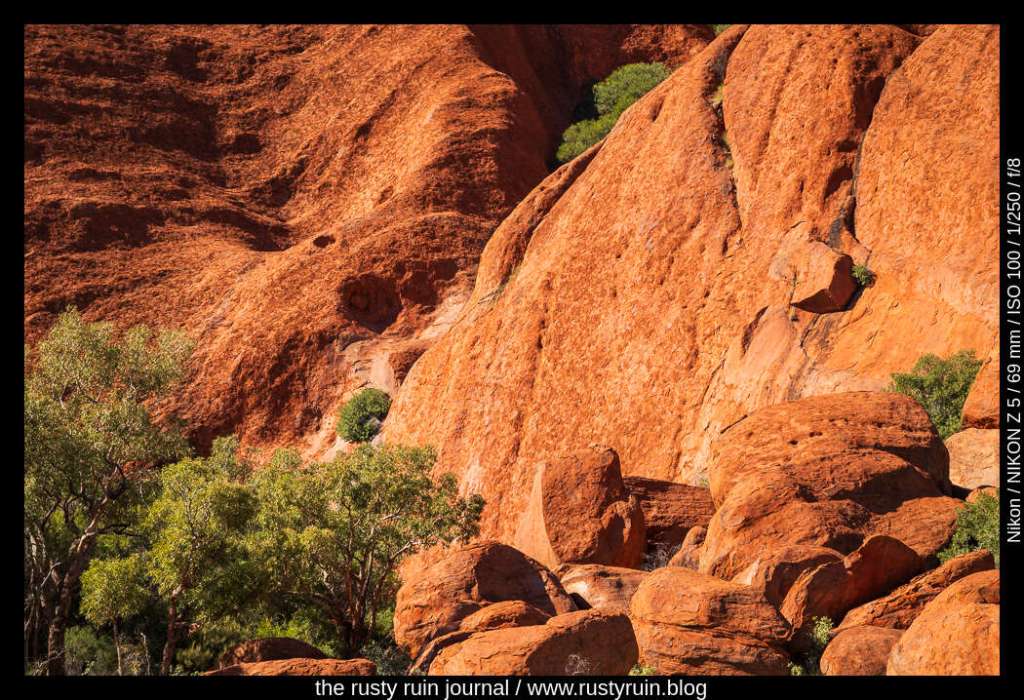
From a distance, Uluru looks like it has quite a uniform surface, but up close is where you get to see the details – weathered sections of grey stone, streaks of white, dark caves that seem to make recognisable patterns, and the iconic red rock that signals high iron content. Both Uluru and Kata Tjuta were formed over millions of years as the soft parts of the Petermann Ranges were eroded, leaving only the boulders and rocks.

Uluru up close – Nikon Z5

Uluru takes on different colours, depending on the time of day and season. It can be bright orange at sunset one moment and then pink with purple and blue shadows the next. I posted a sunset picture in another post, though it was a rushed pull-over to the side of the road and the local police weren’t too happy we’d parked in a no-park area as they beeped us on a drive-by! You take your chances when you have a camera in-hand. There are some designated photo spots in the area for tourists, but they can be quite busy, and I’m not always best pleased to make photos that everyone else does.

The red bones of ancient Australia – Nikon Z5

I was more prudent in my use of the circular polariser on this trip. Hiking around the base of Uluru, I was mindful of the location of the sun. The polarising effect is strongest when the sun is at a 90-degree angle to where you’re pointing the camera – so either on your left or your right. I dial it up so that the effect is strongest, and then dial it back a bit to add more natural stray light reflections back into the scene.

A polariser is fantastic for cutting out stray reflections on foliage and rocks and for deepening colours, but it can also make a scene look flat and darken clear Australian skies to the point of ultra-violet. It’s important not only to be mindful of where the sun is but also whether a polarised photo is what you want. Great for foliage and cutting out reflections on water, but not so useful when you want to preserve all the golden colours of a sunset. It’s also not useful in shady areas, so there was a whole section of the base-walk where I put it away.

Uluru detail: weathering and streaks – Nikon Z5

I’ve often thought of Uluru as the rocky heart of Australia, located not too far from Alice Springs. Amazingly, this monolith extends up to 6 km underground, so it’s much like a rocky iceberg. Absolutely worth visiting if you’re ever in a position to do so.

Rubble and ruin on the side of the road

I find old ruins fascinating. The real treasure is discovering an abandoned home, off the beaten track, weathered and worn and open to the elements. I wonder who lived there and what they did? I wonder how it came to be abandoned? There were once people in such places, living lives and making memories, and all that remains is rubble and broken space.

What was once a life – 35mm Super Takumar 3.5 on Olympus OMD EM5 Mark II

A fascination with ruins isn’t uncommon. Walking through the rubble and detritus of buildings that were once important to someone is a way of connecting to the past and also reminding ourselves that time moves forward relentlessly. All things begin and end. And we must find joy in the experience of living whilst we can, if we can. Not all lives are equal, it’s worth remembering.

The old green room – 35mm Super Takumar on Olympus OMD EM5 Mark II.

Ruins remind us that everything changes, whatever we do. Next to the behemoth of time, we’re vastly small. In some way this is a comforting thought, as even wars and bad governments will fall to the ravages of time in a way that no person, however rich and powerful, can avert. No doubt, this is a terrifying thought to people who can’t bear the reality that their power and influence will fade, and their lives will be forgotten completely.

Nature’s reclamation

Ozymandias, one of my favourite Shelley poems, provides insight into the eventual ruination of once-powerful empires:

I met a traveller from an antique land,

Who said—“Two vast and trunkless legs of stone

Stand in the desert. . . . Near them, on the sand,

Half sunk a shattered visage lies, whose frown,

And wrinkled lip, and sneer of cold command,

Tell that its sculptor well those passions read

Which yet survive, stamped on these lifeless things,

The hand that mocked them, and the heart that fed;

And on the pedestal, these words appear:

My name is Ozymandias, King of Kings;

Look on my Works, ye Mighty, and despair!

Nothing beside remains. Round the decay

Of that colossal Wreck, boundless and bare

The lone and level sands stretch far away.”