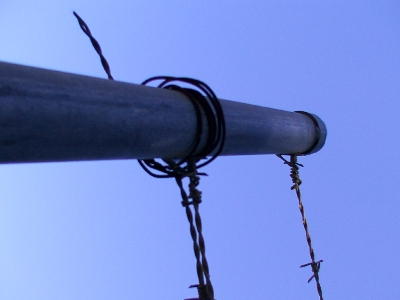
My first digital camera was a Kodak DSC 3200, purchased in 2002, I think. It seemed like magic at the time ~ the fact that I could make photos and NOT have to pay to have film developed was pretty amazing. Even better – I didn’t even need to go to the trouble of using a flatbed scanner so I could transfer them to my computer! In a world saturated by digital imagery and modern cameras that can almost see in the dark, this all seems rather quaint.
My Kodak camera might have been magic in my hands, but it was also really frustrating to use – AA batteries that seemed to be good for only a dozen photos, limited internal storage, and a serial cable connection that took an age to transfer files. Still, I was pretty happy with it, and 1 megapixel seemed like a lot at the time. Here are some old photos made by the Kodak DSC 3200 I happened to find:
Machinery near the old quarry – Kodak DSC 3200Spikes in my sky – Kodak DSC 3200Kodak DSC 3200Kodak DSC 3200
In my previous post, I sang the praises of the Nikon D200 – first released in 2005. Back then, I could barely afford a decent digital point ‘n’ shoot, let alone a premium DSLR like the D200 ! Even RAW photos from this Nikon feature similar contrast, punch, and compressed dynamic range to those from the Olympus E1 – yet another widely respected antiquarian among cameraphiles and CCD sensor enthusiasts. I’ll not expand fervently on that in this entry, as I’ve done previously! Just some more photos from the hefty and reassuringly solid Nikon D200:
A rusty old shed somewhere – Nikon D200 and Tamron 17-50mm F2.8 lensThe green shed – Nikon D200
Notice the old tin shed theme so far? I won’t deny that lonely sheds make for some nice pictures, especially when they’re decaying into the sun-beaten soil.
The yellow shed – Nikon D200
Seriously, I was going to post something other than a shed, I really was, but I couldn’t help myself! Back to another angle of the yellow shed you saw in my last post. Looking at these photos, I can’t help but wonder again about the image quality perfected in some of these old cameras. Makes you also wonder about the role of marketing and what we believe.
The Nikon D200 was released to market in 2005 – a long time ago in the world of digital cameras. Everything about it screams digital retro – the hulking black body, the 10.2 megapixel CCD digital sensor, 11 auto-focus points, and 5 frames per second shooting speed. Anyone who reads this journal regularly, knows that megapixels aren’t everything. Also, I’m a sucker for old and slow technology that does a good job and has a good feel.
Yellow shed – Nikon D200 and Tamron 17-50mm F2.8
I’ve kind of concluded by now that the best of the CCD sensor cameras produce punchy and colourful images. Even the RAW files look nice and punchy. I know that some people put it down to a thicker Color Filter Array above the photosites, and this may certainly be part of it, but I also think that the limited dynamic range of the sensor and the tonal response tuned by the engineers produces photos with extra contrast. Modern CMOS sensors have a much wider dynamic range and tend to produce flatter files for editing. You’ll find that shadows can be lifted more and highlights retain greater detail. In cameras like the D200 and the Olympus E1, the limited dynamic range of the CCD sensor results in less shadow and highlight detail, making for files that have compressed tonal range – more contrast.
The output from the Nikon D200 is reminiscent of the output from the Olympus E1 – a 5 megapixel beast I regard very highly. Of course, the lens makes a difference too, and the Tamron 17-50mm is a nice fast walk-around lens that balances well on this Nikon. It’s a bit on the soft side at 17mm in the corners, but at F8 and around the 35mm mark, it produces sharp images across the frame in my experience. It’s a great fit for the old D200.
Sand and sky and mangroves – Nikon D200
Just as with the Olympus E1, I’m not doing much editing at all with the RAW files from the Nikon D200 – minimal contrast boost if required, sharpening, and only a little vibrance for all of the photos on this page. In use, it’s a solid camera with all of the external control buttons you could ever want. This was a camera with pro features at the time, for sure. The magnesium-alloy skeleton and deep hand grip makes it feel secure and reliable, providing enough weight and heft for balancing longer lenses. Next to modern Nikon mirrorless cameras though, the D200 is an antiquated hulk! It makes the Nikon D70 seem like a cheap piece of plastic.
Shipping containers, a shed, and a caravan – Nikon D200
I received two original Nikon EN-EL3a batteries with the camera. I’d charged both of them before going out, but one of them drained to zero within minutes of fiddling with menu settings. I know the D200 had a reputation for poor battery life, but I think that particular battery may be done for! The other battery seems to have plenty of juice though. I’ve ordered some third-party replacements anyway, as Nikon don’t manufacture the official batteries anymore.
0000 – 9999 – Nikon D200
The Nikon D200 was the last Nikon camera body to feature a CCD digital sensor. The Nikon D300 featured a CMOS sensor, which enabled the use of higher ISO settings and low light photography with less noise. I’ve never used the D300, but I know it’s considered one of Nikon’s best early digitals. In my opinion though, the D200 remains a great camera and certainly scratches the retro digital itch – one of Nikon’s best cameras in the market transition between film and digital.
You can see more D200 photos in my follow-up post here.
Looking out from The Point – Fujifilm Finepix S6500fd
This small bridge camera from Fujifilm only has a small – 7.44 x 5.58 mm – digital sensor, but it features Fuji’s SuperCCD sensor technology, which seems to have some special sauce about it. Can you believe the electronic viewfinder even has a nice live histogram so that you can alter exposure compensation quickly? It even looks like a mini-DSLR. Along with the clunkier Finepix S7000, I think the S6500fd is one of the best bridge cameras from the 2000s era between film and digital.
The moody golden spill – Olympus E1
These aren’t great light conditions for an old CCD-based camera like the Olympus E1 that loves more light, especially when pushing the ISO introduces the type of visible noise that 20+ year old digital cameras are known for. My steady hand and the vestiges of bright sunlight helped keep the shutter speed usable. I still love what this camera can do even more than 20 years after market debut! It can make very painterly images.
When driving along the dusty Southern Flinders road into Hammond, it’s clear that it was once an important town along the formerly vital narrow-gauge rail line that fed so many settlements in the area. Whilst not completely abandoned, another decade or two may see Hammond left to the relentless heat and wind.
On the outskirts of Hammond SA – Olympus E1
I was drawn, of course, to the dilapidated ruins up the road, marking the dusty way to more ghost towns beyond. Yet another reminder that nothing is everlasting.
The E1 proved a great companion here, even on a bright sunny day. As long as I looked after the exposure compensation carefully, so as not to blow out highlights too heavily, I was rewarded with at least half a dozen photos the equal of my Nikon Z5 in all but overall size and resolution. Still, as discussed before, megapixel counts are often overrated.
A once grand entrance, Hammond SA – Olympus E1
If I have the stamina, I also pack my Z5 alongside the E1, but the bag then does tend to drag at the shoulder a little. Fortunately, such long drives into the mid-north necessitate lengthy car rides, thus allowing my shoulder to rest between destinations. As ever, my concern is for a solid shoulder-slung camera bag that allows me to pack enough gear for a comfortable day – hopefully as inexpensively as possible whilst still retaining usability and build quality. My current bag cost all of $60 AUD and allows me to pack both the Nikon Z5 and the Olympus E1, though other features are lacking, including a strap that isn’t adjustable.
Hello Trespassers! – Hammond SA – Olympus E1
The E1 still surprises me. For a camera from 2003, with limited dynamic range, it can certainly handle enough tonal range to produce some of the most attractive photos in my folders. Sure, a good subject helps a lot, but the E1 seems a good match for scenes I would have thought it would struggle with. Perhaps I’ve gelled with it to the point that I’m looking for scenes with more mid-tones and less gap between light and shadows, as this is where it shines best.
Old mysteries behind closed doors, Hammond SA – Olympus E1
Well worth the drive, if you can stand the dust and the gnawing sense of a town that has all but been forgotten. I love it, of course – the sense of melancholy is always a stern reminder of time’s vengeful movement. One interesting feature of our time there: a resident playing modern pop music loudly from inside the old town bank, drifting on the same winds scouring the bones of the empty buildings.
Having been very connected to my Olympus E-1 lately, I decided it was high time to take out another old digital camera in the Nikon D40. I don’t always get the chance to engage in street photography but when I do it can be a lot of fun. It does require a different approach though – being on the look-out for likely scenes and waiting for the right moment. The D40 isn’t exactly a classic street machine but it’s also small enough not to be much of a bother unless a big lens is attached, like the Tamron 17-50 2.8 I decided to go with!
Reaching for the stars – Nikon D40, ISO 200, F 2.8
I find that the D40 makes really nice photos, but the CCD sensor technology isn’t so great when you have to pull details out of heavy shadows during editing. The RAW files are flexible enough, but the heavy shadow areas can be a bit thin. These older sensors also aren’t so great at retaining highlights either, so you have to make the choice – expose for shadows or highlights when the lighting creates dynamic range that’s outside of the scope of the camera. This is similar to slide film.
Framed by yellow – Nikon D40
Even though there’s noise in shadow areas when you pull up the exposure during editing, the digital noise pattern isn’t objectionable. This is one area where CCD sensors had a clear advantage over their CMOS counterparts at the time – lower noise and a finer noise pattern. We seem to have come a long way since those early digital days, but cameras like the D40 still make perfectly excellent photos! How far have we really come, one might wonder?
Free hugs – Nikon D40
There’s also another nice advantage to using an old camera like this – 6 megapixels pairs really well even with a kit lens that doesn’t see a lot of love. The old 18-55mm Nikkor kit lens is much maligned but is nicely sharp on an old camera like this, since it out-resolves the 6 megapixel sensor. My Tamron looks even better and seems to pick up plenty of primary colours wide open. Still a perfectly excellent camera.
The clouds are slowly dissipating after months of grey days and this weekend provided an opportunity to drive around some of the vibrant towns of the Murray River. I packed my bag with the Olympus E-1, Nikon Z5, and the Sony RX100. I continue to be impressed with the output from the old E-1, but dynamic range is limited, and careful consideration of a scene is required before clicking the shutter button, I’ve discovered.
Shadows on emerald metal – Olympus E-1
Window of opportunity
Every digital sensor (and film, of course) has a limited window within which it can manage the dynamic range of a scene. If the dynamic range (brightest and darkest areas) of a scene exceed the window, then an exposure decision must be made: crush blacks or burn highlights? Modern sensors have a bigger window, so provide more latitude. The E-1, not so much.
Scenes with plenty of mid-tones and minimal strong highlights / deep shadows are good for this camera. Evenly lit scenes are great too. With excessive tonal ranges, I usually crush blacks because it’s less distracting for the eye, but it depends on how numerous the extreme tonal ranges are and the composition I’ve decided on.
Unused, catching dust and webs – Olympus E-1
The onboard tonal response of the Olympus is contrasty. Again, great for evenly lit scenes that could use a contrast bump, but not so great for extreme tonal ranges where pushing them further just causes distracting visual elements. The more I use this camera, the better I get at evaluating scenes in front of me before even picking the camera up. And if I can frame a scene and limit the extreme tonal ranges, I’ll do that. I also commonly dial in some negative Exposure Compensation to protect highlights but only when I want to preserve better gradation of tone over areas where distracting highlights could be a problem. Evenly lit scenes don’t need it unless that’s the look I’m going for.
Beneath the old machine – Olympus E-1
Calibrated for the old film pros?
It’s clear to me that the RAW files from the Olympus E-1 are different to the RAW files we get from modern cameras, but I don’t think this is a CMOS or CCD issue. The native tonal response of the E-1 produces files that are already contrasty and punchy. The images on this page are essentially the RAW output with barely any editing at all.
I know that some people will say I should use OM Workspace to get the colour goodness from this camera, but that software remains awful to use. And the few RAW files from the E-1 I’ve loaded into OM Workspace produce much the same initial result as the Adobe Standard profile in Lightroom, though my testing isn’t extensive enough to warrant strong views.
So, back to my speculation on the punchy files from the E-1. In 2003, when the camera was released, digital photography wasn’t mainstream. It’s entirely possible that early cameras like this were internally calibrated to produce images that were as close to certain film types as possible in terms of punchiness and also required less editing in software. Remember, there wasn’t a lot of RAW editing software around at the time.
None of that means these old cameras make filmic photos, but it may explain why there seem to be differences in output compared to our modern cameras. I think this is less about the inherent properties of a CCD sensor and more about what kinds of photos the film companies wanted us to see from their cameras via internal calibrations. Now that photo editing programs are numerous and commonplace, modern cameras are calibrated to output flat RAW files that can easily be edited. Just speculation, of course.
I’ve briefly mentioned elsewhere that I used film cameras growing up. They were nothing too special though. I think my last film camera was an APS (Advanced Photo System) camera from Fujifilm. I liked that this format offered features like extra frames, easy-loading, and panoramic view. In some ways, it was the easy-to-use precursor to digital. It didn’t last long in the camera world as photographers didn’t like the reduction in frame size or the noticeable grain due to the crop. The market take-up of digital was not too far behind either, so APS remains the last turn of the millennium gasp of companies trying to squeeze every final buck out of film.
Sometimes, photographers say they have a relationship with film. I suppose that you might have a fondness for it if photography had been a big part of your life growing up. For me, film cameras were just there for special occasions. I knew exactly one person who had any professional camera gear, and I never saw them use it. My parents were certainly never interested in cameras, other than to document birthdays and other events. Rarely, I might receive a 110 format camera, the aforementioned APS camera, or go out and buy one of the cheapo plastic disposables. The best 35mm film camera I ever owned was given to me by my late father – a Chinon with a tiny lens and auto-rewind. I used it for a while until the film motor broke down.
I didn’t nurture a passion for photography from a young age, partly due to not having the financial means or the inspiration around me. Some of it also has to do with the fact that I’ve never been very technically minded or confident in my ability to learn such things. I always saw high-end photography as the pursuit of those who could afford it and those who could understand the numbers behind it.
When I was gifted my first APS camera, I enjoyed the ease of the exercise. I probably made more photos with that camera than with any other previously. I’ve since lost those photos, but I do remember becoming very interested in framing scenes and doing so in a way that pleased me. I think this is when I really started to develop an interest in the wider world of photography, though my bank account wasn’t always up to the challenge.
Very OrangeSunset – Smena 8 with home-made redscale film
When digital cameras came along, I was pretty excited. Though my first was a Kodak with a measly 1 megapixel and terrible battery life, I loved the immediacy of the experience. There’s something to be said for waiting for film to develop and unwrapping it like a gift, but digital offered me the chance to learn how to make better photos through immediate feedback. That’s when things started to really make sense to me and my, up to that point, nebulous and undefined interest in photography solidified.
I rushed out yesterday with the Olympus E-1, but it wasn’t a great photo session. The sun was out but I just didn’t see much that struck me as an interesting photo. This, of course, happens from time to time. While disappointing, it’s all part of the experience with the camera. You can’t force it.
Blue beams on blue – Olympus E-1
Despite my previous positive experiences with the E-1, this time there were no epiphanies. The sun was high and hot and controlling dynamic range with such an old camera isn’t always the easiest. There’s a point at which exposing for the highlights creates shadow noise and the in-built contrasty tone curve of this camera is a detriment at such times. Still, just look at all that blue! This camera does love plenty of blue.
So, I was left with just two photos from my session that piqued my interest. On the way home, I ran across some new house constructions and just loved the way that all the blue steel beams looked on such a sunny day.
Some days are just not going to be full of great photos. Some days, the eye just isn’t attuned. And that’s perfectly OK. I’ve learned not to worry about my mistakes and missing moments. I’ve learned that on some days the photographic mind is elsewhere and all that remains is forcing a moment. At those times, it’s best to accept the moment and look around. Not everything is for the camera.
The Olympus E-1 is quickly becoming one of my favourite cameras. There’s a certain solidity to the photos from it. The mid-tones are strong and the tone curve applied in-camera produces really attractive images. If there’s anything to the CCD versus CMOS sensor argument, the E-1 is likely one of the best arguments for CCD being inherently superior. None of this is to suggest that modern cameras can’t produce amazing images, of course.
Crystal Lake – Olympus E-1
With my time currently limited, the fact that the RAW files from the E-1 require far less editing than expected is a big positive. And I still think that people are overpaying for cameras like this. It may be a really nice camera, but it lacks many of the niceties we’ve become accustomed to on our modern cameras. The limited dynamic range can be a problem in difficult lighting conditions and there’s no Histogram or highlight blinkies to check exposure. This does lead me to more carefully consider the tonal range of a scene and whether I use ESP or Spot metering, so it’s a good thing for learning, really.
Mine also has a few issues – a missing eye-cup and the mode dial is stuck in either Program mode or Manual mode. The eyepiece is not an issue but the mode dial is frustrating. I can live with it though. It does serve to remind me that this is an old camera now and it won’t last. Yet another reason not to overpay for old tech!
Table for Three – Olympus E-1
I’d also taken out the Finepix S5600 along with the E-1 in my camera bag, but once I opened up the Finepix files at the end of the day, I was disappointed. If I hadn’t been using the E-1 all day, the Finepix would likely have pleased me enough. But looking at those photos side by side, the E-1 completely blows the Finepix out of the water.
I feel a sense of melancholy when I use the E-1 though. Olympus isn’t the company it used to be, with the imaging arm now sold off and owned by OM Digital Solutions. The E-1 is every bit a lovely camera from a different time. It was a time when digital photography wasn’t quite yet mainstream and venerable companies like Olympus were putting every effort into the new digital market – enticing film shooters with the promise of not having to pay for film development.
I can’t help but feel that the E-1 contains as much technical mojo as Olympus could pour into it. The collaboration with Kodak represents the shared vision of two traditional companies focussed on surviving in a rapidly changing photography landscape. Ultimately, neither company managed to escape a brutal market where smartphone cameras defined the new rules, with severe decline causing them either to be sold off piece by piece or handed over to new owners divorced from company tradition.