To the local Jawoyn people, the amazing gorges in Nitmiluk National Park (Katherine Gorge) hold special significance. We were fortunate enough to book a short cruise to see some of the many wondrous gorges in the area and view the ancient sandstone rock formations, calm waters, and freshwater crocodiles. This is an area teeming with life and Dreamtime stories.

Sunlight at the height of the Australian afternoon can be harsh. This is one reason I prefer viewfinders rather than the big LCD screens on so many cameras that get washed out in these conditions.
The soft golden light of dawn or dusk brings out the best colours in the outback landscape, but trip timing doesn’t always permit, and you have to work with the tools you have and the light available when the opportunity arises. One quality this strong afternoon light does emphasise: all the textures on the ancient sandstone.
On the day, I packed lightly since I’d been lugging a not insignificant amount of camera gear around on other days (hello Lowepro Nova 200). The Olympus EM5 provides good image quality and lots of control in a small package. It’s just a small pity I’d also decided to take the 14-42 kit lens with me. That’s not to say that kit lenses are bad at all. Nikon makes some great kit lenses, such as the 18-55mm. And this Olympus Zuiko kit lens is no slouch in the image quality stakes – it does pretty well for a cheapish plastic lens. But at times when I want more sharpness to record all of the landscape’s details, it gets a bit fluffy and squishy at the edges of the frame. Still, you work with what you have and the conditions of the day.
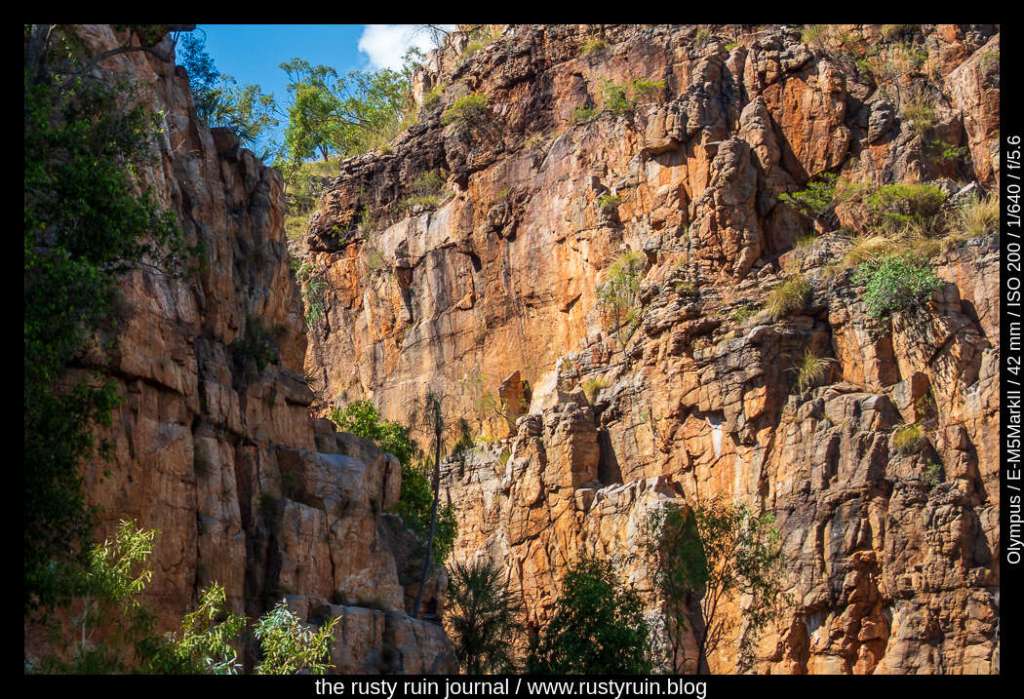
I’ll always say that eye-watering sharpness is generally overrated in photography, but there are times when sharpness is another tool you want in order to communicate certain qualities – the texture of the rocks in this case. Despite some of the shortcomings of my kit lens, careful subject selection, use of exposure compensation to retain as much detail as possible in high dynamic range scenes, and some boost to the red/orange/yellow colour channels during editing helps to make the photos shine. I also reduced highlights to reveal the details of the ancient sandstone.
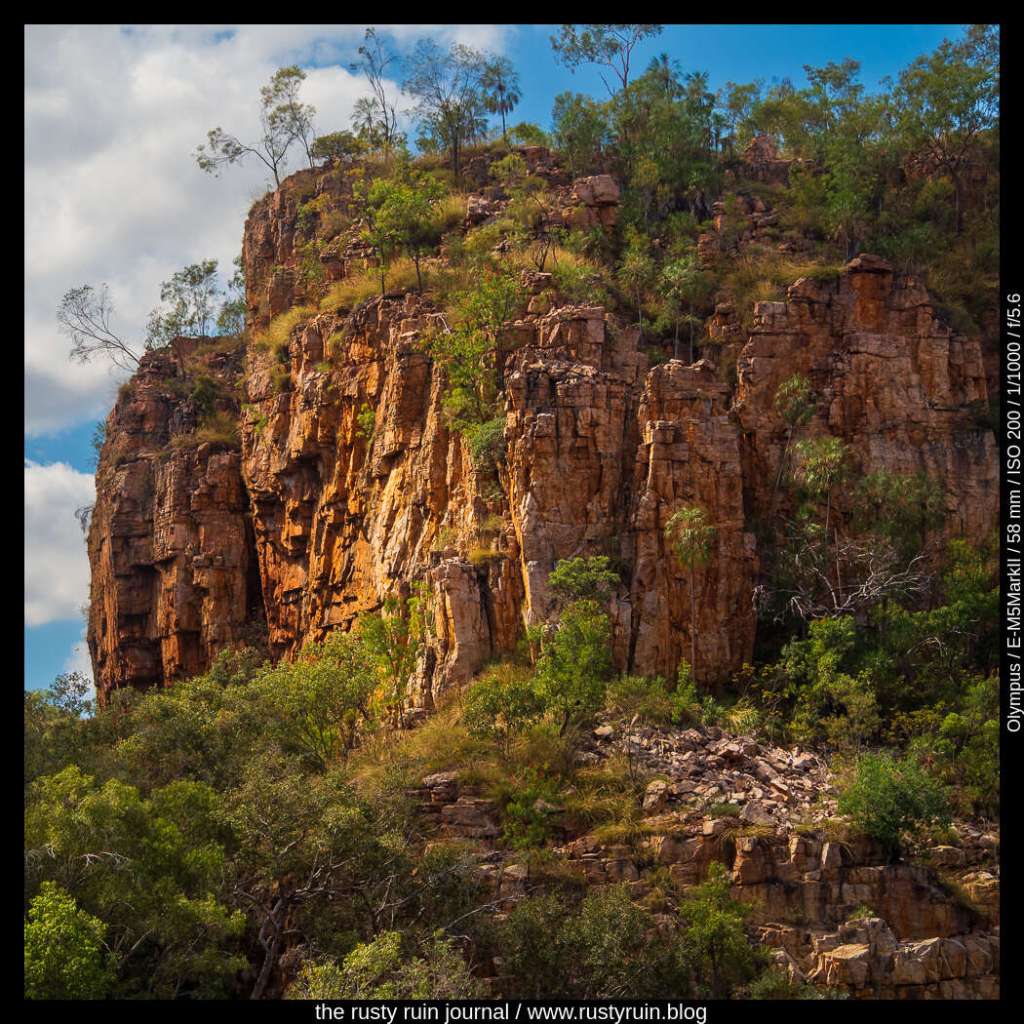
As the clouds grew heavy, the light conditions became a little more forgiving. As you can see in the above photo, clearing clouds also provided an opportunity to record sunlight as it illuminated sections of rock. I used the so-called plastic fantastic 40-150mm Olympus Zuiko lens for this photo – small, light, and really quite sharp at most focal lengths. I guess the message is to know your camera gear and accept and make best use of your tools and the conditions. I’ll freely admit to not knowing all of my gear well enough at times!
Discover more from The Rusty Ruin Journal
Subscribe to get the latest posts sent to your email.
 The Rusty Ruin Journal
Great trip, memories, and photos.
LikeLiked by 1 person
Great detail in these images, and wow, what a beautiful place! Living near the ocean, the highest points are sand dunes!
LikeLiked by 1 person
Thank you. We had to drive a long way to get there! I was pretty impressed by the cheapo Zuiko 40-150mm lens. OK, it’s softish at the long end, but provides a lot of reach for the money and I don’t have 2k to drop on the pro glass.
LikeLike
Thanks Louis. There’s some breathtaking ancient scenery out there!
LikeLike
There are many software tools available these days for coaxing sharpness and details from images.
But, based on the size images you post and the framing, I’m not sure it would matter much to readers since they can’t zoom in to see details . . . unless I save the image and enlarge it.
LikeLiked by 1 person
Absolutely right. At web sizes, none of it matters. I regularly use old 5 and 6 megapixel cameras without concern. And realistically, even those can often be printed at A3 without issue. I’m not a sharpness fiend, as this quality depends on other factors too. Thank you!
LikeLiked by 1 person
For many . . . er. . . most of my subjects, I am a sharpness fiend.
But, my 6MP D100 still takes pleasant and usable pictures, despite the limitations of it being an early DSLR.
LikeLiked by 1 person
I have a few of those early Nikons too. I think people generally place too much emphasis on megapixels. Cropping, printing large with detail, colour accuracy – these are all valid reasons for more megapixels, but for most general use cases, and certainly for printing this 8×10, it doesn’t much matter. I had an old Sigma Foveon camera that made 5mp images, but those images were so sharp and colour accurate that poster sized prints were absolutely possible with no immediately noticeable loss of detail at normal viewing distances. The D200 is also a great camera. Very heavy though!
LikeLiked by 1 person
I make it a point, once or twice a year, to use the D100, the D200, and the D7000, as well as all the lenses. I probably should have bought the D500 instead of the D7500, but that’s also a heavier camera (~1/4 lb heavier) and no pop-up flash.
LikeLiked by 1 person
All of them great cameras from Nikon! My main is the Z5 but the D7100 also gets use. I enjoy the D200, the D40, and the D70s. The Z glass is fantastic really, but it also comes with a hefty price. Increasingly, weight is also my main consideration. I’m kitting out a daytrip bag with as much light and small gear as possible.
LikeLiked by 1 person
I’m looking hard at the Z50II with the 28-400mm . . . for about $2,300, you get a very portable 42-600mm eq.
For about a grand less, you can get the 50-250mm paired with the Z50II, (75-375mm eq.), and an even smaller package.
Then again, I tend to look at these, and then ask myself “why”? I do pretty well with what I have, and I’ve no aspirations to turn pro.
LikeLiked by 1 person
I know what you mean. I do like the crop sensor format and the Z50 looks great for my old manual focus lenses. Like yourself, why? Do I really need it? Hard to justify when I don’t need it for pro work!
LikeLiked by 1 person
I’m having issues interacting with the blog. It’s asking me to sign in whenever I want to comment or leave a like. Hopefully, this will get through.
LikeLiked by 1 person
Oh? That’s odd. I use the Jetpack WordPress Reader app on my phone to interact and read. That seems to work fine. If you’re logged into WP online, it should be quite seamless. What are you using?
LikeLike
Looks like it’s working now.
I suspect it has something to do with third party cookies and which browser I use.
LikeLiked by 1 person
Great. Yes, I expect that’s the likely culprit.
LikeLiked by 1 person
Yeah, I typically use the PC. I had to log in for the first comment and again for the second. This is written on the JetPack app, but I’m not a fan of writing on the phone.
LikeLiked by 1 person
I totally get that. Generally, I use the laptop for posts and the app for reading and interacting. This is because I don’t use the laptop every day and I’m looking at three big screens in my day job. I hope the glitches work out for you.
LikeLiked by 1 person
Hmmm…do you have any browser plugins that might be causing an issue? Sometimes, privacy focussed plugins will cause issues.
LikeLike
I’ve no idea why. Any restrictions have been turned off.
LikeLike
You might see a couple of more comments as I try stuff.
Actually, you won’t see any more after this one because I won’t log in every time just to have you read “testing”.
I’ve had WP log me off all my session, cleaned my cache, deleted all the cookies, tossed some chicken bones, and danced in my underwear while wearing a aluminum foil hat . . . hoping some of that will work.
LikeLiked by 1 person
I’m going to try subscribing to your blog to see if that makes a difference. I’m also using the DuckDuckGo browser (also based on Chrome).
LikeLiked by 1 person
There’s now also a long delay between the time I comment and when it appears.
The other weird thing is that each comment I try to post brings up one of three different login dialogs. Also, while the last comment showed my gravatar, this one does not, meaning it’s not recognizing me as logged in.
Plus, sometimes it asks me for the Authenticator code, and sometimes it doesn’t. All this is very weird.
I think I will wait a few days and try again then.
LikeLike